
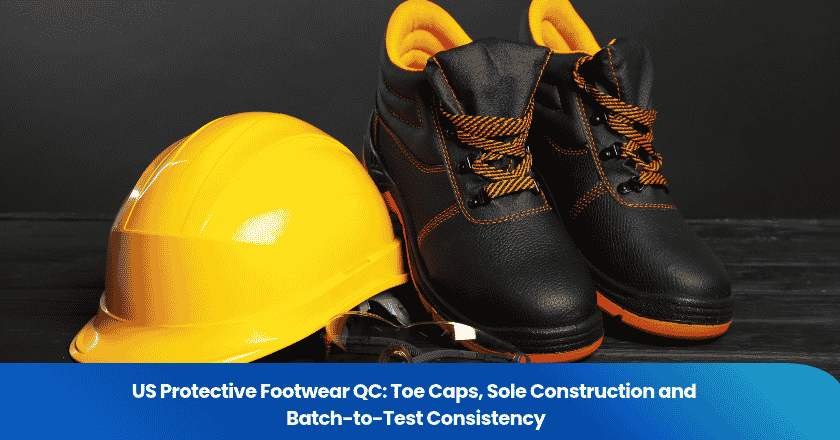
US protective footwear quality control, or QC, connects each safety claim to the assembled shoe that was tested and the construction now being produced. Identify the toe cap, sole components, last, factory and current markings. Compare them with the relevant reports, then check whether any manufacturing change triggers retesting under the adopted program. A component certificate or unchanged model code cannot settle that question alone. Physical inspection can record the agreed checks on the identified batch while missing protective-performance evidence remains open.
What to connect before accepting protective footwear
- The intended US use, adopted requirements and individual protective claims.
- The tested construction, current toe and sole components, and matching markings.
- The batch records, changes, required retesting and actual inspection findings.
Define the US use and adopted footwear requirements
Protective footwear procurement starts with the hazards and requirements of the actual workplace. Ask the employer or safety representative to identify the intended use and required protections. Record the accepted standard editions and any additional purchasing criteria. A general request for “US safety boots” does not establish whether the wearer needs toe, metatarsal, puncture, electrical or other protection.
The federal general-industry PPE hazard-assessment and selection rule requires employers to assess workplace hazards, select suitable personal protective equipment, or PPE, communicate the selection and choose equipment that properly fits. Obtain those requirements from the responsible employer or recipient. An importer’s product inspection brief should follow the identified selection; it does not replace the employer’s assessment.
The federal foot-protection criteria name ASTM F-2412-2005 and ASTM F-2413-2005 among the listed consensus standards and include an employer-demonstrated at-least-as-effective route. A newer ASTM publication does not itself update that regulatory text. Confirm the acceptance basis for the actual jurisdiction, employer and contract rather than treating the newest year on a supplier’s label as automatic legal approval.
Keep the performance specification and test methods distinct. The specification sets the relevant performance requirements; the test-method document describes how particular properties are evaluated. Confirm which versions the laboratory used and which requirements the recipient accepts. A report’s method reference does not, by itself, establish that every claimed property was assessed or that the purchasing specification has been met.
Retain the adopted requirements with the current style, size range and claim list. If a bid, employer instruction and supplier offer name different editions, have the appropriate recipient resolve that difference before relying on the records. The official CFR text and ASTM’s public overviews explain important boundaries, but the full adopted documents and agreed technical criteria are needed for the actual evaluation.
Use TradeAider’s inspection reference guide to discuss the separate physical lot assessment. Its sampling and reporting scope should sit alongside the protective-footwear requirements, with a clear distinction between what will be observed at the factory and what needs specialist test evidence.
Match the toe cap to the tested shoe construction
The protective toe cap needs to be identified as part of the assembled footwear. Record its material, manufacturer, design or part reference and the sizes to which it is fitted. Connect these details to the current shoe specification and the tested sample. A loose-cap record cannot show how a different shoe assembly performs around that cap.
ASTM F2413-24 sets protective-footwear performance requirements and is not a detailed manufacturing or purchasing specification. Its public scope also warns that controlled laboratory results do not establish performance levels for every situation. Keep the actual toe cap and surrounding construction connected to the assessed footwear; a component document alone is insufficient support for the complete shoe claim.
Include the upper, lining, insole and last in the construction record. The last is the shaped form used to build the shoe. Record the relevant construction method, dimensions and fit references, rather than reducing the specification to “steel toe” or “composite toe.” Two shoes can use similar-looking caps while differing in the surrounding materials, shape or assembly that the reviewer needs to evaluate.
Agree what can actually be checked on finished goods. An inspector may compare visible construction, shape, size, labeling and accessible component identifiers against the approved references. If a hidden feature needs confirmation, agree an appropriate evidence or examination route in advance. Do not describe an external appearance check as proof of hidden cap dimensions, assembly details or impact performance.
Where a cut sample or other destructive examination is needed, confirm the method, authorization, specimen identity and disposition of the examined shoe. Keep it distinct from the performance test itself. Photographs can document an exposed component, but they do not supply the prescribed impact or compression result. Link each record to the shoe version it actually represents.
Review the sole stack and each claimed protection
The sole construction should be defined as a set of identified components and processes. Record the outsole, midsole, relevant insole or protective insert, attachment method and applicable material specifications. The outsole is the ground-contacting layer; a midsole sits within the sole assembly. Keep the names used in the factory’s records consistent with the technical documents so that an ordinary comfort footbed is not confused with a protective insert.
Collect the actual outsole design, compound and hardness references, together with the relevant material suppliers and assembly instructions. If puncture protection or another insert-based feature is claimed, identify that component and its position in the documented construction. A familiar tread pattern does not identify the compound underneath it, and a shank or other structural part should not be assumed to provide an unverified protective function.
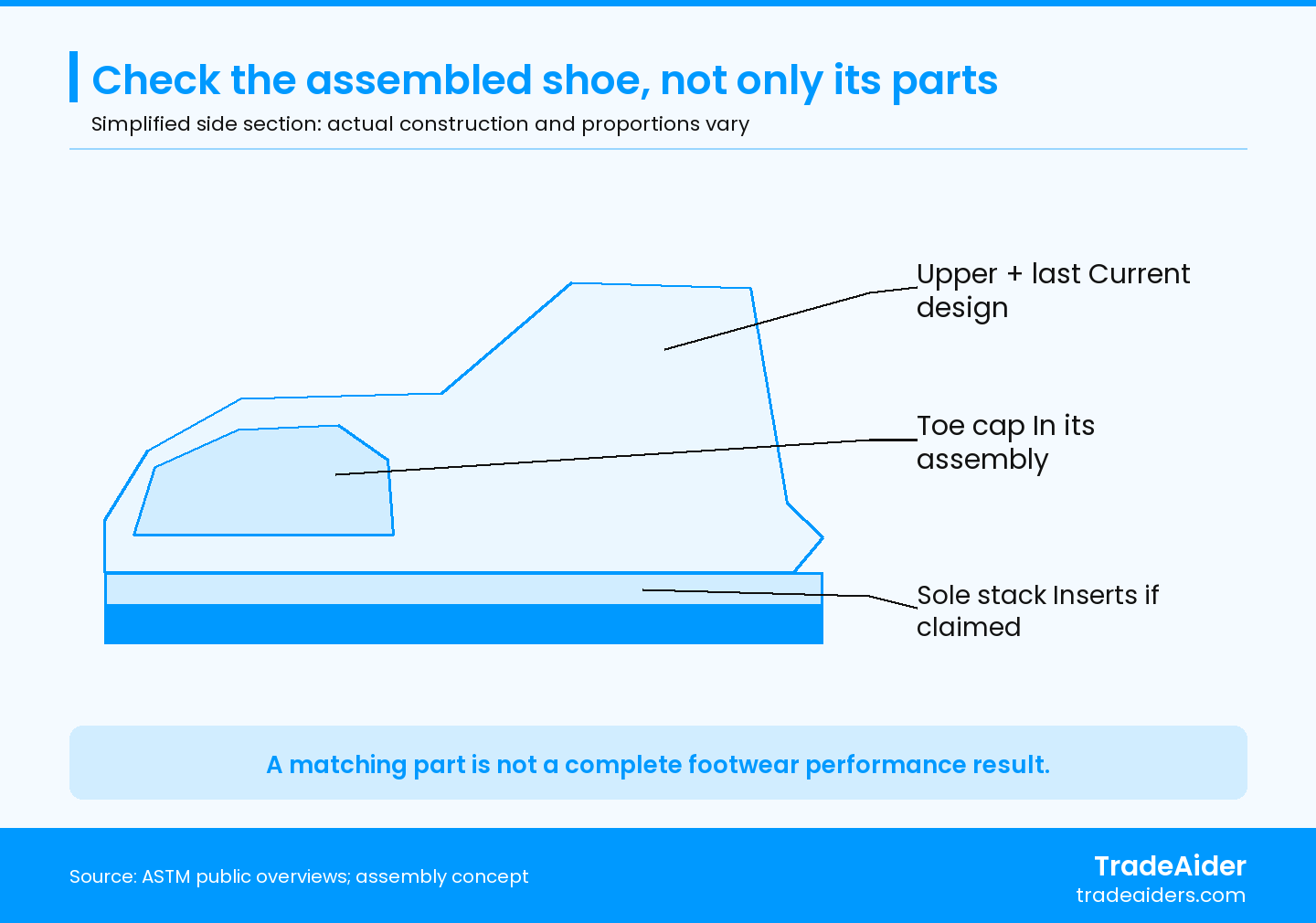
Simplified side-section concept; proportions and layer arrangements vary. Match the toe cap, upper, last, sole stack and any claimed protective insert to the documented tested footwear. This is not a product drawing, a compliant design or proof of protective performance.
ASTM F3445-24 addresses slip resistance of completed footwear using F2913. Its public scope recognizes consideration of workplace-specific floors and contaminants, and does not make controlled laboratory results universal. Match the current outsole and reported conditions to the claim. A tread photograph or a toe-protection result is not a substitute for the relevant slip assessment.
Read puncture, electrical and static-related claims separately. Identify which parts and conditions support each one, and ask the technical reviewer to resolve the actual coverage. Electrical-hazard, conductive and static-dissipative designations are not interchangeable. Do not select footwear for one electrical or static condition simply because its marking includes a different electrical-sounding abbreviation.
For the physical comparison, retain approved outsole and construction references where feasible. Record visible pattern differences, separation, damage or an unexpected insert, and state how each observation was made. If compound or hardness needs verification, agree the relevant method and criterion; hand pressure on a sole does not provide a documented material-hardness result.
The AQL sampling calculator can support an agreed acceptance quality limit, or AQL, sampling plan for workmanship inspection. Keep its sample count separate from the laboratory’s specimen requirements. A sampled visual pass does not demonstrate puncture resistance, electrical properties or traction for all pairs and conditions.
Connect the markings to the actual test reports
Protective-footwear markings should be checked against the actual claim and supporting report, not copied from a generic label illustration. Capture the complete mark on the current shoe, including its standard edition and stated protections. Compare it with the ordered style and assessed construction. A familiar ASTM reference can still accompany a different model, missing result or unsupported additional claim.
ASTM F2412-24 distinguishes toe impact (I), toe compression (C), metatarsal protection (Mt, over the upper foot bones), conductive properties (Cd), electric hazard (EH), static dissipation (SD) and puncture resistance (PR). Its scope permits testing of selected hazards under the applicable agreement or safety standard. Read the individual assessment and conditions; the document’s name does not mean every possible protection was tested.
Use this record to connect the shoe and its claims to the evidence. Fill in document identifiers and actual findings; assign an owner where the connection is missing. The fields are a buyer’s review tool, not a prescribed ASTM marking layout.
| Review item | Record for this order | Evidence or unresolved question |
|---|---|---|
| Shoe identity | Style, size range, construction and factory | Does the tested sample represent these goods? |
| Complete marking | Photograph, edition and claimed protections | Does each claim match the adopted requirements? |
| Report reference | Issuer, report ID, date and sample description | Which current construction was assessed? |
| Selected tests | Method/version, conditions, results and criteria | What passed, failed or was not assessed? |
| Coverage and changes | Represented variants and change history | What further evidence or testing remains? |
Obtain the complete reports needed for the review, including relevant sample descriptions, results and limitations. A cover page or conformity statement may point to those reports without showing their full scope. Keep the original issuer’s records intact. The reviewer should be able to distinguish a verified result from a missing document, a construction mismatch and an assessment that was never requested.
Carry the agreed current references into TradeAider’s Pre-Shipment Inspection services. Pre-Shipment Inspection, or PSI, applies when the order quantity is 100% complete and at least 80% packed for export. The packing threshold does not permit production to be only 80% complete. Agree the feasible physical and marking checks while retaining any outstanding laboratory or technical assessment separately.
Use the component-change checklist before reusing results
A footwear change needs a precise description before the earlier evidence is reused. Record the previous and current part or process, the reason for the change, its effective production point and the affected goods. Compare the change with the adopted program’s requirements instead of accepting “same quality” as the technical conclusion.
Under an adopted ASTM F2412-24 test program, protective-toe footwear samples shall be retested for the specified changes. For upper or insole material thickness, the listed trigger is a change greater than 25%. Do not read that condition as general permission to alter other features or disregard the other listed triggers. Required retesting cannot be closed by a supplier’s equivalence statement alone.
The following checklist condenses the publicly listed change categories. Record the actual old and new references, then have the appropriate technical owner and laboratory implement the required retesting under the adopted program. The table does not provide the complete test procedure or authorize a reduced test scope.
| Change category | Compare the actual references | Keep with the decision |
|---|---|---|
| Toe cap | Material, manufacturer or design | Old/new cap identification and affected sizes |
| Construction or factory | Method of making the footwear or production factory | Process/site change and first affected goods |
| Upper or insole thickness | Material thickness change greater than 25% | Measured specification comparison and basis |
| Outsole or midsole | Component change, including hardness | Design, compound and hardness references |
| Last | Shape used to manufacture the footwear | Old/new last references and represented sizes |
| Protective insole | Material or supplier | Protective component identity and supply records |
| Metatarsal guard | Material or supplier | Guard identity and affected construction |
Keep the required retest and the physical follow-up distinct. The laboratory or responsible technical evaluator determines the applicable specimens, methods and assessment scope under the adopted requirements. The inspection team can check whether the identified revised goods match the authorized construction. Neither an unchanged label nor successful workmanship rework removes a test obligation triggered by the change.
Preserve the original reports as evidence for their identified configuration, alongside the change review and new results. Update the controlling specification only through the agreed authorization route. If earlier and revised shoes have been mixed, establish whether they can be distinguished before narrowing the affected scope. An uncertain boundary should remain an identified uncertainty, rather than being converted into a smaller affected quantity for convenience.
Trace the tested construction into the production batch
The test sample and the current batch need a traceable construction match. Connect the style and size or variant assessment to the current factory, component references, production method and change history. An unchanged model code does not establish that these details stayed the same. Where identity or coverage cannot be resolved, record that gap before relying on the earlier result.
Ask the manufacturer to identify the relevant material receipts, component batches and production records. Record which shoes were made with the original and revised components. A purchase order can contain several constructions or production runs; define the goods to which each evidence record applies. The inspector and recipient should be able to understand that scope without reconstructing an informal message history.
Confirm how the test evidence represents the ordered size range and any design variants. Obtain the technical basis for the claimed coverage instead of assuming that a photograph of one size proves all others. A changed last, cap or protective insert may be relevant to that comparison. Do not invent a universal rule that every size always needs the same test or that one size automatically covers the complete range.
Keep left-right pairing, shoe labels, box labels and carton assortments connected to the actual style and size. Physical sampling should follow the agreed lot and variant plan, with unavailable goods or excluded variants stated. A correctly printed carton does not repair a missing construction link inside it. Use identifiable photographs and records to show which goods were actually presented.
Assign unresolved questions to a named owner. The factory supplies the current construction and production records; the technical reviewer assesses the performance evidence; the buyer or designated recipient determines the acceptance basis. The inspection report should retain observed mismatches and limitations rather than turning the absence of a visible defect into an unsupported protective-performance verdict.
Inspect the identified goods and close the right gaps
A physical inspection can record agreed observations for the identified footwear lot while required retesting or other specialist evidence remains open. Close the physical correction and the performance-evidence question with their own appropriate records. A visual match to the current shoe reference cannot replace a missing protective test result, and a laboratory report cannot show the condition of goods that were not presented for inspection.
Agree the relevant checks on construction, pairing, measurements, workmanship, labels and packing. Include any authorized component examination or other specific checks with their methods and acceptance criteria. Identify what cannot be assessed at the visit. Protective impact, compression, puncture or electrical testing needs the specified equipment, specimens, conditions and competent assessment; an improvised factory demonstration is not equivalent evidence.
Illustrative scenario: A factory retains a safety shoe’s model code, tread pattern and marking but changes the outsole compound and hardness. The order uses the adopted test program discussed above. The buyer records the changed construction and affected production, and retains the original report for the earlier version. The listed outsole/midsole change trigger requires sample retesting; a similar appearance does not remove it. The appropriate technical owner and laboratory arrange the required assessment, while the inspector documents the agreed physical findings on the identified goods. Before relying on the revised claim, the buyer obtains the relevant results and any necessary physical follow-up. This is a hypothetical example, not a measured failure or TradeAider client case.
For each open item, record the affected style or quantity, required action, responsible person and evidence that will close it. Confirm the final recipient’s language, report format and actual acceptance requirements. Preserve restrictions and unperformed checks when forwarding the record. The designated decision maker should be able to see the physical findings and the status of required testing before making the shipment decision.
An initial inquiry can begin with the available product, order, factory location, US destination and expected timing. Before execution, agree the protective claims and adopted requirements, current construction and sizes, reports and markings, batch records, known changes, feasible methods and reporting needs. To discuss this physical inspection assignment, contact the TradeAider team.
Frequently asked questions
Can a strap-on safety toe convert an ordinary shoe into F2413 footwear?
Do not treat a strap-on toe device as footwear covered by the F2413 specification. Its public scope excludes safety-toe overshoes and strap-on safety-toe devices. Ask the employer or safety representative to identify the applicable assessment and acceptable equipment for that use. Adding a toe device does not establish the ordinary shoe’s complete protective performance.
Does a composite toe cap by itself prove electrical-hazard protection?
No; obtain the relevant evidence for the finished footwear and its actual electrical-hazard claim. The cap’s material does not describe the complete shoe, its other components or the conditions assessed. Have the responsible safety and technical reviewers confirm suitability for the intended hazard. Do not add an EH claim solely because the toe cap contains no metal.
Can the original marking be relied on after adding an orthotic or resoling?
Have the modification assessed before relying on the original protective-performance claim. The specification’s public scope warns that changes such as aftermarket footbeds or inserts and resoling can cause failure to meet the standard and invalidate the marking. Obtain the manufacturer’s and technical reviewer’s instructions for the actual modification; keeping the old label does not establish continued conformance.
Related Articles


Grow your business with TradeAider Service
Click the button below to directly enter the TradeAider Service System. The simple steps from booking and payment to receiving reports are easy to operate.