
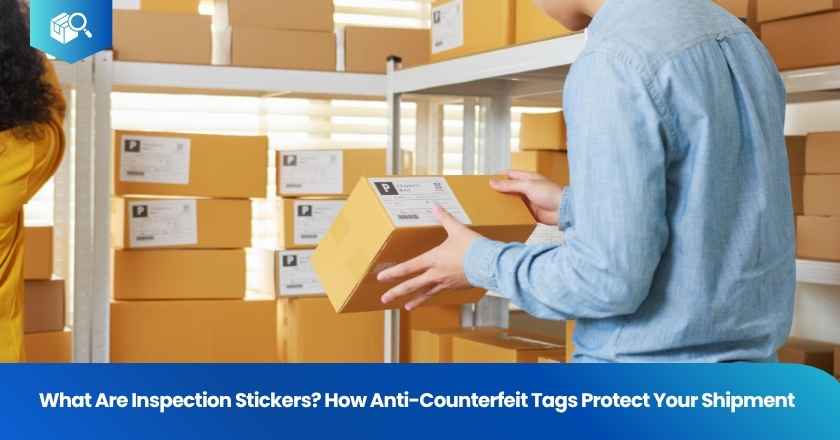
Inspection stickers are physical labels or tags used to connect inspected goods, cartons, samples, or lots to a documented quality-control event. Anti-counterfeit tags add another layer by making it harder for goods to be swapped, copied, relabeled, or mixed after inspection. They do not replace the inspection report, but they can strengthen traceability when the sticker number, carton reference, photo, and report record all match.
Importers often think of inspection as a report. That is only one part of the control system. The report says what was checked. A sticker, tag, seal, or label can help show which physical goods were checked. This matters when goods move between production, packing, warehouse staging, loading, and destination receiving.
Inspection stickers are most useful when the buyer worries about substitution, mixed lots, unapproved relabeling, or unclear carton identity. A sticker can mark inspected samples, accepted cartons, held cartons, reworked cartons, or retained samples. Anti-counterfeit tags can also help a brand distinguish legitimate production from copied or diverted goods.
- Inspection sticker: connects a physical item, carton, or lot to an inspection event.
- Anti-counterfeit tag: adds serial, tamper-evident, QR, holographic, or authentication features.
- Best use: combine tag, photo, carton reference, and report evidence.
- Limit: a sticker is not a certificate and does not prove the whole lot passed by itself.
The Direct Answer
Use inspection stickers when the buyer needs physical traceability after inspection; use anti-counterfeit tags when the buyer also needs stronger protection against substitution or copied goods.
A sticker is a bridge between the report and the product. If an inspector photographs a carton with a serial sticker, records the sticker range in the report, and the buyer later receives cartons with the same identifiers, the buyer has a stronger chain of evidence than a report with no physical reference. The label helps answer a practical question: are these the goods that were checked?
Anti-counterfeit tags go further. They may use serial numbers, tamper-evident material, QR verification, holographic film, destructible labels, security ink, or item-level authentication. The buyer should not treat these features as magic. The value comes from the control process: who issued the tag, where it was applied, which goods it covered, how it was recorded, and how the buyer verifies it later.
For shipment release, the tag should still be connected to ordinary quality-control evidence. TradeAider's Pre-Shipment Inspection checks the finished lot before shipment, while the buyer can add tag verification, carton-reference photos, or sticker-range checks to the inspection checklist when traceability matters.
Inspection Sticker Types
Different labels solve different control problems; the buyer should choose the label that matches the risk.
| Sticker Or Tag Type | What It Does | Best Use Case | Inspection Evidence Needed |
|---|---|---|---|
| Pass / hold sticker | Marks inspected, accepted, or held items | Separating released cartons from rework cartons | Report photo and carton list |
| Serial carton label | Connects carton identity to a number range | Multi-carton shipments or split lots | Sticker range, carton marks, packing list |
| Tamper-evident seal | Shows if a package or carton was opened | High-value goods or controlled samples | Seal number and close-up photo |
| QR verification label | Links to a verification page or internal record | Brand protection and receiving checks | QR scan result and product match |
| Anti-counterfeit tag | Adds security material or authentication feature | Counterfeit-prone branded goods | Tag batch, sample photo, application location |
| Retained-sample label | Identifies the exact sample kept for dispute review | Buyer-supplier defect negotiation | Sample photo and storage record |
The key is not to use every tag at once. Too many labels can confuse warehouse teams and factory workers. The buyer should decide which physical identity problem matters most: shipment release, rework separation, counterfeit prevention, sample retention, or destination receiving.
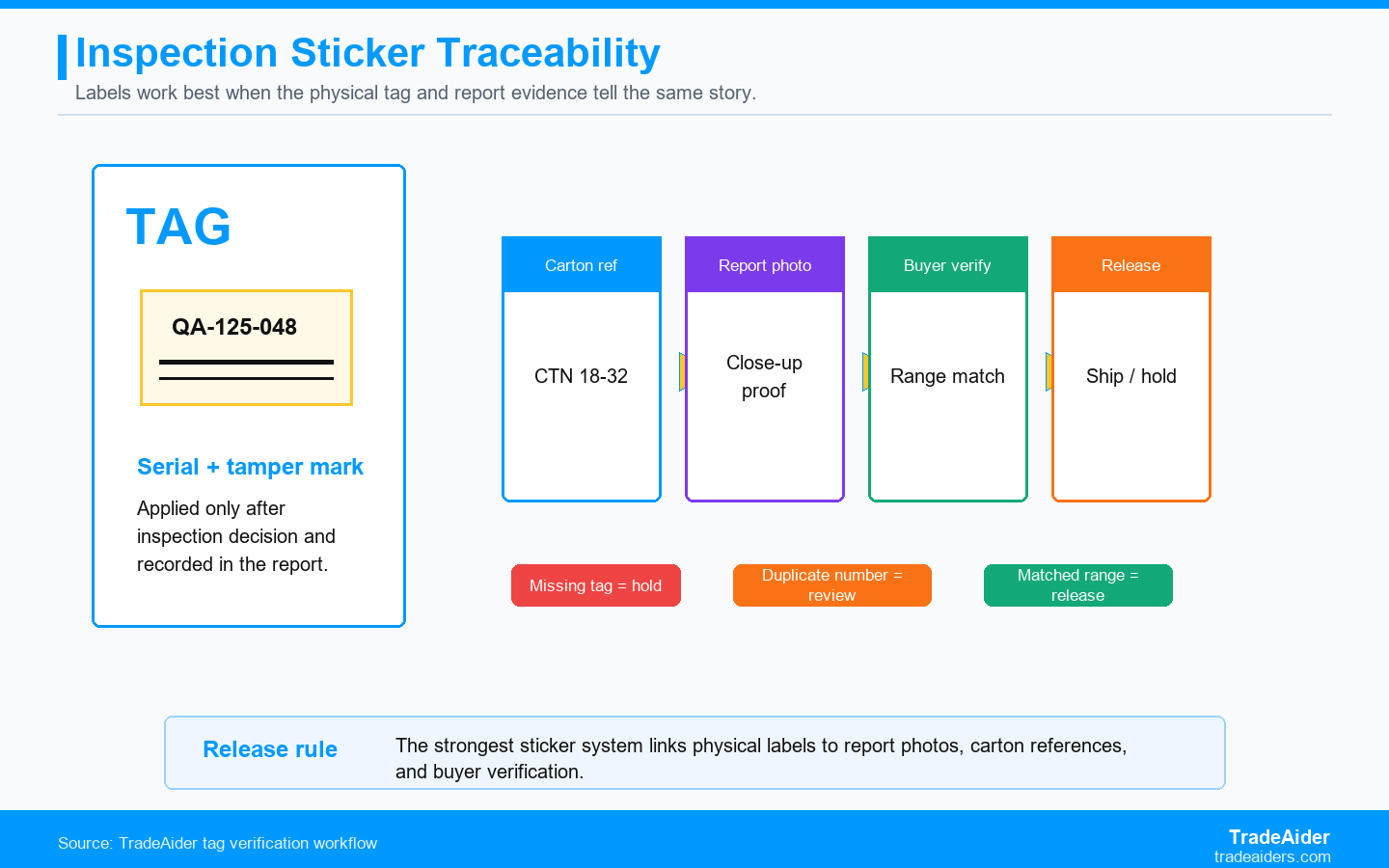
The strongest sticker system links physical labels to report photos, carton references, and buyer verification.
Where Inspection Stickers Help Most
Stickers help when goods might change identity after the inspection visit.
The first use case is lot separation. If a failed PSI leads to sorting or rework, the factory may need to separate passed cartons, reworked cartons, and held cartons. Stickers make that separation visible. They also reduce the chance that an uncorrected carton quietly returns to the release pile.
The second use case is split shipments. A supplier may ship part of a lot now and part later, or the buyer may approve only one SKU while holding another. Serial labels and report photos help the buyer know which cartons belong to the approved scope. This is especially useful when carton marks are similar across SKUs.
The third use case is brand protection. Private-label sellers, distributors, and trademark owners may worry that unauthorized goods will be mixed with legitimate inventory. Anti-counterfeit tags do not solve every brand-control problem, but they give the buyer a verification layer at receiving, resale, or customer-support review.
Where Stickers Can Mislead Buyers
A sticker without process control is only decoration.
A common mistake is treating a sticker as proof of quality. A sticker can say inspected, but the buyer still needs the report, sampling basis, defect counts, photos, and release decision. The sticker identifies goods; the report explains what was checked and what was found.
Another mistake is applying stickers before inspection is complete. If a factory pre-applies inspection stickers or passes labels to uninspected goods, the sticker loses meaning. The control process should define who applies the label, when it is applied, and how the number range is recorded.
A third mistake is failing to train receiving teams. If the buyer's warehouse does not know what the sticker means, which number range to expect, or what to do with missing tags, the system breaks at destination. A simple receiving checklist should match the inspection report and the expected sticker range.
How To Design A Sticker Control Plan
A good sticker plan defines meaning, ownership, numbering, exception rules, and receiving verification before the labels are printed.
Start by defining the sticker's job. Is it marking goods that passed inspection, cartons that must be held, samples retained for dispute review, or products that need anti-counterfeit authentication after sale? One sticker system should not try to answer every question at once. If the label meaning is unclear, factory workers and warehouse receivers will interpret it differently.
Next, define ownership. The buyer should decide who issues the labels, who stores unused labels, who applies them, and who records the used range. If the supplier can freely print or reuse inspection stickers without buyer control, the sticker no longer gives independent traceability. For higher-risk goods, the buyer may require serialized labels, controlled issue records, or inspector-supervised application.
Then define exception rules. Missing sticker, duplicate sticker, damaged tamper label, number outside the expected range, or sticker applied to the wrong carton should not be treated as harmless paperwork. The receiving team should know whether to hold the carton, photograph it, compare it to the inspection report, or ask the supplier for an explanation before selling the goods.
| Control Step | Buyer Instruction | Evidence To Keep | Exception Rule |
|---|---|---|---|
| Label issue | Use controlled serial range for this PO | Issued range and unused balance | Unknown range triggers review |
| Application | Apply after inspection decision or after verified rework | Photos showing position and carton marks | Pre-applied labels do not prove release |
| Report record | Record representative labels and carton references | Close-up photos, range, and packing list | Missing record weakens traceability |
| Receiving | Check expected labels before stock release | Receiving photos and discrepancy log | Missing or duplicate tag triggers hold |
This plan does not need to be complicated. Even a simple serial range and photo rule is stronger than an unrecorded sticker. The buyer's aim is to make physical identity auditable from inspection through receiving.
Where TradeAider Fits In Sticker-Based Traceability
TradeAider fits by turning sticker use into documented inspection evidence rather than a loose factory habit.
During PSI, the buyer can ask TradeAider to include sticker or tag checks in the inspection checklist: verify application location, photograph representative labels, record carton references, check serial ranges, and note whether tags are missing, duplicated, damaged, or inconsistent with the packing list.
If tag application must be controlled before final packing, During Production Inspection may be useful because the inspector can verify whether the factory is applying labels correctly while goods are still moving through production. If the concern is supplier identity or brand-protection controls, a factory audit can check whether the supplier has a stable labeling and record system.
The business fit is evidence continuity. Stickers help the buyer connect report findings to real goods, and TradeAider helps make that connection visible enough to support release, hold, rework, receiving, or dispute decisions.
SPAR Scenario: Stickers Prevented A Lot Mix-Up
The sticker did not create quality; it protected the inspected lot identity.
Situation: A US importer orders 6,000 branded pet accessories from a China factory. Two color variants look similar, and the supplier is producing for another buyer in the same week.
Problem: During PSI, TradeAider finds that one color has an old retail insert. The factory agrees to rework that color while the other color is approved for release. Without visible separation, the buyer worries that cartons may be mixed again before loading.
Action: The buyer requests serial carton stickers for the approved cartons and a different hold sticker for cartons awaiting insert replacement. The report photographs both sticker types, records the carton references, and states which range is approved.
Result: At loading and destination receiving, the buyer can compare cartons to the report. The sticker system helps prevent a corrected-lot dispute and makes the release decision easier to verify.
Action Card: Use Inspection Stickers Safely
Treat stickers as traceability evidence, not as a shortcut around inspection.
- Define what each sticker means: inspected, released, held, reworked, retained sample, or destination check.
- Record sticker numbers, carton references, and photos in the inspection report.
- Do not allow pre-applied inspection stickers before the inspection decision is complete.
- Train receiving teams to check sticker range, damage, duplicates, and missing labels.
- Use anti-counterfeit tags only with a clear verification and record process.
After the first shipment, compare destination receiving against the inspection sticker record. If missing stickers, duplicated numbers, or damaged labels appear, update the supplier instruction before the next order. A traceability system becomes useful only when exceptions trigger action.
For high-value or branded shipments, keep the sticker record with the commercial invoice, packing list, inspection report, and receiving photos. That file gives the buyer a compact evidence trail if a supplier dispute, warehouse discrepancy, suspected counterfeit issue, or destination receiving exception appears later.
It also helps the buyer decide whether the next order needs tighter tag custody, stronger anti-counterfeit material, or a simpler carton identification rule.
If your shipment needs stronger traceability, send TradeAider the packing list, carton marks, label artwork, tag type, verification method, and the reason you need stickers. The next step is to ask TradeAider to add sticker or anti-counterfeit tag verification to the inspection checklist.
Frequently Asked Questions
Do inspection stickers prove that every unit passed?
No. A sticker helps identify inspected or controlled goods, but the inspection report, sample basis, defect counts, photos, and buyer decision are still needed.
Are anti-counterfeit tags the same as inspection stickers?
No. Inspection stickers connect goods to a quality-control event. Anti-counterfeit tags add authentication or tamper-evident features to reduce substitution or copying risk.
When should I use sticker ranges?
Use sticker ranges when cartons or samples need traceability across inspection, rework, loading, destination receiving, or dispute review.
Can TradeAider verify tags during inspection?
Yes. If tag checks are included in the checklist, TradeAider can verify placement, serial ranges, photos, missing labels, damaged tags, and consistency with carton references.
Related Articles


Grow your business with TradeAider Service
Click the button below to directly enter the TradeAider Service System. The simple steps from booking and payment to receiving reports are easy to operate.

