

A Final Random Inspection, or FRI, is a final-stage inspection where samples are randomly selected from completed goods to check whether the lot meets agreed requirements before shipment. Pre-Shipment Inspection, or PSI, is the broader shipment-release service name many buyers use for the same final control point, especially when the inspection happens after production is complete and before goods leave the factory.
Importers often see FRI and PSI used as if they are identical. In many practical sourcing conversations, they overlap heavily. Both usually happen near the end of production, both use sampling, both check the finished lot against buyer requirements, and both support the shipment-release decision. The difference is the emphasis.
FRI emphasizes the inspection method: final timing plus random sampling. PSI emphasizes the business timing: before shipment and before the buyer releases the lot. If a supplier, agent, or inspection company uses one term and the buyer uses the other, the buyer should clarify readiness, packing percentage, sampling method, checklist, and report deliverable rather than debating vocabulary.
- FRI emphasis: final random sampling of completed goods.
- PSI emphasis: pre-shipment release evidence for the buyer.
- Practical overlap: both can check quantity, workmanship, labels, packaging, and basic function.
- Buyer rule: define timing and scope in writing, whichever term is used.
The Direct Answer
Use FRI when you want to emphasize final random sampling; use PSI when you want to emphasize shipment-release evidence before goods leave the factory.
TradeAider's Pre-Shipment Inspection page defines the service around finished goods: 100% of order quantity completed and at least 80% packed for export. That is the commercial moment when a final random sample can support a release, rework, hold, or reinspection decision.
TradeAider also provides an AQL calculator and inspection-standard resources that help buyers think about sample size, critical defects, major defects, minor defects, and acceptance limits. Those tools matter whether the buyer calls the service FRI or PSI.
The safest wording for a purchase order or inspection booking is concrete: inspect the finished shipment before release, randomly sample from the available packed goods, check against the approved specification, classify defects by agreed severity, and issue a report with photos and a release recommendation.
FRI vs PSI Compared
The name matters less than whether the inspection timing and evidence match the buyer's release decision.
| Comparison Point | Final Random Inspection (FRI) | Pre-Shipment Inspection (PSI) | Buyer Takeaway |
|---|---|---|---|
| Main emphasis | Final-stage random sample from completed goods | Shipment-release inspection before goods move | Clarify both method and timing |
| Typical timing | Near the end of production, after goods are finished | Before shipment, commonly when goods are completed and mostly packed | Book before final payment and loading |
| Sampling logic | Random sampling is central to the term | Often uses AQL or agreed sampling plans | Agree sample level and defect limits |
| Scope | Product, workmanship, quantity, packaging, labels, function as agreed | Same areas, plus release-oriented reporting | Write the checklist in advance |
| Decision output | Conformity evidence for the final lot | Release, rework, reinspect, hold, or concession | Convert report into action |
This comparison is why many buyers can treat FRI and PSI as compatible terms in daily sourcing, as long as the inspection scope is not vague. A supplier saying 'we did final inspection' is not enough. The buyer needs to know who inspected, what was sampled, what criteria were used, and what evidence was documented.
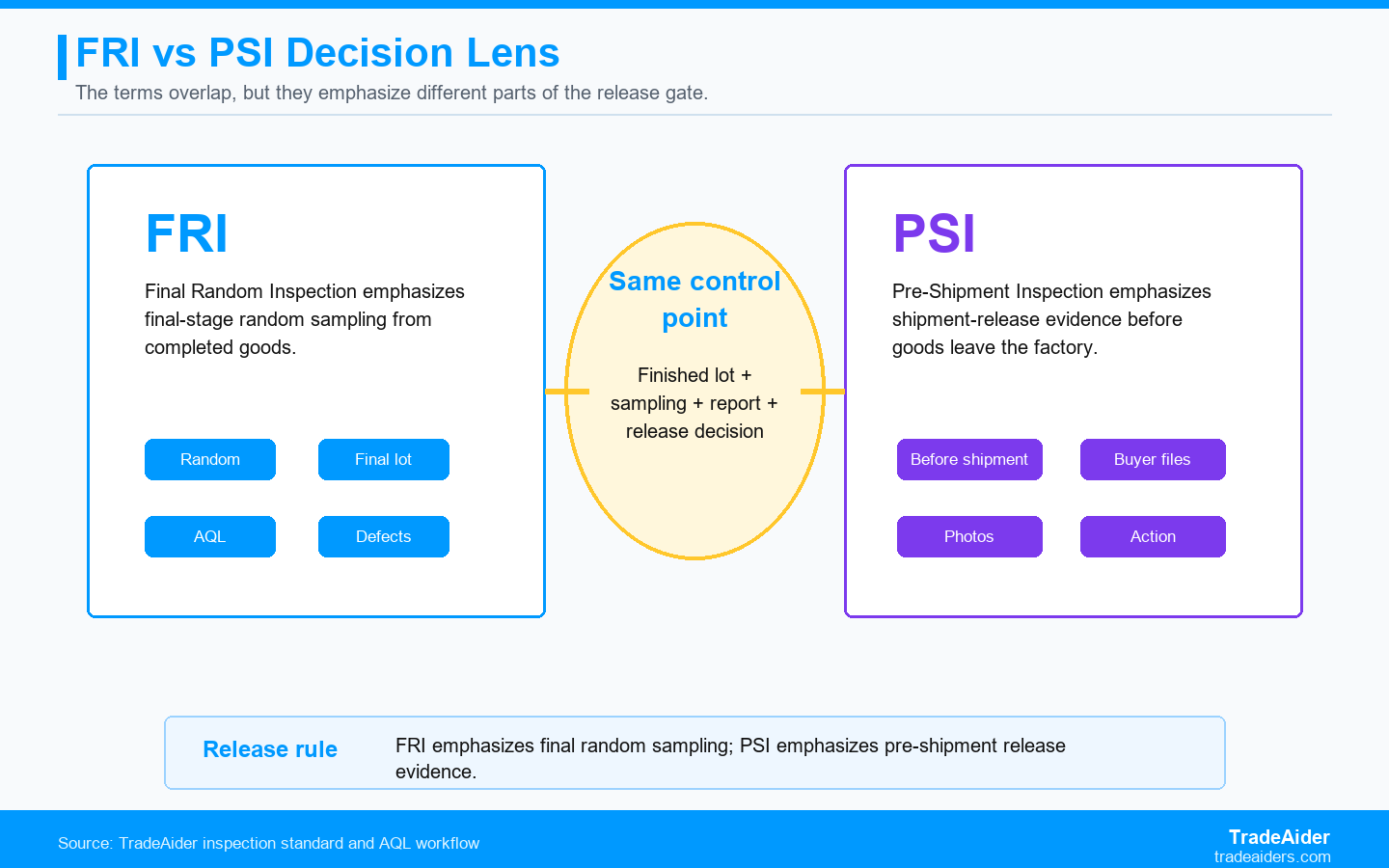
FRI emphasizes final random sampling; PSI emphasizes pre-shipment release evidence.
When To Use FRI
Use FRI language when random sampling of the final lot is the key control point.
FRI is useful when the buyer wants to verify a completed batch without inspecting every unit. The method is especially relevant for standard consumer goods, repeatable production, and lots where random sampling can reveal common workmanship, assembly, packaging, or label problems. The buyer should still define defect categories and sample size rather than relying on the word random by itself.
FRI also helps when a supplier claims its own internal final check is enough. The buyer can require an independent final random sample from packed goods, with photos, defect counts, carton references, and a written result. This turns 'final check' from a supplier assurance into a buyer evidence point.
FRI is weaker when the lot is not actually finished, when goods are split across multiple locations, when high-risk compliance testing is required, or when the defect is hidden and cannot be detected through ordinary visual or functional checks. In those cases, the buyer may need earlier DPI, laboratory testing, or supplier audit in addition to final inspection.
When To Use PSI
Use PSI language when the buyer's main question is whether the shipment should be released.
PSI is the better term when the inspection is tied to final payment, booking cargo, releasing documents, marketplace launch, or retailer receiving. It frames the inspection as a business gate, not only a sampling event. That matters because the buyer needs a next step after the report.
A PSI may include final random sampling, but it should also check practical shipment details: available quantity, packed quantity, carton marks, retail packaging, barcode, labels, accessories, basic function, visible workmanship, sample match, and any buyer-specific risk points. These details are what often create warehouse costs or customer returns.
PSI is also easier for many importers to communicate internally. A purchasing manager, founder, or finance team understands that inspection happens before shipment and before final release. FRI may sound more technical; PSI makes the commercial gate clear.
Common Scope Mistakes When Buyers Say FRI
Most FRI problems come from vague readiness, vague sampling, or vague acceptance rules.
The first mistake is accepting a supplier's internal final check as an independent FRI. A factory may have a legitimate QC team, but internal QC is not the same as buyer-side evidence. If the supplier controls the checklist, the sample selection, the photos, and the reporting line, the buyer has less leverage when defects are found later. Independent FRI or PSI should report to the buyer and check against buyer-approved criteria.
The second mistake is allowing partial readiness. If only one SKU is packed, if cartons are sealed in a way that blocks sampling, or if part of the lot is still on the line, the random sample may not represent the shipment. A final inspection should not become a progress visit. If the buyer needs progress evidence, a During Production Inspection is more honest than stretching the meaning of FRI.
The third mistake is using random sampling without defect definitions. Random selection helps only if the inspector knows what to classify as critical, major, or minor. A scratch on hidden packaging, a missing safety warning, a failed function check, and a wrong barcode cannot be treated as the same business risk. The buyer should define acceptance logic before the inspector arrives.
The fourth mistake is failing to connect the result to action. An FRI report that says defects exist but does not support release, rework, hold, or reinspection leaves the buyer in a negotiation fog. The report should make the supplier conversation more specific: which defect, which severity, which SKU, which photo, which carton group, and which next step.
| Scope Mistake | What It Looks Like | Better Buyer Instruction | Decision Protected |
|---|---|---|---|
| Supplier-only final check | Factory sends a pass note with no neutral sampling | Use independent inspector and buyer checklist | Supplier responsibility |
| Partial lot readiness | Some goods packed, some still being produced | Inspect only when the final lot is representative | Sample validity |
| Undefined defect severity | All issues are discussed as general quality | Define critical, major, and minor before visit | Release threshold |
| No action rule | Report is forwarded without decision | State release, rework, reinspect, hold, or concession | Commercial leverage |
These mistakes explain why the terminology alone cannot protect the buyer. A purchase order that says FRI but gives no readiness rule, no random sampling basis, no AQL level, and no defect categories is weaker than a PSI booking that spells out exactly how the shipment will be checked and what the report must decide.
Where TradeAider Fits When Terms Overlap
TradeAider fits by translating FRI or PSI wording into a concrete inspection scope and release decision.
If a buyer asks TradeAider for PSI, the booking should still define whether the sampling is random, what AQL level applies, which SKUs are included, what files should be checked, and what decision the report should support. The inspection standard and AQL resources can support that discussion.
If the problem appears earlier than final inspection, During Production Inspection may be more useful. If the buyer wants to know whether the supplier has stable systems before placing another PO, factory audit answers a different question.
The business fit is clarity. TradeAider can help the buyer move from terminology to execution: finished-lot readiness, random sampling, checklist, photos, defect classification, report review, and release action.
SPAR Scenario: FRI Name, PSI Decision
The buyer used the supplier's term but controlled the inspection scope.
Situation: A UK importer orders 8,000 silicone kitchen tools. The supplier says it can arrange a Final Random Inspection before loading.
Problem: The buyer is not sure whether the supplier's FRI means random sampling from all packed cartons or a small internal check from convenient cartons. The shipment has three SKUs and custom retail labels.
Action: The buyer books TradeAider PSI and specifies that samples must be randomly drawn from the completed packed lot, labels must be matched to artwork, and defects must be classified by agreed severity. The report documents the lot and the action recommendation.
Result: The inspection functions as FRI in method and PSI in business purpose. The buyer releases the shipment only after the report confirms random sample evidence and label conformity.
Action Card: How To Specify FRI Or PSI
Write the inspection scope so the term cannot be misunderstood.
- State that goods must be completed and sufficiently packed before inspection.
- Define random sampling method, AQL level, defect classes, and SKU coverage.
- Attach approved specs, sample references, packaging artwork, barcode list, and carton marks.
- Require photos for defects, labels, packaging, quantity, and sample comparison.
- Decide in advance what causes release, rework, reinspection, hold, or concession.
The buyer can also write both terms into the instruction when that prevents confusion: request a Pre-Shipment Inspection using final random sampling from completed and packed goods. This wording keeps the commercial gate and the sampling method together. It is especially useful when the supplier is used to saying FRI while the buyer's internal team uses PSI.
For repeat orders, the buyer should compare each final report with the previous one. If the same defect appears again, the problem is no longer only a final random inspection issue; it may be a process-control issue. That is when the buyer should consider earlier production checks or a supplier corrective-action requirement before the next lot reaches final inspection.
If your supplier uses FRI language and you use PSI language, send TradeAider the PO, packing status, SKU list, AQL settings, and buyer files. The next step is to ask TradeAider to translate FRI or PSI wording into one clear inspection scope.
Frequently Asked Questions
Are FRI and PSI the same thing?
They often overlap in practice, but they emphasize different things. FRI emphasizes final random sampling; PSI emphasizes inspection before shipment release.
Which term should I put on a purchase order?
Use the term your team and supplier understand, but define readiness, random sampling, AQL, checklist, report evidence, and release decision in writing.
Can TradeAider perform an inspection that functions as both FRI and PSI?
Yes. A TradeAider PSI can include random sampling from the finished lot and provide the buyer with pre-shipment release evidence.
Is FRI enough for compliance-sensitive products?
Not by itself. FRI can check visible conformity and agreed on-site points, but lab testing, certification evidence, and documentation review may also be needed for compliance-sensitive goods.
Related Articles


Grow your business with TradeAider Service
Click the button below to directly enter the TradeAider Service System. The simple steps from booking and payment to receiving reports are easy to operate.

