
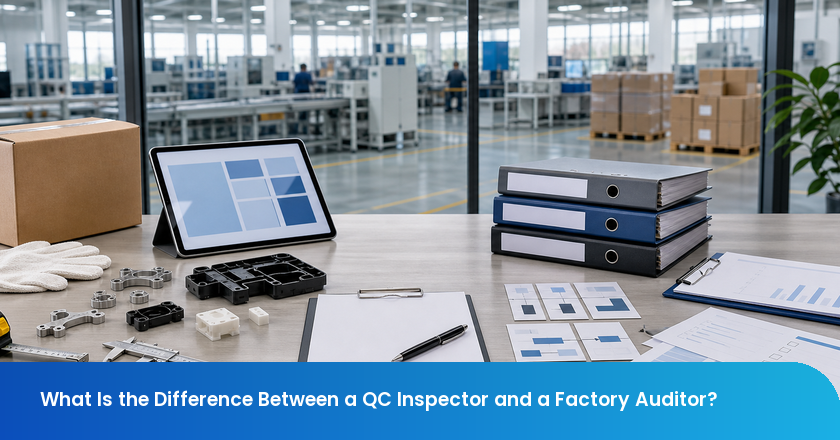
A QC inspector checks the actual product, shipment, packaging, labels, quantity, and defects against buyer requirements; a factory auditor checks the supplier's system, capability, records, process control, and management discipline. The inspector helps decide whether a lot can ship. The auditor helps decide whether a supplier is suitable, controllable, or risky before or during the sourcing relationship.
Importers often use the words inspection and audit as if they are interchangeable. That confusion creates wrong bookings. A buyer may ask for an audit when the real question is whether finished goods can ship. Another buyer may ask for a pre-shipment inspection when the real question is whether a new factory has stable systems, capacity, and process control. Both services are useful, but they answer different questions.
A QC inspector is usually closest to the order. The inspector opens cartons, samples units, checks workmanship, measures dimensions, verifies labels, counts accessories, checks packaging, tests simple function, documents defects, and compares the lot with the purchase order, specification, approved sample, and AQL plan. The output is a shipment report.
A factory auditor is usually closest to the supplier relationship. The auditor checks management systems, production capability, quality records, equipment, incoming-material control, in-process checks, final QC process, subcontracting risk, corrective-action discipline, staff competence, and sometimes social or environmental conditions. The output is a supplier-risk report.
- Use a QC inspector: when the buyer needs evidence about the actual order before payment or shipment.
- Use a factory auditor: when the buyer needs evidence about supplier capability, systems, and risk.
- Use both: when a new or risky factory must be qualified and then the real shipment must be verified.
- Decision rule: inspect the lot; audit the system.
The Direct Answer
The QC inspector protects the shipment release decision; the factory auditor protects the supplier selection and control decision.
ISO/IEC 17020:2026 specifies requirements for competence, impartiality, and consistent operation of bodies performing inspection. Its ISO overview explains inspection as examination of products, processes, services, or other items against requirements. Source: ISO/IEC 17020:2026.
ISO 19011:2026 provides guidelines for auditing management systems and covers audit principles, audit program management, and conducting management-system audits. Source: ISO 19011:2026.
These standards help clarify the difference. Inspection is product or item conformity evidence. Auditing is system and process evidence. In sourcing language, the inspector helps answer, should this shipment be released? The auditor helps answer, should we trust this factory to produce this type of order under this level of control?
Inspector vs Auditor Compared
The difference is the object being checked: actual lot versus supplier system.
| Question | QC Inspector | Factory Auditor | Buyer Decision |
|---|---|---|---|
| What is checked? | Finished or in-process goods, cartons, labels, packaging, quantity, defects | Factory systems, records, equipment, staff, process controls, CAPA | Lot release or supplier approval |
| When used? | During production, pre-shipment, loading, or after rework | Before onboarding, before scaling, after failures, or during supplier review | Shipment timing versus sourcing timing |
| Main evidence | AQL result, defect photos, sample checks, measurements, label photos | Audit findings, records, interviews, site photos, risk rating | Physical conformity versus capability |
| Typical output | Inspection report with pass, fail, or hold recommendation | Audit report with supplier strengths, weaknesses, and corrective actions | Release goods or control supplier |
| Common limit | Cannot prove long-term factory capability alone | Cannot prove a specific finished lot is defect-free | Use the right tool for the question |
The most expensive mistake is using one service as a substitute for the other. A factory can pass an audit and still make a bad shipment. A shipment can pass inspection while the factory system remains weak. The buyer needs to decide whether the risk is order-level, supplier-level, or both.
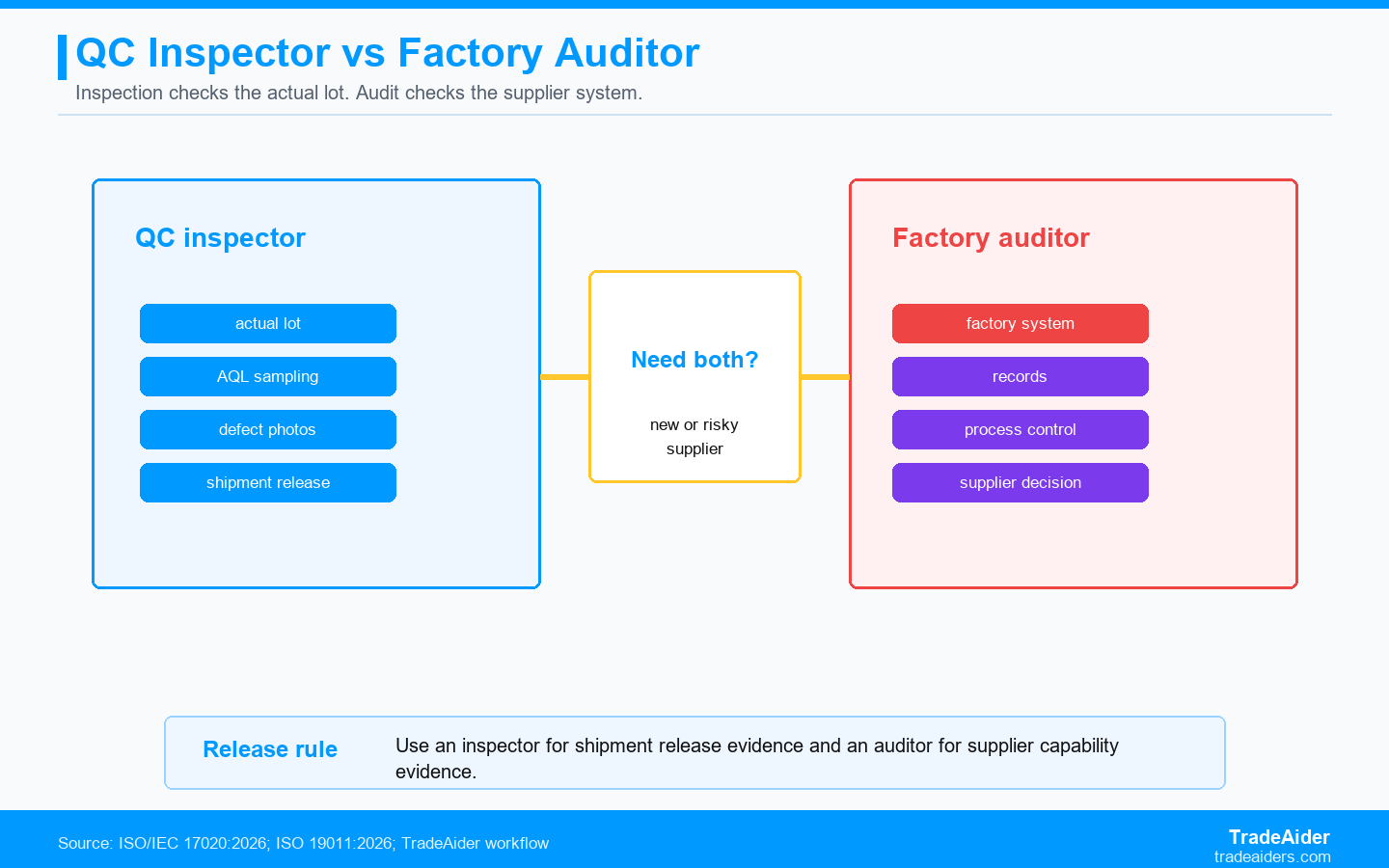
Use an inspector for shipment release evidence and an auditor for supplier capability evidence.
When You Need A QC Inspector
Use inspection when the goods exist and the buyer needs release evidence.
A QC inspector is the right service when the buyer needs to know whether a specific order matches the purchase order and approved files. The inspector can verify model, color, dimensions, workmanship, function, accessories, barcode, label, carton mark, packaging, retail box condition, quantity, and visible defects. The report helps the buyer decide whether to pay the balance, ship, hold, sort, rework, or reinspect.
For repeat suppliers, inspection is still useful because production can drift. A supplier may use a different material, substitute a component, print old labels, miss accessories, mix cartons, or rush packing. The buyer may trust the relationship but still need evidence before goods leave the factory.
Inspection is especially important when the product is customer-visible, complaint-sensitive, customized, marketplace-bound, regulated, or high value. In those cases, a late defect can create returns, account risk, rework, or launch delays. The inspector gives the buyer a structured view of the actual lot before control is lost.
When You Need A Factory Auditor
Use audit when the buyer needs to understand supplier capability and control risk.
A factory auditor is the right service when the buyer is deciding whether to use a supplier, increase order volume, approve a new category, or continue after repeated failures. The auditor checks whether the supplier has systems that can support consistent production, not only whether one visible sample looks acceptable.
A useful audit can review organization, production flow, incoming material control, process records, quality checkpoints, calibration, equipment, capacity, subcontracting, worker competence, nonconforming product control, corrective action, document control, and management responsibility. Depending on scope, it may also include social, environmental, or security elements.
Audit findings should not be treated as decoration. If the auditor finds weak incoming inspection, poor calibration records, unclear subcontracting, or no CAPA discipline, those findings should change the next inspection plan. A weak factory may still ship acceptable goods, but only if the buyer adds appropriate controls.
When You Need Both
The strongest sourcing workflow often audits the system and inspects the lot.
For a new supplier, an audit can happen before the purchase order or before large deposits. It helps decide whether the factory is a serious candidate. A DPI or PSI then checks the actual goods once production starts. The audit tells the buyer where to look; the inspection tells the buyer what was produced.
For a supplier with repeated failures, audit and inspection work together. The audit identifies system causes: weak training, poor packing control, missing fixture, no incoming-material checks, or weak management review. The inspection verifies whether the next lot was corrected. Without audit, the buyer may keep finding symptoms. Without inspection, the buyer may trust a corrective plan without evidence.
For low-risk orders, a buyer may choose only inspection. For supplier onboarding, a buyer may choose audit first. For high-risk products, high-value orders, or urgent marketplace launches, both may be justified because the cost of failure is larger than the cost of evidence.
Where TradeAider Fits In Service Selection
TradeAider fits by matching the service to the buyer's decision, not just the product category.
TradeAider can provide Pre-Shipment Inspection when the buyer needs finished-lot evidence before release, including sampling, AQL findings, labels, packaging, function, and defect photos.
TradeAider can provide factory audit service when the buyer needs supplier-system evidence before onboarding, scaling, or continuing with a risky factory. For process drift, During Production Inspection can connect audit findings to production controls.
The business fit is avoiding wrong-service spend. TradeAider helps the buyer ask the right first question: are we deciding whether the factory is capable, whether the shipment can release, or both?
SPAR Scenario: The Buyer Booked Inspection But Needed An Audit Too
A shipment passed, but the supplier system still created future risk.
Situation: A buyer sources a customized household item from a new factory and books only PSI for the first order.
Problem: The PSI passes, but the second order fails because the factory changed a component and had no change-control process. The buyer realizes the first inspection did not prove system discipline.
Action: TradeAider performs a factory audit focused on material control, process records, subcontracting, and CAPA. The next order also includes DPI and PSI checkpoints based on the audit findings.
Result: The buyer learns that inspection protects release, while audit protects supplier control. Future orders use both tools when product change risk is high.
Action Card: Choose The Right Service
Start with the decision you need to make.
- Choose inspection if the question is whether this lot can ship.
- Choose audit if the question is whether this supplier can be trusted or improved.
- Choose DPI if production drift must be caught before all goods are packed.
- Choose both audit and PSI for new, high-risk, customized, or previously failing suppliers.
- Convert audit findings into inspection checkpoints for the next order.
The buyer should write the decision in one sentence before booking. If the sentence says approve this supplier, an audit is likely needed. If it says release this shipment, inspection is likely needed. If it says stop this defect from repeating, both audit and inspection may be needed.
The buyer should also tell the provider what happens after the result. A failed inspection may trigger sorting and reinspection. A poor audit may trigger CAPA, smaller trial order, stronger DPI, or supplier replacement. Evidence only creates value when it changes a sourcing decision.
Common Booking Mistakes
The wrong service can produce a professional report that answers the wrong question.
One common mistake is booking a factory audit after production is already packed and the buyer only has two days before shipment. At that point, the urgent question is usually whether the goods can ship. An audit may still reveal useful supplier-system risk, but it will not sample the finished lot the way a PSI does. If the buyer needs a release decision, inspection should not be skipped.
Another mistake is booking only PSI for a supplier that has never been qualified. A passed inspection may show that one lot is acceptable, but it does not show whether the supplier has stable controls, honest records, enough capacity, or a disciplined corrective-action process. If the buyer plans to scale volume, supplier-system evidence matters.
A third mistake is using audit findings without converting them into inspection checkpoints. If an audit finds weak incoming material control, the next DPI or PSI should check material identity, supplier labels, records, and visible component consistency. If an audit finds poor packing control, the next PSI should check carton protection and packing-line discipline more deeply.
A mature importer keeps both views in the supplier file. Audit history shows capability. Inspection history shows shipment performance. When those two views disagree, the buyer should investigate before scaling orders.
That combined record also helps internal teams explain why one supplier receives lighter routine checks while another supplier needs audit follow-up, DPI, and stricter final inspection before every release.
If you are unsure whether to book inspection, audit, or both, send TradeAider the product type, supplier history, order timeline, and decision you need to make. The next step is to ask TradeAider to choose the right supplier-control service.
Frequently Asked Questions
Can a factory auditor release a shipment?
Not by audit alone. An audit assesses systems and capability. Shipment release should be based on inspection evidence for the actual lot.
Can a QC inspector approve a supplier?
A good inspection report helps supplier evaluation, but supplier approval usually needs broader capability and system evidence from an audit.
Which should come first, audit or inspection?
For a new supplier, audit often comes first. For an active order, inspection may be urgent. High-risk sourcing may need both.
Does TradeAider offer both services?
Yes. TradeAider can provide factory audits, during-production inspection, and pre-shipment inspection depending on the buyer decision.
Related Articles
Grow your business with TradeAider Service
Click the button below to directly enter the TradeAider Service System. The simple steps from booking and payment to receiving reports are easy to operate.

