
- About Us

- Our Services
- Your Industry
- Resources
- News & Blog
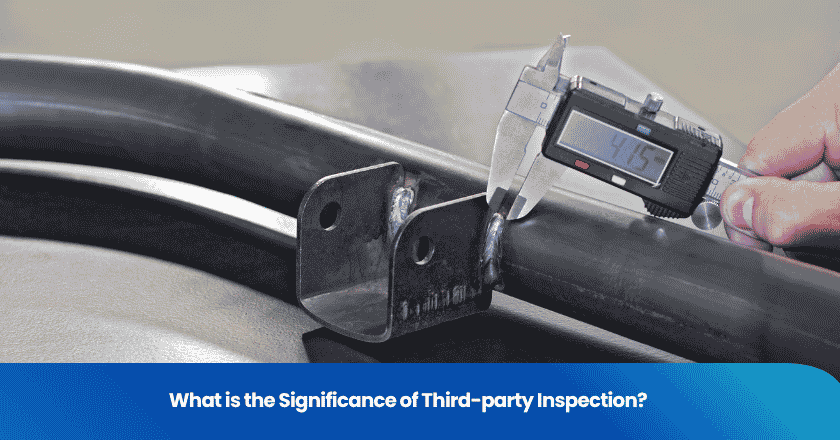
A third-party inspection report's real significance isn't that it makes a buyer feel reassured — it's that the report becomes documentation other parties rely on: retailers doing vendor compliance checks, banks processing trade finance, insurers assessing a cargo claim, and buyers further down the chain who never spoke to the factory directly. An inspection report that can't hold up to that level of scrutiny isn't doing the job it's meant for.
Who Actually Asks to See an Inspection Report
It's easy to think of a third-party inspection report as something that exists between a buyer and a factory — proof for the buyer's own peace of mind. In practice, the report gets used, and asked for, well beyond that relationship:
- Retailers and marketplaces doing vendor compliance. A retailer onboarding a new supplier, or a marketplace enforcing quality standards on third-party sellers, often requires documented inspection evidence as part of vendor approval — not a general assurance that "quality is good," but a specific, dated report tied to a specific batch.
- Banks and trade finance. In transactions involving letters of credit or trade financing, an inspection or survey report can be part of the documentation a bank reviews before releasing payment against a shipment — the bank has no way to verify the goods itself, so it relies on independent documentation.
- Insurers assessing a cargo or quality claim. If a shipment is damaged, defective, or disputed, an insurer evaluating a claim wants to know what was verified before the goods left the factory — a pre-shipment report is often the only independent record of the goods' condition at that point.
- Downstream buyers who never spoke to the factory. In multi-tier supply chains, a distributor or retailer several steps removed from the original factory relationship often has no direct visibility into production at all — the inspection report is the only independent account of what was actually checked.
The consumer-facing use — a report reassuring an end customer — is real, but it's the smallest and least demanding audience of the four. The report has to satisfy the stricter, more specific scrutiny of the other three to actually be useful.
Why "Objective" Means Something Different to Each of These Audiences
A retailer doing vendor compliance wants confirmation that the specific standard it requires was actually checked — not a general quality assurance, but a match against its own vendor requirements. A bank or insurer wants a report that can stand up as evidence independent of both the buyer's and the seller's own account of events — since either party has a financial interest in the transaction going through. A downstream buyer with no direct factory relationship needs a report detailed enough to substitute for the visibility they don't have.
This is the actual reason independence matters — not because it sounds more trustworthy in the abstract, but because each of these audiences has a specific reason to distrust an assessment that comes from either side of the original transaction.
What a Report Actually Needs to Include to Serve These Purposes
A report that's meant to hold up to scrutiny beyond the immediate buyer needs more than a pass/fail conclusion. At minimum, it needs:
- The specific standard or specification the goods were checked against, not a general quality claim
- Dated, photo-based evidence tied to a specific batch or production run
- Clear identification of what was sampled and how many units, so the sampling method itself can be evaluated
- A named inspecting party independent of both the buyer's and the factory's financial interest in the shipment
A report missing any of these is fine for internal reassurance between a buyer and a factory. It's not sufficient for the scrutiny a bank, insurer, or retailer's compliance team will actually apply.
What an Inspection Report Doesn't Prove
It's worth being precise about the limits here, since overstating what a report proves undermines the credibility it's meant to establish. A single inspection report confirms the condition of a specific batch at a specific point in time — it isn't an ongoing certification, and it doesn't guarantee that the next production run will meet the same standard. It's also not the same as a factory audit, which evaluates a facility's capability and systems rather than one shipment's condition. Treating a single report as a permanent guarantee of quality is a common overstatement that eventually undermines trust in the report itself, rather than building it.
Frequently Asked Questions
Does every buyer actually need third-party inspection, or only larger companies dealing with banks and retailers?
Even a buyer with no bank or retailer involvement benefits from independent documentation — if a dispute with a supplier ever arises, or if the buyer later sells to a retailer or marketplace with its own compliance requirements, having the report already on file avoids scrambling to prove something after the fact.
Can a factory's own inspection report be used for these same purposes?
Generally not for the audiences described above. A bank, insurer, or retailer's compliance team specifically wants a report from a party with no financial stake in the shipment — a factory's own report doesn't meet that bar, regardless of how accurate it might actually be.
How long does an inspection report remain valid or useful?
It's tied to the specific batch it covers, not an ongoing period. A new production run needs its own inspection; a report from a prior order doesn't extend to a new one, even from the same factory.
TradeAider provides independent, on-site inspection reports — dated, photo-documented, and tied to a defined sampling standard — for buyers who need documentation that holds up beyond their own relationship with the factory. Contact TradeAider's team to discuss what a report needs to include for your specific use case.
Related Articles


Grow your business with TradeAider Service
Click the button below to directly enter the TradeAider Service System. The simple steps from booking and payment to receiving reports are easy to operate.

