
- About Us

- Our Services
- Your Industry
- Resources
- News & Blog
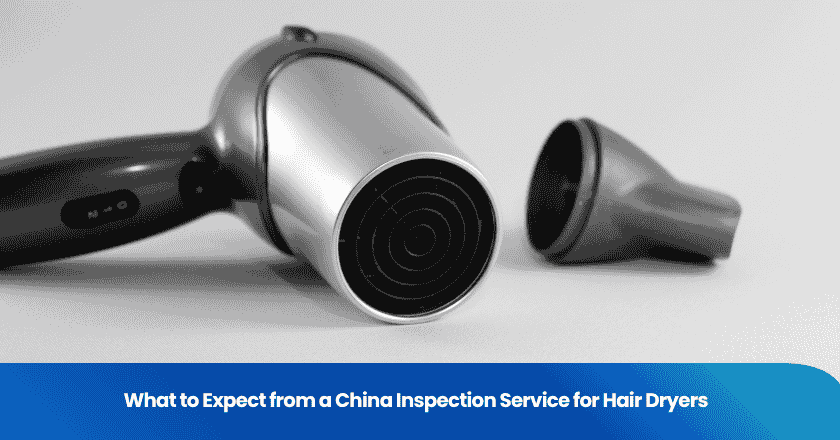
Hair dryers occupy an interesting position in the appliance import business: they're simple enough in function that buyers often underestimate the quality risks, but complex enough in their safety requirements that a failed inspection — or worse, a failed product in the field — carries serious consequences. A hair dryer that overheats, produces excessive EMI interference, or lacks proper grounding is not a minor quality problem. It's a safety incident and a certification liability. If you're importing hair dryers from China and booking an inspection service, this guide explains exactly what should happen — what tests get run, what certifications get checked, and what separates a thorough inspection from one that ticks boxes without delivering real quality assurance.
Key Takeaways
- Hair dryer inspections must include safety tests covering insulation resistance, voltage withstand, and leakage current — not just visual and functional checks.
- CE certification for EU-bound hair dryers requires compliance with EN60335-2-23 (safety) and EN55014-1/2 (EMC) — the inspector should verify both.
- Motor heat-rise testing and thermal cutoff function testing are critical safety items that a competent appliance inspector must run.
- Strain relief, cord integrity, and plug safety checks are among the most commonly failed items in hair dryer inspections from China.
Why Hair Dryer Inspections Carry Higher Safety Stakes
Heat, Electricity, and Moisture: A High-Risk Combination
Hair dryers operate in the bathroom — a humid environment — while producing sustained high heat (typically 1600W to 2200W for consumer models) through a combination of a high-speed motor and a nichrome heating element. This combination means the failure modes for a substandard hair dryer include overheating, electrical shock, fire, and mechanical failure — all in an environment where the user is likely to be in contact with water. The CE certification process for hair dryers under EN60335-2-23 specifically addresses temperature control, motor safety, and protection against water ingress precisely because these risks are well-documented.
From an importer's perspective, this means a hair dryer inspection is not the place to cut corners on the inspection scope. A visual-only inspection that confirms the product looks correct but doesn't run electrical safety tests is providing false assurance — and the liability for a safety incident sits with the importer who approved the shipment based on an incomplete inspection.
The Certification Landscape for Different Markets
Hair dryers exported to different markets face different mandatory certification requirements, and each certification covers overlapping but distinct sets of tests. An inspection service must know which market your product is destined for and verify the right certification accordingly.
| Target Market | Required Certification | Key Standards |
|---|---|---|
| European Union | CE (LVD + EMC + RoHS) | EN60335-1, EN60335-2-23, EN55014-1/2, EN62321 |
| United Kingdom | UKCA (post-Brexit) | BS EN60335-2-23 equivalent |
| United States | UL listing or ETL | UL 859, J60335-2-23 (for some models) |
| Australia / NZ | RCM (SAA) | AS/NZS 60335-2-23, AS/NZS CISPR 14 |
| China Domestic | CCC (mandatory) | GB 4706.1, GB 4706.15, GB 4343.1-2024 |
What an Inspection Service Should Do Before the Inspection
Pre-Inspection Preparation
A professional China inspection service should request several items from you before the inspection date: the approved product specification (including rated voltage, power, and frequency), the golden sample or reference sample for comparison, the target market and applicable certifications, and your AQL acceptance criteria for this product. They should also review any previous inspection findings for the same product or supplier, so the inspector can give additional attention to previously flagged failure points. An inspection service that simply asks "when can we go and what factory?" without gathering product-specific information is not approaching the task with the rigor that hair dryers require.
The Core Inspection Tests for Hair Dryers
Electrical Safety Tests
These are non-negotiable for any hair dryer inspection. A trained appliance inspector should run the following tests in the field or confirm that factory line testing records are available and valid for each tested unit:
Voltage Withstand Test (Hi-pot): The inspector applies 1,500V AC for one second to verify the insulation between live parts and touchable surfaces can withstand overvoltage conditions without breakdown. This tests the integrity of the motor insulation and internal wiring.
Insulation Resistance Test: Measured at 500V DC, insulation resistance should be at least 2MΩ. A reading below this indicates degraded insulation that creates shock risk under normal use conditions.
Leakage Current Test: Measures the current flowing through the user's body if they touch the appliance casing. For hair dryers in bathroom environments, leakage current limits are strictly defined by market-specific standards. Excessive leakage current is an immediate critical defect.
Thermal and Motor Safety Tests
Heat management is the core safety challenge for hair dryers. Inspectors should verify the following:
Temperature Rise Testing: The hair dryer is operated under load conditions for a defined test period, and surface temperatures are measured to confirm they don't exceed the limits defined by the applicable standard. Critical measurement points include the handle, the air outlet, and the motor housing. Exceeding temperature limits during test means the product will exceed them in consumer hands — with a much longer use period.
Thermal Cutoff Function: Modern hair dryers incorporate a thermal cutoff (thermostat or thermal fuse) that shuts the heating element off if the temperature exceeds a safe threshold — protecting against fires if the airflow is blocked (for example, a dryer pressed against a pillow). The inspector should confirm the thermal cutoff activates correctly by blocking airflow during a controlled test.
Motor Rotation Speed: Motor speed under load should match the rated specification. A motor running significantly below spec produces insufficient airflow, meaning the heating element operates at a higher-than-design temperature. Over time, this degrades internal components and accelerates failure.
Functional and Mechanical Safety Tests
Beyond electrical safety, the inspection should cover practical functionality:
Speed and Heat Settings: All speed settings (low, medium, high, cool shot) and all heat settings must function as labeled. Mismatched settings — a "low" setting that actually runs at high speed — are a major defect.
Strain Relief Test: The power cord's strain relief fitting (where the cord enters the appliance body) should withstand a defined pull force without the cord being pulled out or the insulation damaged. Inadequate strain relief is a frequently failed item in China-manufactured hair dryers — the cord is often secured with a simple friction fit rather than a proper strain relief component.
Cord Integrity Check: Visual inspection of the full cord length for cuts, insulation damage, and adequate cross-sectional area relative to the appliance's wattage. An undersized cord on a 2200W hair dryer will overheat in use, creating a fire risk.
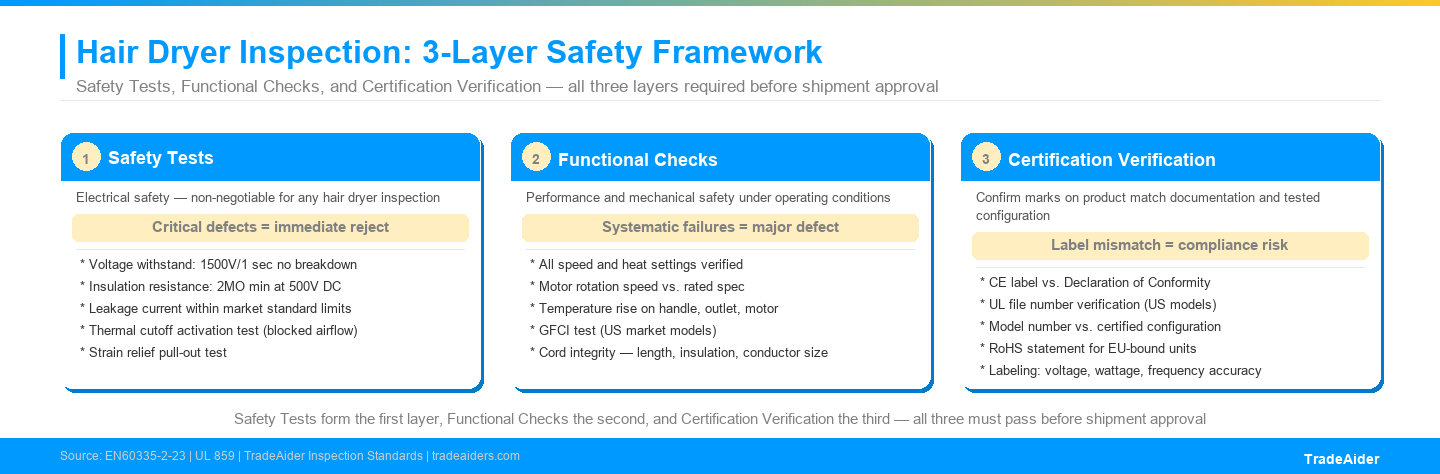
Hair dryer inspection framework: safety tests form the first layer, functional checks the second, and certification verification the third — a complete inspection requires all three layers to pass before approving shipment.
Certification Verification: What an Inspector Can and Can't Confirm
What the Inspector Verifies On-Site
An inspector at the factory can verify the presence and accuracy of certification marks on the product and packaging, confirm that the model number and rated specifications on the label match the certified documentation provided by the factory, and check that the physical product configuration (cord type, plug type, thermal cutoff design) matches the product that was tested during certification. These are meaningful checks — a common failure mode is a factory shipping a product with minor hardware changes that invalidate the original certification, and an experienced inspector will flag these discrepancies.
For CE certification, the inspector should review the Declaration of Conformity document, confirm that EN60335-2-23 and EN55014-1/2 are listed as the applicable standards, and check that the testing laboratory is accredited. For UL listing, the UL mark on the product should be verifiable against the UL product database using the UL file number. View TradeAider's inspection standards for electrical appliances to understand how certification verification is structured within a pre-shipment inspection.
What Requires a Lab Test
Field inspections cannot replace lab testing for EMC compliance, detailed temperature rise measurement under controlled conditions, or RoHS substance analysis. For buyers importing hair dryers at scale, arranging product testing services at an accredited Chinese lab — particularly for new products or new suppliers — provides the additional layer of assurance that a field inspection alone cannot deliver. Pre-compliance EMC testing is especially valuable before committing to a large production run, since EMC failures discovered at the customs stage can result in shipment rejection.
Common Failure Points in Hair Dryer Inspections from China
The Most Frequently Found Defects
Based on the inspection patterns seen across household personal care appliance orders, the defect categories that appear most frequently in hair dryer inspections are:
- Inadequate strain relief: The cord pull-out test is failed by a high proportion of lower-cost hair dryers manufactured with friction-fit cord retention rather than a compliant strain relief component. This is a major defect that requires correction before shipment.
- Incorrect power rating on label: The labeled wattage doesn't match the actual power consumption measured during the functional test. This is a compliance issue — labeled specifications must be accurate — and an indicator of deliberate misrepresentation or poor quality control at the factory.
- Thermal cutoff absent or non-functional: Some factories omit the thermal cutoff entirely or install a cutoff rated at a temperature above the standard-defined limit. This is a critical defect with no conditional acceptance path.
- Casing flash or sharp edges at vents: Air intake and outlet vents on hair dryers are high-risk areas for flash, since the mold geometry is complex and flash at these locations creates sharp edges that users contact during handling.
- Accessory completeness: Missing diffusers, concentrators, or incorrect attachment mechanisms are frequently flagged, especially on models marketed with multiple attachments.
Getting the Most from Your Hair Dryer Inspection
Define Acceptance Criteria Before Booking
The most impactful step a buyer can take before booking a hair dryer inspection is to provide the inspection company with clearly defined acceptance criteria for each test item — not just a checklist of what to test. For electrical safety tests, this means specifying the pass/fail thresholds (1,500V withstand, 2MΩ insulation, etc.). For cosmetic defects, this means specifying zone classifications and size thresholds. An inspector working from a defined specification will deliver a more useful and defensible result than one exercising discretionary judgment on each item.
Use Real-Time Reporting to Act on Findings Immediately
When a hair dryer inspection finds a critical defect — a non-functional thermal cutoff, for example — you want to know immediately, not the next business day. Real-time reporting through TradeAider's inspection platform means findings are uploaded as they're documented, allowing you to instruct the inspector to expand the sample size, request additional testing on suspect units, or initiate a conversation with the factory while the inspector is still on-site. This changes the economics of the inspection: instead of receiving a report that tells you what happened yesterday, you're participating in the inspection as it occurs. Learn how TradeAider's real-time platform works for electrical appliance inspections.
Frequently Asked Questions
How long does a hair dryer inspection in China take?
A standard Pre-Shipment Inspection (PSI) for a hair dryer order of 500–1,500 units under AQL General Inspection Level II typically requires one man-day. This covers AQL sample drawing, visual inspection of all sampled units, electrical safety tests on a subset of units, functional testing across all speed and heat settings, and certification documentation review. Larger orders, more complex product variants, or additional lab-equivalent testing may require two man-days.
Can a China inspection service verify GFCI (Ground Fault Circuit Interrupter) compliance for US-market hair dryers?
Yes — UL 859 requires GFCI protection for hair dryers sold in the US, and an inspector can test GFCI functionality using a standard outlet tester. The inspector should verify that the GFCI trips correctly within the required response time when a ground fault is simulated, and that the reset function works as intended. GFCI module quality varies significantly between factories, and this test should be part of every US-market hair dryer inspection.
What certifications should I require from my Chinese hair dryer supplier?
The required certifications depend on your destination market. For EU: CE certificate with supporting test reports for EN60335-2-23 (safety) and EN55014-1/2 (EMC), plus a RoHS compliance statement. For US: UL listing (UL 859) or ETL certification. For Australia/NZ: RCM mark with AS/NZS 60335-2-23 test report. Request the full test report — not just the certificate — so you can review the tested configuration and confirm it matches your production product.
Is a During Production Inspection (DPI) worth it for hair dryers?
For hair dryer orders from new suppliers, or for orders above 2,000 units, a DPI is a sound investment. Motor and heating element quality issues are most cost-effectively corrected when discovered during production — before a full batch is assembled and packed. A DPI at 10–20% completion also catches assembly process problems (like systematic strain relief omissions or incorrect cord attachment) before they propagate through the entire order. Learn about TradeAider's During Production Inspection (DPI) for household appliances.
Importing hair dryers from China? Get in touch with our team to schedule an inspection with electrical safety testing included — all at $199/man-day, with real-time reporting so you're never waiting on a report to make your go/no-go decision.
Related Articles

Grow your business with TradeAider Service
Click the button below to directly enter the TradeAider Service System. The simple steps from booking and payment to receiving reports are easy to operate.

