
- About Us

- Our Services
- Your Industry
- Resources
- News & Blog
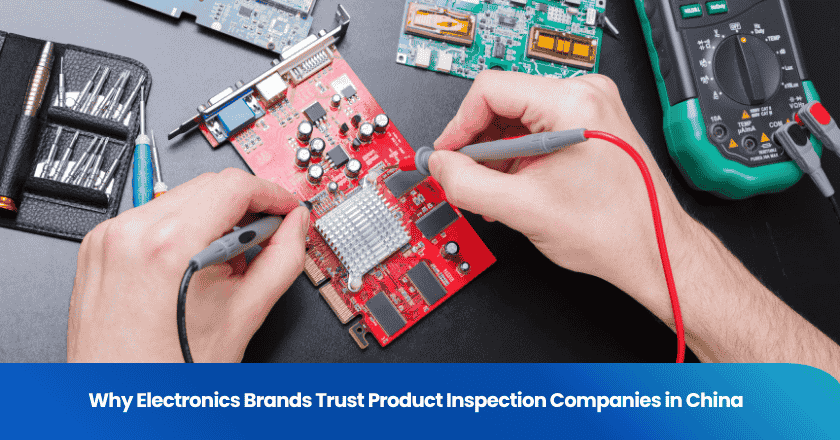
Every electronics brand sourcing from China faces the same fundamental tension: they need low-cost, high-volume manufacturing — and they need to trust that what ships in a container matches what they ordered. The problem is that trust built on factory self-inspection is structurally compromised. When the same team that builds the product also decides whether it's acceptable, you don't have quality control. You have quality theater. This is why growing electronics brands — from Shopify DTC operations to mid-market Amazon private labels — turn to independent product inspection companies in China. Not because they distrust their factories, but because they understand the difference between a supplier telling you it's fine and an independent inspector confirming it is.
Key Takeaways
- Between 2 and 8% of mass-produced goods contain defects significant enough to cause returns, chargebacks, or compliance failures — independent inspection is the systematic catch.
- The core value of a third-party inspection company is structural independence: the inspector is paid by you, not by the factory, so their job is to find problems, not hide them.
- Real-time reporting transforms inspection from a periodic review into ongoing visibility — allowing decisions before containers are loaded, not after they arrive.
- Electronics brands that use regular inspection see measurable supplier accountability improvements: factories that know they'll be inspected consistently perform to a higher standard.
The Core Problem: Why Factory Self-Inspection Isn't Enough
The Conflict of Interest Is Built In
A factory's quality control team is paid by the factory. Their career advancement depends on meeting production targets, shipping on schedule, and keeping buyers happy — all of which creates pressure to approve units that a truly independent reviewer might reject. This isn't a character flaw; it's an institutional incentive structure. According to the Alibaba 3PIS field guide: "Independence isn't just about who signs the invoice — it's about governance. A true third-party inspection maintains documented separation between commercial relationships and inspection outcomes."
Third-party inspection companies in China solve this by design. The inspector is contracted by the importer, not the factory. Their report reflects what they found, not what the factory wants the importer to believe. That structural independence is the single most important reason electronics brands use professional inspection companies — not price, not convenience, but the removal of a fundamental conflict of interest.
The Real Cost of a Defective Shipment
Importers who skip inspection often rationalize it as a cost-saving decision. The math rarely holds up. Industry data aggregated shows that 2–8% of mass-produced goods contain defects significant enough to cause returns, chargebacks, or compliance failures. On a $500,000 electronics order, a 5% defect rate translates to $25,000 in defective goods — before accounting for downstream costs. Those downstream costs compound quickly:
- Amazon account risk: Amazon sellers with chargeback rates above 1% risk account suspension — and an electronics batch with a 5% defect rate will almost certainly cross that threshold
- Retailer chargebacks: Brick-and-mortar and marketplace retailers charge $20–$100 per defective unit incident
- Product recalls: A single safety recall for an electronics product can cost hundreds of thousands of dollars in legal fees, returns logistics, and reputational damage
- Lost lifetime customer value: A customer who receives a defective product rarely returns — the compounding revenue loss far exceeds the cost of the individual defect
A professional product inspection in China costs a fraction of any of these downstream scenarios. The ROI of inspection is not theoretical; it's the avoided cost of a problem you didn't catch at the source.
The 5 Reasons Electronics Brands Specifically Trust Product Inspection Companies in China
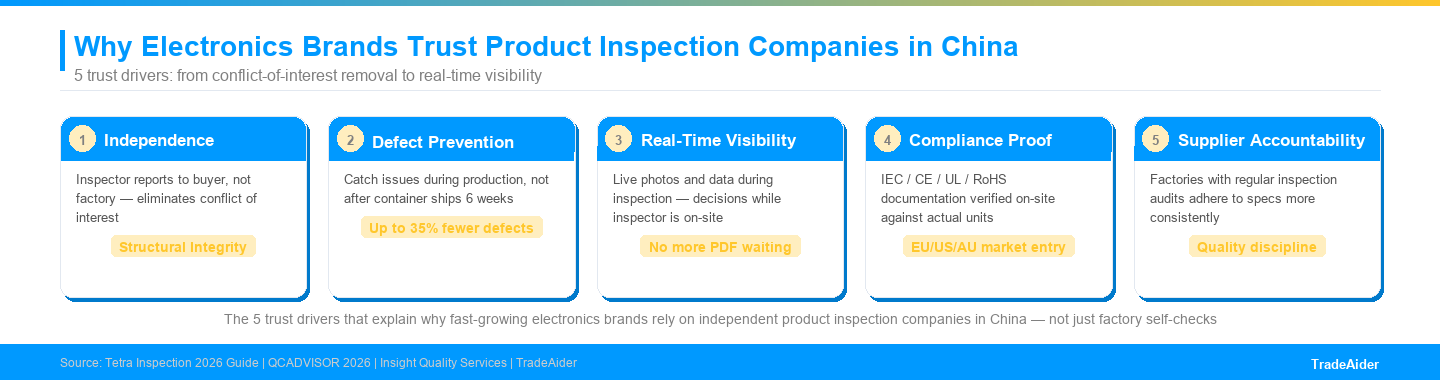
The 5 trust drivers that explain why fast-growing electronics brands rely on independent product inspection companies in China — not just factory self-checks
1. Independence Removes the Conflict of Interest
As detailed above, this is the foundational reason. When a professional inspection company like TradeAider sends an inspector to a factory, that inspector's job is to find and document problems — not to facilitate a smooth ship date. The report goes to you, not to the factory. If the factory tries to influence the inspection, the third-party structure protects report integrity in a way that an in-house buyer representative often can't.
This independence also creates a documented paper trail. An inspection report with photos, measurements, and timestamped findings is the kind of evidence you need when negotiating with a factory over rework costs — or when responding to a marketplace or retailer inquiry about a quality incident.
2. Proactive Defect Prevention Instead of Post-Shipment Discovery
The most powerful use of a product inspection company isn't discovering defects after a batch fails — it's preventing them from shipping in the first place. Insight Quality's analysis captures this well: "A neutral inspector collects data about your products while they're still at the supplier facility, helping you verify that they meet your standards."
The timing is everything. A defect caught at the factory during production inspection can be corrected before the full batch is built. A defect caught during pre-shipment inspection can trigger rework before containers are loaded. A defect discovered after arrival in your warehouse is a cash flow crisis. According to 2026 analysis, global demand for inspections on China-made consumer goods jumped nearly 29% year-over-year in 2024 — brands are increasingly treating inspection as a continuous production monitoring tool, not a periodic safeguard.
For electronics brands with repeat orders, During Production Inspection (DPI) represents the most cost-efficient prevention model — catching systematic issues on the production line while the factory still has time to correct root causes.
3. Real-Time Visibility Into What's Actually Happening
Traditional inspection services produce a static PDF report 24–48 hours after the inspector leaves the factory. By the time you read it, the container may already be loaded. Real-time reporting changes this equation fundamentally. When TradeAider inspectors are on the factory floor, photos, measurements, and defect findings flow directly to the importer's dashboard as they're captured. You can see what the inspector is looking at, ask questions, and make go/no-go decisions while the inspector is still physically present.
This matters especially for electronics products where defect patterns can inform immediate decisions. If an inspector photographs a batch of air fryers and finds that 30% have a specific wiring defect, you know in real time — not 48 hours later — whether to approve, hold for rework, or reject. Real-time visibility is a core reason why tech-forward electronics brands choose modern inspection companies over traditional providers that still operate on static report models.
4. Compliance Documentation and Market Access Proof
Selling electronics in the EU requires CE marking. Selling in the US requires compliance with FCC and UL standards. Australia requires RCM. None of these requirements can be satisfied by a factory self-certification alone — regulators and major retailers require proof of conformity from independent assessment. A product inspection company in China provides on-site verification that the actual units in the batch match the compliance documents submitted for certification: that the components listed in the approved BOM are actually installed, that the product labeling is correct, and that the construction matches what was tested by the certification lab.
According to the Alibaba third-party inspection guide, stricter regulations in the EU (CE marking), North America (FDA, FCC), and Australia (RCM) all require proof of conformity — and third-party inspection and testing is the mechanism by which electronics brands fulfill these legal obligations. Getting this wrong doesn't mean a delayed shipment; it means customs rejection or post-import recall.
5. Supplier Accountability Improvement Over Time
There's a well-documented behavioral dynamic in manufacturing: factories that know they'll be inspected regularly produce to a higher standard than factories that only face occasional inspections. As Markhor Strategies documents: "Suppliers who know their products will be inspected tend to adhere to agreed-upon standards more rigorously."
This creates a compounding benefit for electronics brands that invest in regular inspection programs. The first few inspections often surface the most significant defects. Over time, as the factory understands your quality expectations are enforced — not just stated — production consistency improves. The inspection becomes less about catching catastrophic failures and more about maintaining the quality baseline you've built. An established inspection program with a trusted provider is, in effect, a supplier development tool.
What to Look for in a Product Inspection Company in China
Not all inspection companies are equal. For electronics-specific sourcing, the key criteria are:
| Criteria | Why It Matters for Electronics | Red Flag |
|---|---|---|
| Electronics-specific technical expertise | Hi-pot, earth continuity, EMC checks require trained inspectors | Inspectors with no electrical safety training |
| Transparent, real-time reporting | Electronics defects require immediate decisions before loading | 48+ hour PDF-only report delivery |
| Custom checklist capability | Your air fryer checklist is not the same as your Bluetooth speaker checklist | One-size-fits-all standard template only |
| Transparent, predictable pricing | Hidden fees for weekend/holiday inspections destroy budgets | Unclear pricing with multiple surcharges |
| Geographic coverage in China | Electronics manufacturing spans Guangdong, Zhejiang, Jiangsu | Coverage limited to Pearl River Delta only |
How TradeAider Approaches Electronics Inspection
TradeAider's approach to electronics inspection is built around the principle that inspection should provide real-time visibility, not just a delayed paper record. When a TradeAider inspector is on the factory floor running safety tests on a batch of kitchen electronics, the Shopify brand or Amazon FBA seller who commissioned the inspection can see the results as they happen — including photos of any defect, measurements from hi-pot and earth continuity tests, and AQL sampling outcomes.
This matters because electronics brands operate on tight timelines. If a defect pattern emerges mid-inspection, knowing about it immediately means you can decide whether to pause production, request rework, or communicate with the factory about corrective action — all while the inspector is still on-site. Waiting for a PDF report that arrives after the container is loaded leaves you with no good options.
TradeAider's transparent pricing at $199/man-day — with no hidden fees for weekends, holidays, or overtime — makes it straightforward to budget inspection into the cost of goods, not as an exceptional expense but as a standard line item in your sourcing program. For electronics brands sourcing multiple SKUs from multiple factories, predictable pricing is as important as inspection quality.
Learn more about why brands choose TradeAider or explore our Pre-Shipment Inspection service for your next electronics order.
Frequently Asked Questions
Do I need a product inspection company for every electronics shipment?
Not necessarily every shipment — but you should have a risk-based inspection policy. High-volume importers typically inspect every shipment from new suppliers, every first order of a new product design, and a statistically representative sample of repeat orders from established suppliers. Electronics carry higher compliance risk than most categories, which argues for more frequent inspection, not less. Use TradeAider's inspection calculator to estimate inspection costs relative to your order value.
Can't I just ask my factory to send me quality photos?
Factory-provided photos are first-party evidence — they're selected and staged by the entity with a financial interest in the shipment being approved. They can complement an inspection report, but they can't replace one. An independent inspector's photos document what they actually found, not what the factory wants you to see. The structural difference is the same reason you wouldn't ask your contractor to inspect their own work before you pay the final invoice.
What types of inspections are available for electronics in China?
The three most commonly used inspection types for electronics are: Pre-Production Inspection (PPI) — verifies components and factory readiness before production begins; During Production Inspection (DPI) — checks products mid-line while corrections are still possible; and Pre-Shipment Inspection (PSI) — comprehensive check of finished, packed goods before loading. Many electronics brands use DPI and PSI in combination for new product launches.
How quickly can I schedule an electronics inspection in China?
Professional inspection companies operating in China can typically schedule an inspection within 48–72 hours of booking. TradeAider's network covers all major manufacturing hubs — Guangdong, Zhejiang, Jiangsu, Shandong — with the ability to schedule most inspections within 1–2 business days. Contact our team to confirm scheduling availability for your factory location.
Is there a difference between using a large TIC company versus a specialized inspection service?
Large TIC (testing, inspection, and certification) companies offer breadth and accreditation across many categories, which is valuable for regulated products requiring formal certification. For operational quality control — the day-to-day inspection work that electronics brands need to monitor production quality — specialized inspection companies often provide faster scheduling, more responsive communication, real-time reporting platforms, and more predictable pricing. The right choice depends on whether you need formal certification (large TIC) or operational quality visibility (specialized inspection).
Related Articles
Grow your business with TradeAider Service
Click the button below to directly enter the TradeAider Service System. The simple steps from booking and payment to receiving reports are easy to operate.

