
- About Us

- Our Services
- Your Industry
- Resources
- News & Blog
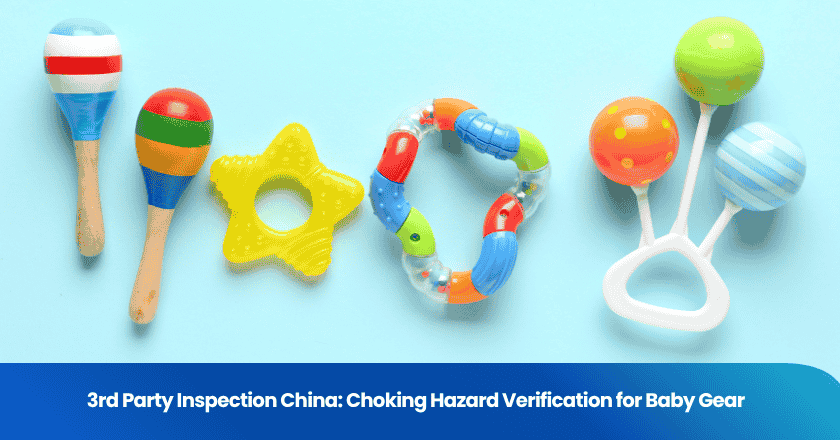
Every year, the U.S. Consumer Product Safety Commission (CPSC) recalls dozens of children's products due to choking hazards. According to the CPSC's National Electronic Injury Surveillance System (NEISS), toy-related injuries sent approximately 154,000 children under 15 to U.S. emergency departments in a single recent year, and choking on small parts remains one of the leading causes. For importers sourcing baby gear from China, the question is not whether to verify choking hazards — it is how to do it reliably before products leave the factory.
A third-party inspection at the Chinese manufacturing facility is the most practical line of defense. Unlike a lab test report that covers a single prototype months before production, an on-site inspector examines the actual finished units from your production run — catching assembly errors, material substitutions, and packaging mistakes that lab tests cannot detect.
Key Takeaways
- Choking hazard verification relies on the CPSC small-parts cylinder (16 CFR 1500.50-51) and is mandatory for products intended for children under three.
- On-site inspection catches production-line defects — loose buttons, weak stitching, detached components — that laboratory testing alone cannot reveal.
- Age grading, labeling, and packaging warnings are just as critical as the mechanical small-parts test for compliance.
- Combining pre-shipment inspection with CPSC-accepted lab testing provides the most robust compliance strategy for baby products.
What Is a Choking Hazard Under U.S. Federal Law?
A "small part" is defined in 16 CFR Part 1501 as any object that fits entirely inside a standardized cylinder with a 1.25-inch (31.7 mm) opening and a slanted bottom that simulates a child's throat. If a component or a piece that breaks off during use-and-abuse testing fits into this cylinder, the product containing it is banned for children under three.
This regulation applies to all children's products — not just toys. According to the CPSC Testing & Certification guidelines, manufacturers and importers of children's products must use a CPSC-accepted third-party laboratory to test compliance with applicable safety rules and issue a Children's Product Certificate (CPC) before the goods can enter U.S. commerce.
Why Lab Testing Alone Is Not Enough
Laboratory testing is essential for regulatory certification — it confirms that your product design meets standards like ASTM F963 (Standard Consumer Safety Specification for Toy Safety) and the CPSC small-parts ban. However, lab testing typically occurs on a handful of samples from a pre-production or early production batch. It cannot catch problems that emerge later on the production line, such as:
- Substituted materials: A factory replaces a securely welded metal rattle ring with a cheaper snap-fit version that detaches under pull force.
- Loose stitching: Stuffed animals pass the lab test, but production units have weak thread holding on eyes or nose buttons.
- Incorrect assembly: A crib mobile component that was correctly assembled in the lab sample is assembled backward at scale, leaving a small locking nut exposed.
- Packaging errors: Products for children under three are shipped with incorrect age grading labels, omitting the required choking hazard warning.
These are exactly the types of defects that a pre-shipment inspection (PSI) in China is designed to catch before goods are loaded into a shipping container.
How On-Site Inspectors Verify Choking Hazards
During a choking hazard verification at a Chinese factory, a qualified inspector follows a structured process that covers both regulatory compliance and production-level quality.
Step 1: Document and Specification Review
The inspector begins by reviewing the buyer's product specifications, age grading, and any previously completed lab test reports. This establishes the compliance baseline — what the product is supposed to be, for what age range, and which standards it must meet.
Step 2: Visual Examination for Detachable Parts
The inspector physically examines each sampled unit, paying special attention to components that could become detached: sewn-on eyes and noses on plush toys, snap-fit caps on rattles, buckle clasps on carriers, and decorative elements on feeding items. Any part that appears loose or poorly secured is flagged for further testing.
Step 3: Small-Parts Cylinder Testing
Using the standardized CPSC small-parts test cylinder (1.25-inch opening), the inspector tests any component that has been removed, has come loose, or is suspected to detach. The test is performed without compressing the part — it must fit freely into the cylinder in any orientation to be classified as a "small part."
Step 4: Use-and-Abuse Simulation
Beyond the static cylinder test, the inspector simulates real-world conditions that could cause parts to break free. This includes drop tests, pull tests (using a force gauge), and torque tests on screws and fasteners. Products intended for children under three face the most stringent thresholds, as even a single failure means the entire batch fails the choking hazard requirement.
Step 5: Labeling and Packaging Verification
Age grading labels must be accurate. Products for children under three must not contain small parts at all, and products intended for ages three and up must carry the statutory warning: "WARNING: CHOKING HAZARD — Small parts. Not for children under 3 yrs." The inspector verifies that these labels appear on both the product packaging and the product itself, as required by CPSC labeling regulations.
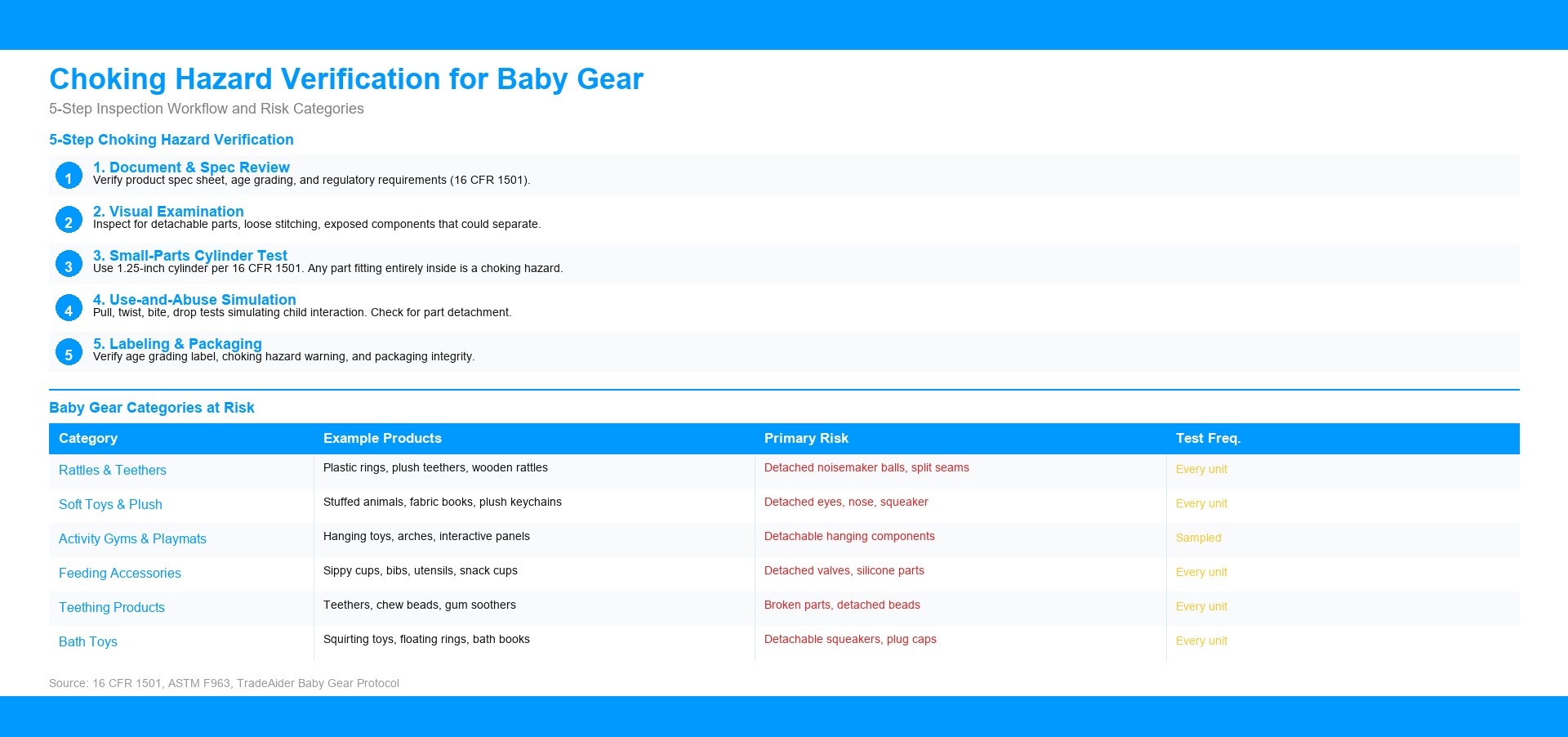
Baby Gear Categories Most at Risk for Choking Hazards
| Category | Example Products | Primary Risk | Recommended Test Frequency |
|---|---|---|---|
| Rattles & Teethers | Plastic rings, plush teethers, wooden rattles | Detached noisemaker balls, split seams | Every production batch |
| Stuffed & Plush Toys | Plush animals, dolls, security blankets | Eyes, noses, buttons coming unstitched | Every production batch |
| Feeding Accessories | Bottle parts, sippy cup valves, bib clips | Small valve discs, clip mechanisms | Every production batch |
| Activity Play Mats | Play gyms, hanging toys, tummy-time mats | Detachable hanging components, mirrors | Every production batch |
| Baby Carriers & Wraps | Structured carriers, hip seats, sling rings | Buckle releases, snap failures, rivets | Every production batch + annual lab |
The TradeAider Difference: Real-Time Verification
Traditional third-party inspection companies send an inspector to the factory, who writes a report, and the buyer receives a PDF days later. If that report reveals a choking hazard, the buyer must then negotiate with the factory for rework — often without knowing whether the fixes were actually implemented.
TradeAider takes a fundamentally different approach. During every inspection service, our inspectors provide real-time online monitoring. Buyers can watch the inspection as it happens, see photos and video of flagged defects in real time, and direct the inspector to investigate specific concerns immediately. If a choking hazard is found on a sample, you see it the moment the inspector sees it — not days after the container has already departed.
For high-value baby gear orders where a choking hazard recall could be catastrophic, TradeAider's WeGuarantee Total Quality Control (TQC) service goes even further. Under WeGuarantee, TradeAider maintains ongoing quality control throughout the entire production period — not just a single inspection day. We share financial responsibility for quality outcomes, meaning if a choking hazard slips through and reaches your warehouse, TradeAider absorbs part of the loss. It is the only QC service on the market where the inspection firm has genuine skin in the game.
Integrating Inspection with Laboratory Testing
The most effective compliance strategy combines both approaches:
- Pre-production lab test: Submit prototypes to a CPSC-accepted third-party laboratory for small-parts testing, use-and-abuse testing, and any applicable chemical or mechanical tests. Obtain the Children's Product Certificate (CPC).
- During production inspection (DPI): At approximately 20-30% production completion, a during production inspection verifies that the factory is following the approved specifications and materials.
- Pre-shipment inspection (PSI): When 80-100% of goods are packed, a pre-shipment inspection performs choking hazard verification on finished units using the small-parts cylinder, simulates use-and-abuse conditions, and confirms correct labeling and packaging.
This three-layer approach ensures that compliance is verified at the design stage, monitored during manufacturing, and confirmed on the final product.
What to Include in Your Inspection Specification
When booking a choking hazard verification inspection, provide your QC partner with a clear specification checklist that includes:
- Target age range (e.g., "0-12 months" or "12-36 months")
- Applicable safety standards (ASTM F963, EN 71-1, AS/NZS ISO 8124)
- Previously completed lab test report numbers and dates
- Golden sample reference photos showing correct assembly
- Specific components of concern (e.g., "verify all embroidered eyes — no hard plastic eyes")
- Packaging and labeling requirements including age grade and warning statements
- AQL level for critical, major, and minor defects (AQL 1.0 for critical defects is recommended for children's products)
The more precise your specification, the more effectively the inspector can evaluate compliance.
Cost of Choking Hazard Verification in China
A standard pre-shipment inspection with choking hazard verification typically costs $199 per man-day, covering AQL-based sampling of the entire production lot. The inspector will test the required number of sample units and provide a detailed report with photographs and video evidence of any defects found. For comprehensive coverage throughout production, TradeAider's WeGuarantee TQC service starts at $399 per order — a small investment compared to the cost of a single product recall, which can easily exceed six figures in CPSC penalties alone under 16 CFR Part 1115.
FAQ
Is the small-parts test required for all baby products?
No. The CPSC small-parts ban applies specifically to products intended for children under three years of age. However, even products for older children require accurate age grading and appropriate warning labels. Products marketed for ages three and up that contain small parts must carry the statutory choking hazard warning.
Can a factory perform its own choking hazard testing?
Factories can and should perform internal QC checks, but these cannot replace third-party verification for compliance purposes. A manufacturer's own test results are not accepted by the CPSC for certification — only results from a CPSC-accepted third-party laboratory count for the CPC. On-site inspection complements lab testing by verifying that production units match the tested prototype.
What happens if the inspection finds a choking hazard?
If the inspector identifies a small-parts failure, the finding is reported immediately (via TradeAider's real-time monitoring system). The batch should not be shipped until the factory performs a full sort and rework. TradeAider can conduct a follow-up inspection to verify the rework. Under WeGuarantee TQC, TradeAider manages this process proactively throughout production to prevent issues from reaching the pre-shipment stage.
How many samples does the inspector test?
The sample size depends on the total order quantity and the chosen AQL level. For critical defects like choking hazards, AQL 1.0 or stricter is recommended. For an order of 5,000 units, this typically means testing 50 samples using the small-parts cylinder. Your inspection provider can calculate the exact sample size using an AQL calculator.
TradeAider goes beyond traditional inspection by giving you real-time visibility into every quality check — so you catch defects before they ship, not after. Whether you need a single pre-shipment inspection or full production quality control with our WeGuarantee service, our team is ready to help. Book your inspection now or get a free quote to protect your next baby gear order.
Related Articles

Grow your business with TradeAider Service
Click the button below to directly enter the TradeAider Service System. The simple steps from booking and payment to receiving reports are easy to operate.

