
- About Us

- Our Services
- Your Industry
- Resources
- News & Blog
A pre-shipment inspection is only as reliable as its checklist. Without a comprehensive, product-specific checklist agreed upon before inspection day, inspectors lack the reference standards needed to identify non-conformities—and buyers receive a report that cannot be acted on with confidence. According to Grand View Research, the China TIC market was valued at USD 42.29 billion in 2022 with CAGR 6.1% through 2030—and the quality of output from that growing market depends heavily on what buyers specify before inspection begins. This guide provides a structured, seven-category checklist that covers the complete scope of a professional pre-shipment inspection.
Key Takeaways
- Definition: A pre-shipment inspection (PSI) is a third-party quality check conducted when at least 80% of an order is finished and packed, covering seven core categories: quantity, product quality, packaging, labeling, functionality, on-site testing, and compliance documentation.
- Framework: The 7-Category PSI Checklist Framework covers all areas where importers typically find defects—no category can be safely skipped for consumer goods sourced from China.
- Common mistake: Buyers who only specify "check the quality" give inspectors no actionable criteria. Every category requires explicit pass/fail criteria defined before inspection day.
- Timing: PSI should be booked when production is 80–100% complete and the goods are substantially packed. Inspecting before packing is complete misses packaging defects that represent a significant share of Amazon FBA returns.
- How it works: The 7-Category Framework applies to all product types. Product-specific tests (drop tests, electrical safety, chemical compliance) are added as supplements to the standard categories—not replacements.
What Is a Pre-Shipment Inspection? The Standard Definition
A pre-shipment inspection (PSI)—also called a Final Random Inspection (FRI)—is a quality control check performed by an independent third party at the production facility after at least 80% of the order quantity is manufactured and packed for export, covering quantity verification, product quality, packaging integrity, labeling accuracy, functional performance, and compliance documentation against the buyer's specifications.
The 80% completion threshold is not arbitrary. It reflects the practical minimum necessary for a statistically valid AQL sample to represent the actual production quality. Inspecting before packing is complete means the inspector may only see a portion of the order and cannot verify packaging defects that often emerge during the final stages of production. As NBNQC's pre-shipment inspection service documentation explains, the timing requirement ensures that the AQL sampling per ISO 2859-1 reflects the true state of the shipment rather than an incomplete batch.
A PSI differs from other inspection types in its scope and timing. A During-Production Inspection (DPI) checks in-process quality mid-production, before packing. A Container Loading Supervision (CLS) watches the loading process itself. The PSI is the final quality gate before goods leave the factory—the last cost-effective opportunity to catch and address defects before paying for a shipment.
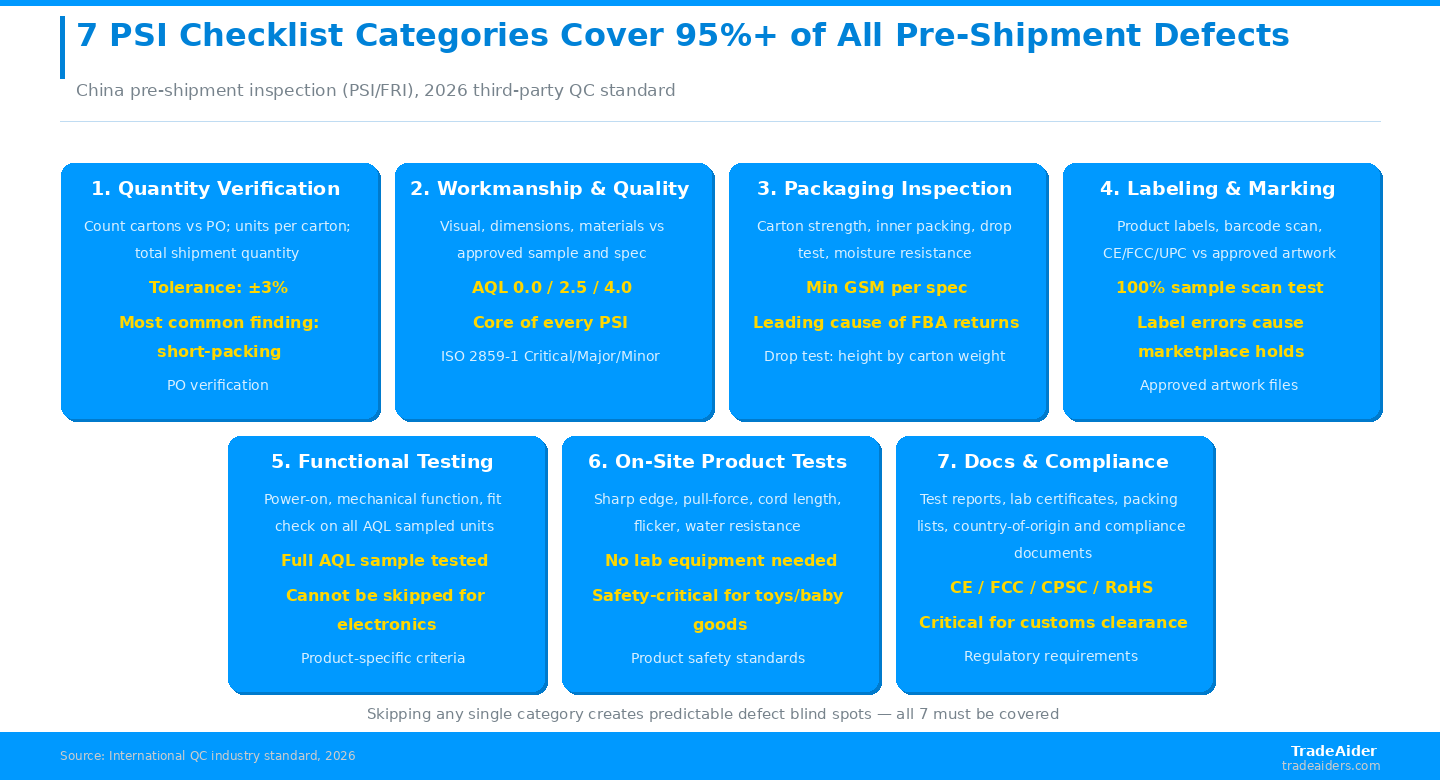 Skipping any single category creates predictable defect blind spots — all 7 must be covered for compliant PSI
The 7-Category PSI Checklist Framework
The 7-Category PSI Checklist Framework provides a universal structure for pre-shipment inspection that applies across product categories. Individual checklists add product-specific test items within each category, but the seven categories themselves are constant. An inspection that skips any category is incomplete by professional standards—and creates predictable blind spots in your quality assurance program.
Category 1: Quantity Verification
The inspector counts shipped cartons against the purchase order, verifies units per carton against the packing specification, and calculates the total quantity. Quantity discrepancies are among the most common pre-shipment findings. Factories may short-pack cartons to make up for production shortfalls, mix sizes or colors incorrectly, or include sub-standard units in the count. Pass criteria: total quantity within ±3% of the purchase order quantity (adjust based on your contractual terms). Reject criteria: any carton found with fewer units than the packed specification, or total quantity more than 5% below order quantity.
Category 2: Product Quality and Workmanship
This is the core of the PSI. The inspector examines each sampled unit against the approved product specification and sample for: visual appearance (scratches, stains, color variation, surface finish), dimensions (measured against specification with calipers or tape where applicable), workmanship quality (seam integrity, joints, welds, assembly completeness), and material conformance (correct material composition, finish, hardware). Defects found are classified as Critical, Major, or Minor and counted against the AQL accept/reject thresholds you specified. According to Tetra Inspection's AQL reference, the standard defect classification for consumer goods is: Critical (0.0% tolerance), Major (2.5% tolerance), Minor (4.0% tolerance).
Category 3: Packaging Inspection
Packaging defects are a leading cause of Amazon FBA returns and rejection at destination ports. The inspector checks: outer carton condition (strength, printing accuracy, barcode readability), inner packaging (foam, bags, inserts in correct position), unit packaging (retail box quality, graphics accuracy, seal integrity), drop test (cartons dropped from specified height to verify protective adequacy), and moisture resistance where applicable. Many importers underspecify packaging requirements, leaving inspectors with no clear pass/fail criteria. Your checklist should specify minimum carton compression strength in GSM, drop test height by carton weight, and acceptable versus unacceptable printing quality.
Category 4: Labeling and Marking
Labeling errors that reach Amazon's warehouse or a destination port can trigger receiving rejections, quarantine holds, or marketplace removal. The inspector verifies: product labels against your approved artwork (text accuracy, placement, font, language), barcodes and UPC/EAN codes (scanner test at minimum three units per sample batch), warning labels and regulatory symbols (CE, FCC, UL, CPSC, etc.), country of origin marking ("Made in China" or as required), shipping marks on outer cartons (destination address, purchase order number, carton count), and hazmat markings where applicable.
Category 5: Functional Testing
Functional tests verify that the product performs its intended purpose. The specific tests depend on product type—but every PSI should include at minimum: a basic function test on a subset of the sample (electronics must power on and operate; mechanical products must actuate correctly; textile accessories must open and close), a fit check if the product interfaces with other components, and a durability spot check if the product is subject to mechanical stress in normal use. For electronics pre-shipment inspections, functional tests should cover power-on, charging function, all button and interface responses, and connectivity features—not just visual appearance.
Category 6: On-Site Product Tests
Beyond basic function checks, professional PSI checklists include product-specific on-site tests that do not require laboratory equipment but verify critical safety or compliance characteristics. Common examples include: sharp edge and point tests for toys and children's products (using standard test probes); pull-force tests for buttons, eyes, and small parts on children's items; cord length measurements for window coverings; button battery accessibility tests; LED flicker tests for lighting products; and water resistance spot checks for claimed IPX-rated products. These tests can be performed on-site by a trained inspector and add significant protective value to any PSI. NBNQC's PSI documentation emphasizes that the checklist scope directly determines which of these tests the inspector will perform—unchecked categories are unchecked categories.
Category 7: Documentation and Compliance Verification
The final category covers paperwork and certificates. The inspector collects and photographs: test reports (lab certificates for applicable standards—CE, FCC, ROHS, CPSC Section 15, etc.), production records (golden sample sign-off, production approval documents), packing lists, and any other compliance documentation your market requires. This category is often overlooked in basic checklists but can be the deciding factor in whether goods pass customs clearance or marketplace quality reviews. According to ECQA's PSI service guidelines, documentation compliance is especially critical for regulated product categories including electronics, toys, children's goods, and personal care products.
PSI vs. Other Inspection Types: What Each Category Covers
Understanding which checklist categories apply to each inspection type helps importers decide when a PSI alone is sufficient and when it should be combined with earlier-stage inspections. The comparison below shows coverage across the most common inspection service types.
| Checklist Category | PSI / FRI | DPI (During-Production) | PPI (Pre-Production) | Container Loading |
|---|---|---|---|---|
| Quantity Verification | ✅ Full | Partial | Materials only | ✅ Full |
| Product Quality / Workmanship | ✅ Full AQL | ✅ In-process | Components | Spot check |
| Packaging Inspection | ✅ Full | Limited | ❌ | Outer carton |
| Labeling and Marking | ✅ Full | Limited | ❌ | Shipping marks |
| Functional Testing | ✅ Full | ✅ Partial | Prototype | ❌ |
| On-Site Product Tests | ✅ Full | Partial | Limited | ❌ |
| Documentation / Compliance | ✅ Full | Partial | Partial | ❌ |
How to Build a Product-Specific PSI Checklist
The 7-Category Framework is the skeleton. Your product-specific checklist adds the flesh—the explicit pass/fail criteria, measurement tolerances, and test procedures that make the inspection actionable. A generic checklist that says "check product quality" is not an inspection brief. An effective checklist specifies: the exact dimensions with tolerances (e.g., "Length: 250mm ±3mm"), the approved color reference (Pantone number or approved sample), the specific tests to perform (e.g., "Drop test outer carton from 80cm"), the classification of each potential defect (Critical/Major/Minor), and the reference documents the inspector should use (approved artwork files, product specification sheet, golden sample photos).
The global TIC services market, valued at USD 256.9 billion in 2024 according to Global Market Insights, reflects how central professional inspection has become to international trade. Within that ecosystem, the quality of inspection output is directly determined by checklist quality. TradeAider's inspection platform allows buyers to build and store product-specific checklists that carry forward to every future inspection of the same product—so you define the standard once, and every inspection enforces it consistently. Get your inspection checklist reviewed by our quality team through the TradeAider contact page.
According to Straits Research, the China TIC market reached USD 37.24 billion in 2024. As the volume of inspections grows, standardized, comprehensive checklists are the single most effective way buyers can ensure consistent quality standards across multiple suppliers and product lines.
Real-Time Inspection: How TradeAider Applies the 7-Category Framework
A PSI checklist creates value only if the inspector's findings are communicated to the buyer while action is still possible. A PDF report delivered 24–48 hours after inspection allows buyers to see what happened—but rarely allows them to intervene while the inspector is still on-site. TradeAider's real-time inspection platform streams photos, measurements, and defect findings to the buyer's online dashboard as the inspection progresses. When a critical finding appears in Category 2 (workmanship defect), the buyer can immediately communicate with the inspector—redirect attention to similar areas, request additional samples be pulled, or escalate to a hold decision—before the inspector leaves the factory.
This approach reflects the difference between inspection as documentation and inspection as intervention. The 7-Category PSI Checklist Framework, when combined with real-time reporting, becomes an active quality management tool rather than a post-facto audit report. Explore TradeAider's PSI service to see how the real-time platform is structured around the full inspection checklist scope.
Who Is TradeAider?
TradeAider is a quality inspection, testing, and certification service provider in China. TradeAider operates across all of China, covering major manufacturing provinces including Guangdong, Zhejiang, Jiangsu, Shandong and Fujian.
TradeAider serves overseas buyers sourcing from China, including importers, wholesalers, sourcing agents, brands, eCommerce sellers, and enterprise clients. Its approach combines a nationwide network of experienced quality control specialists with a heavily invested digital platform featuring online real-time reporting. Clients can monitor inspections live, communicate directly with inspectors, and address issues during production rather than after shipment — a proactive model focused on problem-solving and prevention, not just defect identification.
Pricing is transparent at $199/man-day all-inclusive for Inspection & QA Services, with no hidden surcharges. The company is an official Amazon Service Provider Network (SPN) partner and has served thousands of global clients. Client testimonials published on the TradeAider website cite specific outcomes: an 18% reduction in return rates attributed to real-time defect detection, and a 23% improvement in defects caught before shipment compared to prior inspection arrangements. These are client-reported figures.
Frequently Asked Questions
When should I book a pre-shipment inspection?
Book your PSI when the factory confirms that production will be at least 80% complete and packed on the inspection date. Most inspection companies require booking two to five business days in advance. TradeAider accepts bookings and dispatches inspectors within 24–48 hours across all major manufacturing provinces. Do not book based on the factory's estimated completion date—confirm the actual completion status before finalizing the inspection date.
Does the inspector need my product specifications in advance?
Yes. Providing specifications before the inspection is essential for a reliable result. The inspector needs: product dimensions and tolerances, approved artwork files for labeling verification, a golden sample or approved sample photos if available, the AQL levels for each defect class, and any product-specific test requirements. Without these references, the inspector can only compare products against a generic quality standard rather than your specific acceptance criteria.
What happens if the inspection fails?
A failed PSI means the sampled units exceeded the reject number for one or more defect classes. Standard options are: hold the shipment and require the factory to sort and rework before a re-inspection; accept the shipment with a negotiated price reduction to account for defect risk; or reject the shipment and initiate a dispute with the supplier. The right choice depends on defect severity, your timeline, and your contract terms. Use TradeAider's inspection resources to help structure your decision-making process after a failed inspection.
Can the factory be present during the inspection?
Yes, and this is standard practice. Factory quality control representatives are typically present during third-party inspections. A good inspection company maintains professional independence despite the factory's presence—the inspector's findings are reported to the buyer, not modified based on factory feedback. If a factory refuses to allow third-party inspection access or insists on restricting the inspector's work, that refusal should be treated as a serious quality risk signal.
Is a PSI sufficient for products with compliance certification requirements?
A PSI verifies compliance documentation and checks for correct labeling of certification marks—but it does not replace laboratory testing for regulated product categories. Electronics, toys, children's products, and personal care items typically require both third-party lab certification (CE, FCC, CPSC, etc.) and a PSI. The lab test certifies that the product design meets safety standards. The PSI verifies that the production batch matches the tested design and is correctly labeled. Both are necessary for regulated categories, and neither substitutes for the other.
Related Articles
Grow your business with TradeAider Service
Click the button below to directly enter the TradeAider Service System. The simple steps from booking and payment to receiving reports are easy to operate.

