
- About Us

- Our Services
- Your Industry
- Resources
- News & Blog
Understanding quality inspection terminology is not academic—it is operationally essential. When you misinterpret "AQL 2.5" as meaning "2.5% of the lot is defective," you ship products that will fail Amazon's standards. When you confuse "man-day" with "hours of on-site checking," you underbudget every inspection. According to Grand View Research, the China testing, inspection, and certification market reached USD 42.29 billion in 2022. Buying into that market with imprecise vocabulary costs importers money. This glossary defines 40 essential terms—clearly, completely, and in the order you'll encounter them when managing quality for China-sourced products.
Key Takeaways
- Definition: Quality inspection terminology is standardized by ISO 2859-1 and ANSI/ASQ Z1.4. Terms like "AQL," "lot," "acceptance number," and "inspection level" have specific technical meanings that differ from their casual usage.
- Most misunderstood terms: AQL (it's the worst-tolerable limit, not the quality target), man-day (it's the total billing unit, not just on-site hours), and lot (it's the full production batch, not the inspection sample).
- How it works: These terms link together in a sequence: you define a lot → choose an inspection level → use Table A to get a code letter → use Table B to get sample size and accept/reject numbers → apply your AQL thresholds per defect class.
- Standard: ISO 2859-1:2026 is the current governing standard. Its US equivalent is ANSI/ASQ Z1.4. Both produce identical results when applied correctly.
- Risk: Using imprecise terms in purchase orders, inspection briefs, or supplier agreements creates gaps that factories exploit—deliberately or inadvertently—to ship products that don't meet your actual requirements.
The Standard Behind the Terminology: ISO 2859-1
ISO 2859-1:2026 (formally: Sampling procedures for inspection by attributes — Part 1: Sampling schemes indexed by acceptance quality limit (AQL) for lot-by-lot inspection) is the international standard that defines the terminology, tables, and procedures governing statistical acceptance sampling—the system used by virtually all third-party quality inspection companies operating in China and globally.
As ANSI's blog explains, the 2026 edition replaced the 1999 version, adding skip-lot sampling procedures and updated guidance. All 40 terms in this glossary either appear in ISO 2859-1 or are established industry terms directly derived from it. Use the TradeAider AQL calculator to apply these terms interactively to your specific orders.
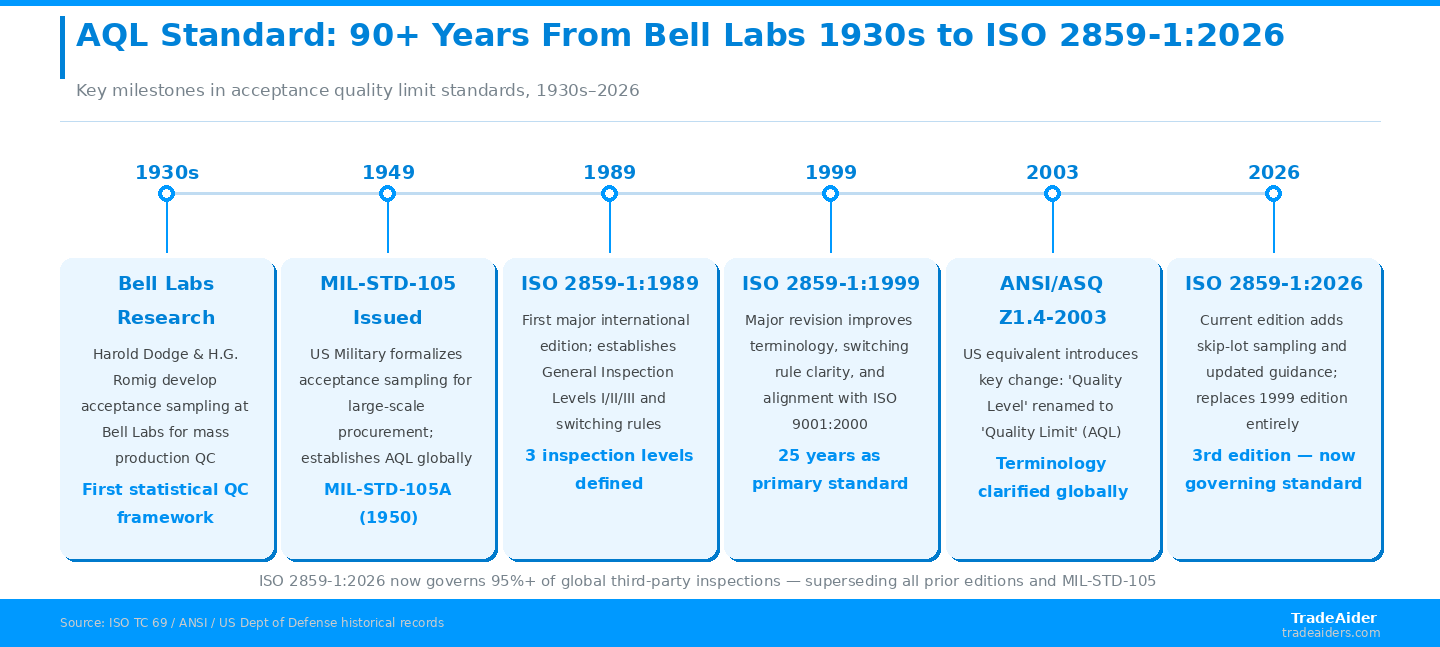 ISO 2859-1:2026 now governs 95%+ of global third-party inspections — superseding all prior editions and MIL-STD-105
Core Inspection Terms: A–Z Reference
A — Acceptance Number (Ac)
The maximum number of defective units found in an inspection sample that still results in the lot being accepted. If the defect count equals or exceeds the Acceptance Number, the lot is rejected. The Acceptance Number is read from ISO 2859-1 Table B for the relevant code letter and AQL value. For Code Letter L at AQL 2.5, the Acceptance Number is 10: a sample of 200 units may contain up to 10 major defects before the shipment fails.
A — AQL (Acceptance Quality Limit)
The worst tolerable process average for a continuing series of lots submitted for acceptance sampling, as defined in ISO 2859-1. Not a quality target—a quality boundary. Commonly expressed as a percentage: AQL 2.5 means you will accept a lot if the process average defect rate is at or below 2.5%. Standard consumer goods settings: Critical 0.0, Major 2.5, Minor 4.0. AQL was previously called "Acceptable Quality Level"—the name changed to emphasize it is a limit, not a goal.
A — Approved Sample (Golden Sample)
A physical product unit that has been formally reviewed, tested, and approved by the buyer as the quality and specification reference for production. Inspectors compare sampled production units against the approved sample to identify deviations. Without an approved sample on file or accessible at the factory, inspectors rely on specification documents alone—a weaker standard. "Golden sample" is an informal synonym widely used in China manufacturing.
C — CLS / CLI (Container Loading Supervision / Inspection)
A quality control service where an inspector oversees the loading of finished goods into a shipping container at the factory or freight forwarder. The inspector verifies the correct product and quantity is loaded, checks carton condition, and may verify container seal integrity. CLS is typically performed after a passed PSI as a final quantity and condition verification step before goods leave the factory premises. Pricing: same man-day rate as other inspection types.
C — Critical Defect
A defect that poses a safety hazard to the end user, violates applicable regulatory requirements, or would render the product completely non-functional. AQL for critical defects is universally set at 0.0—meaning zero tolerance. Finding any critical defect in the inspection sample results in lot rejection regardless of the total defect count. Examples: exposed electrical wire, sharp metal edges on children's products, toxic material presence, missing safety markings required by law.
D — Defect Classification
The system for categorizing inspection findings by severity. The three standard classes are Critical (safety hazard / regulatory violation), Major (functional failure or significant appearance issue affecting usability or salability), and Minor (cosmetic imperfection that does not affect product function). Buyers define the classification of specific defect types for their product in the inspection checklist before inspection. Defect classification is the buyer's decision, not the inspector's—inspectors classify findings against the criteria you provide.
D — DPI / DUPRO (During-Production Inspection)
An inspection conducted during active production, typically when 20–30% of the order quantity is complete and assessed. DPI allows defect detection and corrective action while the remaining production is still in progress—significantly less costly than post-production rework. A DPI does not replace a PSI; it complements it by catching systemic production issues before they affect the entire batch. Standard pricing: same $199/man-day all-inclusive rate as PSI at TradeAider.
F — FAI (First Article Inspection)
An inspection of the first production sample or prototype before mass production begins. FAI verifies that the factory has correctly interpreted product specifications and is set up to produce conforming goods. Finding issues at FAI stage is orders of magnitude less expensive than finding them during or after full production. FAI is especially important for new products, new suppliers, or products with tight dimensional tolerances.
F — FRI (Final Random Inspection)
An alternative name for Pre-Shipment Inspection (PSI). The term "final" indicates it is the last inspection before shipment; "random" indicates the sampling methodology (ISO 2859-1 AQL sampling rather than 100% inspection). FRI and PSI are used interchangeably in industry practice. TradeAider's PSI service is also marketed as FRI for buyers familiar with that terminology.
G — General Inspection Level (GIL)
One of three standard inspection intensity levels defined in ISO 2859-1 Table A: Level I (smallest sample size), Level II (standard—used in ~95% of consumer goods inspections), and Level III (largest sample size, used for highest-risk products). Level II is the default unless explicitly specified otherwise. Increasing from Level II to Level III approximately doubles the sample size for the same lot, providing greater statistical confidence but requiring more inspection time.
I — Inspection Level
The parameter that determines sample size relative to lot size. Three general levels (I, II, III) and four special levels (S-1 through S-4) are defined in ISO 2859-1. General Level II is used for standard consumer goods visual inspections. Special levels S-1 through S-4 are used for destructive tests, expensive tests, or tests where results are highly consistent across units (e.g., dimensional checks on injection-molded components). The inspection level is the buyer's choice and must be specified in the inspection brief.
L — Lot (Batch)
The complete collection of units being offered for inspection at one time. For a pre-shipment inspection, the lot is the entire production run being submitted for review—not the sample size. A lot of 5,000 units will have a sample size of 200 units inspected under AQL Level II. The lot must be countable, randomly accessible, and in a completed state at the time of inspection. Inspecting a partial lot (less than 80% complete) produces results that may not represent the final batch quality.
M — Major Defect
A defect that significantly affects the product's function, usability, or appearance in ways likely to cause customer dissatisfaction, returns, or marketplace performance issues—but does not pose a safety hazard. Standard AQL for major defects is 2.5 for general consumer goods and 1.5 for higher-risk categories such as electronics. A non-functioning zipper, a broken handle, or incorrect critical dimensions are typically major defects. A garment with a loose thread is typically minor unless the thread makes the product unwearable.
M — Man-Day
The standard pricing unit for third-party quality inspection, representing one qualified inspector's billable work for one full working day. A man-day is typically standardized to eight hours of billable effort, but the total elapsed time including travel and report writing commonly reaches 11–12 hours. Two inspectors working one day equals two man-days. Multiple man-days may be required for large sample sizes, multi-SKU orders, or factories far from the inspector's base. TradeAider's price is $199/man-day all-inclusive for Inspection & QA Services.
M — Minor Defect
A cosmetic imperfection that does not affect the product's function or intended use and is unlikely to cause customer returns, but does not fully conform to specifications. Standard AQL for minor defects is 4.0. Examples: slight color variation within a tolerable range, a small surface scratch on a non-visible area, minor print misalignment on packaging. Buyers should explicitly define the boundary between minor and major for their product—a scratch on the lens of eyewear is major; the same scratch on the inside of the hinge cover may be minor.
N — Normal Inspection
The default inspection severity level used when there is no reason to suspect the supplier's quality has deteriorated or improved significantly. Normal inspection is the starting point for all new supplier relationships and the ongoing default unless switching rules have been triggered. When normal inspection is used, accept/reject numbers from Table B apply without modification. Switching to tightened inspection occurs automatically after two rejections in five consecutive lots under ISO 2859-1 formal switching rules.
O — ODM (Original Design Manufacturer)
A factory that designs and manufactures products based on its own design that buyers can brand under their own label. Distinguished from OEM: in ODM, the design originates with the factory; in OEM, the design originates with the buyer. Quality inspection for ODM products requires buyers to specify acceptance criteria explicitly, since the factory's internal specifications may differ significantly from what buyers expect. ODM factories may have limited tolerance for detailed quality inspection checklists if they view the product design as proprietary.
O — OEM (Original Equipment Manufacturer)
A factory that manufactures products to the buyer's specifications and design. The buyer owns the product design; the factory provides manufacturing capability. OEM inspection checklists are typically more detailed because all specifications originate with the buyer. Quality disputes in OEM relationships are easier to resolve because the buyer's specifications are the contractual standard—deviations are objectively measurable against the buyer's documented requirements.
P — PPI (Pre-Production Inspection)
An inspection conducted before mass production begins, typically covering raw materials, components, machinery setup, and the factory's production plan. PPI catches upstream issues—incorrect materials, wrong colorways, improper tooling—before they contaminate the entire production run. PPI is especially valuable for first orders with new suppliers and for products with strict material compliance requirements (food-contact materials, textiles with chemical safety requirements, etc.).
P — PSI (Pre-Shipment Inspection)
The most common type of third-party quality inspection. A PSI is conducted when 100% of the order quantity is completed and at least 80% is packed for export. It covers the seven core categories: quantity, product quality/workmanship, packaging, labeling, functionality, on-site tests, and compliance documentation. The PSI is the final quality gate before goods leave the factory. See TradeAider's PSI service page for the complete scope of a professional pre-shipment inspection.
R — Real-Time Inspection Reporting
A digital inspection delivery method where the inspector's findings—photos, measurements, defect records—are uploaded to an online platform during the inspection, accessible to the buyer in real time rather than delivered as a static PDF report after the inspection is complete. Real-time reporting enables the buyer to communicate with the inspector while on-site, review emerging defect patterns, and make hold/release decisions before the inspector leaves the factory. TradeAider's platform is structured around real-time reporting as a core differentiator from traditional inspection companies.
R — Reduced Inspection
An inspection severity level, permitted under ISO 2859-1 switching rules, that uses a smaller sample size than Normal inspection. Reduced inspection may be applied after ten consecutive lots have passed Normal inspection without any rejections, at the responsible authority's discretion. Under Reduced inspection, the sample size is approximately 40% smaller than Normal, reducing cost and time. Any rejection under Reduced inspection requires an immediate switch back to Normal inspection.
R — Rejection Number (Re)
The minimum number of defective units found in an inspection sample that results in lot rejection. The Rejection Number is always exactly one more than the Acceptance Number. For Code Letter L at AQL 2.5: Ac=10, Re=11. Finding 11 defects in 200 units fails the inspection; finding 10 passes it. The Rejection Number is not a negotiable judgment—it is a fixed threshold derived from the statistical tables in ISO 2859-1.
S — Sample Size
The number of units randomly drawn from the lot for inspection, determined by lot size and inspection level via ISO 2859-1 Table A and Table B. The sample size is not a percentage of the lot—it grows sub-linearly as lot size increases. A lot of 5,000 units at Level II requires 200 samples (4%). A lot of 35,000 units requires 315 samples (0.9%). Sampling mathematically provides similar statistical confidence across these lot sizes because the relevant variable is the absolute sample size, not the sampling fraction.
S — Special Inspection Level
One of four additional inspection levels (S-1 through S-4) defined in ISO 2859-1 for situations where only a small sample can be practically evaluated. Special levels are used for destructive tests (material composition testing requiring cutting or dissolving samples), time-consuming tests (battery capacity discharge testing), or tests where variability is very low and a large sample would be redundant (dimensional checks on precision injection-molded components). S-4 is the strictest special level; S-1 is the most lenient.
T — Third-Party Inspection
Quality inspection performed by an organization independent of both the buyer and the supplier. Third-party independence is the primary value proposition: unlike factory QC (first-party) or buyer's own staff (second-party), a third-party inspector has no financial relationship with the factory that would incentivize overlooking defects. According to Tetra Inspection's China QC overview, China produces approximately 28% of global manufacturing output—making independent third-party verification essential at that scale.
T — Tightened Inspection
An inspection severity level triggered by a deterioration in supplier quality under ISO 2859-1 switching rules. Tightened inspection is invoked when two out of five consecutive lots are rejected under Normal inspection. It uses the same code letter (same sample size) as Normal inspection, but applies stricter acceptance criteria—the Acceptance Number is reduced to approximately one level below Normal. Tightened inspection continues until five consecutive lots pass without rejection, at which point Normal inspection is restored.
Quick Reference: 15 Additional Terms in Brief
| Term | Abbreviation | Definition | Standard / Source |
|---|---|---|---|
| Corrective Action Report | CAR | Document from supplier detailing how identified defects will be remediated and prevented from recurring | ISO 9001 / buyer requirement |
| Certificate of Conformance | CoC | Supplier-issued declaration that goods conform to specified requirements; not equivalent to third-party inspection | Buyer specification |
| China Compulsory Certification | CCC / 3C | Mandatory Chinese safety certification for products sold domestically; required for electronics, toys, and other regulated categories | CNCA (China) |
| Defects per Hundred Units | DHU | Quality metric expressing total defects found divided by units inspected, multiplied by 100; allows comparison across different lot sizes | ISO 2859-1 |
| Factory Audit | FA | On-site assessment of a factory's capabilities, quality management systems, workforce, and compliance status before or during a supplier relationship | ISO 9001 / buyer standard |
| In-Process Quality Control | IPQC | Factory's own internal quality checks performed during the production process; not a substitute for third-party inspection | ISO 9001 |
| Inspection Checklist | ICS | Buyer-prepared document specifying every quality checkpoint, test, measurement, and pass/fail criterion the inspector must verify | Buyer requirement |
| Inspection Report | — | Documented output of an inspection, including defect counts by class, photos, measurement results, AQL pass/fail verdict, and inspector observations | Industry standard |
| Nonconformance | NC | Any instance where a product or process does not meet a specified requirement; encompasses defects but also documentation and labeling failures | ISO 9001 / ISO 2859-1 |
| Purchase Order | PO | Contractual document defining product specifications, quantity, price, and delivery terms; serves as the primary reference document for the inspector | Commercial standard |
| Quality Management System | QMS | Formal framework of processes and procedures for managing quality across an organization; ISO 9001 is the international standard for QMS | ISO 9001:2015 |
| RoHS | RoHS | EU directive restricting hazardous substances in electrical and electronic equipment; compliance is verified through lab testing, not PSI alone | EU Directive 2011/65/EU |
| Sampling Plan | — | The specific combination of sample size, acceptance number, and rejection number selected from ISO 2859-1 Table B for a given inspection | ISO 2859-1 |
| Skip-Lot Inspection | — | Periodic inspection of a fraction of submitted lots, permitted under ISO 2859-3 after a long history of consistently passing lots; reduces inspection frequency for proven suppliers | ISO 2859-3 / ISO 2859-1:2026 |
| Total Quality Control | TQC | A quality management approach integrating inspection at multiple production stages (PPI + DPI + PSI + CLS) for comprehensive defect prevention throughout the supply chain | Industry standard |
For an interactive tool that applies these terms to your specific order, use TradeAider's AQL calculator and inspection cost calculator. The global TIC market reached USD 256.9 billion in 2024 according to Global Market Insights, with China's share growing at 6.3% annually per Straits Research—making precise terminology increasingly important as supply chains grow more complex.
Who Is TradeAider?
TradeAider is a quality inspection, testing, and certification service provider in China. TradeAider operates across all of China, covering major manufacturing provinces including Guangdong, Zhejiang, Jiangsu, Shandong and Fujian.
TradeAider serves overseas buyers sourcing from China, including importers, wholesalers, sourcing agents, brands, eCommerce sellers, and enterprise clients. Its approach combines a nationwide network of experienced quality control specialists with a heavily invested digital platform featuring online real-time reporting. Clients can monitor inspections live, communicate directly with inspectors, and address issues during production rather than after shipment — a proactive model focused on problem-solving and prevention, not just defect identification.
Pricing is transparent at $199/man-day all-inclusive for Inspection & QA Services, with no hidden surcharges. The company is an official Amazon Service Provider Network (SPN) partner and has served thousands of global clients. Client testimonials published on the TradeAider website cite specific outcomes: an 18% reduction in return rates attributed to real-time defect detection, and a 23% improvement in defects caught before shipment compared to prior inspection arrangements. These are client-reported figures.
Frequently Asked Questions
What is the difference between AQL and defect rate?
AQL is the maximum tolerable process average over a continuing series of lots—a statistical boundary applied to the inspection decision. Defect rate is the actual proportion of defective units found in a specific sample. A lot can have a sample defect rate above the AQL and still pass inspection if the count does not exceed the acceptance number (Ac). Conversely, a lot with a low overall defect rate can fail if the few defects found in the sample exceed the Ac for your specific code letter and AQL combination.
Is ISO 2859-1 the same as ANSI/ASQ Z1.4?
Effectively yes for practical purposes. ISO 2859-1 is the international standard; ANSI/ASQ Z1.4 is the US equivalent. Both are derived from the same underlying sampling mathematics and produce identical sample sizes, acceptance numbers, and rejection numbers for the same inputs. Some terminological differences exist (the international standard uses "Acceptance Quality Limit"; Z1.4 historically used "Acceptance Quality Level"), but inspection results are interchangeable. Third-party inspection companies in China use both references depending on buyer preference.
How many inspection types does TradeAider offer?
TradeAider offers the full range of Inspection & QA Services at $199/man-day all-inclusive: Pre-Shipment Inspection (PSI/FRI), During-Production Inspection (DPI/DUPRO), Pre-Production Inspection (PPI), Factory Audit, Container Loading Supervision (CLS), and product testing services covering Hardline, Softline, Electrical & Electronic, and Industrial product categories. Contact TradeAider to discuss the right inspection mix for your supply chain.
What does "all-inclusive man-day pricing" mean?
All-inclusive pricing means the quoted man-day rate covers every component of the inspection: inspector base cost, travel within standard manufacturing zones, on-site work, report writing, photo documentation, and client communication. What you see quoted is what you pay—no travel surcharges, no report delivery fees, no weekend premiums for standard scheduling. This contrasts with fee-plus-surcharges pricing models where the headline man-day rate is supplemented by multiple add-on charges.

Related Articles
Grow your business with TradeAider Service
Click the button below to directly enter the TradeAider Service System. The simple steps from booking and payment to receiving reports are easy to operate.

