
- About Us

- Our Services
- Your Industry
- Resources
- News & Blog
You've just received a 40-page inspection report from your third-party QC company in China. It's packed with tables, photos, AQL numbers, and defect classifications. But what does it actually mean for your shipment? Should you approve it, reject it, or negotiate with your supplier?
This guide breaks down exactly how to read and interpret a third-party inspection report—so you can make confident, data-driven decisions instead of guessing.
Key Takeaways
- The report result (Pass/Fail/Hold) is just the starting point—understanding defect types and AQL limits tells the real story
- Critical, Major, and Minor defects have different thresholds—know what each category means for your product
- Photos and detailed findings matter more than the summary—always review the evidence behind the numbers
- A "Pass" doesn't mean zero defects—it means defects are within acceptable limits
- Real-time inspection reports give you decision-making power—not just after-the-fact documentation
What Is a Third-Party Inspection Report?
A third-party inspection report is an independent, objective assessment of your products conducted by a quality control company that has no financial interest in the outcome. Unlike factory self-inspections, third-party reports provide unbiased documentation of product quality at a specific point in time—typically before shipment.
These reports serve multiple purposes: they help you decide whether to accept a shipment, provide leverage for supplier negotiations, and create an audit trail for compliance. According to Investopedia's guide to Acceptable Quality Level, the AQL standard used in these reports is the industry benchmark for determining whether a batch meets quality requirements.
Real-World Example: When a Report Saved a Shipment
An Amazon FBA seller sourcing LED string lights from Shenzhen received an inspection report showing 8 major defects in a 200-unit sample. The report categorized them as "loose battery compartment covers." While technically a "pass" at AQL 2.5, the photos showed a pattern—nearly all defects were from one production line. The seller negotiated with the factory to rework that specific batch before shipment. Three months later, competitor listings were flooded with "battery door falls off" reviews. The seller's listing remained clean at 4.8 stars. That's the power of reading beyond the pass/fail result.
What Should a Complete Report Include?
A professional inspection report should contain several essential components. Missing sections are a red flag:
- Inspection Details: Date, location, inspector name, and reference number
- Product Specifications: SKU, quantity, batch number, and order reference
- Sampling Methodology: Sample size, AQL level, and inspection level used
- Detailed Findings: Measurements, test results, and defect counts by category
- Photo Documentation: Clear images of defects and conforming products
- Final Result: Pass, Fail, or Hold recommendation with reasoning
Understanding the AQL System: The Heart of Every Report
The Acceptance Quality Limit (AQL) is the statistical backbone of most inspection reports. It defines the maximum number of defective units acceptable in a sample batch. If defects exceed the AQL limit, the entire batch fails inspection.
AQL sampling follows internationally recognized standards (ISO 2859-1 / ANSI/ASQ Z1.4). The inspector randomly selects a sample size based on your total lot quantity and inspection level, then inspects each unit against your specifications.
The Three Defect Categories Explained
Every defect found during inspection is classified into one of three categories:
| Defect Type | Definition | Typical AQL |
|---|---|---|
| Critical | Safety hazards, regulatory violations, or defects that could harm users | 0% (Zero tolerance) |
| Major | Significantly reduces usability or marketability; clearly noticeable | 2.5% |
| Minor | Small imperfections that don't affect function | 4.0% |
Critical defects demand immediate attention. Even one critical defect typically results in automatic batch rejection. These include sharp edges on children's toys, electrical shock hazards, or missing required safety labels. Eurofins' AQL explanation emphasizes that critical defects "fail to meet mandatory regulations and/or affect the safety of consumers."
Major defects are the primary focus of most inspections. These are the problems that would cause a customer to return the product—a zipper that doesn't close, a significant color mismatch, or missing functionality.
Minor defects are often acceptable within limits. Small scratches, slight thread issues, or minor packaging imperfections fall into this category.
How to Read the Inspection Result
The final result—Pass, Fail, or Hold—is determined by comparing actual defect counts against AQL limits. But this binary outcome doesn't tell the whole story.
What "Pass" Really Means
A "Pass" result means the number of defects found was within the acceptable limits defined by your AQL standards. It does not mean the shipment is defect-free. For example, with an AQL of 2.5 for major defects on a sample of 200 units, you could have up to 10 major defects and still pass.
What "Fail" Requires You to Do
A "Fail" result means at least one defect category exceeded its AQL limit. Your options include:
- Reject the shipment and require the factory to rework or replace defective units
- Accept with discount — negotiate a price reduction based on defect severity
- Request re-inspection after the factory has addressed the issues
- Sort and rework — have the factory 100% inspect and fix problems
Understanding "Hold" Results
Some reports use "Hold" status when the situation requires your input before proceeding. This might happen when defects are borderline, or when the inspector needs clarification on acceptance criteria.
The Inspection Report Sections You Should Actually Read
1. Executive Summary
Start here, but don't stop here. The summary gives you the bottom line—Pass/Fail/Hold, total defect counts, and the inspector's overall recommendation.
2. Sampling and Methodology
This section confirms whether the inspection was statistically valid. Check that the sample size matches your lot quantity per AQL tables and that random sampling was performed.
If you're unsure about AQL calculations, you can use the AQL calculator to verify the sampling was appropriate.
3. Detailed Findings and Measurements
This is where the real data lives. Look for:
- Dimensional measurements: Are products within tolerance?
- Functionality tests: Did all tested units work correctly?
- Visual inspections: What specific defects were found?
- Barcode and label verification: Are all markings correct?
4. Photo Documentation
Photos are your evidence. They show exactly what the inspector saw—often more clearly than written descriptions. Good inspection reports include overall product appearance, close-ups of each defect type found, measurement photos with rulers visible, and packaging photos.
If your inspection company provides real-time inspection reports, you can view these photos as the inspection happens—not days later when options are more limited.
Common Mistakes When Reading Inspection Reports
Mistake #1: Only Looking at Pass/Fail
A shipment that "passes" with 9 major defects out of a 10-unit allowable limit is very different from one that passes with only 2 defects. Both are technically acceptable, but the first signals a quality trend that needs attention.
Mistake #2: Ignoring Minor Defects
Minor defects may be "acceptable," but they still matter. Patterns of minor defects often indicate process problems that will eventually become major defects.
Mistake #3: Not Comparing to Previous Reports
A single report gives you a snapshot. Multiple reports show you trends. Is this supplier getting better or worse over time? Are certain defects recurring?
Mistake #4: Accepting Reports Without Photos
An inspection report without clear photo documentation is just an opinion. Always require photo evidence—minimum 20-30 photos for a standard inspection.
What to Do After Receiving Your Report
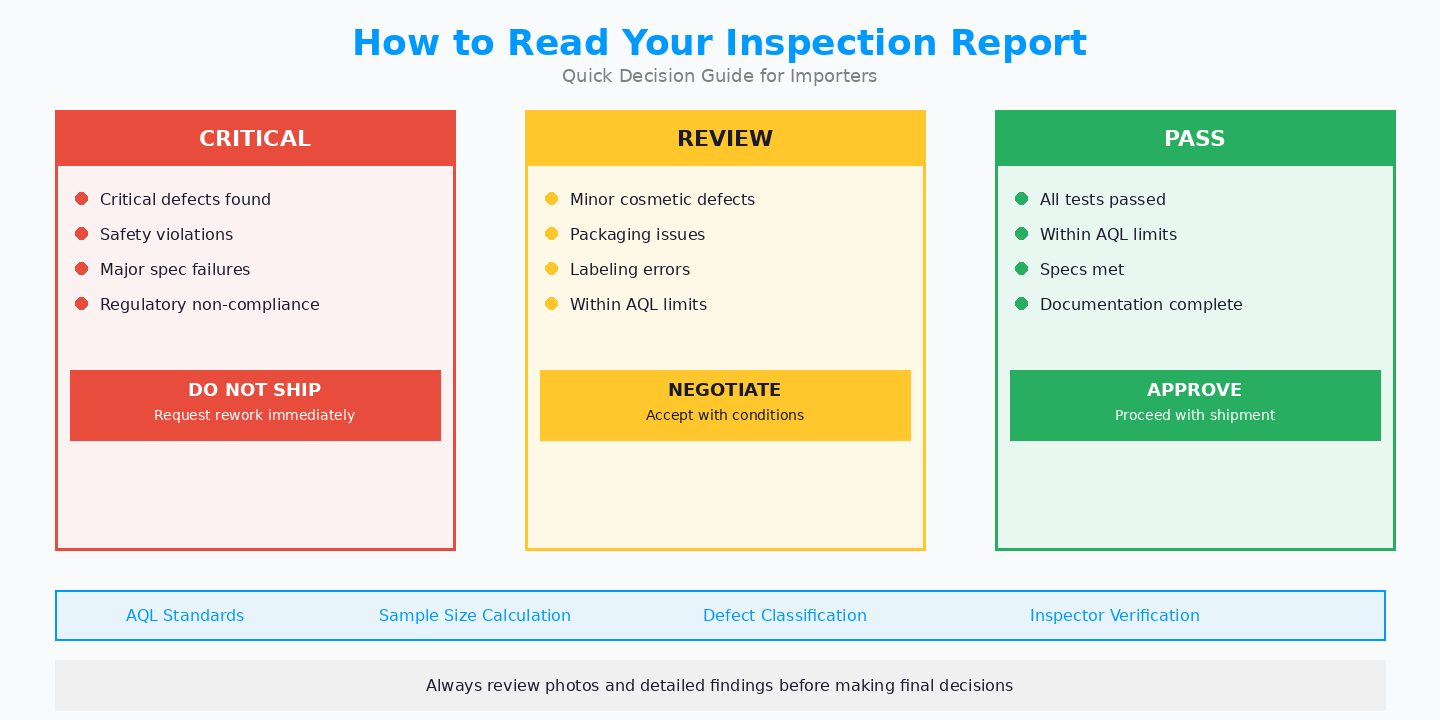
Decision flowchart for acting on inspection report findings
If the Report Shows PASS:
- Review defect details and photos for quality insights
- Share feedback with your supplier on areas for improvement
- Proceed with shipment approval
If the Report Shows FAIL:
- Identify the specific defects that caused the failure
- Request rework plan from the factory with timeline
- Schedule a re-inspection after fixes are complete
If You're Unsure:
- Contact the inspection company for clarification
- Request additional photos or measurements if needed
- Consider whether a factory audit might reveal root causes
FAQs About Reading Inspection Reports
What does AQL 2.5/4.0 mean?
AQL 2.5/4.0 refers to the acceptance quality limits for major (2.5%) and minor (4.0%) defects. It means major defects must stay below 2.5% of the sample for the batch to pass.
Can a shipment pass inspection but still have defects?
Yes. A "pass" means defects are within acceptable limits—not that the shipment is perfect. Always review the specific defects found.
How many photos should a good inspection report include?
Minimum 20-30 photos for a standard inspection, covering overall product appearance, close-ups of defects, packaging, and labels.
Should I share inspection reports with my supplier?
Yes—sharing reports provides specific, documented feedback that helps suppliers improve. However, consider your negotiation position before sharing complete reports.
Understanding your inspection report is the first step toward better quality control. If you're looking for inspection services that provide clear, actionable reports with real-time visibility, contact our team to learn how TradeAider can help you make confident decisions about your China-sourced products.
Related Articles
Grow your business with TradeAider Service
Click the button below to directly enter the TradeAider Service System. The simple steps from booking and payment to receiving reports are easy to operate.

