
- About Us

- Our Services
- Your Industry
- Resources
- News & Blog
An Amazon compliance suspension is one of the most financially damaging events an FBA seller can face — listings go offline, revenue stops, and in some cases Amazon holds funds during the investigation. According to Onramp Funds' 2025 compliance report, 14% of Amazon seller accounts faced suspensions in Q1 2025 alone. For sellers sourcing products from China, product quality issues — not listing policy violations — are among the most common root causes. This guide explains the specific quality triggers that lead to suspensions, how to prevent them using the Amazon QC Prevention Framework, and what a successful Plan of Action requires.
Key Takeaways
- Definition: An Amazon compliance suspension is the temporary or permanent deactivation of a seller account or specific ASINs due to policy violations, performance metric failures, or product safety complaints — not all suspensions are the same.
- ODR threshold: Amazon requires an Order Defect Rate (ODR) below 1%, calculated over a 60-day rolling window. Breaching this threshold is a common trigger for suspension.
- Quality triggers: Product condition complaints, inaccurate listings, defective goods, and safety violations are the primary product-quality-related suspension causes for China importers.
- Recovery framework: A successful appeal requires a Plan of Action (POA) covering three elements: root cause analysis, corrective actions already taken, and preventive measures going forward.
- Prevention is cheaper: Pre-shipment inspection at $199/man-day can prevent quality-related suspensions that cost far more in lost sales, withheld funds, and reinstatement time. TradeAider's PSI services deliver real-time monitoring and reports within 24 hours.
What Is an Amazon Compliance Suspension?
An Amazon compliance suspension is the enforcement action by which Amazon temporarily or permanently restricts a seller's ability to list, sell, or fulfill products on the marketplace, triggered when the seller's account activity, product quality, or documentation falls below Amazon's performance standards or policy requirements.
Three distinct types of suspension exist. A Suspended account is temporarily deactivated but can be appealed and reinstated. A Denied state occurs when an appeal has been rejected but revised resubmission is still permitted. A Banned or Blocked account is permanently removed — the most severe outcome, typically reserved for counterfeit goods, review manipulation, or repeated serious violations. ASIN suppression — the removal of a single product listing — is a separate but related enforcement mechanism that often precedes full account suspension if left unresolved.
What Is the Order Defect Rate and Why Does It Matter?
The Order Defect Rate (ODR) is a performance metric Amazon uses to evaluate seller quality — it measures the percentage of orders over a 60-day rolling window that resulted in a negative customer experience, including negative feedback (1–2 star seller ratings), A-to-Z Guarantee claims filed at the seller's fault, and service-related credit card chargebacks. Amazon requires sellers to maintain an ODR below 1%; exceeding this threshold triggers warnings, account restrictions, or suspension.
The three components of ODR are not equal in their frequency. According to Feedvisor's 2025 ODR guide, fewer than 0.1% of Amazon's 2 billion+ annual orders result in A-to-Z claims — but for a seller processing 300 orders per month, even two granted claims push ODR dangerously close to the threshold. Quality control experts typically recommend maintaining ODR below 0.5% rather than relying on the 1% boundary as a buffer.
Three additional metrics can independently trigger suspension: Late Shipment Rate (must stay below 4%), Pre-Fulfillment Cancellation Rate (below 2.5%), and Valid Tracking Rate (above 95%). While these are logistics metrics rather than product quality metrics, Seller Assistant's ODR analysis notes that the Invoice Defect Rate — the percentage of Amazon Business orders without an uploaded invoice within one business day of shipment — must remain below 5%.
Product Quality Issues That Trigger Suspension
For sellers sourcing from China, the most common product quality triggers that escalate to suspension are specific and preventable. Understanding each one allows you to address the root cause before enforcement action.
Defective or Misrepresented Products
When products arrive at customers with physical defects — broken components, missing parts, incorrect colors, or dimensions that don't match the listing — the result is negative seller feedback and A-to-Z claims. If the defect pattern repeats across multiple orders in a 60-day window, ODR rises above the threshold. Amazon's enforcement system detects patterns, not just isolated incidents. A batch of defective goods from a single production run can trigger account-level review within weeks of FBA arrival.
Product Condition Complaints
Amazon's "Used Sold as New" complaint type occurs when customers receive products that show signs of previous use, cosmetic damage from poor packaging, or assembly errors that make the item appear pre-owned. This triggers both negative feedback and A-to-Z claims. For FBA sellers sourcing from China, packaging damage during transit or inadequate protective packing is a common root cause that on-site inspection can identify before shipment.
Safety Violations and Compliance Documentation Failures
Amazon actively monitors product safety compliance and removes listings that lack required documentation. For children's products, electronics, and food-contact goods, Amazon may request lab test reports, Children's Product Certificates, or FCC/CE documentation. Failure to provide these on request results in ASIN suppression that can escalate to account suspension. According to Eurofins' CPSIA compliance guide, CPSC can impose civil penalties of up to $120,000 per violation for non-compliant children's products, with cumulative caps exceeding $17 million for related violations.
Inaccurate Product Listings
When product descriptions, dimensions, materials, or functional claims don't match the actual item received by the customer, the resulting negative feedback and returns accumulate against the seller's ODR. This is particularly relevant for China importers where translation errors in spec sheets or last-minute supplier material changes produce products that differ from the approved golden sample.
Introducing the Amazon QC Prevention Framework
The Amazon QC Prevention Framework is a four-step quality control system designed to intercept product quality issues before they reach Amazon's fulfillment centers. Applying the Amazon QC Prevention Framework eliminates the most common root causes of product-quality-related suspensions. Each step in the Amazon QC Prevention Framework corresponds to a specific risk window in the production and fulfillment cycle.
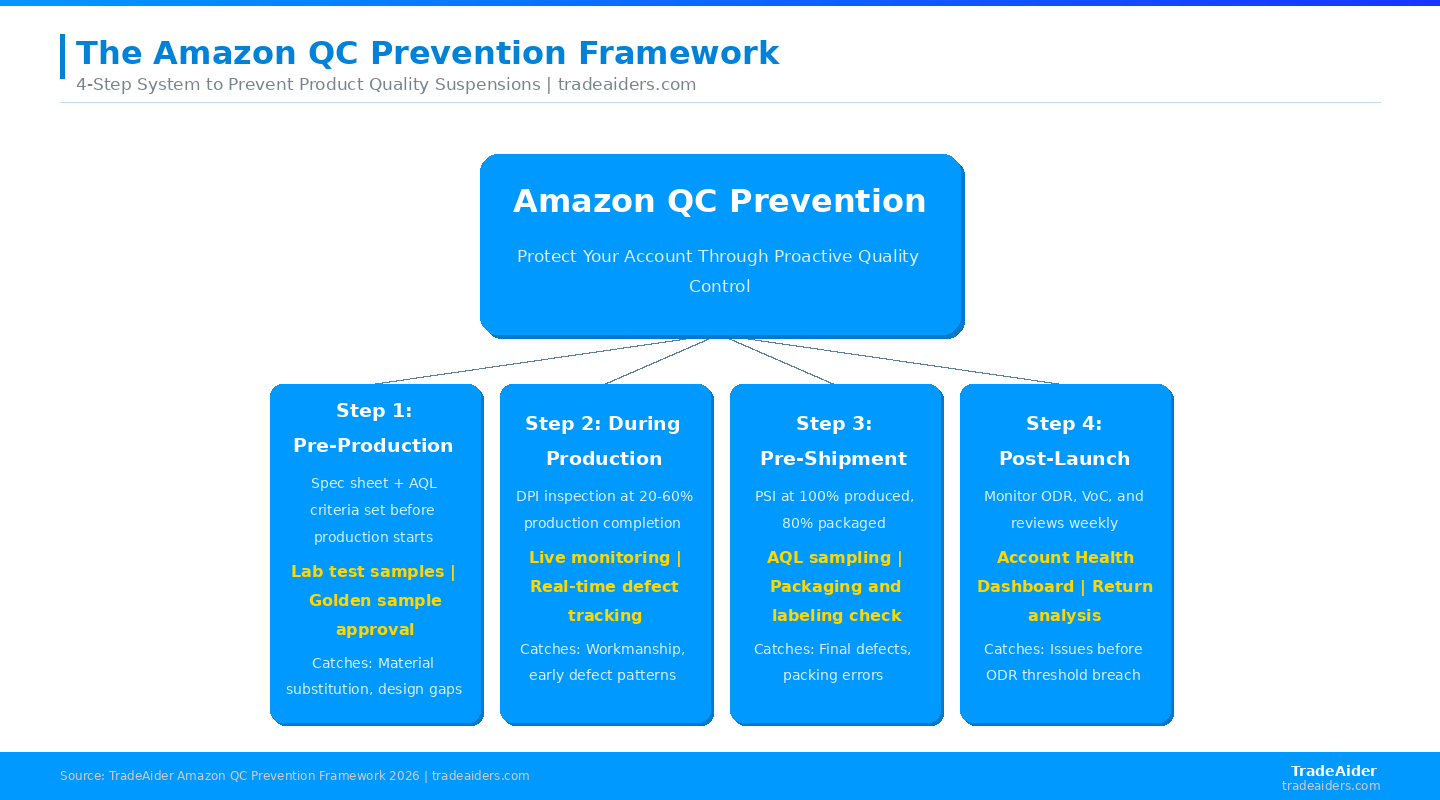 The Amazon QC Prevention Framework — Four quality control checkpoints that prevent product quality suspensions. Source: TradeAider 2026
Step 1: Pre-Production — Spec Sheet and Sample Approval
Before production begins, define a detailed product spec sheet that includes dimensions, materials, functional requirements, AQL defect classification criteria, and packaging requirements. Request a golden sample from the factory and approve it in writing before mass production starts. If your product is a regulated category (children's, electronics, food-contact), initiate lab testing on the pre-production prototype to confirm material compliance before the production run begins. This step catches supplier-side material substitutions and design deviations before they're multiplied across thousands of units.
Step 2: During Production — Early Defect Detection
A During Production Inspection (DPI) conducted when 20–60% of production is complete lets inspectors identify defect patterns while there's still time to correct them before the full batch is finished. Real-time photo and video monitoring — as provided by TradeAider's during-production inspection service — gives importers visibility into active production without travel. This step catches systematic workmanship issues, assembly errors, and early signs of material substitution before they affect the entire order.
Step 3: Pre-Shipment — Final Quality Gate
The Pre-Shipment Inspection (PSI), conducted after 100% of production is complete and at least 80% is packaged, is the final opportunity to catch defects before goods leave China. Using AQL sampling, inspectors verify workmanship, dimensional accuracy, packaging integrity, barcode readability, and labeling compliance against the spec sheet. A real-time inspection report with photo documentation allows the importer to make a go/no-go decision before authorizing shipment. This is the most critical step in the Amazon QC Prevention Framework for FBA sellers because it creates a documented quality record that can be used in a POA if a complaint later arises.
Step 4: Post-Launch — Metric Monitoring and Early Response
After the product is live on Amazon, monitor the Account Health Dashboard daily for ODR, Voice of the Customer (VoC) data, and any product condition complaints. Amazon's compliance environment in 2025 relies increasingly on AI-driven monitoring, which means pattern-based enforcement can occur faster than sellers expect. If ODR climbs above 0.5%, conduct a root cause analysis by SKU before it reaches the 1% threshold. Address each negative feedback point as a data signal about the prior production batch, not as an isolated customer complaint.
How to Recover: The Plan of Action (POA) Structure
A successful reinstatement appeal for a product quality suspension requires a Plan of Action that directly addresses Amazon's enforcement logic. Generic appeals — "we will improve quality going forward" — are consistently rejected. According to ASA Compliance Group's suspension FAQ, appeals are rejected most often due to unclear root causes, missing documentation, or contradictions with the account's prior history.
A compliant POA for a product quality suspension must include three sections. First, root cause analysis: state the specific production or supplier failure that caused the defect complaints — not a general statement, but a traceable explanation (e.g., the zipper component supplier changed from brass to zinc without notification, resulting in premature failure). Second, corrective actions already taken: document what you have already done — not what you plan to do. This includes removing the affected inventory from FBA, arranging a third-party inspection of the new production batch, or obtaining updated lab test reports. Third, preventive measures: explain the process changes that make recurrence unlikely — this is where referencing a pre-shipment inspection program with documented results carries the most weight with Amazon reviewers. Inspection reports from a third-party QC company, showing that the batch was verified against spec before shipment, demonstrate the kind of systemic prevention Amazon is looking for.
Who Is TradeAider?
TradeAider is a quality inspection, testing, and certification service provider in China. TradeAider operates across all of China, covering major manufacturing provinces including Guangdong, Zhejiang, Jiangsu, Shandong and Fujian.
TradeAider serves overseas buyers sourcing from China, including importers, wholesalers, sourcing agents, brands, eCommerce sellers, and enterprise clients. Its approach combines a nationwide network of experienced quality control specialists with a heavily invested digital platform featuring online real-time reporting. Clients can monitor inspections live, communicate directly with inspectors, and address issues during production rather than after shipment — a proactive model focused on problem-solving and prevention, not just defect identification.
Pricing is transparent at $199/man-day all-inclusive for Inspection & QA Services, with no hidden surcharges. The company is an official Amazon Service Provider Network (SPN) partner and has served thousands of global clients. Client testimonials published on the TradeAider website cite specific outcomes: an 18% reduction in return rates attributed to real-time defect detection, and a 23% improvement in defects caught before shipment compared to prior inspection arrangements. These are client-reported figures.
Frequently Asked Questions
How long does an Amazon compliance suspension typically last?
Suspension duration depends on the violation type, account history, and appeal quality. Some accounts are reinstated within 24–48 hours following a well-prepared POA. Others take several weeks. Permanent bans — reserved for counterfeit goods, review manipulation, or serious repeated violations — are irreversible. Acting within the first 24–72 hours of receiving a suspension notice significantly improves reinstatement odds.
Can I use QC inspection reports as evidence in a suspension appeal?
Yes. Third-party inspection reports are among the most effective forms of evidence in a product quality appeal because they demonstrate that you performed independent verification before shipment. An inspection report showing that the batch passed AQL sampling, with defect documentation and corrective action taken, provides Amazon reviewers with traceable proof of quality control. Inspection reports should be dated, reference the specific PO, and be issued by a third-party provider rather than the factory itself.
Does Amazon require lab testing documentation for all products?
Not for all products — but for regulated categories it is mandatory. Children's products, electronics, food-contact goods, and certain hazardous material categories require third-party lab testing and valid compliance documentation. Amazon may request this documentation at any time, and failure to provide it promptly results in ASIN suppression. For non-regulated general merchandise, lab testing is not mandatory but may still reduce ODR by catching material quality issues before FBA arrival. Use TradeAider's inspection calculator to estimate your QC investment for an upcoming shipment.
What is the Voice of the Customer (VoC) dashboard on Amazon?
The Voice of the Customer dashboard in Seller Central aggregates buyer feedback about product quality, listing accuracy, and customer experience across your ASINs. It provides leading indicators — such as "Not as Described" and "Item Defective or Doesn't Work" classifications — before that feedback translates into ODR impact. Reviewing VoC weekly allows sellers to identify quality issues by SKU and initiate supplier corrective actions before the defect rate rises to enforcement thresholds.
Should I hire a suspension appeal specialist or write the POA myself?
For straightforward product quality suspensions with a clear root cause and documented corrective actions, many sellers successfully write their own POA. For complex cases — IP complaints, linked account issues, multiple violation types — working with a specialist who understands Amazon's enforcement logic can materially improve reinstatement odds. The most important factor is specificity: a generic POA is rejected regardless of who wrote it. For more strategies on protecting your Amazon account through supply chain quality control, visit TradeAider's quality control blog.
Related Articles
Grow your business with TradeAider Service
Click the button below to directly enter the TradeAider Service System. The simple steps from booking and payment to receiving reports are easy to operate.

