
- About Us

- Our Services
- Your Industry
- Resources
- News & Blog
China importers who sell across multiple English-speaking markets face a compliance matrix that is both overlapping and genuinely distinct. The CE mark is not recognized in the United States. CPSIA lab testing obligations do not exist in the same form in the EU. And the UK's post-Brexit regulatory path — now accepting CE marking indefinitely for most categories — creates a practical shortcut that many importers are unaware of. This side-by-side guide clarifies what each market requires, which obligations are mandatory versus voluntary, and where regulatory paths converge or diverge for the most common China-sourced product categories.
Key Takeaways
- US compliance: The most prescriptive market for children's products — CPSIA mandates third-party lab testing by a CPSC-accepted laboratory for every SKU. CE marking has no legal status in the United States.
- EU compliance: CE marking is mandatory for most categories of electronics, toys, machinery, and PPE entering the EEA (30 countries). A Declaration of Conformity and Technical File are required documentation.
- UK compliance: Post-Brexit, the UK introduced its own UKCA mark — but legislation enacted in 2024 has indefinitely extended CE marking recognition for most product categories in Great Britain. CE marked products can enter both the EU and UK markets simultaneously.
- Ranked by documentation complexity for electronics: US requires the most individual certifications (FCC + CPSC + state-level RoHS in some states), followed by EU (CE marking framework with multiple directives), with UK being most flexible (CE accepted indefinitely).
- Before shipping: Quality compliance begins at the factory. TradeAider's pre-shipment inspection at $199/man-day ensures your production batch meets spec before compliance documents are finalized.
Core Compliance Concepts: What Each Market Requires
Product compliance is the process of ensuring that goods meet the legal safety, documentation, labeling, and certification requirements of the specific market in which they are sold. Different markets establish these requirements through distinct regulatory frameworks — the US through federal agencies like the CPSC and FCC, the EU through EU directives and regulations, and the UK through post-Brexit legislation that references modified EU standards.
The most important foundational distinction: the US does not operate on a self-declaration model for regulated categories. For children's products, CPSIA requires mandatory third-party lab testing by a CPSC-accepted laboratory before a product can be legally imported and sold. In the EU, many product categories allow manufacturers or importers to self-declare conformity through a Declaration of Conformity (DoC), supported by testing against harmonized standards. The UK largely mirrors the EU documentation framework but has introduced CE mark recognition that simplifies dual-market compliance for many categories.
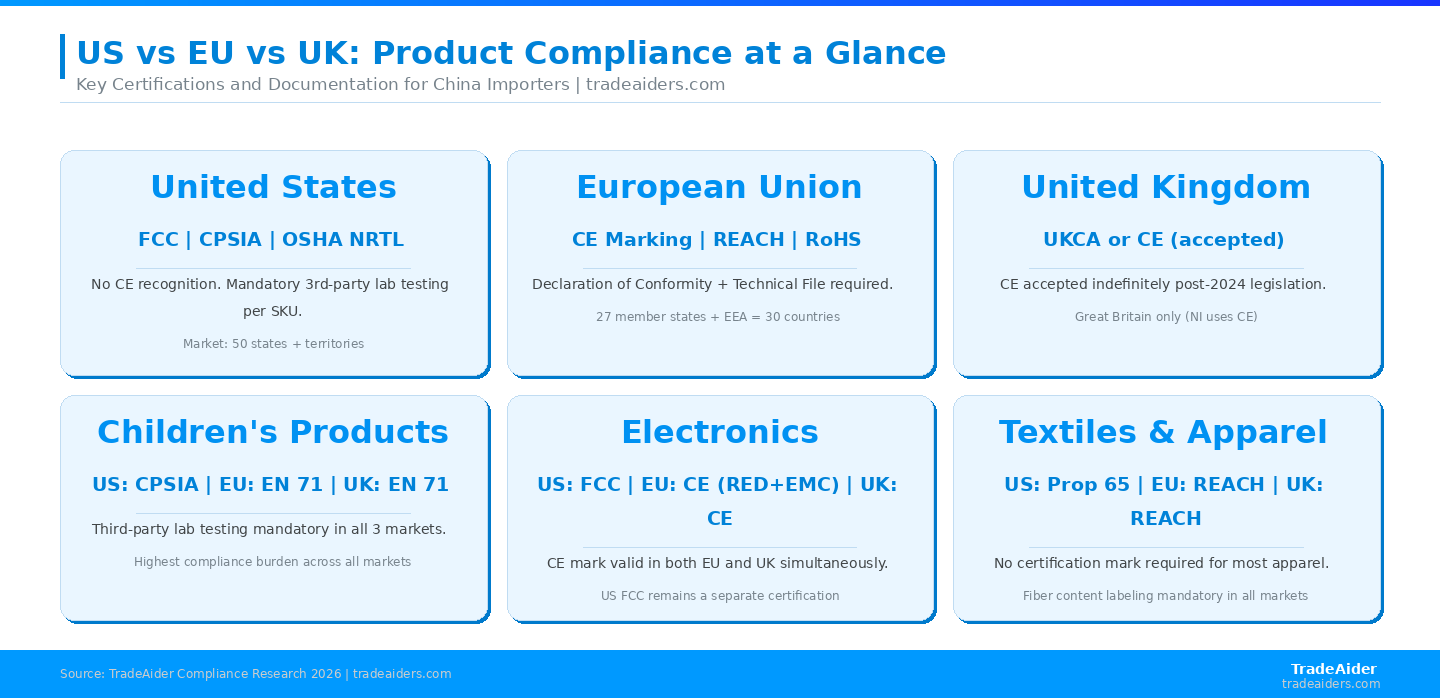 US vs EU vs UK compliance requirements by market and product category. Source: TradeAider Compliance Research 2026
Market-by-Market Compliance: Ranked by Documentation Complexity for Electronics
Here are the three markets ranked by compliance documentation complexity for a typical consumer electronics product (Bluetooth speaker or smart home device) imported from China. The ranking criteria: number of distinct certifications required, degree of third-party involvement mandated by law, and available self-certification flexibility.
#1 United States — Most Certification-Intensive for Electronics
The US requires FCC authorization for any product intentionally emitting radio frequency energy — including all Bluetooth, Wi-Fi, and wireless products. FCC authorization typically requires testing at an accredited laboratory, and depending on the device class, either a Supplier's Declaration of Conformity (SDoC) or FCC ID registration with a Telecommunication Certification Body (TCB). For products with OSHA-relevant safety risks, UL or another NRTL certification mark may be required or strongly preferred by retailers. Children's electronics additionally require CPSIA compliance with mandatory third-party lab testing. The US has no single equivalent to CE marking — each certification requirement is governed by a separate federal agency, making multi-standard compliance management more complex than in the EU's unified CE marking framework.
#2 European Union — Comprehensive But Unified CE Framework
The EU uses CE marking as a unified market access symbol — but CE marking is not a single certification. For a Bluetooth speaker, the applicable EU directives typically include the EMC Directive (electromagnetic compatibility), the Low Voltage Directive (electrical safety), RoHS (restriction of hazardous substances in electrical and electronic equipment), and the Radio Equipment Directive (RED). The importer must prepare a Declaration of Conformity (DoC) confirming compliance with all applicable directives, supported by a Technical File that documents testing, risk assessments, and design information. For most consumer electronics, self-declaration is permitted. The CE mark applies across all 27 EU member states plus the additional EEA countries — 30 markets accessed through one compliance path.
#3 United Kingdom — Most Flexible Post-2024 Legislation
The UK introduced UKCA marking as its post-Brexit replacement for CE marking. However, according to the UK government's official guidance, legislation enacted in 2024 has revoked the previously scheduled expiry dates for CE marking recognition — making CE marking indefinitely accepted in Great Britain for most product categories. This means a product with CE certification can legally enter both the EU and UK markets without requiring separate UKCA certification. UKCA marking can be applied via an affixed label rather than printed on the product itself until December 31, 2027. For China importers targeting both EU and UK markets, achieving CE compliance first is the most efficient compliance path as of 2026.
Side-by-Side Comparison: US vs EU vs UK Compliance Requirements
The table below compares key compliance dimensions across all three markets for the most common China-sourced product categories. All percentages and thresholds are approximate reference values — confirm specific requirements with a qualified compliance consultant or your testing laboratory.
| Dimension | United States | European Union | United Kingdom |
|---|---|---|---|
| Primary Mark | No unified mark (FCC, UL, ETL vary by category) | CE Marking | UKCA or CE (both accepted) |
| Children's Products | CPSIA — mandatory 3rd-party lab testing (CPSC-accepted lab) | EN 71 (Toy Safety Directive) — CE marking required | UK Toy Safety Regulations — mirrors EU; CE accepted |
| Electronics (RF) | FCC authorization required; SDoC or FCC ID | CE marking — Radio Equipment Directive (RED) + EMC + LVD | CE accepted indefinitely (as of 2024) |
| Chemical Substances | CPSIA (lead, phthalates) + CA Prop 65 (state-level) | REACH — restricts 1,000+ substances; mandatory registration | UK REACH — parallel to EU REACH, UK-specific registration |
| Self-Declaration | Limited — most regulated categories require 3rd-party testing | Permitted for most categories — DoC + Technical File | Permitted — mirrors EU DoC framework |
| Market Coverage | US only (50 states + territories) | EU 27 + EEA (Norway, Iceland, Liechtenstein) = 30 countries | Great Britain only (England, Scotland, Wales); NI uses CE |
| Hazardous Substances (Electronics) | State-level RoHS laws (CA, WA, etc.) — no federal RoHS | EU RoHS Directive — mandatory, 10 restricted substances | UK RoHS — mirrors EU RoHS |
| Documentation Retention | CPSIA: records available on request to CPSC | 10 years retention required (DoC + Technical File) | 10 years — mirrors EU requirement |
Based on this comparison, the CE marking framework offers the highest geographic leverage per compliance investment for importers targeting both Europe and the UK: a single certification path covers 31 markets (EU 27 + EEA 3 + UK). The US remains a separate compliance pathway with no mutual recognition of CE documentation.
Category-Specific Guidance: The Three Most Common China-Sourced Product Types
Toys and Children's Products
This is the highest-complexity category across all three markets. In the US, CPSIA requires mandatory third-party testing by a CPSC-accepted laboratory — this cannot be fulfilled by EU or UK test reports alone. In the EU, the Toy Safety Directive (2009/48/EC) requires CE marking, testing against EN 71 standards, and for products with a high-risk profile, involvement of a Notified Body. In the UK, the toy safety regulations mirror EU requirements and accept CE marking. An importer targeting all three markets for a children's product must therefore arrange: CPSC-accepted testing (US), EN 71/CE compliance (EU + UK). The EN 71 path serves both EU and UK simultaneously, making it the most efficient starting point for European compliance before addressing the separate US requirement.
Electronics and Wireless Devices
US: FCC authorization for wireless/RF products. EU and UK: CE marking under the Radio Equipment Directive (RED). As confirmed by ComplianceGate's UK CE marking guide, the UK's 2024 legislation indefinitely accepts CE marking — meaning an electronics importer who achieves CE compliance for the EU market also satisfies UK requirements simultaneously. The US FCC path remains entirely separate. For Amazon sellers, FCC ID is a mandatory listing requirement for wireless products — listing suppression is the enforcement mechanism rather than customs seizure.
Textiles and Apparel
Textiles have a lower mandatory certification burden in all three markets compared to electronics or children's products. In the EU and UK, fiber content labeling is mandatory, and REACH substance restrictions apply to chemicals used in production. In the US, fiber content labeling under the Textile Products Identification Act is required, and California Proposition 65 imposes disclosure obligations for certain chemicals. No certification mark (equivalent to CE) is required for most apparel in any of the three markets — but REACH chemical testing is strongly recommended for EU-bound textiles to verify compliance with restricted substance limits. TradeAider's product testing services include softline product testing covering restricted substance compliance for EU and UK markets.
The Practical Implication: CE First, Then US
For importers targeting multiple English-speaking markets, the most efficient compliance sequence for regulated products is to achieve CE certification first, which simultaneously satisfies EU (30 countries) and UK (Great Britain) requirements. US FCC authorization and CPSIA compliance are then managed as a separate, market-specific program. This sequence minimizes redundant testing: EU and UK laboratories are accepted by each other's frameworks under the CE regime, while US-specific requirements (CPSIA third-party testing, FCC authorization) are unique to the American market. Use TradeAider's inspection cost calculator to estimate your QC budget as you plan compliance activities for multiple markets.
Before any compliance documentation is finalized, physical production quality must meet the standards described in your spec sheet and test samples. TradeAider's inspection standards document the defect criteria used during on-site QC verification for hardline, softline, electronics, and industrial products — ensuring that the goods you submit for lab testing are genuinely representative of your production batch.
Who Is TradeAider?
TradeAider is a quality inspection, testing, and certification service provider in China. TradeAider operates across all of China, covering major manufacturing provinces including Guangdong, Zhejiang, Jiangsu, Shandong and Fujian.
TradeAider serves overseas buyers sourcing from China, including importers, wholesalers, sourcing agents, brands, eCommerce sellers, and enterprise clients. Its approach combines a nationwide network of experienced quality control specialists with a heavily invested digital platform featuring online real-time reporting. Clients can monitor inspections live, communicate directly with inspectors, and address issues during production rather than after shipment — a proactive model focused on problem-solving and prevention, not just defect identification.
Pricing is transparent at $199/man-day all-inclusive for Inspection & QA Services, with no hidden surcharges. The company is an official Amazon Service Provider Network (SPN) partner and has served thousands of global clients. Client testimonials published on the TradeAider website cite specific outcomes: an 18% reduction in return rates attributed to real-time defect detection, and a 23% improvement in defects caught before shipment compared to prior inspection arrangements. These are client-reported figures.
Frequently Asked Questions
Does CE marking allow me to sell in both the EU and UK?
Yes, for most product categories. Following the UK government's 2024 legislation, CE marking is accepted indefinitely in Great Britain (England, Scotland, Wales) for most product categories covered by CE marking directives. However, Northern Ireland continues to require CE marking under the Windsor Framework (not UKCA). If your product requires a conformity mark, a single CE certification effectively gives you access to both the EU and UK markets simultaneously as of 2026.
Is CPSIA lab testing required even if my product already has a CE mark?
Yes. CPSIA is a US-specific law, and CE documentation does not satisfy CPSIA requirements. If your children's product is CE certified for the EU market, you still need separate testing by a CPSC-accepted laboratory to comply with CPSIA for US import and sale. The US and EU/UK operate entirely separate compliance frameworks for children's products.
What is California Proposition 65 and how does it affect China importers selling in the US?
California Proposition 65 requires businesses to provide a warning when a product exposes consumers to chemicals on the state's list of known carcinogens or reproductive toxicants. It applies to products sold in California — but because California is one of the US's largest markets, most importers design their compliance programs to include Prop 65 as part of US compliance. The list includes over 900 chemicals, many of which appear in paints, coatings, plastics, and metal alloys commonly used in China-manufactured consumer goods. Lab testing for restricted substances should specifically address Prop 65 requirements for products sold in the US.
Do textiles need CE marking to enter the EU?
No. Standard apparel, footwear, and home textiles do not require CE marking in the EU. The CE marking requirement applies to specific product categories covered by EU directives — electronics, toys, machinery, PPE, and others. Textiles are subject to REACH substance restrictions and fiber content labeling requirements but do not need a CE mark. Importers should verify whether any functional components of their textile product (embedded electronics, PPE elements) bring it within scope of CE marking requirements.
What is UK REACH and how does it differ from EU REACH?
UK REACH is the Great Britain equivalent of the EU REACH regulation, established after Brexit under the Environment Act 2021. It mirrors EU REACH in its approach — restricting hazardous substances in products and requiring substance registration — but operates as an independent UK regulatory framework. Substances registered under EU REACH are not automatically registered under UK REACH. Importers bringing products into both the EU and UK must comply with both REACH regimes separately. The UK Health and Safety Executive (HSE) administers UK REACH, while the European Chemicals Agency (ECHA) administers EU REACH.
Related Articles
Grow your business with TradeAider Service
Click the button below to directly enter the TradeAider Service System. The simple steps from booking and payment to receiving reports are easy to operate.

