
- About Us

- Our Services
- Your Industry
- Resources
- News & Blog
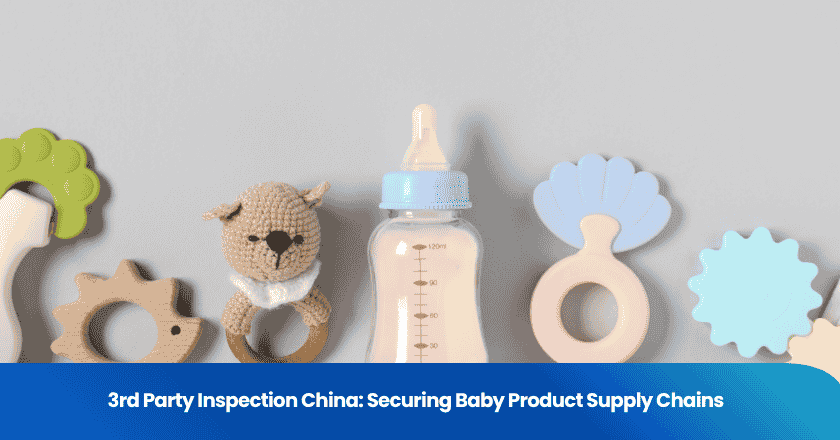
In January 2026, the U.S. Consumer Product Safety Commission (CPSC) recalled more than 15,000 baby products sold on Amazon — every single item manufactured in China. Baby loungers with unsafe gaps, crib mattresses that posed suffocation risks, self-feeding pillows that couldn't be pulled away by an infant. None of these products should have made it to a warehouse shelf. The question most importers don't ask until after a recall is: where did the quality control break down? The answer, nearly every time, is the same — there was no independent third-party eye on the supply chain. This article explains how 3rd party inspection in China specifically addresses baby product risks, what inspectors actually check, and why real-time visibility is the standard that modern importers can't afford to skip.
Key Takeaways
- Baby product recalls disproportionately originate in China — CPSC data shows 89% of toy and children's product violation notices in 2025 involved Chinese-manufactured goods.
- Third-party inspections in China cover structural integrity, chemical safety, labeling compliance, and dimensional tolerances — not just visual defects.
- Real-time inspection platforms let importers review findings the same day, enabling faster decisions before goods are loaded and shipped.
- Pre-production, during-production, and pre-shipment inspections create a layered safety net that catches problems at the cheapest possible stage.
Why Baby Products Demand a Higher Standard of Inspection
The Stakes Are Different When the End User Can't Speak
Baby products occupy a uniquely high-risk category in consumer goods. Infants and toddlers cannot read warning labels, cannot recognize a structural failure before it happens, and cannot communicate when something is wrong. This means the safety margin built into every product — and every inspection — must be wider than for adult goods.
According to the CPSC's official list of mandatory third-party testing requirements, baby products covered by federal law include bassinets, bedside sleepers, strollers, play yards, frame child carriers, high chairs, and cribs — each governed by its own specific CFR regulation. This regulatory complexity means a supplier in China may be producing for multiple destination markets simultaneously, each with different standards. An importer relying on supplier self-certification is exposed to the full risk of that complexity.
Third-party inspection breaks that dependency. An independent inspector working to your checklist — not the factory's — verifies compliance against the standards that apply to your market, not whatever the factory has on file.
What's Actually Going Wrong in Chinese Factories
The 2026 CPSC crackdown on Chinese testing labs reveals a structural problem beyond individual factories. Four CPSC-accredited labs in China had their accreditations withdrawn after investigators found falsified reports, concealed loss of accreditation, and products that later failed independent safety testing — including children's products. One lab had certified furniture as compliant that failed tip-over testing; another showed systemic failures in testing procedures for infant walkers, bath seats, and bassinets.
This doesn't mean all Chinese manufacturing is unsafe. China remains the world's largest producer of baby products, and thousands of compliant goods ship every day. What it does mean is that paper certification from a Chinese lab is no longer sufficient due diligence — importers need independent eyes on the factory floor, not just a report in an inbox.
What 3rd Party Inspectors Actually Check in Baby Product Factories
Structural and Mechanical Safety
For hard goods like strollers, cribs, high chairs, and baby walkers, inspectors verify the physical structure against the applicable standard. Under 16 CFR Part 1227 (ASTM F833) for carriages and strollers, and 16 CFR Part 1219 (ASTM F1169) for full-size cribs, key checks include:
- Crib slat spacing — gaps must prevent a child's head from becoming trapped (less than 2-3/8 inches per U.S. standards)
- Brake function on strollers — do wheel locks engage and hold on a slope?
- Stability testing — does the product tip when loaded to its stated weight capacity?
- Harness and buckle integrity — can the restraint be released by a caregiver but resist force from an infant?
- Sharp edges and pinch points — inspectors use a fingertip gauge to verify no exposed metal or plastic edges exceed the permitted radius
- Small parts — anything detachable is assessed against small-parts cylinders to confirm choking-hazard compliance
A practical example: an Amazon FBA seller importing a foldable travel crib from a Guangdong factory engaged pre-shipment inspection before shipping 500 units. The inspector found that three slat spacings on 40% of sampled units exceeded the permissible gap by 4mm — a defect invisible in product photos but immediately detectable with a gauge. The supplier corrected the tooling before final loading, avoiding a recall that would have cost multiples of the inspection fee.
Chemical and Material Safety
For soft goods — fabric carriers, nursing pillows, swaddle blankets — and for painted or coated surfaces on hard goods, chemical compliance is as critical as physical structure. Key tests that inspectors coordinate include:
- Lead content in surface coatings (U.S. limit: 90 ppm per CPSIA; EU REACH limit: 500 ppm)
- Phthalate content in soft PVC components — a concern for teething products, bath toys, and soft stroller handles
- Formaldehyde content in fabrics (relevant for products certified under OEKO-TEX Standard 100)
- Azo dye restrictions in textile components
- BPA-free verification for feeding bottles and silicone products
Inspectors don't run lab tests on-site — but they collect samples for accredited laboratory analysis and verify that production lots match the approved sample submitted for certification. Discovering a material switch mid-production (a common cost-cutting move by factories) is one of the highest-value catches a during-production inspection can make.
Labeling, Packaging, and Documentation Compliance
Regulatory compliance in baby products extends to the box. Missing age warnings, absent tracking labels, or non-compliant instructions can trigger a CPSC enforcement action even when the product itself is physically safe. Inspectors verify:
- Presence and accuracy of age-grading warnings (e.g., "Not suitable for children under 36 months")
- CPSC-required tracking labels (manufacturer identity, production date, batch number)
- Weight capacity labeling where required
- Instructions for assembly in the destination language
- Barcode and FNSKU label accuracy for Amazon FBA shipments
The Three-Inspection Model for Baby Product Supply Chains
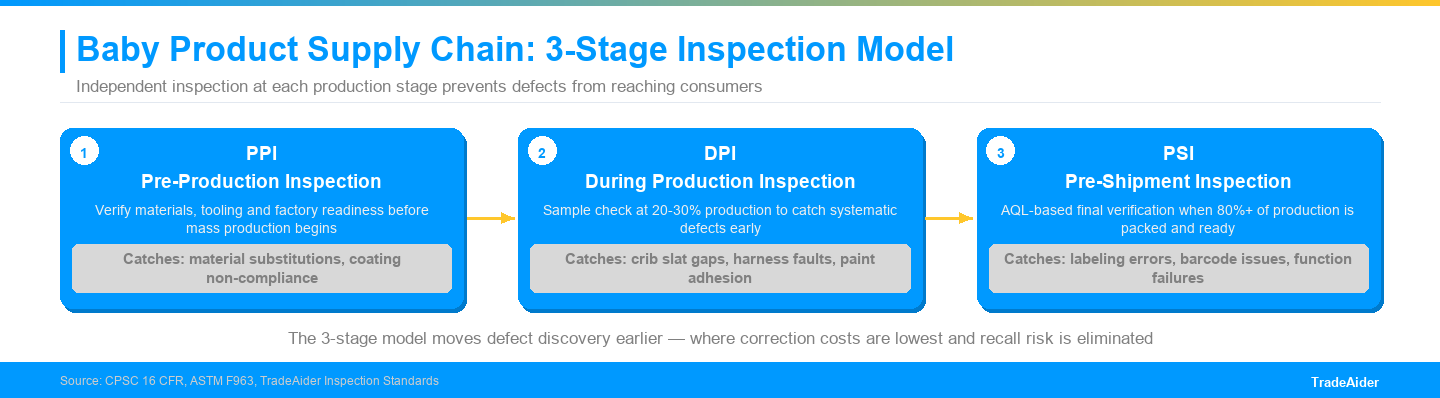
The three-stage inspection model shows how each intervention point catches a different class of risk — moving defect discovery earlier in the supply chain reduces cost and prevents recalls.
Waiting until the goods are packed and ready to load is the most common inspection mistake importers make. By that point, correcting a defect means either delaying the shipment or accepting a risk. The three-inspection model distributes verification across the production lifecycle:
| Inspection Type | Timing | Primary Purpose | Key Baby Product Checks |
|---|---|---|---|
| Pre-Production Inspection (PPI) | Before mass production begins | Verify raw materials, tooling, and factory readiness | Material certifications, fabric content, surface coating approvals |
| During Production Inspection (DPI) | When 20–30% of production is complete | Catch systematic defects before they propagate | Slat spacing, harness strength, paint adhesion, small parts |
| Pre-Shipment Inspection (PSI) | When 80%+ of production is finished and packed | Final AQL-based pass/fail before loading | Full functionality, labeling compliance, packaging integrity, barcode verification |
For high-risk or high-value baby product orders, using all three stages is the most cost-effective safety strategy available. The cost of a DPI that catches a systematic crib slat defect on 30% of production is a fraction of the cost of a recall, and infinitely less than the reputational damage to a brand when a safety issue reaches the news cycle. If you're sourcing regularly from China, during-production inspection is the stage most importers underuse — and the one with the highest return on investment for defect prevention.
AQL Sampling Standards for Baby Products
Why Standard AQL 2.5 May Not Be Enough
Most general merchandise inspections run at AQL 2.5 — meaning the acceptable quality limit allows up to 2.5% of units to have major defects before a batch fails. For baby products, many experienced importers and retailers require AQL 1.0 or even AQL 0 for critical defects like sharp edges, entrapment hazards, or chemical non-compliance.
The logic is straightforward: a 2.5% defect rate on a shipment of 1,000 strollers means accepting that 25 units could have a structural problem. For a consumer product used by an infant, that's not an acceptable risk.
| Defect Class | Examples in Baby Products | Recommended AQL |
|---|---|---|
| Critical | Sharp edges, entrapment gaps, small parts, strangulation risks | AQL 0 (Zero Tolerance) |
| Major | Broken components, missing hardware, harness malfunction | AQL 1.0 |
| Minor | Surface scratches, minor color variation, packaging dents | AQL 2.5 |
If you're unsure what AQL level applies to your product category, TradeAider's AQL calculator lets you input your order quantity and risk tolerance to determine the right sample size before you book an inspection.
The Role of Real-Time Visibility in Baby Product Inspections
Static PDF Reports Are No Longer the Standard
The traditional inspection model delivers a PDF report 24–48 hours after the inspection is completed. For a buyer in the US reviewing a factory visit that happened yesterday in Guangdong, that report is historical data — not actionable intelligence. By the time you read that a harness buckle is failing load tests on 15% of sampled units, the factory may have already packed and palletized the batch for loading.
Real-time inspection platforms change this dynamic fundamentally. With TradeAider's inspection service, buyers receive live updates as the inspector works through the checklist — photos, measurements, and pass/fail determinations visible in the platform within minutes of capture. This means you can respond to a finding while the inspector is still on-site: ask for additional samples, escalate a defect to the factory manager, or make the call to hold the shipment before goods are loaded.
For baby products especially, where a single defect class can trigger a CPSC enforcement action, the difference between a 24-hour lag and a real-time update is the difference between catching a problem and shipping it. TradeAider's pre-shipment inspection service includes this real-time reporting capability as standard at $199/man-day — no hidden fees for expedited reports or online access.
Frequently Asked Questions
What regulations apply to baby products imported from China to the US?
Baby products must comply with CPSIA (Consumer Product Safety Improvement Act) and the specific CFR regulations for each product type — for example, 16 CFR Part 1219 for full-size cribs, 16 CFR Part 1227 for strollers, and 16 CFR Part 1221 for play yards. All applicable children's product rules require third-party testing by a CPSC-accepted laboratory before a Children's Product Certificate (CPC) can be issued. From 2026, importers must also submit CPC data through the CPSC's eFiling portal. Importers — not factories — are legally responsible for CPC compliance.
Can I rely on the factory's own quality control for baby products?
No. Factory QC and third-party inspection serve different purposes. Factory QC is conducted by employees whose incentive is to pass units, not to flag issues that could delay shipment. Third-party inspection is independent by definition — the inspector's job is to report accurately against your specification and the applicable standard. The CPSC's 2026 crackdown on falsified lab reports from Chinese testing facilities makes clear that even accredited Chinese labs cannot always be trusted to self-police. For any product where a defect could harm a child, independent third-party inspection is not optional — it's the minimum responsible standard.
How much does 3rd party inspection for baby products in China cost?
Most professional inspection services in China charge per man-day. TradeAider's transparent pricing is $199/man-day with no hidden fees for weekend inspections, real-time reports, or rush delivery. For most shipments up to around 2,000 units, a single man-day pre-shipment inspection covers the full AQL sample. Larger orders or complex products (e.g., motorized swings with multiple components) may require two man-days. Use the inspection calculator to estimate the cost for your specific order.
What's the difference between product testing and product inspection for baby products?
Inspection and laboratory testing are complementary, not interchangeable. Inspection is a physical assessment of finished or in-progress goods against a visual and functional checklist — it happens at the factory. Laboratory testing is chemical and mechanical analysis conducted in an accredited lab — it validates compliance with standards like ASTM F963 or EN 71. Importers need both: lab testing establishes that the product design is compliant; inspection verifies that production batches match the approved design. A product that passed lab testing six months ago may fail inspection today if the factory switched a component without notifying the buyer.
Building a Safer Baby Product Supply Chain
The CPSC's recall of 15,000 Chinese-manufactured baby products in January 2026 wasn't a one-off anomaly. It was the predictable outcome of supply chains where independent oversight was absent. Importers who use layered third-party inspection — pre-production, during-production, and pre-shipment — with real-time reporting don't just reduce recall risk. They build the documented trail of compliance evidence that regulators, retailers, and consumers increasingly require.
If you're sourcing baby products from China and don't currently have a third-party inspection program in place, the right time to start is before your next order ships — not after a CPSC notice lands in your inbox. Contact our team to schedule your first inspection or get a free quote tailored to your product category and order volume.
Related Articles
Grow your business with TradeAider Service
Click the button below to directly enter the TradeAider Service System. The simple steps from booking and payment to receiving reports are easy to operate.

