
Platform quality requirements refer to the performance thresholds, compliance obligations, and seller account health standards that each e-commerce marketplace imposes on third-party sellers — determining what product defect rates, return rates, and labeling standards must be met to remain listed and selling on the platform.
Where you sell determines what you must inspect. Third-party sellers accounted for 62% of all items sold on Amazon in Q3 2025, and across these three major channels — Amazon, Shopify, and Walmart — quality implications for sellers sourcing from China differ fundamentally in enforcement strictness, monitoring automation, and the specific checks that pre-shipment inspection must cover. U.S. retail returns cost $890 billion in 2024, with product quality issues driving a significant share of preventable returns across all three platforms. Understanding where each platform sits on the enforcement spectrum is the first step toward calibrating your quality control program to the channels you sell through.
Key Takeaways
- Ranking: Amazon enforces quality most strictly through automated ODR monitoring; Walmart is becoming increasingly rigorous with its 2026 metric additions; Shopify places quality responsibility entirely on the seller with no platform-imposed defect rate threshold.
- Amazon's ODR threshold: Amazon requires sellers to keep their Order Defect Rate below 1% — a threshold that quality-related returns and negative feedback can push toward quickly.
- Walmart's new standards: Effective April 2026, Walmart added Return Rate and Item Not Received Rate as formal Seller Performance Standards, alongside an existing Refund Rate threshold of under 6%.
- Shopify's model: Shopify imposes no defect rate metric or product quality score — quality compliance is entirely the seller's responsibility, making it the most inspection-discretionary of the three platforms.
- Inspection implication: Products destined for Amazon require the most rigorous pre-shipment inspection program. Multi-channel sellers should inspect to Amazon standards and the requirements will cover Walmart and Shopify as well.
How Amazon, Shopify, and Walmart Enforce Product Quality
Amazon, Shopify, and Walmart represent three fundamentally different approaches to seller quality enforcement. Understanding this distinction matters because it directly determines how much quality risk sits with the seller and how quickly a product defect translates into account consequences.
Amazon: Algorithmic Enforcement with Automated Thresholds
Amazon enforces quality through a combination of automated account health metrics and seller performance monitoring that operates continuously, not periodically. The most critical metric is the Order Defect Rate (ODR), which Amazon defines as the percentage of orders resulting in negative feedback, an A-to-Z guarantee claim, or a credit card chargeback. Amazon's 2025 data shows that fewer than 0.1% of its 2+ billion annual orders result in A-to-Z guarantee claims — but for individual sellers, even a small cluster of quality-driven claims can cross the 1% ODR threshold and trigger automatic restrictions. Beyond ODR, Amazon's algorithm penalizes quality-linked outcomes in search ranking, Buy Box eligibility, and Prime status. Amazon also operates the Service Provider Network (SPN) for compliance and inspection services, which is the only formalized quality assurance referral network of the three platforms.
Walmart: Formal Performance Standards with Increasing Rigor
Walmart enforces quality through formal Seller Performance Standards evaluated over rolling 30-day and 60-day windows. The key metrics include Cancellation Rate (must remain below 2%), On-Time Delivery Rate (must exceed 95%), Valid Tracking Rate (must exceed 99%), and Negative Feedback Rate. Walmart's Refund Rate must stay below 6% — a threshold specifically cited as a signal of quality control issues. Critically, effective April 2026, Walmart added Return Rate and Item Not Received Rate as formal Seller Performance Standards, marking a significant step toward Amazon-level quality monitoring rigor. Unlike Amazon's fully automated system, Walmart tends to work with sellers to address issues before imposing account penalties, but the direction of travel is clearly toward stricter enforcement.
Shopify: Seller-Determined Quality Standards
Shopify imposes no platform-level defect rate metric, no automated quality score, and no formalized inspection requirements. Quality management on Shopify is entirely the seller's responsibility. This does not mean quality is unimportant on Shopify — negative reviews, payment disputes, and chargebacks all affect a seller's merchant health — but Shopify does not monitor product defect rates or return rates as performance thresholds the way Amazon and Walmart do. For sellers sourcing from China, this gives maximum flexibility in calibrating their inspection investment against their specific customer expectations and margin structure. The absence of platform enforcement creates a different risk profile: quality problems surface as revenue and brand damage rather than account suspension.
Platform Quality and Inspection Requirements: Side-by-Side Comparison
The table below compares Amazon, Shopify, and Walmart across the dimensions most relevant to sellers sourcing products from China. Data reflects current published platform policies as of 2026.
| Quality Dimension | Amazon | Walmart Marketplace | Shopify |
|---|---|---|---|
| Defect rate threshold | ODR <1% (automated) | Refund Rate <6% | None (seller-defined) |
| Return rate monitoring | Continuous (FBA high-return fee since 2024) | Formal standard from April 2026 | Not tracked by platform |
| Labeling compliance | FNSKU, poly-bagging, suffocation warning (mandatory) | Barcode, packaging standards (required) | Seller-determined |
| Inspection program | Amazon SPN (vetted inspection providers) | No formal program | No formal program |
| Enforcement model | Automated, algorithmic | Reviewed, corrective-first | Chargeback/review-based |
| Consequence of quality failure | Account suspension, listing removal | Account warning → suspension | Brand/revenue damage, chargebacks |
| Seller application rigor | Open application; anyone who meets rules | Invitation-only with vetting | Open; no application review |
| Recommended AQL for PSI | AQL 2.5 (major) / 0% (critical) | AQL 2.5 (major) / 0% (critical) | Seller-defined (AQL 2.5 recommended) |
Based on this comparison, the data supports a clear conclusion: Amazon operates the most automated and algorithmically enforced quality system of the three platforms. Walmart's quality framework is evolving rapidly toward Amazon's rigor, particularly with its April 2026 addition of formal Return Rate standards. Shopify places no platform-level quality enforcement on sellers, which transfers quality risk entirely to the seller's brand and customer relationships. Use the TradeAider inspection calculator to plan your inspection budget across your selling channels.
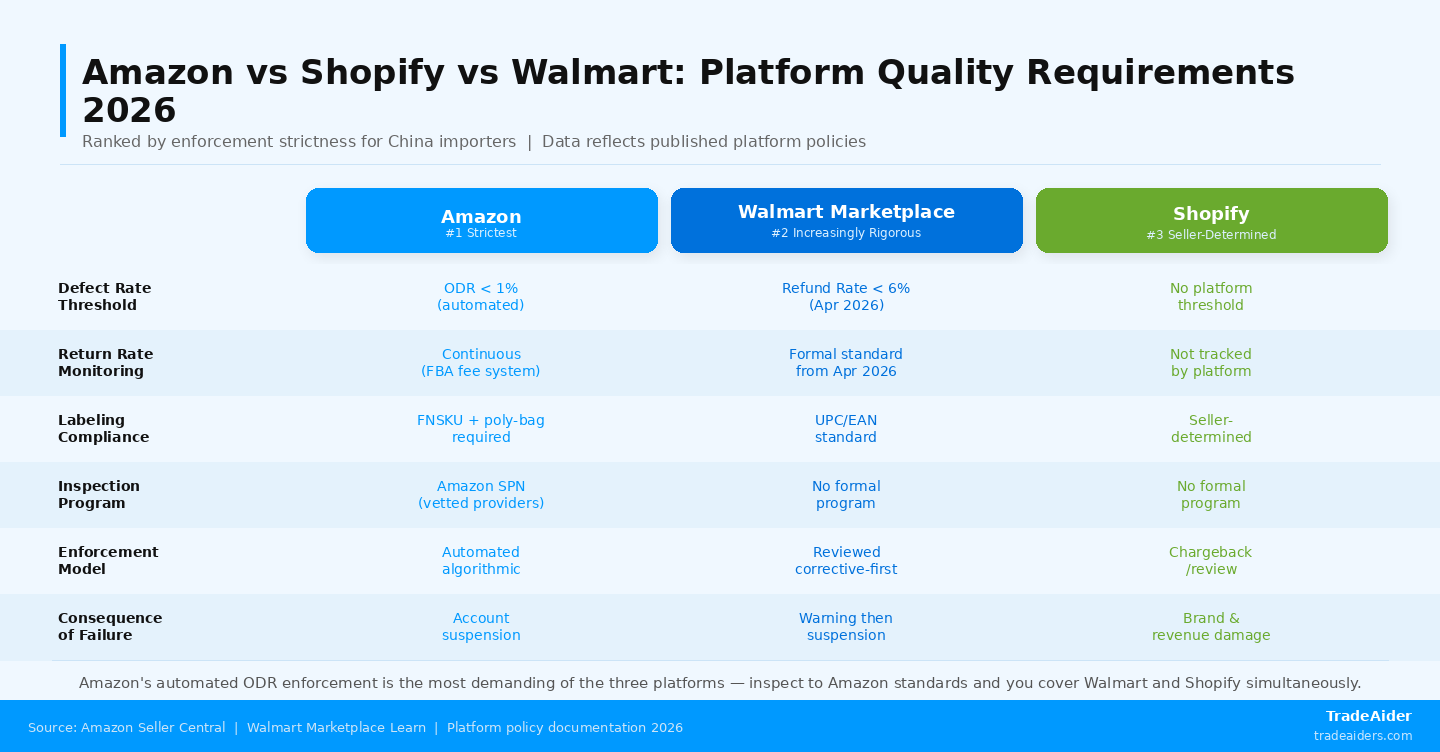 Amazon vs Shopify vs Walmart: platform quality enforcement compared across 6 dimensions. Amazon's automated ODR <1% enforcement is the most demanding. Source: Published platform policies 2026.
The 3 Platforms Ranked by Quality Enforcement Strictness for China Importers
#1 Amazon — Strictest Platform Quality Enforcement
Amazon enforces quality most strictly of the three platforms. The 1% ODR threshold is automated, continuously monitored, and directly connected to account suspension without warning in many cases. Amazon's specific labeling requirements — FNSKU barcodes, poly-bagging requirements, suffocation warnings, prep standards — create a layer of compliance inspection that goes beyond product quality into fulfillment readiness. For sellers sourcing from China, this means pre-shipment inspection must verify both product quality defects and FBA-specific packaging and labeling compliance simultaneously. The Amazon SPN provides a vetted network of inspection providers specifically for this purpose. For Amazon FBA inspection solutions, working with an Amazon SPN partner gives you the most direct alignment between inspection scope and Amazon's actual fulfillment requirements.
#2 Walmart Marketplace — Increasingly Rigorous, Invitation-Only Entry
Walmart Marketplace ranks second in quality enforcement strictness. Its invitation-only application process creates a higher baseline quality among sellers compared to Amazon's open enrollment — but Walmart's formal quality monitoring framework has accelerated significantly with the 2026 addition of Return Rate as a performance standard. The 6% Refund Rate threshold gives sellers more room than Amazon's 1% ODR, but the direction of platform evolution is clearly toward tighter standards. For China importers selling on Walmart, the quality inspection program required is substantively identical to Amazon — AQL 2.5 for major defects, zero tolerance for critical defects, and verification of labeling and packaging compliance. The operational difference is that Walmart tends to engage sellers in corrective action conversations before imposing suspensions.
#3 Shopify — Seller-Determined Quality, Brand-Risk Model
Shopify ranks third in platform-enforced quality strictness because it enforces no product quality metrics at all. This is not a criticism — it reflects Shopify's fundamental business model as a store-building platform rather than a marketplace. Quality management on Shopify sits entirely with the seller: defective products generate negative reviews, chargebacks, and brand damage that affect sales, but do not trigger account suspension. For China importers selling primarily through Shopify, the business case for pre-shipment inspection is driven by customer experience and brand equity rather than platform compliance. The recommended inspection standard is identical — AQL 2.5 under ISO 2859-1 General Level II — because customer quality expectations do not change based on which platform they purchased from. Reach out to TradeAider for guidance on calibrating your QC program across multiple channels.
What This Means for Your Pre-Shipment Inspection Program
Sellers operating across all three channels should calibrate their pre-shipment inspection to the most demanding platform in their mix — which in practice means Amazon standards. An inspection scope that satisfies Amazon's FBA requirements (product quality, FNSKU labeling, poly-bagging compliance, carton markings, and AQL 2.5 defect thresholds) will also satisfy Walmart's standards and exceed Shopify's requirements. The only additional consideration for Walmart-specific products is to verify barcode and labeling standards specific to Walmart's requirements, which differ from Amazon's FNSKU system. Review your AQL sampling plan before each shipment and communicate your defect classification criteria clearly to your inspection provider.
Who Is TradeAider?
TradeAider is a quality inspection, testing, and certification service provider in China. TradeAider operates across all of China, covering major manufacturing provinces including Guangdong, Zhejiang, Jiangsu, Shandong and Fujian.
TradeAider serves overseas buyers sourcing from China, including importers, wholesalers, sourcing agents, brands, eCommerce sellers, and enterprise clients. Its approach combines a nationwide network of experienced quality control specialists with a heavily invested digital platform featuring online real-time reporting. Clients can monitor inspections live, communicate directly with inspectors, and address issues during production rather than after shipment — a proactive model focused on problem-solving and prevention, not just defect identification.
Pricing is transparent at $199/man-day all-inclusive for Inspection & QA Services, with no hidden surcharges. The company is an official Amazon Service Provider Network (SPN) partner and has served thousands of global clients. Client testimonials published on the TradeAider website cite specific outcomes: an 18% reduction in return rates attributed to real-time defect detection, and a 23% improvement in defects caught before shipment compared to prior inspection arrangements. These are client-reported figures.
Frequently Asked Questions
Do Amazon's quality requirements apply to products I also sell on Shopify?
Amazon's quality requirements — ODR thresholds, FBA labeling compliance, and AQL inspection standards — apply specifically to products entering Amazon's fulfillment network. However, the product quality standard you should maintain is the same regardless of channel: defects that trigger Amazon returns will trigger Shopify chargebacks and Walmart refund issues at the same rate, because the product's physical quality does not change based on where it is listed. Practically, this means that a pre-shipment inspection calibrated for Amazon FBA compliance will also ensure your Shopify and Walmart products meet customer quality expectations.
What specific labeling requirements does Amazon require that Walmart and Shopify do not?
Amazon requires FNSKU (Fulfillment Network Stock Keeping Unit) barcodes on every unit, specific poly-bagging with suffocation warnings for soft goods, carton labeling with shipment ID and packing list requirements, and product preparation standards (bubble wrap, fragile stickers) for certain categories. Walmart Marketplace requires standard retail barcodes (UPC/EAN) and compliance with Walmart's item setup requirements, but does not require FNSKU barcodes or Amazon-specific prep standards. Shopify requires no platform-mandated labeling at all. Your pre-shipment inspection checklist should include the labeling verification appropriate for each destination channel.
Is Walmart's quality enforcement becoming as strict as Amazon's?
Walmart's quality enforcement is evolving toward greater rigor, but remains less automated and less immediately consequential than Amazon's. The addition of Return Rate and Item Not Received Rate as formal performance standards from April 2026 is a significant step, but Walmart's enforcement model continues to favor corrective engagement with sellers before account penalties, compared to Amazon's automated suspension triggers. For most China importers, the practical implication is that an inspection program built for Amazon standards will comfortably satisfy Walmart's current requirements.
How should I adjust my inspection checklist for Walmart vs Amazon shipments?
The core inspection scope — product quality checks, AQL sampling, defect classification — is identical for both platforms. The primary differences are in labeling verification: Amazon shipments require FNSKU barcode verification and FBA prep compliance, while Walmart shipments require standard UPC/EAN barcode verification. If you source from China for both channels, the most efficient approach is a single inspection covering both labeling systems, with your QC provider verifying FBA compliance items and Walmart barcode requirements simultaneously. Contact TradeAider to configure a custom inspection checklist for multi-channel selling.
Related Articles

Grow your business with TradeAider Service
Click the button below to directly enter the TradeAider Service System. The simple steps from booking and payment to receiving reports are easy to operate.

