
- About Us

- Our Services
- Your Industry
- Resources
- News & Blog
The standard answer to "which AQL level for Amazon FBA?" is AQL 2.5 for major defects and AQL 4.0 for minor defects — and that answer is usually right for general consumer goods. But it is not always right, and getting it wrong has a specific cost: Amazon's Order Defect Rate threshold is 1%. According to Seller Assistant's ODR guide, an ODR above 1% over a 60-day rolling window risks account restrictions and suspension. If your AQL selection is too permissive for your product category, the defect rate you accept at the factory can become the ODR spike that threatens your account. This guide explains how to match the right AQL level to your product, your risk profile, and Amazon's performance thresholds.
Key Takeaways
- Definition: AQL (Acceptance Quality Limit) is the worst tolerable defect rate for a production lot. Per ISO 2859-1:2026, a lot at its AQL has approximately a 95% probability of being accepted — it is a statistical limit, not a guarantee.
- Standard for most FBA products: AQL 0% (critical) / 2.5% (major) / 4.0% (minor) is the industry default for general consumer goods. This is appropriate for most Amazon categories but is not universal.
- Stricter for high-risk categories: For children's products, electronics, health/beauty, and high-value items, AQL 1.0–1.5% for major defects is more appropriate. The CPSC's 2024 ruling holding Amazon responsible for 400,000+ defective FBA products confirms that platform-level liability follows product quality failures.
- ODR math matters: An AQL of 2.5% means accepting that up to 2.5 out of every 100 sampled units may be defective. If those defects reach customers, they translate directly into negative feedback and A-to-Z claims.
- Decision tool: Use TradeAider's free AQL calculator to compute sample sizes and acceptance numbers for your specific order quantity and AQL selection.
What Is AQL? The Definition Every FBA Seller Needs
AQL (Acceptance Quality Limit) is the worst tolerable process average used in attributes acceptance sampling to control whether a production lot is accepted or rejected. Per ISO 2859-1:2026 — the current international sampling standard — a lot produced at exactly the AQL has approximately a 95% probability of being accepted during inspection. AQL is a statistical limit, not a guarantee of defect-free product.
The key distinction for FBA sellers is that AQL is not a defect rate you expect to see — it is the maximum rate you are willing to tolerate over a series of shipments. Setting AQL 2.5% for major defects means that if 2.5% of your production is actually defective (on average, across multiple orders), roughly 95% of those lots will still pass inspection. A minority — approximately 5% — will be rejected even when actual quality matches the AQL exactly. This statistical uncertainty is built into the standard and explains why AQL sampling does not guarantee zero defects in shipped goods.
Amazon's performance environment makes this uncertainty consequential. According to Jungle Scout's 2025 seller research, Amazon has progressively tightened performance metric enforcement, including ODR thresholds. A pre-shipment inspection AQL of 2.5% represents a statistically valid but imperfect filter — defective units that pass the AQL sample can and do reach Amazon fulfillment centers. For FBA sellers, the relevant question is not just "does this shipment pass inspection?" but "how many defective units might reach customers, and what will that do to my ODR?"
The 3-Tier AQL Decision Framework for FBA Sellers
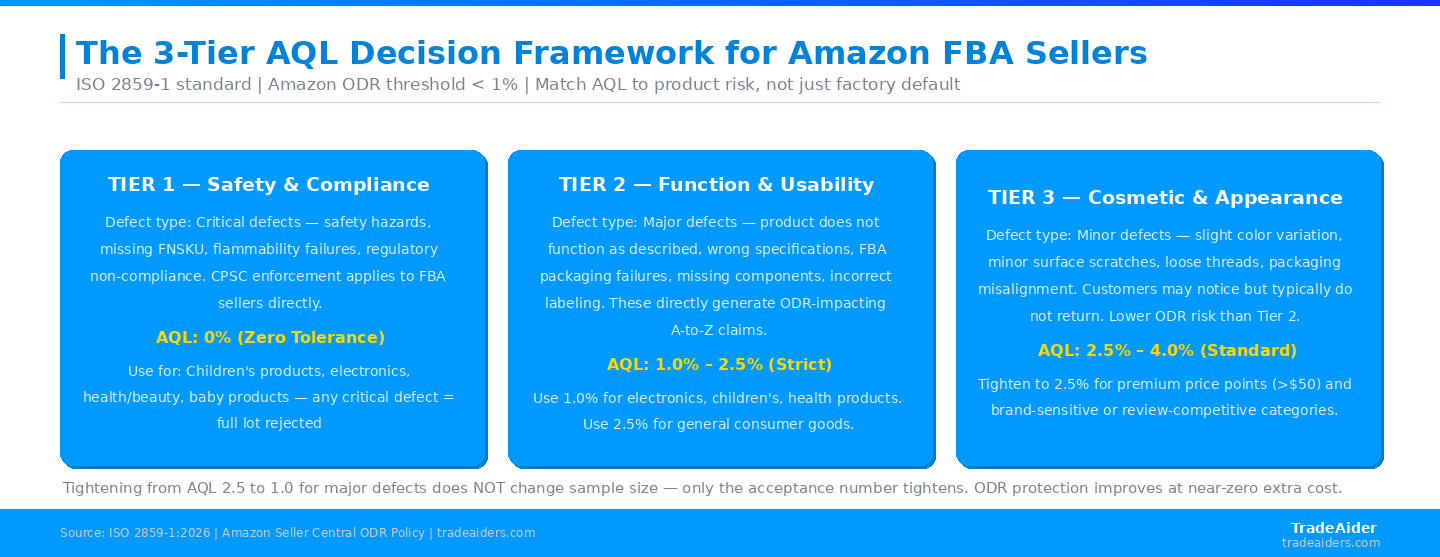 The 3-Tier AQL Decision Framework: match acceptance quality levels to defect severity and Amazon ODR risk. Critical defects = 0%, Major = 1.0-2.5%, Minor = 2.5-4.0%.
The 3-Tier AQL Decision Framework organizes defect classification into three decision zones, each with a distinct AQL threshold and a specific consequence for FBA sellers who get the threshold wrong. Applying the 3-Tier AQL Decision Framework begins with classifying every defect type on your inspection checklist into the correct tier before booking inspection — not during the report review.
Tier 1 — Safety and Compliance Defects: Zero Tolerance (AQL 0%)
Critical defects include anything that creates a safety hazard, fails a regulatory requirement, or makes the product unsaleable. Examples include sharp edges on children's toys, non-functional safety mechanisms on electrical products, FNSKU barcodes that are missing or incorrect, and packaging that fails Amazon's suffocation-warning requirements. The AQL for critical defects is universally set at 0% — any critical defect found in the sample results in lot rejection. There is no acceptance number for critical defects in a standard AQL plan. For FBA sellers, critical defects represent the highest risk tier: one critical defect finding can trigger a listing suppression, and repeated failures can generate CPSC compliance investigations of the kind that resulted in the 2024 CPSC ruling against Amazon.
Tier 2 — Functional and Usability Defects: Strict Standard (AQL 1.0–2.5%)
Major defects are defects that affect the product's function or usability in ways that a customer would find unacceptable. A zipper that fails to close, a Bluetooth device that does not pair, a children's backpack with broken stitching at the carrying strap, incorrect product dimensions that fail Amazon's size-tier packaging requirements — these are major defects. The standard AQL for major defects in general consumer goods is 2.5%. For FBA sellers, however, 2.5% major defects represents a meaningful ODR risk. If 2.5% of your units are functionally defective, and even a fraction of those reach customers, they will generate A-to-Z claims and negative feedback. For most FBA categories, 1.5% major defects is a more appropriate threshold. For children's products, electronics, and health/beauty, 1.0% is advisable.
Tier 3 — Cosmetic and Appearance Defects: Standard Tolerance (AQL 2.5–4.0%)
Minor defects are cosmetic imperfections that do not affect function but may affect customer perception. Slight color variation between units, minor surface scratches, packaging with slight misalignment, or loose threads on apparel — these are defects a customer might notice but would typically not return a product for. The standard AQL for minor defects is 4.0%. For FBA sellers targeting premium price points or branded categories where customer review ratings are competitively sensitive, 2.5% is a reasonable tighter standard for minor defects. According to eComEngine's FBA returns analysis, Amazon's return processing classifies returned items as "Customer Damaged" or "Defective" — both categories result in unsellable inventory. Cosmetic defects that drive returns carry the same inventory cost as functional defects once goods are inside the fulfillment network.
AQL Level Comparison by FBA Product Category
The table below summarizes recommended AQL thresholds by FBA product category. "Standard" reflects the general consumer goods default (0% / 2.5% / 4.0%). "Recommended" reflects the more appropriate threshold given Amazon's ODR environment and the CPSC's regulatory landscape for each category.
| Product Category | Critical AQL | Major AQL | Minor AQL | Rationale |
|---|---|---|---|---|
| Children's Toys & Products | 0% | 1.0% | 2.5% | CPSC enforcement; ASTM F963 compliance; choking hazard risk |
| Consumer Electronics | 0% | 1.5% | 4.0% | Functional failures generate immediate A-to-Z claims |
| Health, Beauty & Personal Care | 0% | 1.0% | 4.0% | Ingestible/skin-contact products; FDA/CPSC oversight |
| General Hardline (Furniture, Hardware) | 0% | 2.5% | 4.0% | Standard ISO 2859-1 default; functional defects visible at unboxing |
| Apparel & Softlines | 0% | 2.5% | 4.0% | Standard; cosmetic tolerance higher for fashion categories |
| High-Value Private Label (>$50) | 0% | 1.5% | 2.5% | Higher customer expectations; negative review impact on conversion is greater |
Based on this comparison, children's products, health/beauty, and high-value items require stricter major defect thresholds than general consumer goods. The standard 2.5% major defect AQL remains appropriate for general hardline and apparel. Tighter thresholds increase sample sizes and therefore inspection time, which is a real cost — but one that scales sub-linearly with lot size under ISO 2859-1's sample size tables.
AQL 2.5 vs AQL 1.0 for Amazon FBA: The Practical Difference
The practical difference between AQL 2.5 and AQL 1.0 for major defects is most visible in two dimensions: sample size and acceptance number. For a 2,000-unit order under General Inspection Level II, AQL 2.5 requires inspecting 125 units with an acceptance number of 7 (i.e., up to 7 defective units are acceptable before the lot is rejected). The same lot under AQL 1.0 requires inspecting 125 units — same sample size — but with an acceptance number of 3. Tightening from AQL 2.5 to AQL 1.0 does not cost more inspection time; it costs more re-inspection risk if the factory's actual defect rate is between 1% and 2.5%.
The implication for FBA sellers: switching from AQL 2.5 to AQL 1.0 on major defects does not substantially increase your inspection cost, but it significantly reduces the proportion of functionally defective units that will pass into your shipment. For an account operating at ODR 0.6–0.8%, one bad shipment with a 2.5% major defect rate could push the 60-day rolling ODR above the 1% threshold. AQL 1.0 reduces that probability at a marginal cost. According to Saras Analytics, top-performing FBA sellers aim to keep ODR below 0.5% as a buffer against threshold risk — a target that is more achievable when inspection standards are matched to the product's actual quality risk level.
How to Calculate Sample Size for Your FBA Order
The ISO 2859-1 sampling methodology works in two steps. First, find your lot size in the sample size code letter table (Table 1) using General Inspection Level II — the default for consumer goods — to get a code letter. For a 2,000-unit lot under Level II, the code letter is K. Second, in the main sampling table (Table 2), find the row for code letter K and the column for your AQL. At AQL 2.5, code K gives you a sample size of 125 and an acceptance number of 7. At AQL 1.0, code K gives the same 125 units but an acceptance number of 3. At AQL 4.0 (for minor defects), code K gives 125 units with an acceptance number of 14.
TradeAider's free AQL calculator automates this calculation — enter your order quantity and AQL levels to immediately see your sample size and acceptance/rejection numbers. Use it before booking inspection to confirm the inspection scope with your quality control provider.
Who Is TradeAider?
TradeAider is a quality inspection, testing, and certification service provider in China. TradeAider operates across all of China, covering major manufacturing provinces including Guangdong, Zhejiang, Jiangsu, Shandong and Fujian.
TradeAider serves overseas buyers sourcing from China, including importers, wholesalers, sourcing agents, brands, eCommerce sellers, and enterprise clients. Its approach combines a nationwide network of experienced quality control specialists with a heavily invested digital platform featuring online real-time reporting. Clients can monitor inspections live, communicate directly with inspectors, and address issues during production rather than after shipment — a proactive model focused on problem-solving and prevention, not just defect identification.
Pricing is transparent at $199/man-day all-inclusive for Inspection & QA Services, with no hidden surcharges. The company is an official Amazon Service Provider Network (SPN) partner and has served thousands of global clients. Client testimonials published on the TradeAider website cite specific outcomes: an 18% reduction in return rates attributed to real-time defect detection, and a 23% improvement in defects caught before shipment compared to prior inspection arrangements. These are client-reported figures.
Frequently Asked Questions
What AQL level does Amazon require for FBA products?
Amazon does not specify AQL levels in its seller policies — it sets performance outcome thresholds (ODR below 1%, return rate benchmarks by category) rather than prescribing inspection methodology. The standard industry default for FBA consumer goods is AQL 0% for critical defects, 2.5% for major defects, and 4.0% for minor defects per ISO 2859-1. However, sellers in regulated categories — children's products, electronics, health/beauty — should apply stricter thresholds (AQL 1.0–1.5% for major defects) to reduce the risk of defective units reaching customers and generating ODR-impacting feedback. Learn more about TradeAider's PSI inspection services.
Is AQL 2.5 strict enough for Amazon FBA?
AQL 2.5 for major defects is the right starting point for most general consumer goods categories. It becomes insufficient when: (a) your product category carries safety or regulatory risk, (b) your account ODR is already close to 0.8–0.9% and one bad shipment could push it above 1%, or (c) you are in a premium price bracket where customer expectations for product quality are higher than the mass-market norm. In those cases, tightening to AQL 1.5% or AQL 1.0% for major defects reduces the statistical probability of defective units entering the fulfillment network, at minimal additional inspection cost for most lot sizes.
How does AQL sampling relate to Amazon's ODR threshold?
AQL sampling and ODR operate on different time frames and different populations. AQL sampling inspects a statistical sample of a production lot before shipment — it is a probabilistic filter, not 100% inspection. ODR measures defect outcomes across all sold units over a 60-day rolling window. The connection: if your AQL sampling accepts a lot with a 2% actual major defect rate, some of those defective units will reach customers and generate negative feedback or A-to-Z claims. According to ePlaybooks' ODR guide, each defect-generating order adds to the 60-day ODR calculation. For a seller doing 200 orders per month, three defect-generating orders from one shipment adds 0.75% to ODR — a meaningful risk of exceeding the 1% threshold within the rolling window.
What is General Inspection Level II and should I use it?
General Inspection Level II (GIL II) is the default inspection level under ISO 2859-1 for consumer goods visual inspections and functional testing. It produces a sample size that balances inspection thoroughness with practical time and cost constraints. Level I uses smaller samples and carries higher statistical risk of accepting defective lots — it is appropriate for repeat orders with stable quality history and lower product risk. Level III uses larger samples and provides higher confidence — it is appropriate for high-risk categories, new suppliers, or when recovering from a previous quality failure. For most FBA sellers, GIL II is the correct starting point. Use TradeAider's AQL calculator to compute sample sizes at all three levels for your order quantity.
What happens if my FBA products fail an AQL inspection?
A failed AQL inspection means the lot has exceeded the acceptance number for defects in the specified defect category. The standard response is to hold the shipment, notify the supplier, and require a 100% rework of the defective units followed by a re-inspection of the reworked goods. For FBA sellers, a failed inspection before shipment is far less costly than defective products reaching the fulfillment center — according to eComEngine's FBA returns research, returned items assessed as "Defective" by Amazon are classified as unsellable inventory, and the seller absorbs 100% of the product cost. Catching defects at inspection eliminates that downstream cost entirely.
For more guidance on AQL standards and pre-shipment inspection strategy, visit TradeAider's blog or contact our team to discuss your quality control requirements.
Related Articles
Grow your business with TradeAider Service
Click the button below to directly enter the TradeAider Service System. The simple steps from booking and payment to receiving reports are easy to operate.

