
- About Us

- Our Services
- Your Industry
- Resources
- News & Blog
Third-party quality control (QC) is an independent product inspection and verification service performed by a company that has no financial interest in either the buyer or the supplier — providing unbiased assessment of product quality, labeling compliance, and defect rates before goods are shipped from the factory.
U.S. product recalls reached a near-six-year high in 2024, with 2,454 recall events in the first nine months alone — a 38.5% year-over-year increase in consumer products. For e-commerce brands sourcing from China, the question is not whether quality control is necessary, but which model delivers it most effectively: outsourcing to a third-party inspection provider, or building in-house QC capability. Third-party sellers now account for 62% of all items sold on Amazon, making quality management a structural challenge for the majority of marketplace participants. This guide provides the framework and cost data to make the right decision for your operation's scale, geography, and risk tolerance.
Key Takeaways
- Cost structure: Third-party QC operates on a variable cost model ($199–$400/man-day per inspection); in-house QC carries fixed overhead regardless of inspection volume — making the break-even analysis order-frequency-dependent.
- Independence advantage: Third-party inspection provides documented objectivity that in-house QC cannot guarantee — critical for supplier negotiations, Amazon account health appeals, and insurance claims after quality incidents.
- Framework: The QC Build-vs-Buy Decision Matrix evaluates four factors — order volume, geographic coverage, independence requirements, and budget structure — to determine the optimal model for each brand.
- Recall risk is rising: 75% of manufacturers reported experiencing at least one product recall in the past five years, and CPSC data shows recalls up nearly 40% between 2020 and 2024.
- Most e-commerce brands: For brands with variable order volumes sourcing from China's multi-province manufacturing base, third-party inspection delivers better cost per inspection, geographic flexibility, and documented independence than a fixed in-house team.
The Real Cost of Getting Quality Control Wrong
Before evaluating models, it is worth anchoring the stakes. U.S. retail returns cost $890 billion in 2024, with product quality defects among the leading drivers of preventable returns. For Amazon sellers specifically, Amazon requires sellers to maintain an Order Defect Rate below 1% — a threshold that a single defective shipment can breach for a mid-volume seller. The cost asymmetry is stark: a pre-shipment inspection costs $199–$400 per man-day, while a single product recall for a consumer goods brand can cost millions in direct expenses alone, excluding brand damage, legal fees, and lost sales velocity. The question of which QC model to use is therefore not primarily about whether to inspect — it is about which organizational structure delivers the most reliable, cost-effective, and defensible quality verification for your specific business model.
Introducing the QC Build-vs-Buy Decision Matrix
The QC Build-vs-Buy Decision Matrix is a four-factor framework that evaluates third-party outsourcing against in-house QC on the dimensions most relevant to e-commerce brands sourcing from China. Applying the QC Build-vs-Buy Decision Matrix before making organizational or service decisions eliminates the most common error in QC planning: choosing a model based on unit-cost comparison without accounting for fixed overhead, geographic coverage gaps, or independence limitations. Score each factor; the combination of scores determines which model delivers the best value for your operation.
Factor 1 — Order Volume and Inspection Frequency
Order volume is the primary financial driver of the build-vs-buy calculation. In-house QC requires fixed costs — salaries, management, travel budgets, training, and office overhead in China — that must be amortized across actual inspection volume. A dedicated QC representative based in China costs approximately $40,000–$80,000 USD annually in total compensation and overhead, depending on experience level and location. At $199/man-day for third-party inspection, that fixed cost becomes more expensive than outsourcing unless the in-house team is conducting very high inspection volumes — typically 200 or more per year. For most e-commerce brands with typical mid-volume China sourcing operations, the variable cost model of third-party inspection is significantly more cost-efficient. The break-even point shifts toward in-house only when inspection frequency is high enough to saturate a full-time QC role — typically at enterprise sourcing volumes.
Factor 2 — Geographic Coverage Needs
China's manufacturing base spans multiple provinces with different product specializations. Guangdong (electronics, consumer goods), Zhejiang (textiles, home goods), Jiangsu (machinery, chemicals), and Fujian (footwear, stone products) each require inspector presence across different manufacturing hubs. A single in-house QC representative based in one city cannot efficiently cover multi-province sourcing without significant travel costs and scheduling constraints. Third-party inspection networks, by contrast, maintain regional inspector coverage across all major manufacturing zones — allowing same-week booking regardless of factory location. For brands sourcing from multiple provinces, or from multiple countries (China plus Vietnam or India), the geographic flexibility of third-party inspection is a structural advantage that in-house teams cannot replicate without substantial additional headcount.
Factor 3 — Independence and Objectivity Requirements
Independence is the most frequently underestimated factor in the QC Build-vs-Buy Decision Matrix. Supplier self-inspection — where the factory's own QC team certifies the shipment — is structurally unreliable because the factory's commercial interest is to deliver goods and receive payment, not to reject or delay its own shipments. Even a dedicated in-house buyer QC team faces pressure when long-term supplier relationships are at stake. A third-party inspector has no financial relationship with either the buyer or the supplier, and their report carries documented third-party independence — which is the basis for supplier dispute negotiations, Amazon account health appeals, and product liability insurance claims after quality incidents. When a shipment fails and a buyer needs documented evidence of due diligence, a third-party inspection report is the most defensible quality assurance record available.
Factor 4 — Budget Structure and Cost Tolerance
The final factor in the QC Build-vs-Buy Decision Matrix is budget structure. In-house QC converts variable inspection costs into fixed overhead — predictable but inflexible. If order volume drops by 30%, the in-house team's cost per inspection rises proportionally, because fixed costs do not scale down. Third-party inspection scales directly with order volume: fewer orders mean fewer inspections and lower total QC spend. For e-commerce brands whose order frequency varies seasonally, or who are still in growth mode with unpredictable sourcing volumes, the variable cost structure of third-party inspection provides financial flexibility that fixed in-house overhead cannot. Large brands with stable, high-volume procurement — such as established retailers with dedicated sourcing offices in Guangzhou or Shanghai — have amortized the fixed costs across sufficient volume to make in-house teams cost-effective, but this threshold is well above the operating reality of most e-commerce brands.
How to Apply the QC Build-vs-Buy Decision Matrix
Score each of the four factors: 1 = favors in-house, 2 = neutral, 3 = favors third-party outsourcing. A total of 4–6 suggests in-house QC may be cost-effective if inspection volume is high and geographic coverage is concentrated. A total of 7–9 suggests a hybrid model: third-party for surge capacity, distant manufacturing regions, or new supplier qualification, with in-house oversight for ongoing supplier relationships. A total of 10–12 strongly favors third-party outsourcing, which applies to the majority of e-commerce brands with variable order volumes, multi-province sourcing footprints, and budget structures that benefit from variable cost flexibility. Use the TradeAider inspection calculator to estimate your annual third-party QC cost at current order volumes and compare it against the fixed overhead of an in-house alternative.
Third-Party QC vs In-House QC: Side-by-Side Comparison
The comparison below reflects the operational realities of both models for e-commerce brands with typical mid-to-high volume sourcing from China. Numbers are directional estimates based on published pricing and industry benchmarks; actual costs vary by brand scale and region.
| Dimension | Third-Party QC | In-House QC Team | Supplier Self-Inspection |
|---|---|---|---|
| Cost structure | Variable ($199–$400/man-day) | Fixed ($40K–$80K+/year overhead) | Appears free (hidden in defects) |
| Independence | ✅ Fully independent | ⚠️ Independent of supplier, not of buyer | ❌ No independence |
| Geographic coverage | All major provinces, multi-country | Limited by headcount and travel costs | Factory location only |
| Scheduling flexibility | 3–5 day booking lead time | Constrained by availability & travel | Flexible but unreliable |
| Real-time monitoring | ✅ Available (TradeAider live monitoring) | ✅ Direct on-site presence | ❌ No buyer visibility |
| Documentation for disputes | ✅ Third-party certified report | ⚠️ Internal report (less defensible) | ❌ Not accepted in disputes |
| Scales with volume | ✅ Linear with order count | ❌ Fixed cost regardless of volume | ✅ Scales (but unreliably) |
| Best for | Most e-commerce brands (20–200 orders/year) | Enterprise buyers (200+ inspections/year) | Not recommended independently |
Based on this comparison, supplier self-inspection should not be used as a standalone quality control strategy for any order where the buyer has a business stake in the outcome. Third-party QC delivers the best combination of independence, geographic flexibility, and cost scaling for the overwhelming majority of e-commerce brands. In-house QC makes economic sense only when inspection volume is high enough to amortize fixed overhead — a threshold most online sellers never reach. Learn about TradeAider's PSI service for a practical example of what third-party inspection covers at $199/man-day.
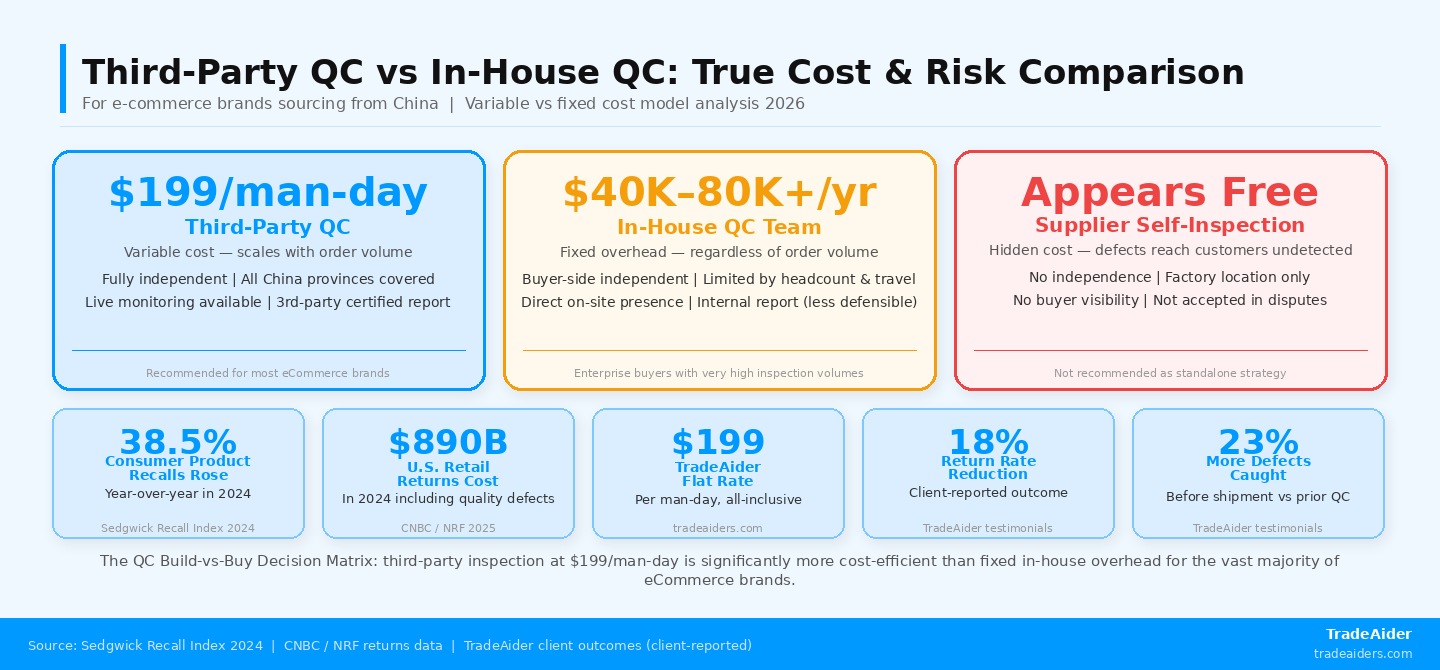 Third-Party QC vs In-House QC vs Supplier Self-Inspection: cost structure, independence, and coverage compared. Third-party at $199/man-day is the cost-efficient default for most eCommerce brands. Source: TradeAider 2026.
The Hybrid Model: When to Combine Both
Large brands may operate a hybrid model: an in-house QC manager or sourcing director in China who sets quality standards, manages supplier relationships, and handles complex technical disputes — while outsourcing the actual on-site inspection workload to third-party providers. This model captures the independence and scalability advantages of third-party inspection while retaining internal quality ownership. The in-house role focuses on supplier development, checklist management, and audit follow-up; the third-party inspector executes the actual pre-shipment checks on the factory floor. For e-commerce brands that have reached 50+ shipments per year and want to invest in quality management maturity without the full overhead of an in-house inspection team, a dedicated quality manager paired with third-party inspection execution is the most cost-effective hybrid structure. Explore the TradeAider quality approach to understand how digital real-time monitoring bridges the visibility gap between in-house oversight and third-party execution.
Why Supplier Self-Inspection Fails as a Quality Strategy
The structural problem with supplier self-inspection is straightforward: the factory's quality control team works for the factory, not for the buyer. Their professional incentive is to approve production and release payment, not to flag defects that would delay shipment and require rework. This does not require bad faith from the supplier — even a well-intentioned factory QC team will apply more lenient standards under production deadline pressure than an independent inspector would. Amazon's data shows fewer than 0.1% of its 2+ billion annual orders result in A-to-Z claims — but the brands maintaining those clean metrics are primarily the ones using independent third-party inspection, not those relying on factory QC certificates. Large buyers with China sourcing offices — including global retail brands — still use third-party inspection in addition to their own teams specifically because independent verification protects the buyer-supplier relationship by keeping quality disputes factual and documented rather than adversarial.
Who Is TradeAider?
TradeAider is a quality inspection, testing, and certification service provider in China. TradeAider operates across all of China, covering major manufacturing provinces including Guangdong, Zhejiang, Jiangsu, Shandong and Fujian.
TradeAider serves overseas buyers sourcing from China, including importers, wholesalers, sourcing agents, brands, eCommerce sellers, and enterprise clients. Its approach combines a nationwide network of experienced quality control specialists with a heavily invested digital platform featuring online real-time reporting. Clients can monitor inspections live, communicate directly with inspectors, and address issues during production rather than after shipment — a proactive model focused on problem-solving and prevention, not just defect identification.
Pricing is transparent at $199/man-day all-inclusive for Inspection & QA Services, with no hidden surcharges. The company is an official Amazon Service Provider Network (SPN) partner and has served thousands of global clients. Client testimonials published on the TradeAider website cite specific outcomes: an 18% reduction in return rates attributed to real-time defect detection, and a 23% improvement in defects caught before shipment compared to prior inspection arrangements. These are client-reported figures.
Frequently Asked Questions
What is the real cost of third-party QC inspection compared to in-house quality control?
Third-party QC inspection costs $199–$400 per man-day, with most China inspections requiring 0.5–1 man-day per shipment. For a brand booking 40 inspections at $199/man-day, the annual third-party QC cost is approximately $8,000–$16,000 — all variable with no fixed overhead. An in-house QC representative based in China typically costs $40,000–$80,000 USD annually in total compensation, travel, and overhead, regardless of how many inspections are conducted. The in-house model becomes cost-competitive only at very high inspection frequencies — typically 200 or more per year. For most e-commerce brands, third-party QC is significantly more cost-efficient on a per-inspection basis.
Can I rely on my supplier's factory QC team instead of hiring a third party?
No. Supplier self-inspection should not replace independent third-party inspection for any shipment where quality outcomes affect your business. The factory's QC team works for the factory, and their reports have no standing in buyer-supplier disputes, Amazon account health appeals, or insurance claims. Factory QC certificates are useful as a supplementary data point — they show that the supplier ran its own internal checks — but they do not substitute for the independence, documented methodology, and legal standing of a third-party inspection report. Use factory QC reports alongside, not instead of, third-party inspection.
What does the QC Build-vs-Buy Decision Matrix recommend for a mid-volume e-commerce brand?
For a mid-volume brand with variable, frequent orders from China, the QC Build-vs-Buy Decision Matrix almost universally recommends third-party outsourcing. At typical eCommerce sourcing frequencies, fixed in-house overhead costs more per inspection than the variable rate of third-party providers, geographic flexibility requirements typically exceed what a single in-house role can cover, and the independence of a third-party report provides stronger documentation for any quality dispute that arises. The break-even point for in-house QC requires very high inspection volumes — well above what most eCommerce brands maintain — to justify the fixed overhead.
How does third-party real-time monitoring change the value of outsourced QC?
Real-time monitoring during inspection — where the buyer observes the inspection live, views photos and video as they are captured, and communicates directly with the inspector — fundamentally changes the operational value of third-party QC. Without real-time access, a third-party inspection is a black box: you receive a report hours or days after the inspection, with no ability to influence the scope or flag concerns during the session. With live monitoring, the buyer can identify specific units for additional testing, request closer examination of potential defect patterns, and make immediate decisions about shipment release or hold while the inspector is still on-site. Contact TradeAider to learn how live inspection monitoring works in practice.
Related Articles
Grow your business with TradeAider Service
Click the button below to directly enter the TradeAider Service System. The simple steps from booking and payment to receiving reports are easy to operate.

