
- معلومات عنا

- خدماتنا
- صناعتك
- الموارد
- الأخبار والمدونة
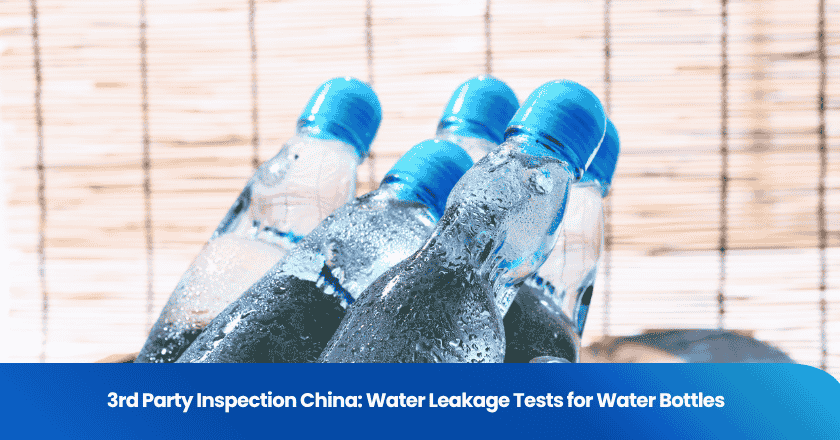
Importing water bottles from China without proper leak testing is a gamble that can cost you returns, negative reviews, and lost customers. A single batch with faulty seals or defective threading can turn a profitable order into a logistics nightmare. Third-party inspection in China provides the on-site verification you need, and water leakage testing is one of the most critical checks any importer should require before shipment.
Key Takeaways
- Water leakage testing is essential for all water bottle categories, including stainless steel vacuum flasks, plastic sports bottles, and glass containers.
- Multiple test methods exist, from simple inverted leak checks to ASTM-standard vacuum decay testing, each suited to different bottle types and risk levels.
- AQL sampling ensures statistical reliability without inspecting every unit, keeping costs predictable at $199/man-day.
- Real-time inspection reporting allows importers to make immediate decisions about defective batches before goods ship.
Why Water Leakage Testing Matters for Importers
A water bottle that leaks is not just a defective product; it is a brand-damaging event. When a customer opens their gym bag to find their new bottle has soaked everything inside, they don't blame the factory. They blame your brand. According to research published in Science of the Total Environment, product quality failures in consumer goods sourced from overseas consistently rank among the top drivers of customer complaints and returns.
For importers buying water bottles from China's major manufacturing hubs like Yongkang, Shenzhen, and Cixi, the risk is real. Production variations in cap threading, silicone seal placement, and vacuum insulation can all lead to leaks that aren't visible in a photo or a factory sample. That's why on-site water leakage testing during a pre-shipment inspection is a non-negotiable quality gate.
Common Water Bottle Leak Defects Found During Inspection
Inspectors regularly encounter several categories of leakage defects when checking water bottle production batches:
Seal and Gasket Failures
Silicone O-rings and gaskets may be missing, misaligned, undersized, or made from inferior material that hardens over time. A seal that passes a quick factory hand-check can fail after a few days of temperature cycling. Inspectors check for proper gasket seating, correct material hardness, and dimensional accuracy against specifications.
Cap and Closure Defects
Thread mismatches between the cap and bottle body are one of the most common leak causes. If the molding temperature was off by even a few degrees during production, thread tolerances can shift enough to prevent a watertight closure. Cross-threading during assembly is another frequent issue inspectors flag.
Vacuum Insulation Failure
For double-wall stainless steel vacuum bottles, the vacuum layer between inner and outer walls is what provides thermal insulation. If this vacuum is compromised during manufacturing, the bottle may not leak liquid, but it will fail to retain temperature, effectively making it a defective product. According to industry data from production facilities in Yongkang, vacuum failure rates can reach 3-5% in lower-tier factories.
Body and Weld Defects
Stainless steel bottles rely on precision welding to create a seamless inner chamber. Incomplete welds, pinholes, or porous weld seams can cause slow seepage that's hard to detect without proper testing. Glass bottles may have micro-cracks from annealing defects.
| Defect Type | Typical Cause | Detection Method |
|---|---|---|
| Missing gasket | Assembly line skip | Visual + inverted test |
| Thread mismatch | Molding tolerance drift | Functional torque test |
| Vacuum failure | Poor welding/evacuation | Temperature retention test |
| Pinhole leak | Weld porosity | Vacuum decay or pressure test |
| Crack propagation | Annealing defect (glass) | Visual + thermal shock test |
Water Leakage Test Methods Used During Third-Party Inspection
Professional inspectors in China use several standardized and field-practical methods to detect leaks in water bottles. The choice of method depends on the bottle material, construction type, and the buyer's quality requirements.
Inverted Leak Test (Field Standard)
This is the most common on-site test performed during pre-shipment inspections. The inspector fills each sampled bottle with water, tightens the cap to specification, inverts the bottle, and holds it for a set period (typically 10-30 minutes) while checking for any moisture on the exterior surface. For vacuum flasks, the inspector may also place the bottle on absorbent paper to detect slow seepage that isn't immediately visible.
While simple, this test is highly effective at catching the most common leak defects: missing gaskets, cross-threaded caps, and manufacturing defects in the body. When combined with AQL sampling per the ISO 2859-1 standard, it provides statistically reliable results across the entire batch.
Pressure Leak Test
For higher-value products or when buyers specify stricter requirements, inspectors may perform a pressure-based leak test. The bottle is pressurized internally (typically with compressed air at a specified PSI), submerged in water, and observed for air bubbles escaping from any point. This method detects micro-leaks that the inverted test would miss, including pinhole defects in welds and hairline cracks.
Vacuum Decay Testing (ASTM F2338-24)
For laboratory-grade verification, the ASTM F2338-24 standard defines a vacuum decay method for non-destructive leak detection. This test is recognized by the U.S. FDA as a consensus standard and is particularly relevant for importers selling into the U.S. market. While this method is typically performed in a testing laboratory rather than on-site during inspection, understanding the standard helps importers specify the right testing protocols for their products.
Temperature Retention Test (Vacuum Bottles)
For insulated vacuum flasks, leak testing goes beyond liquid tightness. Inspectors fill the bottle with hot water (typically 95°C), cap it, and measure the interior temperature after a specified duration (6, 12, or 24 hours). If the temperature drops faster than the specification allows, it indicates vacuum insulation failure, even if no liquid leaks out.
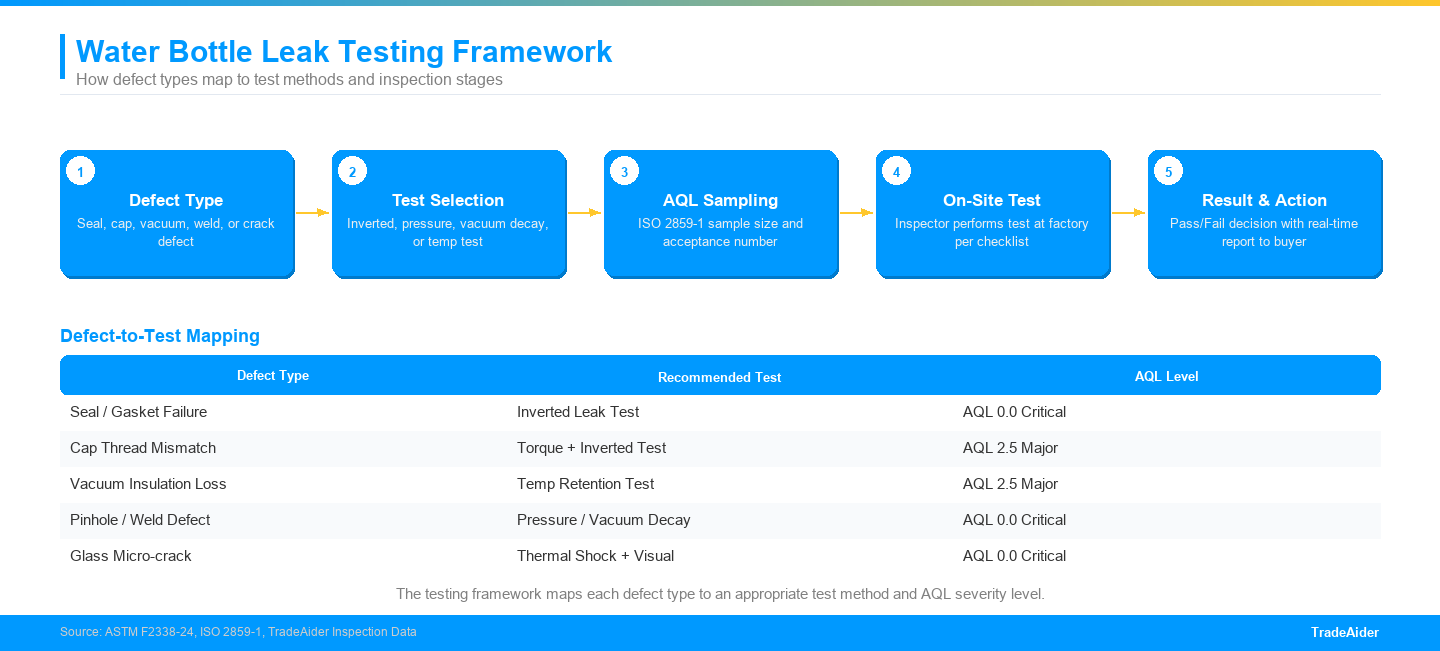
Water bottle leak testing decision framework: the relationship between defect types, test methods, and inspection stages forms a systematic quality gate.
AQL Sampling for Water Bottle Leak Tests
Testing every single bottle in a production run of 10,000 or 50,000 units is impractical. That's where Acceptable Quality Limit (AQL) sampling comes in. AQL, defined in the ISO 2859-1 standard, provides a statistically valid framework for determining how many units to test and how many defects are acceptable.
For water bottle leak tests, inspectors typically apply the following AQL levels:
| Defect Category | AQL Level | What It Means |
|---|---|---|
| Critical (any leak) | AQL 0.0 | Zero tolerance; any leaking unit fails the batch |
| Major (seal misalignment) | AQL 2.5 | Limited major defects allowed per sample size |
| Minor (cosmetic on seal) | AQL 4.0 | More tolerance for minor cosmetic issues |
You can use the AQL calculator to determine exact sample sizes and acceptance numbers for your specific order quantity.
Real-World Scenario: A Shopify Brand's Leak Test Discovery
An Amazon FBA seller ordering 15,000 stainless steel vacuum bottles from a factory in Yongkang scheduled a pre-shipment inspection after the first production run. The factory's own quality team had passed all units. During the independent inspection, the inspector performed inverted leak tests on the AQL sample of 200 units and found 12 bottles with slow seepage around the cap seal, a 6% defect rate on a critical parameter.
Further investigation revealed the factory had changed silicone gasket suppliers mid-production to reduce costs, and the new gaskets were slightly undersized. Because the issue was caught before shipment, the buyer was able to require the factory to replace all gaskets and re-run production, saving an estimated $45,000 in potential returns and negative reviews.
How TradeAider Performs Water Bottle Leak Testing
When you book a pre-shipment inspection with TradeAider, the inspector arrives at your supplier's factory with a detailed checklist tailored to water bottles. The inspection covers workmanship, dimensions, labeling, and functional tests, including water leakage testing.
The key advantage of TradeAider's approach is real-time visibility. Through the TradeAider platform, you receive live photo and video updates as the inspection happens, including footage of leak tests being performed. If the inspector finds a batch failure, you know immediately, not days later after reading a static PDF report. This lets you engage your factory in real time to address issues while production capacity is still available.
At $199/man-day with transparent pricing and no hidden fees, TradeAider makes professional water bottle leak testing accessible for importers of all sizes.
Frequently Asked Questions
How many bottles should be leak tested during an inspection?
The sample size depends on your total order quantity and the AQL level you specify. For a typical order of 10,000 bottles at AQL Level II, the inspector would test approximately 200 units. You can use the AQL calculator to determine the exact sample size for your order.
Can leak testing be done on all types of water bottles?
Yes. Leak testing applies to stainless steel vacuum flasks, plastic sports bottles, glass bottles, collapsible silicone bottles, and insulated tumblers. The test method may vary depending on the bottle type, but the principle is the same: verify that the container holds liquid without seepage under expected use conditions.
What should I do if the inspection finds a high leak rate?
If the defect rate exceeds your AQL limits, the batch is classified as failed. Your options include requiring the factory to rework the batch (replace gaskets, re-tighten tolerances), rejecting the batch entirely, or negotiating a discount. The key is having the inspection data to support your decision. With real-time reporting from TradeAider, you can start these conversations immediately.
Is vacuum decay testing better than inverted leak testing?
Vacuum decay testing (ASTM F2338-24) is more sensitive and can detect micro-leaks that inverted testing misses. However, it requires specialized equipment and is typically performed in a laboratory setting rather than on-site during inspection. For most importers, the inverted leak test combined with proper AQL sampling provides sufficient quality assurance for production batches.
How long does a water bottle leak test take during inspection?
An individual inverted leak test takes 10-30 minutes per unit. However, inspectors typically test multiple units simultaneously, so the total time for leak testing a full AQL sample is usually 1-2 hours within a standard inspection day.
مقالات ذات صلة

نمِ عملك مع خدمة TradeAider
انقر على الزر أدناه للدخول مباشرة إلى نظام خدمة TradeAider. الخطوات البسيطة من الحجز والدفع إلى تلقي التقارير سهلة التشغيل.

