
- معلومات عنا

- خدماتنا
- صناعتك
- الموارد
- الأخبار والمدونة
Golden sample, counter sample, and approved sample are not three names for the same object. They answer different quality questions: what standard should production match, how does the factory interpret the requirement, and what has the buyer formally accepted?
Sample confusion causes factory defects because buyers approve a physical item without defining what the approval means. One sample may show the ideal finish. Another may show the factory's attempt to copy a reference. A third may carry an approval stamp but still exclude packaging, labeling, accessories, barcode, or compliance documents. When those roles are mixed, the factory can claim it followed the sample while the buyer receives a shipment that does not match the commercial product.
The practical issue is not terminology elegance. It is release control. A sample only prevents defects when the factory, buyer, and inspector know which sample governs which product attributes. The sample needs a version, date, scope, approval owner, matching spec sheet, and inspection use.
For importers sourcing from China, the safest approach is to build a sample chain: request a counter sample, approve the correct production sample, lock a golden sample, then inspect the finished lot against that locked reference and the written specification.
Key Takeaways
- Definition: A golden sample is the locked production reference; a counter sample is the factory's interpretation; an approved sample is the buyer's acceptance status.
- Risk: A sample without version, scope, and written tolerances can create more ambiguity than control.
- Evidence: Samples should be paired with specifications, photos, measurements, test limits, and packaging records.
- Inspection: PSI should compare the finished lot against the right sample, not whichever sample is easiest to find.
- Timing: A PSI is conducted when 100% of the order quantity is completed and at least 80% is packed for export.
The Direct Answer
A golden sample is the buyer's locked reference for what mass production should match. A counter sample is the factory's response that shows how it interprets the buyer's requirement. An approved sample is a status decision, not always a complete production standard by itself. Sample control fails when buyers approve a nice unit but do not define version, scope, tolerances, packaging, and inspection use.
TradeAider treats sample control as a release-evidence problem: the inspector can only judge the finished lot if the buyer has named which sample version controls each product, package, label, and accessory detail.
This is why a single photo that says "approved" is weak evidence. It may prove the buyer liked one unit, but it does not prove the factory knows which attributes are critical, which differences are acceptable, or which later changes require reapproval. Strong sample control turns approval into a traceable standard.
Three Samples Solve Three Different Problems
The three sample types form a sequence. The counter sample tests factory interpretation, the approved sample records buyer acceptance, and the golden sample locks the standard for mass production and inspection.
According to ASQ's quality plan guidance, a quality plan can specify standards, resources, specifications, and inspection or audit programs for a product or contract. Sample approval should work the same way. The physical sample is only one part of the control plan; it should be tied to measurable standards, responsible parties, and later inspection activities.
According to ISO's ISO 9001 overview, evidence-based decision making is a quality management principle. In sample control, evidence means more than "the buyer approved it." It means the factory can show which sample version is approved, what it controls, what it does not control, and how production will be checked against it.
Golden sample locks the buyer's final standard
A golden sample should be the locked reference that production and inspection use to decide what "correct" looks like. It should represent the final material, color, finish, assembly, function, packaging, label, accessory set, and market version that the buyer has accepted. The word "golden" should not mean perfect in a vague way; it should mean controlled. If the buyer approves a lamp body but not the retail box, adapter, manual, barcode, and carton mark, the sample is not golden for the whole shipment. It is only a reference for the lamp body.
Counter sample reveals the factory's interpretation
A counter sample is useful before approval because it exposes how the factory interprets the buyer's request. If the buyer sends a reference product or drawing, the factory's counter sample shows whether it understands the material, surface, dimension, assembly feel, accessory count, and packaging expectation. A counter sample is not automatically approved and should not be used as a production master until the buyer reviews it against the spec. The value is diagnostic: it shows where the factory's assumptions differ from the buyer's intention before mass production multiplies the misunderstanding.
Approved sample is a decision status, not always a physical master
An approved sample is a sample the buyer has accepted for a specific purpose. That purpose must be written down. The approval may cover only color, only package artwork, only a pre-production unit, or the complete production standard. Problems begin when the factory treats a limited approval as full approval. If a buyer approves the outer carton artwork but not the inner protection, the factory cannot use that approval to justify weak packaging. The approval record should say what was approved, who approved it, when it was approved, and what still needs confirmation.
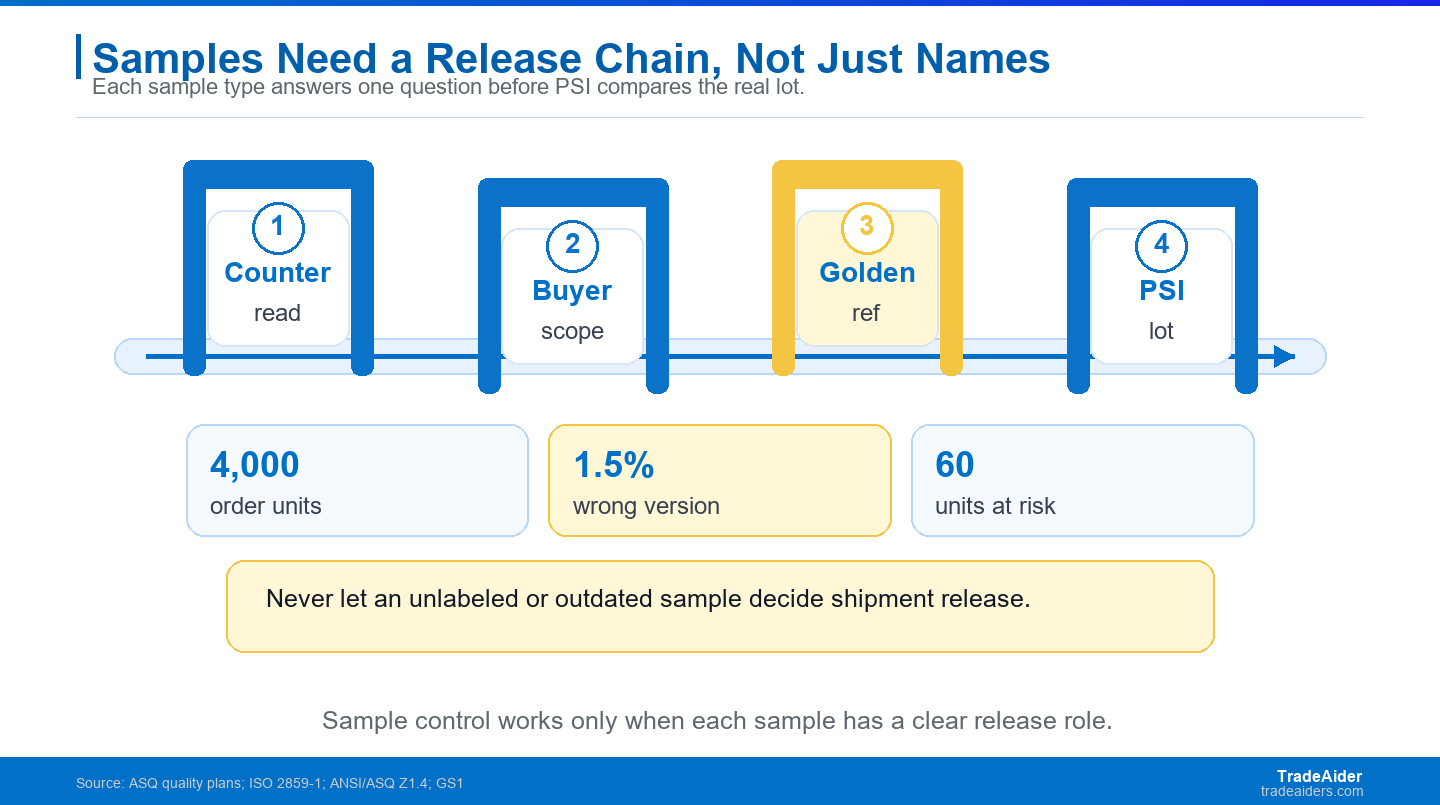
Sample control prevents defects only when each sample has a role, version, and inspection use.
Golden Sample vs Counter Sample vs Approved Sample Comparison
The right sample controls the right decision. Mixing the roles creates avoidable disputes because each side can point to a different object and call it the standard.
The table below separates the role of each sample in a China sourcing workflow.
| Sample Type | Main Question | Best Timing | What It Controls | Common Failure |
|---|---|---|---|---|
| Counter sample | Did the factory understand the requirement? | Before approval and deposit | Factory interpretation | Buyer treats it as approved without review |
| Approved sample | What has the buyer accepted? | Before production release | Accepted attributes within stated scope | Approval scope is not defined |
| Golden sample | What must mass production match? | After final approval, before mass production | Locked production and inspection reference | Sample excludes packaging, label, or accessory version |
The comparison points to one release rule: never let an unlabeled sample decide a shipment. A sample must be connected to the specification, purchase order, version record, and inspection checklist. Without that connection, the sample is evidence of a conversation, not evidence of a standard.
How Sample Control Prevents Factory Defects
Sample control prevents defects by reducing interpretation. The factory should not have to guess which sample matters, which attributes are critical, or whether a later change reopened approval.
According to ISO 2859-1:2026, lot-by-lot inspection by attributes can use sampling schemes indexed by AQL. According to ASQ, ANSI/ASQ Z1.4 provides sampling plans and switching rules for attribute inspection. These standards help decide whether a finished lot should pass, but they still need a clear reference standard. A sample that is not version-controlled cannot support a reliable inspection decision. This is where sample control becomes a real inspection-service problem rather than a naming debate: a TradeAider's Pre-Shipment Inspection can only make a strong release decision when the inspector knows which golden sample, counter sample, or approved sample governs color, dimensions, packaging, labels, and accessory count.
According to GS1 barcode standards, barcodes support product identification in supply chains. According to CBP origin-marking guidance, imported goods may need legible country-of-origin marking. These two sources show why sample control must include labels and packaging, not only the product body. A sample can look perfect while the shipped item fails identity, marking, or market-readiness requirements.
Label each sample with version and scope
Every controlled sample should have a version label: date, product name, SKU, model, factory, buyer, approval owner, and scope. If the sample controls finish only, say finish only. If it controls full retail pack, say full retail pack. If it replaces an older version, retire the old version. This may sound administrative, but it prevents the most common sample-room failure: a factory uses a previous sample because it is still sitting on a shelf. On a 4000 unit order, even a 1.5% wrong-version issue creates 60 units that may need sorting or rework.
Pair the sample with written tolerances
The sample shows appearance and feel; the specification defines measurable limits. A golden sample can show the target color, but the spec should define allowed color range if color consistency is critical. A sample can show assembly fit, but the spec should define torque, gap, weight, or test method when function matters. According to FCC equipment authorization guidance, radiofrequency devices may need authorization before marketing or import, so electronics samples should be tied to model, label, and component version. The sample helps people see the standard; the spec helps them measure it.
Use PSI to test production against the right sample
A PSI is conducted when 100% of the order quantity is completed and at least 80% is packed for export. That is when the buyer can compare the actual shipment against the locked sample and written requirements. According to the CPSC Children's Product Certificate guidance, covered children's products need certificate evidence based on accepted lab testing, so the inspection file should confirm whether the sample, label, and compliance documents describe the same product. The inspector should not inspect against memory or supplier photos; the inspector should inspect against the controlled reference package.
SPAR Scenario: The Approved Color That Was Not an Approved Package
A sample approval can be correct and still incomplete. The defect appears when the factory applies that approval beyond its scope.
Situation: An Amazon seller approves a counter sample for 6000 silicone lunch boxes. The buyer's email says "color and texture approved," and the factory starts production. The retail box artwork is still being revised, but the factory assumes the physical sample approval is enough to begin packing.
Problem: During PSI, the product body matches the approved sample, but 14 of 160 sampled retail boxes use the old barcode position and 9 boxes have a country-of-origin mark that is partly covered by a sticker. The product itself is acceptable; the approved sample simply did not control the final packaging version.
Action: The buyer separates the sample roles. The original sample remains approved for color and texture. A new golden sample package is created with the correct barcode, origin mark, insert, and accessory count. The factory opens affected cartons, replaces old boxes, and the inspector checks a second sample of packed units.
Result: The shipment is delayed by 2 days and the factory charges for replacement boxes. The buyer accepts the cost because the alternative is sending a visually correct product with a packaging identity problem. The useful lesson is that sample approval needs a scope line; "approved" is not enough.
Sample Control Checklist
- Keep one controlled sample set for the buyer, one for the factory, and one reference package for inspection when practical.
- Write the sample scope directly in the approval record: product body, color, function, packaging, label, accessory set, or full shipment standard.
- Retire old sample versions so the factory cannot use them as accidental references.
- Pair each sample with measurable tolerances and pass/fail tests.
- Require PSI to compare finished goods against the locked sample package, not only against supplier photos.
If the factory is working from several sample versions, send TradeAider the golden sample record, counter sample photos, approved sample notes, spec sheet, PO, artwork files, and packing status. The next step is to ask TradeAider to turn the sample package into a PSI release checklist before cartons are sealed.
Frequently Asked Questions
Is a golden sample the same as an approved sample?
No. A golden sample is usually the locked production reference, while an approved sample is a sample the buyer has accepted for a stated purpose. An approved sample becomes a golden sample only when the buyer clearly defines it as the full production and inspection standard.
Who should keep the golden sample?
The buyer and factory should both keep controlled reference samples when possible, and the inspection team should know which version governs the shipment. Each sample should be labeled, dated, and tied to the purchase order or product specification.
Can PSI replace sample approval?
No. PSI checks finished goods against an agreed standard. If the buyer never created a clear sample and specification standard, the inspector has weaker evidence for deciding whether the shipment conforms.
مقالات ذات صلة



نمِ عملك مع خدمة TradeAider
انقر على الزر أدناه للدخول مباشرة إلى نظام خدمة TradeAider. الخطوات البسيطة من الحجز والدفع إلى تلقي التقارير سهلة التشغيل.

