
- معلومات عنا

- خدماتنا
- صناعتك
- الموارد
- الأخبار والمدونة
Quality inspection in China is not about distrusting a supplier; it is how an importer converts buyer requirements into timed evidence before payment, shipment, and customer commitments remove correction leverage. The practical answer is to inspect the risks that can still be changed, record the evidence that proves conformity, and decide whether to release, hold, sort, rework, test, or reinspect before the shipment moves beyond buyer control.
Key Takeaways
- Start from the buyer decision: release, hold, rework, test, pay balance, book shipment, or escalate supplier risk.
- Match timing to correction leverage: PPI protects setup, DPI controls spread, PSI supports final lot release, and loading checks handover.
- Use AQL with a clear lot map: sample size is not enough unless the inspected cartons, SKUs, colors, and subgroups are visible.
- Keep compliance separate from inspection: visual reports do not replace customs, safety, labeling, or testing evidence.
How Should Importers Structure Quality Inspection in China?
Importers should structure China inspection around the decision they need to make: approve a supplier, start production, correct production, release a finished lot, test a claim, or supervise loading.
Quality inspection in China should start with a product file and a decision rule. ISO 9001 connects quality management to requirements and controlled processes, while ISO/IEC 17020:2026 connects inspection to competent, impartial, and consistent determination of conformity. Those two ideas are practical for importers: define the requirement, inspect at the right time, and decide what the evidence means.
The right inspection stage is the one that answers the question the buyer can still act on. If the question is supplier capability, inspect before the PO. If the question is whether materials and labels are ready, inspect before production. If the question is whether defects are spreading, inspect during production. If the question is shipment release, inspect when goods are finished and packed enough to represent the lot.
A China inspection plan should begin with the release decision, then work backward to the evidence needed. That prevents the common mistake of booking a final inspection and expecting it to solve supplier selection, material proof, process control, packaging, testing, and shipment release all at once.
China Inspection Stages and Buyer Decisions
Different inspection stages exist because buyer leverage changes over time. The table below keeps each stage tied to a decision rather than treating inspection as one generic service.
| Stage | Best Buyer Question | Evidence to Request | Likely Action |
|---|---|---|---|
| Supplier audit | Can this supplier make the order reliably? | Factory profile, process, capacity, quality system | Approve, qualify, or avoid |
| Pre-production | Are inputs and setup ready? | Materials, sample, labels, tooling, packing file | Start, hold, or correct setup |
| During production | Are defects spreading? | Early output, defect pattern, process correction | Adjust line or isolate issue |
| Pre-shipment | Can the finished lot ship? | AQL result, photos, counts, labels, cartons | Release, hold, sort, or reinspect |
| Product testing | Are hidden claims proven? | Lab samples, reports, standards, documents | Release claim or retest |
| Loading supervision | Did the right cartons load correctly? | Container condition, count, seal, photos | Load, stop, or record exception |
This structure helps the importer avoid a false sense of control. A supplier audit cannot prove a finished lot. A final inspection cannot reconstruct every upstream material decision. Product testing cannot count cartons. Loading supervision cannot replace product inspection.
The practical rule is to use the stage that closes the risk still open at that moment. If several risks are open, the buyer may need a combined plan instead of one visit.
PPI, DPI, PSI, Testing, and Loading Each Close Different Risks
Pre-Production Inspection checks readiness before production starts. During Production Inspection checks early or mid-production output while correction is still possible. Pre-Shipment Inspection checks finished goods; for TradeAider PSI, the order should be 100 percent complete and at least 80 percent packed for export. ISO 2859-1:2026 can support AQL sampling for attribute-based lot decisions at the correct stage.
Inspection becomes stronger when it is specific. A PPI should not only say the factory is busy. It should check whether materials, samples, labels, tooling, packing files, and production planning match the buyer file. A DPI should not only say some goods were checked. It should identify defect families, concentration, correction action, and whether the risk is likely to spread.
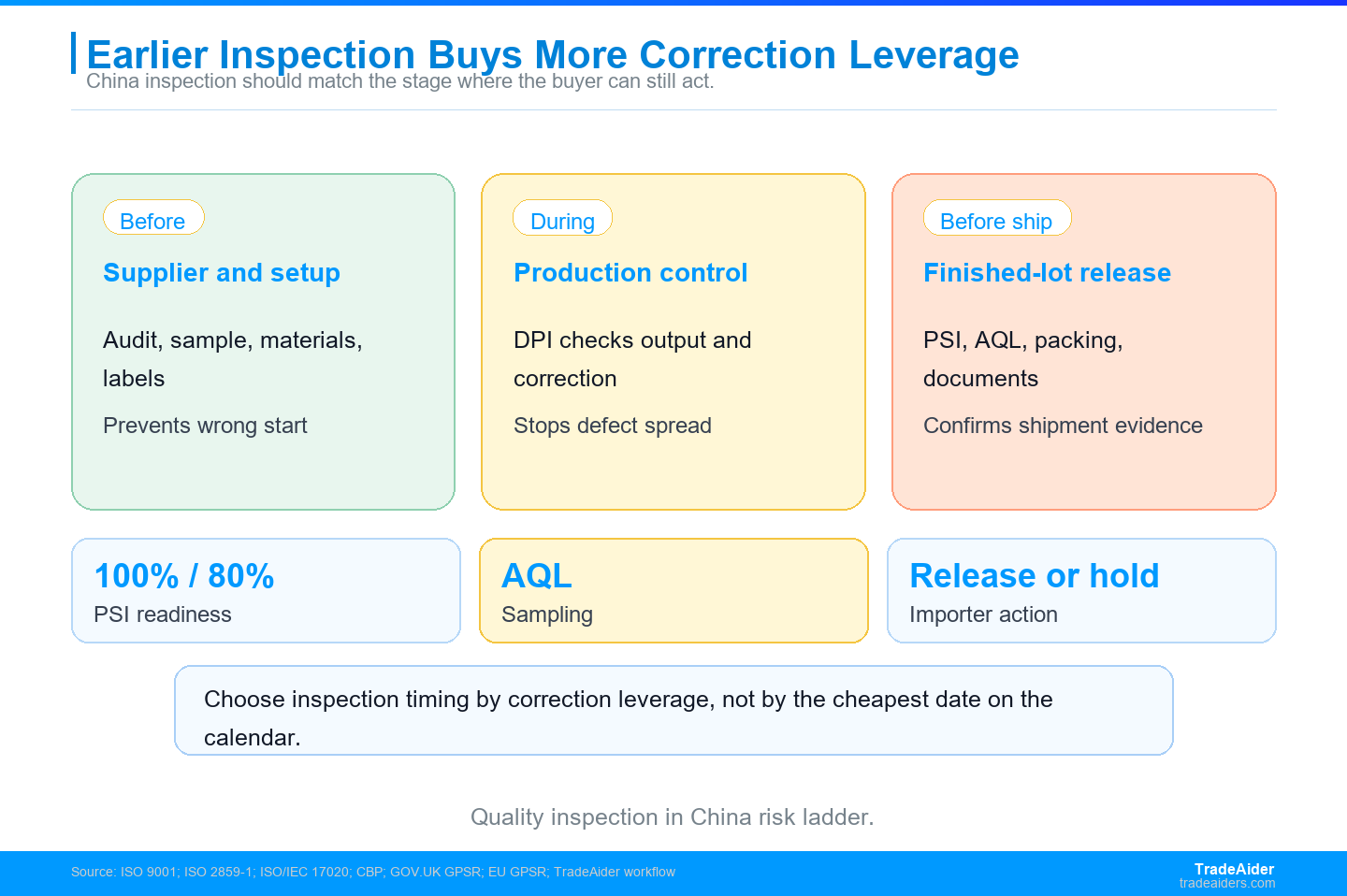
Quality inspection in China gives importers the most leverage when it is matched to the stage where the risk can still be corrected.
Earlier inspection protects correction leverage
The value of early inspection is not that it replaces final inspection. It reduces the chance that final inspection becomes expensive bad news. A wrong label, wrong material, poor bonding setup, or misunderstood tolerance is easier to fix before thousands of units are finished. When a defect can spread by line, material lot, operator station, color, or size, DPI often gives the buyer the most practical containment signal.
In a 20,000-unit order, a defect found at 30 percent production may still be isolated to 1 line, 1 material lot, or 1 date range. The same defect found after 6,000 packed units can become a carton-opening project. Earlier inspection buys the buyer time, not just information.
Final inspection protects release evidence
Pre-shipment inspection remains important because buyers need current evidence before paying balances, booking cargo, or accepting shipment. PSI should show sample size, carton spread, defect counts, severity, photos, measurements, function checks, labels, packing, and release recommendation. It is not a guarantee that every unit is perfect; it is a structured lot decision based on defined sampling and acceptance rules.
Final inspection is strongest when the goods are 100 percent complete and at least 80 percent packed for export. At that point, the buyer can see finished appearance, labels, cartons, quantities, and packing condition together. The limitation is timing: PSI can support release, but it may be late for preventing upstream defect spread.
Importer Compliance Risks Should Not Be Hidden Inside QC
Inspection supports quality decisions, but importers still need customs and safety responsibility. CBP basic importing guidance reminds importers to understand laws and ensure goods are lawfully and safely sourced, while CBP reasonable care guidance frames the importer's responsibility to use care in customs matters.
Destination safety rules can also affect release. GOV.UK GPSR guidance describes importer obligations for product safety in the relevant market context, and the EU GPSR update shows the EU's newer general product safety framework from December 2024. A China inspection report can verify labels, markings, documents, samples, and shipment condition, but it should not replace legal classification, certification, or testing where those are required.
For some trade contexts, the WTO Agreement on Preshipment Inspection shows that preshipment inspection has a formal trade history. For ordinary importers, the practical lesson is narrower: keep inspection evidence, testing evidence, and customs evidence connected but not confused.
AQL Sampling in China Inspection Needs a Lot Map
AQL sampling is useful only when the inspected samples represent the defined lot. ASQ explains acceptance sampling as a way to decide whether to accept or reject based on sample evidence. In China inspection, the buyer should define total quantity, SKUs, colors, sizes, production dates, carton count, and any high-risk subgroup before sample selection.
A report that says 200 units were checked is incomplete if the buyer cannot see where those samples came from. The report should show carton numbers, production dates, size or color spread, and any targeted sampling. If a late-packed SKU or corrected subgroup is checked separately, that should be transparent instead of mixed into the main result.
Representative sampling prevents false comfort
If the sample comes only from accessible front cartons, the buyer may miss cartons packed on another date, another line, or another warehouse zone. Representative sampling does not mean every subgroup gets equal units. It means the sample plan reflects the risk structure of the order. High-risk subgroups may need targeted checks in addition to normal AQL, and the report should label them as targeted evidence.
A sample of 200 units can look statistically serious but still be operationally weak if all samples come from the front row of cartons. The buyer should see carton numbers, date ranges, SKU spread, and targeted checks. Otherwise, the report may say pass while a late-packed subgroup remains untested.
Defect severity connects AQL to buyer action
The buyer should define critical, major, and minor defects before inspection. A failed safety feature, wrong certification label, missing accessory, wrong barcode, severe function failure, or wrong material can create a different action from a small cosmetic mark. AQL only becomes a business tool when the defect classification and acceptance numbers are tied to release, hold, sort, rework, or reinspection.
If one critical defect triggers hold but 7 minor defects can still pass, those thresholds must be clear before the report arrives. Severity turns counts into action. It tells the buyer whether to release, hold, sort, rework, test, or reinspect instead of debating labels after the supplier sees the result.
Scenario Estimate: DPI Can Contain a Defect Before PSI
Scenario estimate: assume a 20,000-unit order. A DPI at 30 percent production finds a defect family affecting 1,800 units and concentrated in one production line. If the buyer waited for PSI only, the same issue might appear after 6,000 packed units require carton opening, sorting, and reinspection.
Calculated from the scenario assumptions, 6,000 packed units x USD 0.18 equals about USD 1,080 of handling before delay or supplier negotiation. The DPI path does not remove all cost, but it creates a smaller containment boundary while the supplier can still correct the process.
This means the value of inspection timing is often defect containment, not only pass or fail. The estimate is illustrative and assumes the defect is visible during production and the supplier cooperates with correction.
Calculated from the same China inspection scenario, every 1,000 packed units opened at USD 0.18 equals USD 180 of handling before supplier negotiation. Calculated from a 30 percent DPI point, the buyer sees risk after 6,000 units instead of waiting for 20,000 units to finish. Calculated from a 2-day correction window, an earlier visit means 48 hours of process adjustment before shipment booking. Calculated from 3 inspection stages, PPI, DPI, and PSI means 3 different buyer decisions rather than one generic pass or fail.
Where TradeAider Fits in China Inspection
TradeAider helps importers choose the inspection stage that matches the open risk, the production status, and the buyer release decision.
If the buyer needs supplier confidence, factory audit services can review capability, process, capacity, and basic quality systems. If materials, samples, labels, or setup are uncertain, Pre-Production Inspection can check readiness before production starts.
If production is already moving, During Production Inspection can check early output, defect concentration, correction evidence, and process stability. If the order is finished, Pre-Shipment Inspection can support release with AQL sampling, photos, defect counts, labels, packing, and report evidence.
If hidden safety, material, or performance claims matter, TradeAider can coordinate product testing services. If you are planning inspection in China, send the PO, approved sample, product file, order quantity, production status, destination market, known risks, and shipment date. The next step is to choose the inspection stage before correction leverage disappears.
SPAR Scenario: Final Inspection Was Too Late for a Label Error
Situation: A buyer ordered 18,000 units with new destination-market labels and a tight delivery date.
Problem: The supplier planned final inspection only, but the label change was being applied manually during production.
Action: TradeAider added a DPI focused on the first labeled units, label artwork, carton spread, and correction proof before PSI.
Result: The buyer corrected the label process after 740 affected units instead of reopening thousands of packed cartons at final inspection.
China Inspection Checklist for Importers
Use this checklist before booking a China inspection. It keeps the inspection tied to buyer decisions rather than supplier reassurance.
- Define the buyer decision: supplier approval, production start, correction, shipment release, testing, payment, or loading.
- Freeze product file, approved sample, drawings, tolerances, labels, packaging, and destination requirements.
- Choose PPI, DPI, PSI, testing, audit, or loading supervision by the open risk.
- Define lot size, SKUs, colors, sizes, cartons, production dates, and high-risk subgroups.
- Set critical, major, and minor defect rules before inspection.
- Require photos, counts, measurements, sample spread, exception evidence, and release action.
The buyer should be able to read the report and decide what happens next. If the report does not support that decision, the inspection scope was too vague.
Related Guides
For a broader inspection-method view, read quality inspection methods, manufacturing inspection methods, and third-party inspection for importers. TradeAider buyers can use these guides to decide whether the next risk needs PPI, DPI, PSI, testing, audit, or loading evidence.
Frequently Asked Questions
What is quality inspection in China?
Quality inspection in China is the buyer-facing verification of supplier readiness, production output, finished goods, packaging, labels, testing evidence, or loading condition before the importer makes a business decision. It can include audits, PPI, DPI, PSI, product testing, and container loading checks.
When should importers use pre-shipment inspection in China?
Use pre-shipment inspection when goods are finished enough to represent the shipment. For TradeAider PSI, the order should be 100 percent completed and at least 80 percent packed for export so labels, packaging, cartons, quantities, and finished-lot defects can be reviewed before release.
Is AQL required for China inspection?
AQL is common for finished-lot inspection, but it is not the only method. It works best for attribute defects in a defined lot. Process risks, hidden material claims, safety issues, and compliance questions may require PPI, DPI, testing, documents, or audits.
How do importers choose between PPI, DPI, and PSI?
Choose PPI when setup, materials, labels, or samples are uncertain before production. Choose DPI when defects can spread and correction is still possible. Choose PSI when the finished lot needs shipment-release evidence. Many higher-risk orders need more than one stage.
Can inspection in China guarantee product compliance?
No. Inspection can verify visible quality, quantities, labels, packaging, documents, samples, and report evidence, but legal compliance may also require classification, certificates, lab testing, customs review, and market-specific requirements. Keep inspection evidence and compliance evidence connected but separate.
مقالات ذات صلة

نمِ عملك مع خدمة TradeAider
انقر على الزر أدناه للدخول مباشرة إلى نظام خدمة TradeAider. الخطوات البسيطة من الحجز والدفع إلى تلقي التقارير سهلة التشغيل.

