
- معلومات عنا

- خدماتنا
- صناعتك
- الموارد
- الأخبار والمدونة
Every new China supplier relationship begins with the same question: how do you know if this factory is actually capable of delivering what it claims before you commit real money? According to the U.S. International Trade Administration, China remains the world's largest manufacturing hub — which means an enormous number of supplier options, with an equally enormous variance in capability and reliability. Two primary tools exist for new supplier qualification: the product sample order and the factory audit. Many first-time importers assume samples are sufficient. This article introduces the Audit vs Sample Decision Framework to explain precisely when each tool is appropriate, what each reveals, and what combination of both produces the most reliable foundation for a first production order.
Key Takeaways
- Framework: The Audit vs Sample Decision Framework provides a 5-stage sequence for new China supplier vetting, with clear decision rules for when to add audit verification to sample-based qualification.
- Samples alone are insufficient for any production order above test-level. Samples verify product specification compliance; audits verify whether the factory can reproduce that quality consistently at production volume.
- Audit first, then sample is the sequence recommended for orders above approximately $5,000–10,000 — the audit confirms capability, the sample confirms specification alignment.
- Supplier refusal to audit is a significant red flag: legitimate factories with nothing to hide welcome independent verification as part of a professional supplier relationship.
- Cost threshold: A one-day factory audit at $199/man-day costs less than 1% of most first orders — making it the highest-return risk management investment available at the qualification stage.
The Audit vs Sample Decision Framework
The Audit vs Sample Decision Framework organizes the five stages of new China supplier qualification into a logical sequence, assigning the appropriate verification tool to each stage based on what information is needed and what risk is being managed. The framework is built on a core principle: samples verify the product; audits verify the supplier's capability to produce that product reliably and at scale. These are different questions requiring different tools. Using only samples to qualify a new Chinese supplier is like test-driving one car and concluding the manufacturer can build 10,000 reliable vehicles — the sample tells you about the specific item produced, not about the factory's systemic capability.
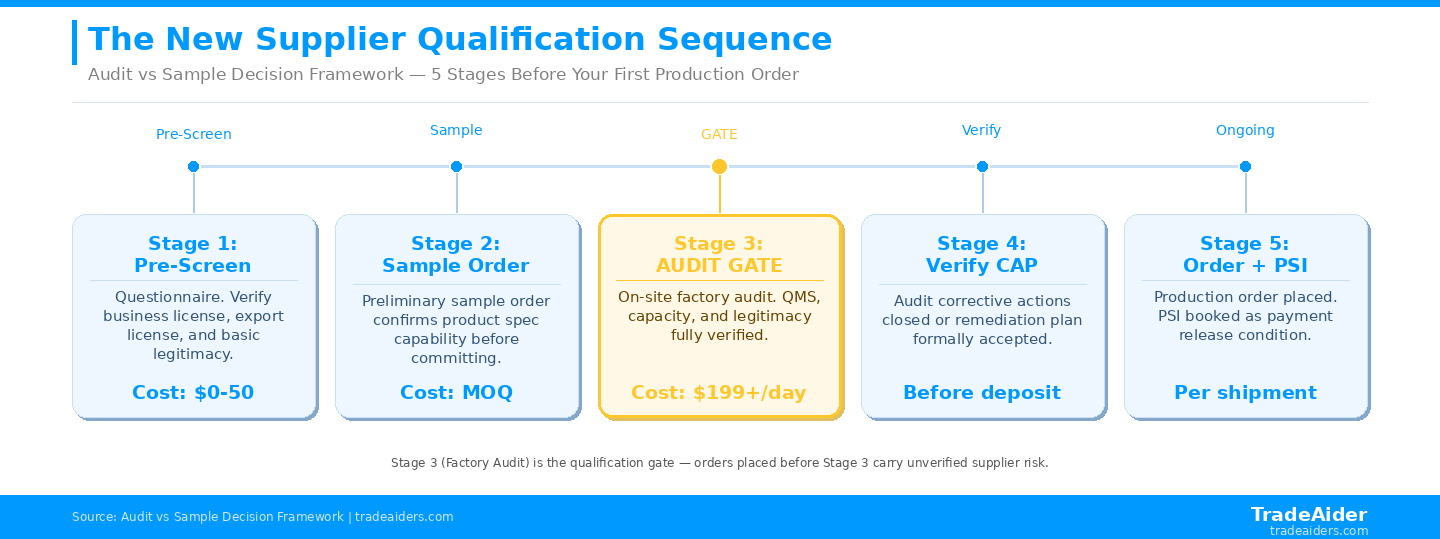 The Audit vs Sample Decision Framework: 5 stages from supplier shortlist to verified production order. Stage 3 (audit) is the qualification gate.
Stage 1 — Pre-Screening (Documents and Questionnaire)
The first stage uses a structured supplier questionnaire to narrow a supplier shortlist from initial discovery through platforms such as Alibaba, Made-in-China, or direct sourcing channels. Questionnaire content covers business registration, export licenses, production capacity claims, and relevant certifications. This stage costs little but produces self-reported data — use it to eliminate obviously unsuitable candidates, not to confirm supplier quality. Key disqualifiers at this stage include missing or clearly fraudulent business licenses, refusal to provide basic documentation, and capacity claims that are mathematically implausible for the stated factory size. As noted by supplier qualification research from simpleQuE, 45% of manufacturing leaders identify supplier disruptions as their top external threat — questionnaire pre-screening reduces the shortlist but does not address this risk.
Stage 2 — Sample Order
The sample order is the first tangible verification step — physical product samples from the top 2–3 shortlisted suppliers allow direct evaluation of specification compliance, material quality, workmanship, and packaging. Samples confirm what the factory is capable of producing when attention is focused on a single buyer's requirement. They do not confirm that production quality will be maintained at volume, that the same materials and processes will be used for the production order, or that the factory's operational capability matches what you observed in the sample. One critical risk at the sample stage is "bait-and-switch" or "quality fade": the sample is produced under exceptional care specifically to win the order, after which production quality gradually declines. According to supplier quality management research from Deltek, a significant portion of the Cost of Poor Quality originates in supplier-related activities — activities that a sample cannot reveal.
Stage 3 — Factory Audit (New Supplier Qualification Gate)
The factory audit is the qualification gate in the Audit vs Sample Decision Framework. For any order above approximately $5,000–10,000 with a new supplier, completing a factory audit before placing the production order is the correct decision sequence. The audit verifies that the factory's stated capabilities are real: equipment exists and is calibrated, production lines are operational, QMS documentation is active rather than decorative, worker count matches claims, and no undisclosed subcontracting arrangements exist. A factory audit conducted before the production order — not after quality problems emerge — is a proactive decision that costs $199–400/man-day and prevents exposures that can reach tens of thousands of dollars. TradeAider's factory audit service combines on-site verification with real-time monitoring, allowing buyers to observe audit findings live and direct the auditor's attention to specific areas of concern.
Stage 4 — Production Order with Pre-Shipment Inspection
After a supplier has passed both sample qualification and factory audit, the first production order is placed with a pre-shipment inspection (PSI) booked as a condition of payment release. The PSI closes the quality loop at the shipment level: where the factory audit confirmed systemic capability, the PSI verifies that this specific production run — this exact order quantity — meets the agreed specifications before goods leave the factory. This combination of audit and PSI represents the minimum recommended quality program for a new China supplier in the first production cycle. According to supplier audit guidance from Ramp, the audit closing and corrective action process is most effective when documented in detail — providing the buyer with a baseline supplier record against which subsequent performance is measured.
Stage 5 — Ongoing Supplier Monitoring
After a successful first production cycle, the supplier transitions from "new supplier qualification" to "ongoing supplier management." Annual re-audits are standard practice for strategic suppliers; pre-shipment inspections should continue for every production order where quality failure would be significant. The Audit vs Sample Decision Framework does not end at the first order — it establishes the verification baseline that ongoing monitoring builds on over time.
Audit vs Sample: What Each Tool Reveals (and What It Doesn't)
Understanding the specific scope of each tool is the foundation of the Audit vs Sample Decision Framework. The comparison below maps key supplier qualification questions to the tool that can reliably answer them.
| Qualification Question | Sample Order | Factory Audit |
|---|---|---|
| Does the product meet my specifications? | Yes — direct verification | Indirectly (via QMS audit) |
| Is the factory legally registered and legitimate? | No | Yes — Pillar 1 verification |
| Can the factory produce this quality at volume? | No | Yes — capacity and QMS verified |
| Will production be subcontracted to another factory? | No | Yes — on-site verification |
| Does finished goods quality match sample quality? | No (sample ≠ production run) | Partially (QMS checks) |
| Are production equipment and tools as claimed? | No | Yes — Pillar 4 verification |
| Are labor practices compliant? | No | Yes — Pillar 7 social compliance |
Based on this comparison, the data shows that samples and audits are complementary tools with almost entirely non-overlapping scope. A sample answers "did this specific item meet my specifications?" An audit answers "does this supplier have the organizational capability to consistently produce to those specifications at scale, and is it legitimate?" Both questions must be answered before a buyer can place a meaningful production order with confidence. The Audit vs Sample Decision Framework makes this explicit: qualification is incomplete until both tools have been applied.
When a Supplier Refuses an Audit — and What It Means
A practical test at the supplier shortlist stage is to inform each shortlisted factory that an on-site audit will be required before placing the first production order. A legitimate, capable manufacturer will accept this as a professional standard — independent quality verification is part of any serious supplier-buyer relationship. A supplier that becomes evasive, cancels communication, or refuses an audit should be treated as a significant red flag. Refusal does not prove that a factory is fraudulent, but it does prove that the factory is unwilling to submit to independent verification — which is itself a supply chain risk signal. Legitimate factories with strong quality systems understand that audits benefit both parties: the buyer gains verified confidence, and the factory demonstrates its capabilities without relying solely on its own claims. TradeAider's approach focuses on proactive, problem-solving oriented quality control — working with suppliers rather than against them to surface and resolve issues at the earliest possible stage.
Audit Timing: Before or After the Sample?
A common question in applying the Audit vs Sample Decision Framework is whether the audit should come before or after the sample order. The recommended sequence is: preliminary sample first (to confirm the supplier can produce the product at all), then audit before committing to the production order. This sequence minimizes wasted audit costs on clearly unsuitable suppliers while ensuring that the audit verification happens before meaningful financial exposure. In some cases — particularly for very high-value first orders, regulated products, or suppliers found through channels with limited verification history — auditing before any sample order provides the safest basis for engagement. The ISO 9001:2015 Clause 8.4 framework for controlling externally provided processes recommends risk-based supplier evaluation — meaning the appropriate depth and timing of verification scales with the risk profile of the supply relationship, not with a fixed universal sequence.
Practical Checklist: New China Supplier Qualification Decision Points
Use the following checklist when qualifying a new Chinese supplier for a first production order. Each item corresponds to a stage in the Audit vs Sample Decision Framework. A supplier should pass all applicable items before the production order is placed and deposit wired. To learn how inspection costs compare to potential order loss, TradeAider's calculator lets you model the ROI of audit investment against your specific order values.
| Stage | Checklist Item | Tool |
|---|---|---|
| 1 | Business license verified, factory address confirmed | Questionnaire + Audit |
| 2 | Preliminary sample meets specifications | Sample Order |
| 3 | Factory audit completed; QMS, capacity, equipment verified | On-Site Audit |
| 4 | Corrective actions from audit confirmed or remediation plan accepted | Audit Follow-up |
| 5 | PSI booked as payment condition for first production order | Pre-Shipment Inspection |
| 6 | Annual re-audit scheduled for ongoing supplier management | Recurring Audit Program |
This six-step sequence embodies the Audit vs Sample Decision Framework applied to new supplier qualification. It is not a single event but a structured process that converts an unknown supplier — found online — into a verified supply chain partner with documented qualification evidence. As standardized supplier audit evaluation frameworks confirm, systematic qualification reduces both the frequency and severity of supply chain quality failures over time.
Who Is TradeAider?
TradeAider is a quality inspection, testing, and certification service provider in China. TradeAider operates across all of China, covering major manufacturing provinces including Guangdong, Zhejiang, Jiangsu, Shandong and Fujian, etc.
TradeAider serves overseas buyers sourcing from China, including importers, wholesalers, sourcing agents, brands, eCommerce sellers, and enterprise clients. Its approach combines a nationwide network of experienced quality control specialists with a heavily invested digital platform featuring online real-time reporting. Clients can monitor inspections live, communicate directly with inspectors, and address issues during production rather than after shipment — a proactive model focused on problem-solving and prevention, not just defect identification.
Pricing is transparent at $199/man-day all-inclusive for supplier audit & quality inspection Services, with no hidden surcharges. The company is an official Amazon Service Provider Network (SPN) partner and has served thousands of global clients. Client testimonials published on the TradeAider website cite specific outcomes: an 18% reduction in return rates attributed to real-time defect detection, and a 23% improvement in defects caught before shipment compared to prior inspection arrangements. These are client-reported figures.
Frequently Asked Questions
Should I audit a factory before or after ordering samples?
The recommended sequence in the Audit vs Sample Decision Framework is: preliminary sample order first (to confirm the supplier can produce the product), then factory audit before committing to the production order. This approach avoids wasting audit cost on clearly unsuitable suppliers while ensuring audit verification happens before significant financial exposure. For very high-value orders, regulated products, or high-risk sourcing channels, auditing before any sample order provides the highest protection.
Is a good sample guarantee of production quality?
No. A sample confirms that the factory can produce one item meeting your specifications under focused attention. It does not confirm that the factory can reproduce that quality consistently across a full production run, that the same materials will be used at volume, or that the factory's QMS will prevent defects at scale. Production quality "fade" — where the sample quality is not maintained in the production order — is one of the most common problems in China sourcing and is not detectable through samples alone. A factory audit verifies the systemic capability behind the sample.
What is the Audit vs Sample Decision Framework?
The Audit vs Sample Decision Framework is a 5-stage new supplier qualification model for overseas buyers sourcing from China. Stage 1 is questionnaire pre-screening; Stage 2 is preliminary sample order; Stage 3 is factory audit (the qualification gate before the production order); Stage 4 is the first production order with pre-shipment inspection; Stage 5 is ongoing annual re-audits. The framework provides a structured sequence that combines sample-based product verification with audit-based capability verification — the two tools required for complete new supplier qualification.
What should I do if a supplier refuses a factory audit?
A supplier who refuses an independent factory audit should be treated as a high-risk partner. Legitimate factories with nothing to hide welcome independent verification. Audit refusal may indicate undisclosed subcontracting, capability misrepresentation, labor or compliance issues, or simple unwillingness to accept buyer oversight — all of which are risk signals worth taking seriously. In most cases, the appropriate response is to continue qualification with an alternative supplier who accepts audit verification as a standard part of a professional buying relationship.
Starting a new Chinese supplier relationship? Contact TradeAider to book a new supplier factory audit at $199/man-day — the qualification step that converts a supplier's claims into verified data before you wire your deposit.
مقالات ذات صلة

نمِ عملك مع خدمة TradeAider
انقر على الزر أدناه للدخول مباشرة إلى نظام خدمة TradeAider. الخطوات البسيطة من الحجز والدفع إلى تلقي التقارير سهلة التشغيل.

