

When vetting a Chinese supplier for the first time, buyers face a real question: how deep does your verification need to go? According to supplier quality research from simpleQuE, 45% of senior manufacturing leaders identify supplier disruptions as a top external threat — and most of those disruptions trace back to inadequate upfront supplier qualification. Three verification methods are available to importers: the supplier questionnaire (self-reported documents), the virtual or video factory audit (remote live inspection), and the on-site third-party factory audit (physical verification). This article uses The 3-Layer Supplier Verification Framework to explain what each method actually reveals, what it cannot, and how to match verification depth to order risk.
Key Takeaways
- Definition: Supplier questionnaires rely entirely on self-reported data; virtual audits add live visual verification; on-site audits are the only method that physically validates factory conditions.
- Data quality: Only an on-site third-party audit can verify physical infrastructure, hidden subcontracting, equipment calibration, actual worker count, and whether production genuinely occurs at the audited facility.
- Decision rule: Use questionnaires for pre-screening only. Add virtual audits for low-value first orders or as a supplement to on-site audits. Use on-site audits for any order where quality failure would create significant financial or reputational risk.
- Framework: The 3-Layer Supplier Verification Framework maps each method to an order value and risk threshold, giving buyers a clear decision rule rather than a subjective judgment.
- Cost context: On-site audits start at $199/man-day — a cost that is typically recovered by avoiding a single defective shipment or production halt.
Why Supplier Verification Method Matters
China's manufacturing ecosystem is enormous. As World Bank manufacturing data shows, China contributes more to global manufacturing value added than any other country — which means a corresponding volume of supplier relationships are initiated every year by overseas buyers who have never physically visited their factories. In that environment, the verification method a buyer chooses before placing their first order directly determines how much real information they actually have about their supplier versus how much they have been told by the supplier themselves.
The problem with most approaches to China supplier qualification is that they conflate data collection with data verification. A supplier questionnaire collects claims. A virtual tour shows a camera-framed slice of a facility. Only an on-site audit — conducted by an independent third-party auditor with full physical access — verifies whether those claims are grounded in operational reality. As the U.S. International Trade Administration notes, Chinese supply chain relationships carry layers of regulatory and operational complexity that make on-the-ground oversight essential for any serious buyer program.
Introducing the 3-Layer Supplier Verification Framework
The 3-Layer Supplier Verification Framework organizes the three available verification methods into a hierarchy based on the depth and verifiability of the data each produces. The framework assigns each method to a specific use case and risk threshold, giving buyers a decision rule rather than a subjective judgment about "how much verification is enough." The three layers are: Layer 1 (Supplier Questionnaire), Layer 2 (Virtual Factory Audit), and Layer 3 (On-Site Third-Party Audit).
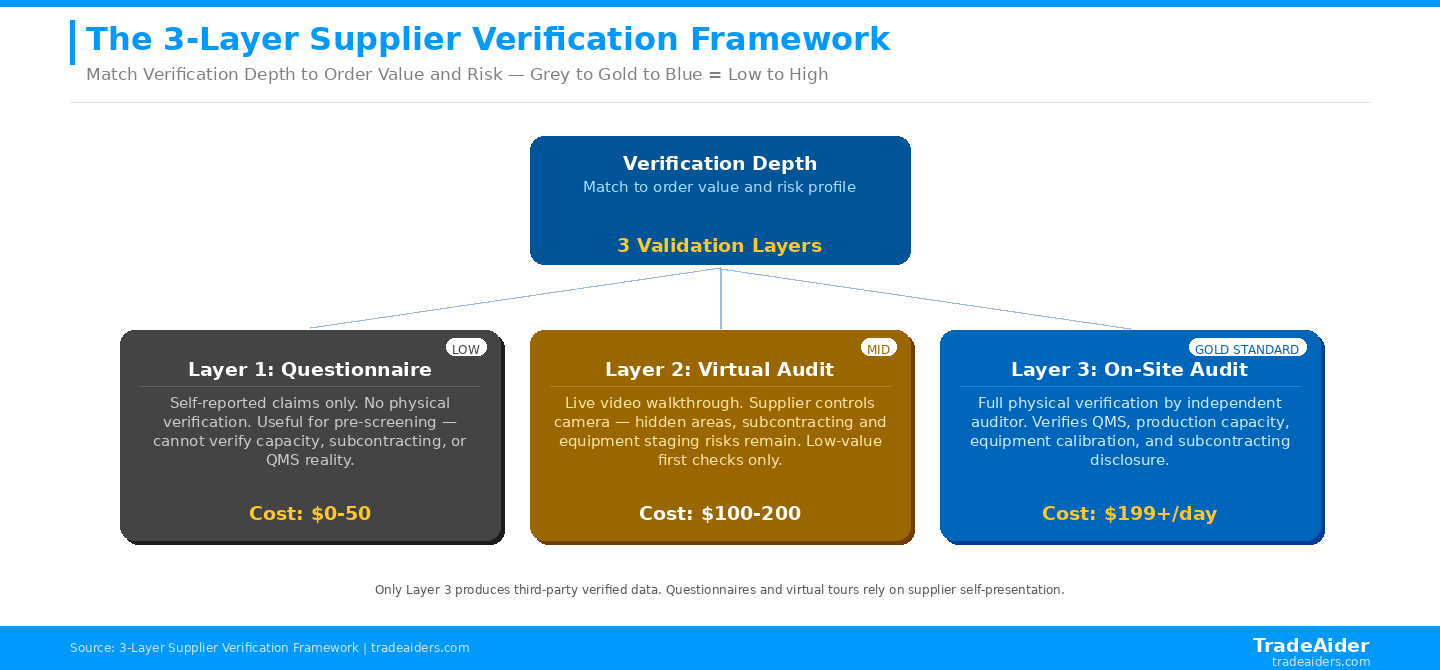 Only Layer 3 (on-site audit) produces third-party verified data — questionnaires and virtual tours rely on supplier self-presentation.
Layer 1 — The Supplier Questionnaire
The supplier questionnaire is a document request sent to the factory before any engagement. Typical questionnaire content covers business registration, export licenses, quality certifications (ISO 9001, product certifications), production capacity claims, and historical compliance documentation. Its cost is near zero; its limitation is total reliance on self-reported data. Questionnaires tell you what a supplier says about itself. They do not verify whether any of those claims are true. A factory can submit a legitimate-looking questionnaire with fabricated export volumes, borrowed ISO certificates, or capacity figures that reflect a different facility than the one they intend to use for your order. As a pre-screening tool to narrow a supplier shortlist, questionnaires have genuine value — as a standalone verification method for any meaningful order, they do not.
Layer 2 — The Virtual Factory Audit
A virtual or video factory audit involves a live video walkthrough of the factory facility, typically combining a video call with the supplier's team and a guided tour of production areas, equipment, and working conditions. Virtual audits became common during 2020–2022 when travel restrictions made on-site visits impossible, and they remain a practical first-look tool for buyers in the early qualification stage or for very small orders. The key limitation is selective visibility: the supplier controls what the camera shows. Hidden areas, subcontracted production floors, and falsified equipment staging are all possible in a virtual audit. A virtual audit also cannot physically verify equipment calibration, inspect raw material storage conditions, conduct random worker interviews without supplier presence, or assess fire safety and building structure in any meaningful way. Virtual audits are best understood as an upgrade over a questionnaire — not as a substitute for on-site verification.
Layer 3 — The On-Site Third-Party Factory Audit
The on-site third-party factory audit, conducted by an independent auditor with full physical access to the facility, is the only verification method that produces genuinely verified data. On-site auditors can walk every area of the facility — including areas a supplier might prefer to hide from a camera — inspect equipment calibration records, interview workers independently, review production documentation under conditions where fabrication is much harder, and assess physical infrastructure such as building structure, fire safety systems, raw material handling, and subcontracting arrangements. According to supplier quality management research from Deltek, a significant portion of the Cost of Poor Quality stems from supplier-related activities that only surface through systematic evaluation — not through questionnaires or video calls. The on-site audit is the method that converts supplier claims into verified evidence.
Side-by-Side Comparison: Three Supplier Verification Methods
We compared all three methods across six dimensions that determine verification reliability. The table uses established industry standards for each method type.
| Dimension | Supplier Questionnaire | Virtual / Video Audit | On-Site Third-Party Audit |
|---|---|---|---|
| Data Source | Self-reported only | Supplier-controlled video | Independent physical verification |
| Physical Infrastructure Verified | No | Partial (camera-limited) | Yes — full facility access |
| Hidden Subcontracting Detection | No | Very limited | Yes |
| Worker Interview (Independent) | No | No (supplier-supervised) | Yes — unaccompanied interviews |
| Equipment Calibration Verification | Document claim only | Visual only, unverified | Physical log + instrument check |
| Typical Cost | $0–50 (internal time) | $100–200 | $199–400/man-day |
| Suitability for First-Order Qualification | Pre-screening only | Low-value orders | All order values above $5,000+ |
Based on this comparison, the data shows a fundamental difference in verification quality between on-site audits and the alternatives. Questionnaires and virtual audits produce data that is structurally reliant on supplier cooperation and self-presentation; on-site audits produce data that is third-party verified. For any buyer placing an order where quality failure carries real financial or reputational consequences, the comparison reveals that Layers 1 and 2 are insufficient as standalone qualification methods.
What Only On-Site Verification Can Reveal
Shadow Factories and Subcontracting
One of the most significant risks in China supplier qualification is the "bait-and-switch" or shadow factory scenario: a supplier presents a qualified, capable facility during negotiations, then subcontracts production to a lower-cost, lower-capability factory for the actual order. Questionnaires cannot detect this. Virtual audits, where the supplier controls the camera, provide no reliable protection against it. An on-site audit conducted after production has begun — or as part of a during-production inspection — can identify whether the facility actually producing your goods matches the one that was audited. This is why periodic on-site factory audits are recommended not just at supplier onboarding but at regular intervals throughout the supplier relationship.
Quality Management System Reality vs. Certification Claims
ISO 9001 certification is widely held by Chinese manufacturers, but certification does not guarantee that the quality management system described in the certificate is actively and consistently implemented on the production floor. As noted in industry research, many Chinese factories hold ISO 9001 certificates that do not reflect their actual operational discipline — the certificate was obtained through a certification body without embedding real process change. An on-site audit evaluates QMS implementation in practice: auditors check whether production records are maintained consistently, whether calibration logs reflect actual equipment status, whether corrective actions from previous issues are genuinely closed, and whether quality checkpoints on the production line operate as documented. ISO 9001:2015 Clause 8.4 places this verification responsibility explicitly on the buyer — the standard requires that buyers control and evaluate externally provided processes, not merely accept supplier self-certification.
Worker Count, Capacity, and Infrastructure Claims
A supplier claiming 500 workers and 20 production lines on a questionnaire cannot have that claim verified by a questionnaire or a camera angle. An on-site auditor physically counts active workstations, observes actual production throughput, inspects raw material inventory against claimed lead times, and assesses whether the facility has the infrastructure — power, ventilation, tooling, testing equipment — to deliver on stated production capacity. This is the most common category of misrepresentation in China supplier qualification, and it is invisible to any verification method except physical presence. According to supplier audit guidance from Ramp, pre-audit questionnaires are best used to target high-risk areas before arriving on-site — they are preparation tools for an audit, not substitutes for one.
Applying the 3-Layer Supplier Verification Framework to Your Sourcing Decision
The 3-Layer Supplier Verification Framework provides a practical decision rule for overseas buyers sourcing from China. Use the order value and risk profile of each supplier relationship to select the appropriate verification depth.
When to Apply Layer 1 (Questionnaire Only)
Questionnaires are appropriate for pre-screening a long supplier shortlist — reducing 20 potential factories to 5 before committing to deeper evaluation. They are also a useful administrative step before any audit, allowing auditors to review certifications and documents in advance. Questionnaires should never be the sole verification method for a supplier that will produce orders above test-sample level, regardless of how professional the factory's documentation appears.
When to Add Layer 2 (Virtual Audit)
Virtual audits are appropriate as a preliminary check for very small first orders (under approximately $3,000–5,000) where the buyer wants a basic visual confirmation before committing to a physical audit. They are also useful as a mid-cycle supplemental check for an established supplier between annual on-site audits, covering specific concerns that do not require a full physical visit. Virtual audits work best when combined with — not instead of — Layer 3 for any strategic supplier.
When to Require Layer 3 (On-Site Third-Party Audit)
On-site audits are required before committing meaningful production volume to any new supplier — in practice, before placing any order above $5,000–10,000 with a factory that has not been third-party verified. They are also the appropriate method for re-qualifying an existing supplier after any quality incident, after personnel or ownership changes, or as part of annual supplier review programs. TradeAider's factory audit service applies the 3-Layer Supplier Verification Framework through its on-site audit process, which covers manufacturing capability, QMS effectiveness, capacity verification, and corrective action history — the full set of checkpoints that only physical presence can validate. As the standard supplier audit evaluation framework confirms, a compliant audit must cover management responsibility, infrastructure, personnel practices, and traceability — dimensions that questionnaires and video calls cannot systematically address.
Cost Comparison: Verification Method ROI
The cost differential between the three verification methods looks significant in isolation: $0–50 for a questionnaire, $100–200 for a virtual audit, and $199–400/man-day for an on-site audit. The relevant comparison is not audit cost versus zero; it is audit cost versus the cost of a supplier qualification failure. A single defective shipment on a $30,000 order — requiring rework, air freight, partial rejection, or customer compensation — will typically cost more than 10 on-site audits at $199/man-day. The U.S. International Trade Administration's China overview notes that China remains central to global manufacturing supply chains, reinforcing that the structural argument for investing in on-site verification is as strong as ever — particularly as tariff environments increase the financial stakes of each sourcing decision. TradeAider's inspection cost calculator allows buyers to model this ROI directly against their specific order values and defect risk scenarios.
Who Is TradeAider?
TradeAider is a quality inspection, testing, and certification service provider in China. TradeAider operates across all of China, covering major manufacturing provinces including Guangdong, Zhejiang, Jiangsu, Shandong and Fujian, etc.
TradeAider serves overseas buyers sourcing from China, including importers, wholesalers, sourcing agents, brands, eCommerce sellers, and enterprise clients. Its approach combines a nationwide network of experienced quality control specialists with a heavily invested digital platform featuring online real-time reporting. Clients can monitor inspections live, communicate directly with inspectors, and address issues during production rather than after shipment — a proactive model focused on problem-solving and prevention, not just defect identification.
Pricing is transparent at $199/man-day all-inclusive for factory audit & Inspection Services, with no hidden surcharges. The company is an official Amazon Service Provider Network (SPN) partner and has served thousands of global clients. Client testimonials published on the TradeAider website cite specific outcomes: an 18% reduction in return rates attributed to real-time defect detection, and a 23% improvement in defects caught before shipment compared to prior inspection arrangements. These are client-reported figures.
Frequently Asked Questions
Is a supplier questionnaire enough to qualify a Chinese factory?
A supplier questionnaire is not sufficient to qualify a Chinese factory for meaningful production volume. Questionnaires collect self-reported claims about certifications, capacity, and compliance — they do not verify any of those claims physically. Questionnaires are appropriate for pre-screening a supplier shortlist, but for any order where quality failure would be financially significant, an on-site third-party audit is required to convert supplier claims into verified data.
What can a virtual factory audit reveal that a questionnaire cannot?
A virtual audit adds live visual confirmation of the factory's physical existence, the general condition of the production floor, and a real-time conversation with factory management. Compared to a questionnaire, this provides a meaningful additional layer of information. However, a virtual audit cannot verify hidden subcontracting arrangements, equipment calibration records, independent worker conditions, or physical infrastructure not shown to the camera — all of which an on-site audit can address.
What is the 3-Layer Supplier Verification Framework?
The 3-Layer Supplier Verification Framework is a decision model that matches verification method to order risk: Layer 1 (questionnaire) for pre-screening, Layer 2 (virtual audit) for low-value initial checks, and Layer 3 (on-site third-party audit) for any production commitment where quality failure carries real financial or reputational consequences. The framework provides a decision rule rather than a subjective judgment about verification depth, reducing the risk of under-qualifying suppliers at early stages of a sourcing relationship.
How much does an on-site factory audit in China cost?
An on-site factory audit in China typically costs between $199 and $400 per man-day, depending on the provider, audit scope, and location. TradeAider charges $199/man-day all-inclusive for its Inspection & QA Services with no hidden fees. A standard manufacturing capability audit covering quality systems, production capacity, and social compliance typically requires one to two man-days. For most consumer goods orders, the total audit investment is well below 1% of order value — making it one of the highest-return risk management tools available to importers sourcing from China.
Ready to move beyond questionnaires to verified supplier data? Contact TradeAider to schedule an on-site factory audit with real-time monitoring at $199/man-day.
مقالات ذات صلة

نمِ عملك مع خدمة TradeAider
انقر على الزر أدناه للدخول مباشرة إلى نظام خدمة TradeAider. الخطوات البسيطة من الحجز والدفع إلى تلقي التقارير سهلة التشغيل.

