
- معلومات عنا

- خدماتنا
- صناعتك
- الموارد
- الأخبار والمدونة
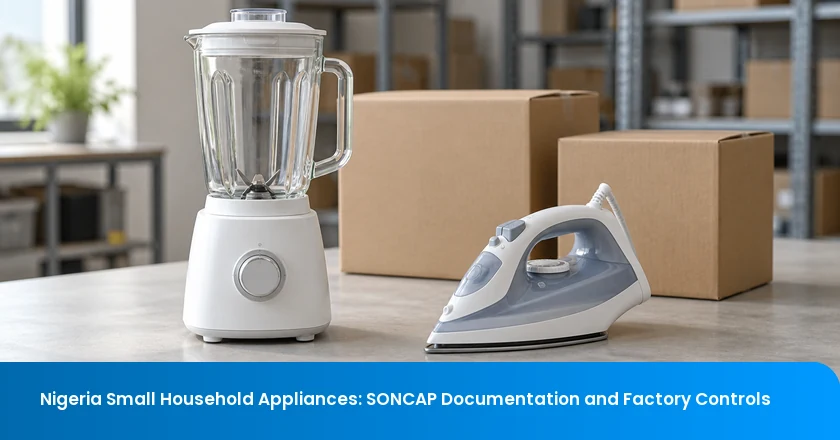
For small household appliances entering Nigeria, settle the Standards Organisation of Nigeria Conformity Assessment Programme (SONCAP) certification route before production, prepare product evidence for the listed models, and keep the final shipment documents aligned with the goods being loaded. Assign certificate processing to the responsible conformity-assessment firm and importer; give the factory inspector a separate, explicit checklist. A finished order can become a different consignment when someone adds stock at the loading door. Controls over those changes are as useful as collecting the original paperwork.
Keep Product Approval and Shipment Evidence Connected
A certificate file and a factory report should identify the same appliances and the same shipment before the importer authorizes dispatch.
- Confirm the exact models, manufacturer, intended use, and applicable certification route.
- Keep product evidence distinct from the documents for an individual consignment.
- Reconcile quantities, model descriptions, carton numbers, and document revisions before loading.
- Check certificate status and the importer’s activation step separately.
- Reopen the shipment review when goods are added or substituted.
Confirm SONCAP Scope and the Applicable Route
The Standards Organisation of Nigeria Conformity Assessment Programme, or SONCAP, is described by SON as pre-shipment conformity verification against applicable Nigerian Industrial Standards or approved equivalents. Start with the actual appliance and its intended use when asking which requirements apply.
For new kettles, blenders, irons, and similar appliances bought for resale, ask the appointed firm to confirm product classification, applicable standards and accepted test evidence. Include photographs, ratings, model names, the manufacturing site, and the proposed importer. A broad description such as “kitchen equipment” is not a sufficient technical brief. An appliance with a battery, wireless function, or specialized intended use may raise additional questions.
SON identifies unregistered, registered, and licensed Product Certificate routes, commonly called A, B, and C. Do not select a route solely because a supplier says it exports frequently. Confirm eligibility for the exact products and manufacturer, together with the current assessment requirements. Published route summaries can change; ask the responsible firm for the requirements that will govern this application.
Choose that firm from SON’s current official information and confirm its appointment directly when necessary. A commercial quality inspection is a separate assignment. The name of an inspection company on a report does not establish authority to issue SONCAP certificates. When assessing the provider for the commercial assignment, review TradeAider’s company profile.
Build the Product File Before Opening Form M
SON’s SONCAP FAQ identifies the Product Certificate (PC) as the document used to open Form M, and the SONCAP Certificate (SC) as the document used to process the Pre-Arrival Assessment Report (PAAR) for clearance. Product and consignment documents therefore perform different jobs. Evidence for a product does not automatically describe every later selection of goods shipped under its name.
Form M is part of Nigeria’s import-document processing. Treat the preparation of its supporting product file as an early task, rather than leaving it until cartons are ready. Ask the supplier for the model schedule, test reports and other assessment evidence requested by the appointed firm, plus the pro forma invoice and importer details needed for the transaction. Keep the accepted versions together.
For the consignment file, prepare the current commercial invoice, packing list, relevant import references, and transport information as it becomes available under the confirmed procedure. Ask the firm and importer which documents are required at each step; do not mark an unavailable transport document as already issued. A working checklist should distinguish “required later” from “missing now.”
Where a Certificate of Conformity, or CoC, appears in the firm’s process, establish what further issuance or portal action follows it. Do not treat a CoC, an application acknowledgment, a PC, and an SC as interchangeable attachments. SON limits an SC to a single PAAR consignment and one entity; reusing a previous shipment’s file is therefore an evidence problem, even when the product looks unchanged.
Check Certificate Coverage When Models or Factories Change
A repeat order needs a coverage check whenever the model, manufacturer, or product configuration changes.
Check the certificate number, named parties, covered products, validity, and conditions against the new purchase. Route B or C status is not a blanket statement about every appliance a trading company can source. Ask the appointed firm whether an added model, a new manufacturing site, or a revised construction falls within the accepted scope before relying on an existing PC.
Give technical changes a clear paper trail: what changed, when, which production units use it, and what evidence the firm requires. A replacement motor, heater, cord, plug, or protective component should not be hidden behind an unchanged retail model name. Conversely, do not decide from a different name alone that the product has failed; obtain the technical and identity explanation. The factory’s role is to disclose and document the change, while the competent evaluator determines its certification implications.
Give the Factory a Controlled Shipment Checklist
The factory should connect each packing-list line to a product reference, a production record, and identifiable cartons.
Use a controlled checklist with revision dates and named owners. The table below is a practical purchasing control, not a complete SONCAP test protocol. Build the agreed workmanship and packaging checks from an inspection-standard resource and the actual appliance specification. The inspector needs to know both what to compare and where to record a discrepancy.
| Control | Reference to provide | Factory evidence | Escalation trigger |
|---|---|---|---|
| Model identity | Accepted model schedule and product photographs | Unit, retail-box and carton identifiers | An unexplained model or manufacturer |
| Electrical build | Settled ratings, cord, plug and component references | Labels, component records and agreed checks | A substitution or inconsistent rating |
| Quantity and assortment | Current invoice and packing-list revision | Count by model and carton range | Extra, missing or substituted stock |
| Packing and accessories | Approved artwork and pack specification | Manuals, accessories, carton marks and photographs | Mixed versions or omitted contents |
| Inspection history | Previous findings and correction instructions | Rework records and fresh verification results | A correction without evidence of completion |
For electrical checks, specify the approved method, equipment, competent operator, and acceptance criteria before the visit. A power-on demonstration answers a narrow functional question; it does not reproduce a full laboratory safety evaluation. Record unavailable tests explicitly and obtain the required technical evidence through the appropriate route.
For mixed models, make the carton allocation visible before sampling. Record where inspected units came from and identify any inaccessible stock. A photograph of one blender cannot establish the contents of another model’s cartons. Preserve labels and count records through rework so the final load can still be traced back to the findings.
Agree Inspection Timing Before the Goods Are Packed
Agree the certification firm’s attendance, sampling, testing, and any loading requirements before the factory finalizes its schedule. Then coordinate the buyer’s commercial inspection around the same identified goods. One visit should not be assumed to satisfy both assignments merely because it occurs before shipment. Confirm the scope, authorized personnel, and reporting obligations for each.
Before assembly, settle the model references and change-notification process. During production, check the records and features that will become difficult to access once the casing is closed or the goods are packed. If the supplier changes a component, resolve that event when it occurs rather than asking a final inspector to reconstruct the whole production history.
TradeAider describes its pre-shipment inspection service readiness as 100% of the order complete and at least 80% packed. The 80% condition concerns packing, not unfinished production.
Before booking, confirm the quantity that will actually be available, the models included, access to cartons, and the reference versions. If the factory is short of the agreed readiness, decide whether a different visit would answer a useful question or whether the final check should move. Do not silently rename an incomplete production check as final shipment verification.
After a failed check or rework, specify what must be revisited. Recounting cartons will not verify a replaced protective component, and a new test result will not prove that the correct retail manuals were packed. Match the follow-up evidence to the original finding, and keep the corrected goods identifiable until the shipment decision is made.
Verify Certificate Status and Importer Activation
SON’s May 2026 certificate flow chart shows transmission through the SONCAP portal followed by importer activation on the National Single Window. It connects the activated documents to Form M or PAAR processing, as applicable.
Keep an owner and a status beside each step: assessment complete, certificate issued, transmission confirmed, and importer activation checked. Those statuses describe different events. A supplier’s PDF may help identify a document, but it does not demonstrate that the importer has completed the relevant portal step for this transaction.
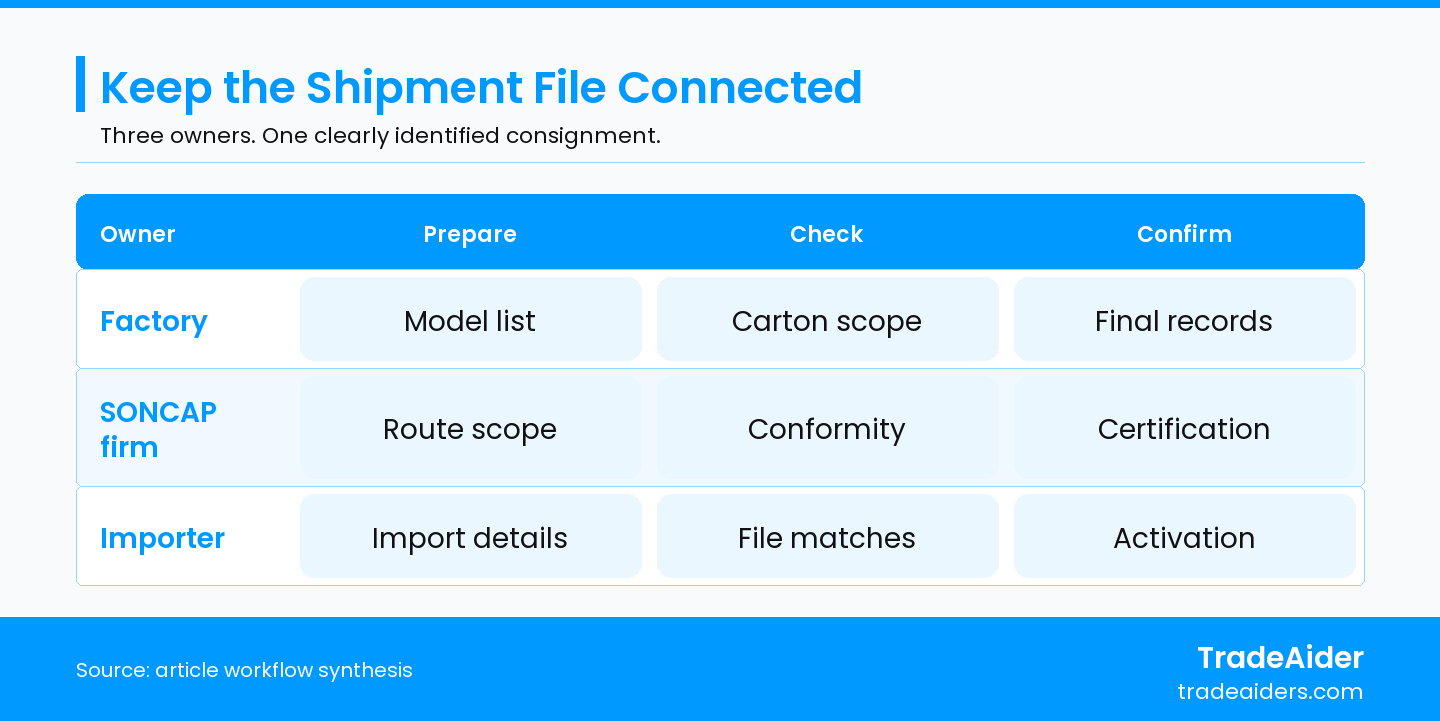
Use the current SON procedure to confirm the document handoff for the actual consignment.
SON provides an official certificate-verification page. Use the official route to check the certificate reference, then compare the returned information with the file and shipment details. A valid number still needs a scope check; authenticity and applicability are separate questions.
SON’s activation page provides PC and SC activation options and asks for the importer’s Tax Identification Number (TIN). Have the importer confirm the appropriate current workflow and identity details rather than borrowing another entity’s account information.
These official online materials were checked on September 8, 2026. Because portal labels and channels can change, follow the current instructions linked by SON and confirm transaction-specific routing with the responsible parties. Keep the resulting status evidence in the shipment file. If transmission or activation cannot be confirmed, identify the pending step and owner before committing to a dispatch instruction.
Reconcile Late Additions Before Loading
Adding goods after the shipment file is prepared reopens the question of what the consignment documents actually cover.
Require the warehouse to report additions before loading, including free goods and promotional stock. “No extra charge” does not mean “no extra product.” Compare the revised load with the last reviewed packing list and ask whether the existing inspection and certification evidence still describe it.
Illustrative Example: Extra Blenders on a Revised Packing List
A Nigerian importer orders 1200 blenders in 120 numbered cartons for retail resale. In this illustrative example, the original quantity has undergone the buyer’s inspection and its shipment file is being finalized. At loading preparation, the factory adds 240 promotional blenders in 24 separately marked cartons. The added model is absent from the file sent to the certification firm; the original 120 cartons remain clearly identifiable.
In this illustrative example, separately traceable extra blenders can be removed from the load while the original consignment is reconciled. The earlier commercial inspection did not cover the added stock, and the importer has no confirmed certification coverage for that additional model.
Stop loading and segregate the 24 added cartons. Restore the packing list to the original 1200 units, preserve the revised version as a change record, and send the actual loading scope to the appointed firm and importer for confirmation. Hold the 240 additional units for a separately resolved shipment or a properly revised application; do not fit them into an existing description merely to keep the truck moving.
Before authorizing dispatch of the original order, recount the loading set, check its carton identifiers, and confirm that the consignment evidence and applicable activation cover that set. This illustrative example depends on reliable separation. If cartons have been mixed and their contents cannot be established, removing 24 cartons at random does not restore the original scope. Broaden the reconciliation until the actual goods are known. The example illustrates a purchasing decision, not a guarantee of partial release or customs clearance.
Use Sampling for Lot Quality, Not Certificate Coverage
NIST describes acceptance sampling as using a random sample to decide whether to accept or reject a lot. That statistical decision does not establish certificate coverage for an added model.
Use the AQL calculator after agreeing the lot definition, inspection level, and Acceptance Quality Limit (AQL), the parameter used to select the sampling plan.
Keep the sampling result attached to the population that was available for inspection. If the factory adds stock later, determine whether the new goods require separate coverage or a revised inspection. An acceptable defect count from the original population is not an observation about cartons that were never available.
Also distinguish the categories of unresolved findings. Workmanship defects need the agreed acceptance decision; a safety concern needs the relevant technical response; a missing shipment reference needs documentary reconciliation. Combining them into one score can obscure the action required. A low cosmetic defect rate cannot close a safety or certification question.
Record the actual methods, sample origins, exclusions, and corrective checks in the report. Where uncertainty concerns the identity of the entire load, increasing a cosmetic sample without restoring traceability answers the wrong question. First determine what goods the evidence must represent, then choose a check capable of resolving the remaining uncertainty.
Send a Brief That Separates Certification from Factory Checks
An inspection brief should name the confirmed product references, carton scope, and unresolved factory questions.
Send the model list and photographs, purchase specification, current packing list, carton numbering, factory location, order quantity, and packing status. Include relevant certificate-scope references already confirmed with the responsible firm, together with any changes since the earlier review. State which technical or documentary questions remain open so they are not mistaken for settled inspection criteria.
Identify the person who can authorize a correction and the person who will decide shipment release. Ask the provider to confirm the feasible factory checks and timing, and to report observations, photographs, unavailable checks, and discrepancies against the agreed references. This gives the importer useful physical evidence to combine with the certification file, without making the inspection report responsible for issuing import documents.
TradeAider can confirm the agreed inspection scope from these inputs; the appointed certification firm and importer retain their respective certificate and import-processing responsibilities. Contact our team to arrange your inspection.
Frequently Asked Questions
Can a CE mark replace SONCAP documents?
No. A CE mark does not replace the Nigerian documents required for a SONCAP-regulated consignment. Send any underlying test reports to the appointed firm for an assessment of whether they are acceptable evidence for the actual model and applicable requirements. A symbol printed on the retail packaging is not that technical assessment.
Does a factory’s ISO 9001 certificate cover the appliances?
No. A quality management system certificate does not, by itself, establish product conformity or consignment coverage. It describes a different subject from an appliance test report. Where the selected route considers factory systems, have the appointed firm specify the supporting evidence it requires rather than treating ISO 9001 as an appliance approval.
Can I use the manufacturer’s import permit for retail stock?
Do not assume a manufacturing-related permit covers finished appliances bought for resale. SON distinguishes permits for particular import purposes from the product-certification route for commercial sale and distribution. Explain the intended use and transaction to SON before relying on an exemption or another party’s permit; the factory’s manufacturing status alone does not settle your retail import.
Should I book freight using a quoted certificate turnaround time?
Book against confirmed readiness and the actual certification status, rather than treating an advertised processing time as a guaranteed departure date. Ask what remains outstanding: test evidence, an assessment visit, corrected documents, issuance, or importer processing. A quoted turnaround does not eliminate the time needed to resolve a nonconformity or change in the goods.
مقالات ذات صلة
نمِ عملك مع خدمة TradeAider
انقر على الزر أدناه للدخول مباشرة إلى نظام خدمة TradeAider. الخطوات البسيطة من الحجز والدفع إلى تلقي التقارير سهلة التشغيل.

