- معلومات عنا

- خدماتنا
- صناعتك
- الموارد
- الأخبار والمدونة
AQL (Acceptable Quality Limit)
AQL (Acceptable Quality Limit), defined by the International Organization for Standardization under ISO 2859-1, is the worst tolerable process average percentage or ratio of defects that is considered acceptable during random sampling inspections.
In simpler terms, AQL represents the maximum number of defective units that can be found in a sample batch before the entire shipment is rejected. It does not mean a supplier has the right to produce defects; rather, it sets a statistically validated baseline for what a buyer is willing to accept based on financial and operational trade-offs.
The Statistical Foundations: ISO 2859-1 and ANSI/ASQ Z1.4
Modern third-party quality control agencies execute random sampling based on standardized statistical tables, most commonly:
- ISO 2859-1: International standard for sampling procedures for inspection by attributes.
- ANSI/ASQ Z1.4: The American national equivalent standard, heavily adapted from the military standard MIL-STD-105E.
These tables use the total Lot Size (Order Quantity) and the chosen Inspection Level to generate a specific Sample Size (the exact number of units an inspector must draw at random) and corresponding Accept/Reject (Ac/Re) thresholds.
SPONSORED RECOMMENDED SERVICENo More Blind Imports: Verified Quality via Strict AQL Inspections.Delivering transparent, on-site quality control and reliable inspection reports. ➔ Get a Free Plan
How to Classify Product Defects under AQL
Not all manufacturing defects carry the same weight. Under AQL standards, defects found during on-site inspections are categorized into three severe tiers:
Critical Defects
Defects that fail to meet mandatory regulatory requirements or pose an immediate safety hazard to the end consumer (e.g., exposed live wires on an electronic item, sharp metal edges on a children's toy).
- Typical AQL Threshold: 0% or 0.01% (Usually leads to immediate batch rejection).
Major Defects
Defects that reduce the usability, function, or marketability of the product, meaning the consumer would likely return the item or complain (e.g., a zipper that jams, a laptop that fails to boot, significant color mismatching).
- Typical AQL Threshold: 2.5%
Minor Defects
Defects that represent a departure from established quality standards but do not affect the product’s functionality or marketability (e.g., minor scuffs on the bottom casing, small loose threads inside a garment).
- Typical AQL Threshold: 4.0%
Step-by-Step Guide: How to Read the AQL Table
To determine whether a production batch passes or fails, importers and quality engineers follow a three-step process using the ANSI/ASQ Z1.4 charts.
Step 1: Locate Your Sample Size Code Letter
Using the Lot Size Chart, locate your total order quantity on the left, then move horizontally to find your Inspection Level (General Inspection Level II is the industry standard for consumer goods). The intersection yields a Code Letter (e.g., Letter "L").
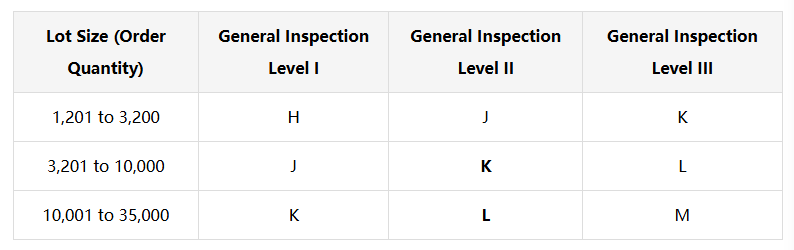
Step 2: Determine Sample Size and Ac/Re Thresholds
Switch to the Master Sampling Plan Chart. Look up your Code Letter (e.g., "L"). The chart will dictate:
- Sample Size: For Letter L, the required sample size is exactly 315 units.
- Ac / Re Limits: Move horizontally to your designated AQL percentages (e.g., 2.5 for Major, 4.0 for Minor).
Step 3: Execute and Score the Inspection
If the designated limits for Letter L at AQL 2.5 are Ac: 14 / Re: 15:
- If the inspector finds 14 or fewer Major defects, the lot Passes.
- If the inspector finds 15 or more Major defects, the lot Fails.
Why AQL is Crucial for Global Importers
Implementing a clear AQL standard in your Proforma Invoice (PI) or supplier agreement protects your business in three major ways:
- Eliminates Subjectivity: "Good quality" is highly subjective. AQL replaces opinions with concrete, mathematical pass/fail data.
- Saves Inspection Costs: Instead of paying for a 100% full inspection of 20,000 units, checking a statistically valid sample of 315 units yields high confidence at a fraction of the cost.
- Legal Leverage with Vendors: If a batch officially fails the AQL threshold, the buyer holds the contractual right to demand a product rework, factory-paid sorting, or financial compensation before final payment is released.
References
[1] ISO. ISO 2859-1:2026 Sampling procedures for inspection by attributes — Part 1: Sampling schemes indexed by acceptance quality limit (AQL) for lot-by-lot inspection[S]. Geneva: International Organization for Standardization, 2026. https://www.iso.org/obp/ui/en/#!iso:std:85464:en
[2] American Society for Quality, American National Standards Institute. ANSI/ASQ Z1.4-2003 (Reaffirmed 2018) Sampling Procedures and Tables for Inspection by Attributes[S]. Milwaukee: ASQ Quality Press, 2018.
[3] U.S. Department of Defense. MIL-STD-105E Sampling Procedures and Tables for Inspection by Attributes[S]. Washington D.C.: DoD, 1989 (Cancelled 1995).
Reference Notes
- ISO 2859-1:2026 is the latest global normative standard defining AQL terminology, sampling tables, defect classification rules and lot acceptance judgment logic, serving as the core theoretical basis of this article.
- ANSI/ASQ Z1.4 is the U.S. domestic equivalent standard derived from MIL-STD-105E, widely adopted by North American importers and third-party quality inspection agencies.
- MIL-STD-105E is the original military sampling standard; though formally cancelled, its framework remains the foundation of all modern AQL sampling systems.
Related Knowledge Base
TradeAider