
Every day, tens of thousands of cargo containers arrive at U.S. ports of entry — and U.S. Customs and Border Protection (CBP) cannot physically examine more than a fraction of them. To allocate its inspection resources effectively, CBP uses risk stratification: companies with known, verified security practices get expedited treatment; higher-risk shipments get more scrutiny. CTPAT — the Customs-Trade Partnership Against Terrorism — is the voluntary program that puts importers on the low-risk side of that equation. For importers with meaningful import volumes, CTPAT certification is one of the most concrete operational advantages available within the U.S. trade compliance system.
Key Takeaways
- CTPAT-certified importers receive significantly fewer CBP cargo examinations, front-of-line priority processing, and access to dedicated fast lanes — directly reducing port dwell time and associated costs.
- According to the World Customs Organization, CTPAT member shipments achieve a cargo examination exemption rate of approximately 98%, compared to the general importer population.
- CTPAT is not just a security program — it has expanded to include supply chain compliance benefits tied to forced labor monitoring, connecting directly to UFLPA risk management for importers sourcing from high-risk regions.
What Is CTPAT?
The Customs-Trade Partnership Against Terrorism (CTPAT) is a voluntary supply chain security program administered by U.S. Customs and Border Protection (CBP). Established after the September 11 attacks to address vulnerabilities in the global supply chain, CTPAT operates on a partnership model: in exchange for meeting CBP's minimum security criteria and allowing CBP validation of their security practices, members receive a range of tangible operational and compliance benefits.
CTPAT is open to a broad set of trade community entities: U.S. importers of record, U.S. and foreign manufacturers, licensed customs brokers, freight forwarders, air, sea, and land carriers, and contract logistics providers. For importers — particularly those sourcing manufactured goods from overseas — the program's benefits are most directly felt in the speed and predictability of cargo clearance.
As of 2026, the program has continued to expand its scope. A 2025 Federal Register notice formalized the expansion of CTPAT to include asset-based and non-asset-based third-party logistics providers under a pilot program, reflecting CBP's intent to extend trusted trader benefits deeper into the supply chain.
The Core Benefits of CTPAT Certification for Importers
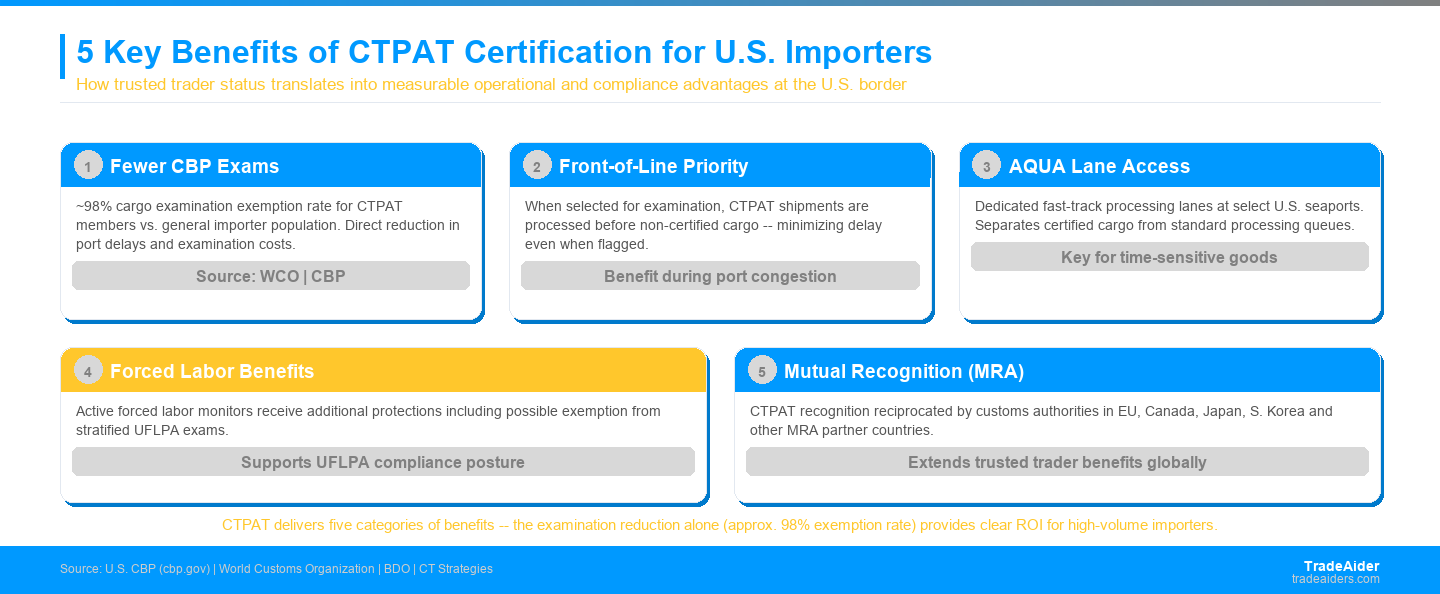
CTPAT delivers five categories of benefits — the most operationally significant for importers is the dramatic reduction in CBP cargo examinations, which directly affects port dwell time and logistics predictability.
1. Dramatically Fewer CBP Cargo Examinations
The most quantifiable — and for most importers, the most valuable — benefit of CTPAT is the reduction in CBP cargo examinations. CBP examinations are disruptive: they delay cargo release, create unpredictable dwell time at port, can require devanning and repacking of containers, and generate costs that are difficult to pass through to customers or absorb in thin-margin product categories.
According to data cited by the World Customs Organization, CTPAT member shipments achieve an examination exemption rate of approximately 98% — meaning that the vast majority of a CTPAT-certified importer's cargo moves through CBP processing without a physical or non-intrusive examination. For importers running high-frequency import programs, the cumulative cost and time savings of this reduced examination rate are significant.
This is the direct operational payoff of CBP's risk stratification approach: because CTPAT members have demonstrated their supply chain security practices and submitted to CBP validation, their shipments are flagged as low-risk and generally bypass the examination queue that applies to the broader importer population.
2. Front-of-the-Line Inspection Priority
When a CTPAT member's shipment is selected for examination — which, while rare, does happen — it receives front-of-the-line priority treatment. This means that the examination is processed before non-CTPAT shipments, minimizing the delay even when the cargo is flagged for review.
In practical terms, this benefit is particularly valuable during periods of port congestion or high inspection volumes, when examination queues for standard importers can stretch to multiple days. CTPAT members get to the front of that queue, limiting the duration of any delay to the examination itself rather than the combined wait-plus-examination time that non-members face.
3. AQUA Lane Access
The Advanced Qualified Unlading Approval (AQUA) Lane is a dedicated fast-track processing lane at select U.S. seaports available exclusively to CTPAT-certified companies. It provides accelerated cargo release by separating certified member shipments from the general cargo stream at port entry points.
As CBP's official CTPAT overview confirms, AQUA Lane access is one of the core tangible differentiators between certified and non-certified importers at participating ports. For importers with time-sensitive product categories — seasonal goods, perishables, components for just-in-time manufacturing — the ability to use dedicated expedited lanes can have direct supply chain impact beyond just cost savings.
4. CTPAT Trade Compliance and Forced Labor Monitoring Benefits
CTPAT has evolved significantly beyond its original supply chain security focus. A parallel track — CTPAT Trade Compliance — now links program membership to benefits specifically tied to import compliance, including trade sanctions and forced labor enforcement.
For importers with supply chain exposure to regions covered by the Uyghur Forced Labor Prevention Act (UFLPA), CTPAT participation offers meaningful additional protection. According to BDO's analysis of CTPAT forced labor benefits, CTPAT members who demonstrate active monitoring and compliance with forced labor laws receive additional benefits including possible exemption from stratified examinations — a tier of targeted examination that even standard CTPAT members may face for high-risk commodity categories.
In an environment where UFLPA enforcement has expanded to cover new industries and more supply chain participants, this benefit is increasingly significant for importers of textiles, electronics components, solar panels, and other product categories with documented exposure to high-risk supply chains. CTPAT participation signals to CBP that the importer has implemented robust supply chain traceability and due diligence processes — exactly the kind of proactive compliance posture that CBP uses to differentiate risk levels.
5. Mutual Recognition Arrangements (MRA) with Foreign Customs Authorities
The United States has established Mutual Recognition Arrangements (MRAs) with customs authorities in several major trading partners — including the EU, Canada, Mexico, Japan, South Korea, and others. Under these arrangements, CTPAT certification is recognized as equivalent to, or compatible with, the trusted trader programs of those partner countries.
For importers with complex multi-country supply chains, MRA benefits can translate into faster customs processing in partner countries as well as in the U.S. — a multiplier effect on the operational efficiency gains from CTPAT participation. For importers sourcing from countries with active MRAs, the program effectively extends trusted trader status across the relevant portions of the supply chain, not just at the U.S. border.
CTPAT Requirements: What Importers Must Meet
CTPAT benefits are not automatic — they come with substantive requirements. According to the CBP importer eligibility and requirements page, importers seeking CTPAT membership must:
- Have and maintain a valid continuous import bond registered with CBP
- Operate a U.S.-based business office staffed by U.S. citizens or legal residents
- Be an active U.S. importer of record with a demonstrable import history
- Have no disqualifying CBP violations within the relevant lookback period
- Implement and document security measures meeting CBP's Minimum Security Criteria (MSC) for importers
The Minimum Security Criteria cover seven domains: business partner requirements (vetting of suppliers and carriers), container security, physical access controls, personnel security, procedural security, security training and threat awareness, and information technology security. Each domain has specific documented requirements that must be implemented and demonstrable during CBP validation.
The validation process — conducted by CBP Supply Chain Security Specialists — involves a review of the importer's security policies and procedures and a physical assessment of facilities and practices. CBP conducts revalidations periodically to ensure continued compliance.
CTPAT and Supply Chain Due Diligence: The Connection
For importers building a comprehensive supply chain compliance program, CTPAT intersects with due diligence requirements in important ways. The business partner security requirements within CTPAT's Minimum Security Criteria effectively require importers to vet their overseas manufacturers and suppliers against security criteria — which overlaps significantly with broader supply chain due diligence obligations.
In practice, an importer implementing CTPAT business partner requirements will need to assess their Chinese factories and other overseas suppliers against security criteria, collect security questionnaires or conduct security assessments, and document supplier vetting processes. This work complements (and partially satisfies) the supplier verification requirements under supply chain due diligence frameworks like the CSDDD and UFLPA traceability obligations.
According to the 2024 CTPAT Impact Report analyzed by CT Strategies, the program continues to reinforce that supply chain security and compliance investment delivers measurable return — through reduced examination costs, faster cargo release, and the risk mitigation value of having documented, auditable supply chain security processes.
For importers sourcing from China who are building their CTPAT business partner compliance documentation, independent factory audits and product inspections provide the on-the-ground verification needed to satisfy both CTPAT's supplier security requirements and broader due diligence obligations. TradeAider's factory audit service provides documented, independent assessments that importers can include in their CTPAT partner vetting files. If you're reviewing how your inspection and audit program supports your CTPAT compliance documentation, contact our team to discuss how to structure the evidence trail CBP looks for.
Is CTPAT Worth It? Evaluating the ROI
CTPAT is a voluntary program, and the decision to pursue membership should be based on an honest assessment of costs and benefits relative to your import profile.
| Factor | CTPAT Benefits | CTPAT Costs/Requirements |
|---|---|---|
| Examinations | ~98% exam exemption rate; front-of-line when selected | Staff time to document and maintain security procedures |
| Clearance Speed | AQUA Lane access; reduced port dwell time | Initial implementation of 7 security domains |
| Forced Labor Risk | Additional UFLPA-related benefits for active monitors | Business partner security vetting required (ongoing) |
| International Trade | MRA recognition in partner countries' customs systems | CBP validation and periodic revalidation |
| CBP Relationship | Direct access to CBP Supply Chain Security Specialists | Continuous import bond requirement |
For importers with high shipment frequency (10+ containers per month) or time-sensitive product categories, the examination reduction benefit alone typically delivers clear ROI — a single avoided physical examination can save thousands of dollars in demurrage, devanning, and delay costs. For lower-volume importers, the calculus is less straightforward, though the compliance and risk management benefits still carry weight in an environment of heightened UFLPA enforcement.
Frequently Asked Questions
Is CTPAT mandatory for U.S. importers?
No — CTPAT is a voluntary program. There is no legal requirement for U.S. importers to be CTPAT-certified. However, the benefits are significant enough that many high-volume importers treat it as effectively essential. Some importers also face indirect pressure from retail customers or supply chain partners who prefer or require CTPAT-certified importers for risk management reasons. The program is best understood as a voluntary investment in operational efficiency and compliance risk reduction, not a regulatory obligation.
How long does it take to get CTPAT certified?
The CTPAT application and validation process typically takes 3 to 6 months from initial application to full membership and CBP validation. The timeline depends on how quickly you can document your security procedures across the seven minimum security criteria domains, the CBP validation queue in your region, and how much remediation is required after the initial assessment. The most common delay is the documentation phase — writing security policies and procedures that meet CBP's criteria if they don't already exist as formal documents.
Does CTPAT reduce tariff rates or duties?
No. CTPAT is a supply chain security program focused on cargo examination risk and trusted trader benefits — it does not reduce tariff rates, duty rates, or the value of goods subject to customs duties. Importers sometimes confuse CTPAT with trade preference programs or duty drawback programs that do have cost-reduction effects. CTPAT's financial benefits come from reduced examination costs, faster cargo release, and improved supply chain predictability — not from changes to the duty assessment itself.
What is the difference between CTPAT and C-TPAT?
"C-TPAT" (with hyphens) and "CTPAT" (without hyphens) refer to the same program — Customs-Trade Partnership Against Terrorism. CBP shifted to the unhyphenated "CTPAT" in more recent official communications, but both spellings are used interchangeably across industry and government sources. There is no substantive difference; they describe the same voluntary trusted trader program administered by CBP.
How does CTPAT connect to UFLPA compliance for importers?
CTPAT and UFLPA are separate programs with distinct requirements, but they intersect for importers with supply chain exposure to regions covered by forced labor enforcement. CTPAT's Trade Compliance benefits — specifically the additional protections for members who demonstrate active forced labor monitoring — are designed to reward importers who have implemented the kind of supply chain traceability and due diligence processes that UFLPA requires. In practice, this means that a strong CTPAT compliance posture, particularly around business partner vetting and supply chain documentation, supports the evidence base an importer needs to defend shipments under UFLPA scrutiny. The two programs are complementary components of a comprehensive import compliance program.
Related Articles



Grow your business with TradeAider Service
Click the button below to directly enter the TradeAider Service System. The simple steps from booking and payment to receiving reports are easy to operate.

