
- About Us

- Our Services
- Your Industry
- Resources
- News & Blog
Product quality assurance for a Shopify store starts on the product page, not at the loading dock. When a seller lists a capacity, a material, a function, a pack or a compliance claim, that listing is already a promise about what the product must do. A passed final inspection only shows that one lot met the limits someone wrote down; if the promise was never turned into a measurable requirement, no inspection can protect it.
The strategies below carry those promises into written requirements a supplier can build to, verify them in stages, and keep what comes back in the loop, from writing the standard to handling returns.
What Poor Product Quality Costs a Shopify Store
Poor product quality rarely stays inside one order. On a Shopify store it surfaces as returns that eat the margin on a sale, one-star reviews that sit under the listing for months, customers who stop trusting the brand, support tickets that consume a working week, and refunds that turn a strong month flat. Each of these is a customer meeting a promise the product did not keep, and the cost is not only the refunded unit. It is also the ranking, the repeat purchase and the referral that never happen.
Most of that cost traces back to a few gaps that are visible before anything ships: a claim that was never written down, a sample that was never approved, a component that was changed without agreement. The sections below place a check where each gap appears, and the inspection and testing work behind those checks is set out in TradeAider's company background.
A seller does not need a large quality department to act on this. The sequence matters more than the size of the team, and the first move costs nothing: read the listing and write down what it promises.
Start With the Promises on Your Product Page
The place to start is the product page, because that is where the promise is already written. A listing is not marketing copy alone; it is the description a supplier can be held to. The first quality step is to read every claim on the page and turn it into a specification: the written, measurable requirement a supplier must meet, with a value and a test method. A specification is not a wish list. It is the document an inspector measures against, so it has to be specific enough that two people reading it reach the same verdict.
Who owns that promise is not ambiguous. Under Shopify's Terms of Service, the merchant is the seller or merchant of record for every sale, responsible for the store, its materials, the goods it sells, required disclosures and regulatory compliance, and Shopify states that it is not the seller. That responsibility is why the specification starts from the listing rather than from a generic factory default.
In practice, the first pass is mechanical. List each claim in one column, then note the characteristic, the target value, the tolerance, the test method and the pass or fail limit beside it. Claims that cannot be measured yet are the ones that need a decision, not another sentence of copy.
Turn a Claim Into a Measurable Specification
A claim only becomes usable when it can be measured the same way twice. "Holds one liter" is a promise; "measured capacity of at least 1,000 ml, tested by filling to the rim on a level surface" is a specification. The difference is the test method and the tolerance, and without them two inspectors can reach two different verdicts on the same unit.
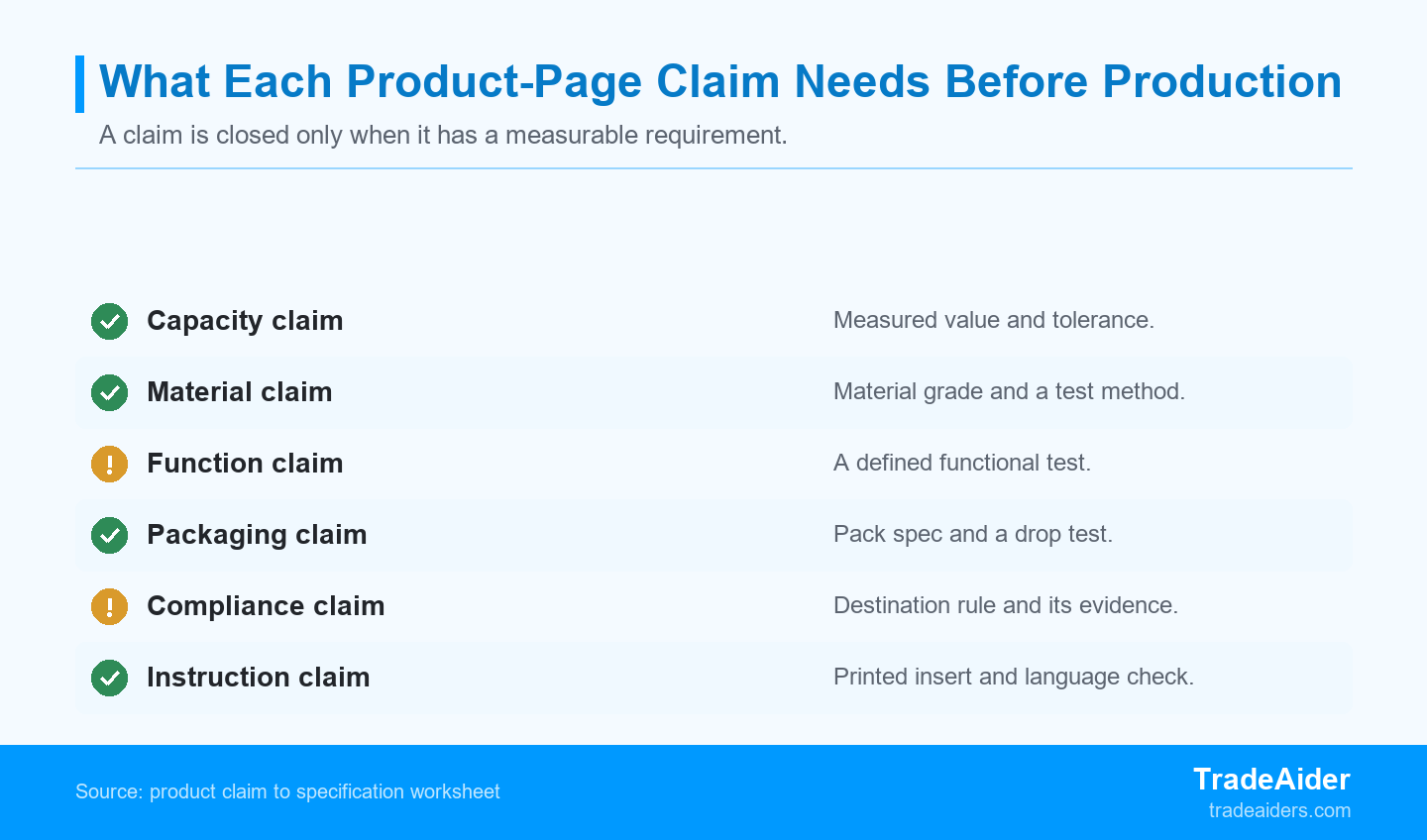
Each claim is only closed when it has a measurable requirement and a test method, so the specification comes before the inspection.
This is not only a quality habit. Under US law, claims in advertisements have to be truthful, non-deceptive and evidence-based before a seller can rely on them, and writing the measurable version before production is the cheapest way to know that support exists.
For each claim, record the characteristic, the value, the tolerance, the method and the limit in one row, and keep the row with the order. inspection-standard guidance is useful here because it keeps the acceptance criteria separate from the method used to check them, so the same row can be reused on the next order without rewriting the requirement.
Approve a Sample and Keep It as the Reference
A written specification still leaves room for argument about look, feel and finish, so the buyer approves a physical unit as well. An approved sample is a unit the buyer checks and accepts before production starts, kept as the object that later units are compared with. It fixes the specification in something both sides can point to when a measurement is disputed, and it should be labeled, dated and stored where the supplier and the inspector can both reach it.
The value of a shared reference is not a private idea. A standards organization reports that over 13,000 standards operate globally and help people have confidence in the things they buy and use. A retained sample plays the same role on a single order that a published standard plays across an industry: it turns a description into something both parties can measure against.
Check Quality at the Right Stages
Once the specification and the sample exist, the checks can be placed. Quality is protected by staged checks, pre-production, during production, pre-shipment and at the warehouse, because each stage catches a different failure while a correction is still cheap. A check placed only at the end finds the defect after the money has been spent, which is exactly the cost the first section described.
| Stage | What it catches | Who owns the record |
|---|---|---|
| Pre-production | Wrong or unapproved materials and a first article that misses the specification | Buyer and supplier, against the approved sample |
| During production | Drift on a running line before a whole run is built the same wrong way | Factory process owner |
| Pre-shipment | A finished, packed order that does not match the specification at release | Third-party inspector, if one is used |
| Warehouse | Handling, storage and pack damage after release | Seller or fulfillment partner |
Each row names the failure the stage is meant to catch and the owner of the record, because a check without an owner is a check that will not happen. Two details then decide whether a stage is useful. The first is the sampling plan: an AQL calculator shows how a lot size becomes a sample size and an accept or reject decision, so the seller knows what the check will and will not cover.
The second detail is what a sampling result means. Acceptance sampling is a lot-level decision: a random sample is used to judge whether a batch should be accepted, rather than checking every unit. Its main purpose of acceptance sampling is to decide whether a lot is likely to be acceptable, not to estimate the quality of the lot or to prove every unit. A passed lot is a decision about the batch, not a certificate for each item inside it.
Illustrative Example: When a Claim Drifts From Production
The following illustrative case shows how a passing inspection can still miss the promise on the listing. A Shopify brand places a 6,000-unit run of insulated water bottles, the run passes its sampling limit, and the measured capacity and a lid leak test miss the product-page claim, so the seller holds the run and fixes the specification and the product. The example is a composite, not a client case or measured data.
A Shopify brand sells a one-liter insulated water bottle and lists it as 18/8 stainless steel that keeps drinks cold for 24 hours. The brand approves a sample that matches the listing, then places a production run of 6,000 units with the same factory. The factory confirms the run is ready and the brand books a pre-shipment inspection without rewriting the listing claims as a measured specification.
The measured capacity of the sampled units is 950 ml, below the one-liter claim on the product page. A lid leak test fails on part of the sample, and the factory has no record of the leak test in its process file. The inspection passes the appearance and finish checks, because those were the only requirements written down.
The sampling verdict was decided against a specification that never captured capacity or lid sealing, so a passing lot and a product that misses its page promise looked the same on the report. Hold the run, including the 1,200 units already built, restate the listing claims as a measured specification with a capacity tolerance and a leak test, and require a corrective action before the units ship.
The factory corrects the lid gasket and confirms capacity on a rebuilt sample, and the brand updates the specification and the approved sample record. Re-measure capacity and re-run the leak test on the corrected sample against the new specification, and keep the first and second inspection records in one file. An illustrative quality-assurance example, not measured client defect data, a supplier rating, or a compliance result.
Use Third-Party Inspection Where You Cannot See the Factory
A seller who is not standing in the factory cannot see the product, so independent evidence matters. Third-party inspection verifies the written specification against the physical product and reports what the inspector found, requirement by requirement. The report is only as strong as the specification behind it: an inspector can measure a capacity or a leak, but cannot check a claim that was never written down.
The release-stage check is the one most sellers start with, and its readiness rule is precise: a pre-shipment inspection is conducted when the order is 100% complete and at least 80% packed for export, and the 80% threshold concerns packing rather than production completion. TradeAider's pre-shipment inspection is booked at that point and measures random samples against the buyer's specification.
Choosing a provider is a fit question, not a brand question. Look for experience in the product category, coverage where the supplier actually is, a clear sampling plan, and a report that shows measurements rather than adjectives. A provider who cannot explain how the sample was drawn cannot help a seller defend the result when a customer disputes it.
Use Quality Data and Tools to Catch Drift
Quality data is what turns a single inspection into a trend. Inspection results, product reviews, return reasons and support tickets all describe the same product, and when the same complaint appears in two of those channels it points to a defect the specification should prevent. Quality data is only useful when it is recorded against a product, a supplier and a date, so the next order can be compared with the last one.
The tools do not have to be sophisticated. A shared quality log, the store's review and return reports, and an inventory flag that holds a suspect batch until it is checked are enough to catch drift. The point is to review the trend before the next purchase order is placed, not after the returns arrive and the season is over.
One rule keeps the data honest: record what was measured, not what was concluded. "Two of forty lids leaked at 60 seconds" is a fact the supplier can act on; "quality was poor" is not.
Build Supplier Relationships That Hold the Standard
The standard only holds if the supplier receives it, agrees it and hears the findings. That makes the supplier relationship part of the quality system rather than a separate commercial task. A supplier who never sees the specification is being asked to guess, and a supplier who never hears about a defect has no reason to change the process that produced it.
Four habits carry most of the weight. Send the specification and the sample reference with the order. Agree in writing how a component or process change is approved. Ask for the process records behind the checks. And return the findings, not just the rejection, so the next run starts from a corrected process rather than from the same one that failed.
This is also where the approved sample earns its keep. When both sides hold the same labeled unit, a disagreement about a finish or a fit becomes a comparison instead of an argument, and the conversation can move to what to change.
Treat Returns and Complaints as Quality Data
Returns are quality data that has already cost money, so they deserve a place in the plan. A return rate is the share of orders customers send back, and it points to the defects a specification should prevent; the reasons behind it are more useful than the number alone. Categorizing return reasons and feeding the top two or three back into the specification closes the loop between the customer and the factory.
The shipping and refund side carries real obligations as well. Under the FTC's Mail, Internet, or Telephone Order Merchandise Rule, a shipment representation must have a reasonable basis, and a materially different substitution requires the customer's express prior agreement. A seller who swaps a component, a size or a color after the listing is written is not only risking a quality complaint; the change may be one the customer had to agree to first.
Set Customer Expectations Honestly
The product page is both the promise and the expectation, so an inflated claim creates a quality problem the factory cannot fix. Accurate descriptions and honest images set an expectation the product can meet, and they reduce the returns that come from a customer expecting something the listing implied but the product never offered.
Customer feedback closes the loop. Reviews and support messages tell a seller which promise is landing and which one is not, and a description that promised more than the product delivers is a specification problem as much as a copy problem. Updating the listing after the sample is approved keeps the page and the product aligned, and it keeps the next specification honest.
Turn the Plan Into an Inspection Scope
The first step is a short brief, not a large program. Send the specification, the sample reference and the production stages with the request so the quality plan and the inspection scope can be reviewed together. A brief that names the product, the claims, the stages and the destination market gives a reviewer enough to propose a stage list and a sampling plan.
- Write the product-page claims as measurable requirements before comparing quotes or placing checks.
- Approve and retain a sample, and label it as the production reference.
- Place one check at each production stage and name the owner of the record.
- Verify the release-stage lot against the specification before it ships.
- Feed return reasons and complaints back into the specification.
To turn the plan into a scoped inspection, send the product and SKU, the product-page claims and the specification, the production schedule, and the destination market. TradeAider will review the claims and specification, agree which stages are inspected, and confirm the sampling plan and the reporting deliverable, so the first order starts from a plan rather than from a hope. To scope that work, contact TradeAider about your Shopify quality plan.
Frequently Asked Questions
What if my supplier says the product already meets my quality standard?
Ask the supplier to show the measurement against your specification, because a claim that the product meets the standard is not the same as a recorded value for each requirement. A useful reply names the characteristic, the value, the tolerance, the method and the pass or fail limit, and attaches the record behind each one. If the supplier cannot produce that record, the requirement is still open, however confident the verbal assurance sounds. The record, not the reply, is what lets the seller decide whether to release the order.
Does a passed pre-shipment inspection mean my product matches the listing?
Only for the requirements that were written into the specification. An inspection checks the limits it is given, so it cannot verify a claim that was never converted into a measurable requirement. If the listing promises a capacity, a material or a function that the specification never captured, a passed report and a product that misses the listing can coexist. Treat the report as evidence for the specification, not for the product page.
How do I choose the right inspection stage for a small first order?
For a small first order, book a pre-shipment inspection once the run is complete and packed, and add a pre-production check only when the product or the supplier is new. The pre-production stage is where materials and a first article are checked against the specification, so it pays off when the design or the factory is untested. For a repeat order from a proven supplier, the release-stage check is usually enough, and the sample you already hold gives the inspector a reference.
How many units should be checked in a production lot?
The sample size is set by the sampling plan and the lot size rather than by a fixed number, and the result decides whether the lot is accepted, not whether every unit is good. The plan fixes the sample size and the accept or reject limits in advance, so the verdict is repeatable from one order to the next. Tightening the limits reduces the risk of accepting a bad lot; it does not turn sampling into a per-unit guarantee.

Related Articles

Grow your business with TradeAider Service
Click the button below to directly enter the TradeAider Service System. The simple steps from booking and payment to receiving reports are easy to operate.

