
- About Us

- Our Services
- Your Industry
- Resources
- News & Blog
Kitchen textiles, encompassing everything from heat-resistant oven mitts to highly absorbent tea towels and protective aprons, are subject to rigorous safety and quality standards. Unlike standard apparel, these items must withstand high temperatures, frequent laundering, and significant mechanical stress. A professional kitchen textiles inspection focuses on structural integrity through Stitches Per Inch (SPI) measurement and strictly enforces international warning label compliance. By implementing systematic quality check protocols, manufacturers can ensure product safety while minimizing the risk of consumer injury and costly regulatory recalls.
Key Takeaways
- Stitch Density (SPI): High SPI ensures seam strength and prevents insulation migration in heat-resistant products.
- Safety Compliance: Warning labels must adhere to specific FTC (US) and REACH (EU) regulations regarding fiber content and care.
- Material Performance: Inspection verifies shrink resistance (AATCC 135) and color fastness to prevent cross-contamination.
- AQL Standards: Critical defects like broken needles result in immediate rejection under the ANSI/ASQ Z1.4 sampling plan.
- Real-Time Auditing: Digital reporting facilitates immediate on-site rectification of label or workmanship errors.
Technical Assessment of Stitch Density and Workmanship
In the textile industry, Stitches Per Inch (SPI) is a definitive measure of a seam's strength. For kitchen linens, which are often composed of heavy-duty cotton or synthetic blends, the SPI must be balanced to prevent "Needle Cutting" (too high) or "Seam Slippage" (too low). A professional fabric and textile inspection focuses on maintaining a consistent SPI based on the ISO 4915 stitch types.
Stitch Per Inch (SPI) Audit Standards
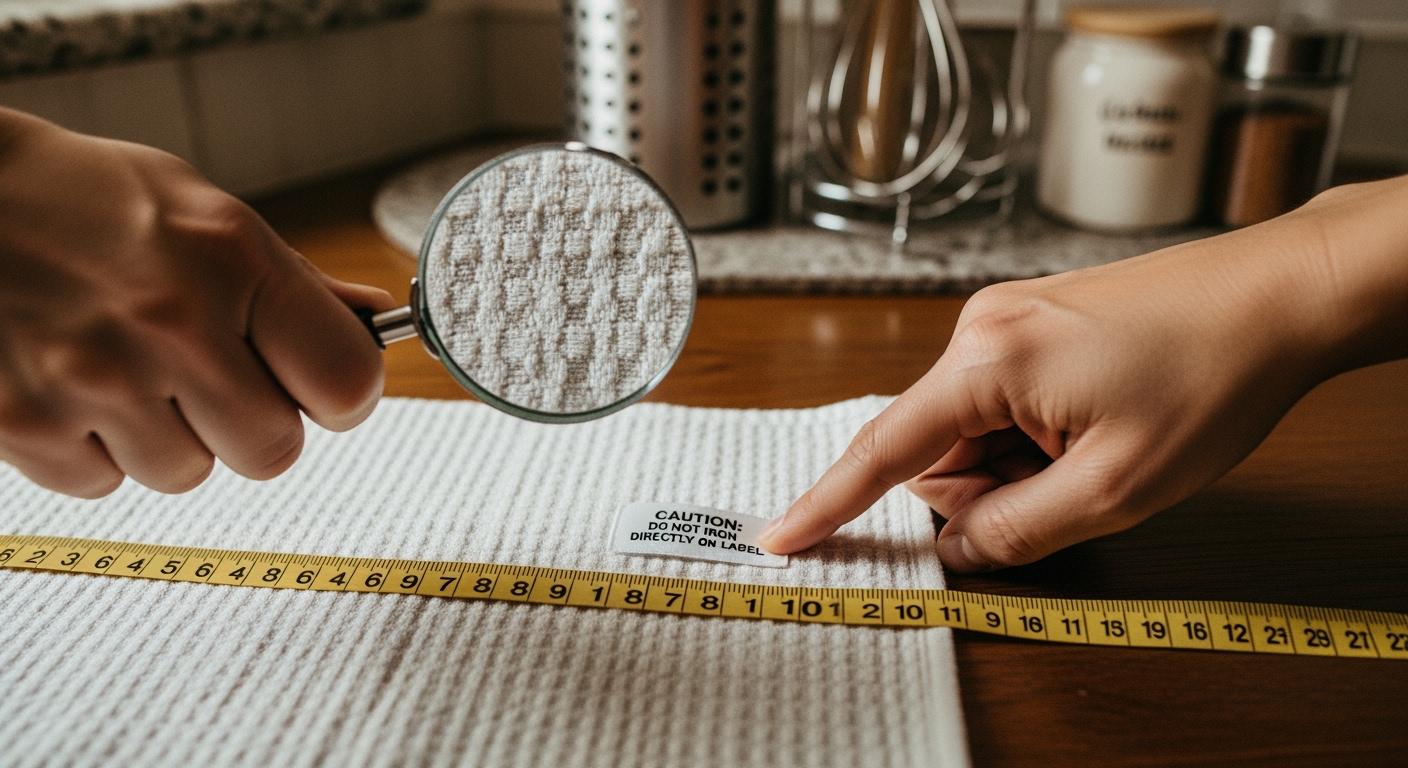
Inspectors utilize a calibrated magnifier to audit the SPI across at least five distinct areas of the product. For high-stress items like oven mitts, the seam must maintain a minimum of 10 to 12 SPI using a 301 lockstitch. If the density drops below 8 SPI, the structural integrity of the insulation layer (usually polyester or cotton batting) is compromised, increasing the risk of thermal failure.
| Textile Item | Recommended SPI | Technical Objective |
|---|---|---|
| Oven Mitts / Pot Holders | 10 - 12 SPI | Secure internal insulation; prevent heat leaks. |
| Aprons (Heavyweight) | 8 - 10 SPI | Ensure strap attachment points resist tearing. |
| Tea Towels / Linens | 12 - 14 SPI | Prevent edge unravelling after industrial washing. |
| Tablecloths | 10 - 12 SPI | Maintain straight, aesthetic hems. |
"Precision in stitch density is the only barrier between a professional-grade oven mitt and a potential burn injury. Seam integrity is non-negotiable in kitchen safety textiles."
Comprehensive Labeling and Regulatory Compliance
Warning labels on kitchen textiles are more than mere information; they are legal requirements that ensure consumer safety. A failed label compliance check is often classified as a "Major" or "Critical" defect in a professional quality control inspection.
Mandatory Fiber Content and Care Labeling
Under US Federal Trade Commission (FTC) guidelines, all textile products must clearly state the generic fiber names and their percentages in descending order. For kitchen products, the "Country of Origin" must be permanently attached to the product. Failure to correctly identify "Rayon" (often mislabeled as "Bamboo") can lead to immediate shipment rejection at customs.
| Regulatory Body | Mandatory Label Info | Specific Requirement |
|---|---|---|
| US FTC / CBP | Fiber Content & RN Number | Generic names only; RN ID for traceability. |
| EU REACH | Chemical Safety (SVHC) | Zero prohibited azo dyes or phthalates. |
| CA Prop 65 | Chemical Warning | Mandatory warning for lead or cadmium in dyes. |
| CPSIA | Tracking Labels | Mandatory for children's sized aprons/mitts. |
The Safety Label Rubbing Test
A warning label that peels off after one wash is useless. Inspectors perform a "Durability Rub Test" (often based on ISO 105-X12). The label is rubbed 15 times with a white cotton cloth soaked in water, and then another 15 times with a cloth soaked in a 70% ethanol solution. If the ink smears or the label detaches, the product fails the compliance determination.
Functional Testing for Kitchen Performance
Thermal Resistance (BS 6526:1998)
For oven mitts and gloves, visual inspection is insufficient. Technical audits include a "Heat Transfer Test." The product is placed against a heat source at 250 degrees Celsius for 15 seconds. The internal temperature must not rise by more than 30 degrees Celsius. This ensures the insulation weight (measured in GSM - grams per square meter) is sufficient for household safety.
Absorbency and Color Fastness
Kitchen towels must be tested for "Absorbency Rate" (AATCC 79). A drop of water should be absorbed within 5 seconds. Additionally, "Color Fastness to Crocking" ensures that the dyes in a red apron won't bleed onto the consumer's clothing or food surfaces during use.
| Performance Test | Standard Methodology | Pass/Fail Criteria |
|---|---|---|
| Dimensional Stability | AATCC 135 (Washing) | Shrinkage must not exceed +/- 3.0%. |
| Tear Strength | ASTM D1424 (Elmendorf) | Minimum 15N for heavyweight aprons. |
| Seam Slippage | ASTM D434 | Zero visible yarn shifting at 100N force. |
Defect Classification and AQL Sampling
During the Final Random Inspection (FRI), the inspector pulls a statistically significant sample based on the total order size. Defects are categorized to help the buyer make an informed "Ship or Re-work" decision.
- Critical Defects: Broken needles found during metal detection scan; sharp metal burrs. Acceptance = 0.
- Major Defects: Missing warning labels; SPI below 8; holes or stains. Acceptance = 2.5 (Standard).
- Minor Defects: Long thread ends (untrimmed); slight color shading variation. Acceptance = 4.0 (Standard).
Digital Transparency and Real-Time Oversight
The traditional method of receiving inspection reports days after production is no longer viable for modern e-commerce. TradeAider's quality control audits utilize digital platforms. Inspectors capture high-definition photos and videos of the SPI measurement and upload photos of labeling compliance.
By reviewing the Online Real-time Report, brands can make timely decisions on how to handle defective products—whether to accept them commercially, require on-site rectification by suppliers with the support of TradeAider inspectors, or reject them before shipment.This allows buyers to authorize shipments based on live data, significantly reducing lead times and ensuring only compliant goods are palletized.
Best Practices for Kitchen Textile Sourcing
To maintain a low defect rate, brands should request a "Pre-Production Meeting" (PPM) to align on the Golden Sample. Furthermore, implementing an "In-Line Inspection" when the first 20% of the order is completed can catch systemic issues with stitch tension or incorrect label printing before the entire order is finished.
Ready to secure your product quality before shipment?
As your third-party inspection, testing & certification partner in China, TradeAider supports brands and sourcing teams across the entire production process, helping you identify quality risks early, ensure compliance, and strengthen your team’s capabilities before shipment.
Book an Inspection or Testing Service with TradeAider today, or for tailored solutions and expert guidance, contact us at services@tradeaider.com.
FAQ
Why is "Bamboo" labeling illegal on kitchen towels?
The FTC mandates that unless the fiber is mechanically processed from the bamboo plant (which is rare and expensive), it must be labeled as "Rayon" or "Viscose from Bamboo." Mislabeling is a major legal compliance failure.
What is the most common reason for oven mitt recalls?
The most common reason is "Insufficient Insulation" or "Flammability." If the stitch density is too low, the internal batting shifts, creating 'cold spots' where the user's hand is directly exposed to heat through only two layers of fabric.
How do I test the "Hand-Feel" vs. "Absorbency" of a towel?
Many tea towels feel soft due to "Chemical Softeners" applied during finishing. However, these chemicals often repel water. A professional absorbency test ensures the towel actually performs its primary function: drying surfaces.
What is the "Needle Log" requirement in textile factories?
To prevent "Critical Defects," factories must keep a daily log of every broken needle. The worker must find all pieces of the broken needle and tape them to the log before a new needle is issued. All products in that area must then pass through a metal detector.
Is a 100% inspection better than AQL sampling?
For kitchen textiles, AQL Level II is generally sufficient. However, for premium luxury kitchen linens or high-risk safety items (like professional chef mitts), a 100% inspection of "Critical Safety Points" (like strap attachments and labels) is recommended.
Related Articles
Grow your business with TradeAider Service
Click the button below to directly enter the TradeAider Service System. The simple steps from booking and payment to receiving reports are easy to operate.

