
- About Us

- Our Services
- Your Industry
- Resources
- News & Blog
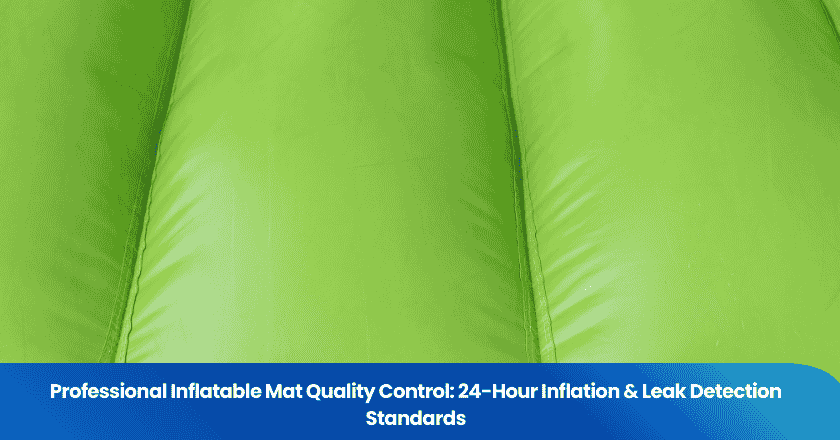
Quality assurance for inflatable mats is a rigorous process designed to ensure structural integrity and user safety in demanding outdoor environments. Whether for camping, sports, or medical use, inflatable products must maintain constant internal pressure under various thermal conditions. A professional inspection utilizes a dual-verification approach: the 24-hour static inflation test to measure overall pressure retention and the soap water "bubble" method for precise puncture localization. By implementing systematic quality checks, manufacturers and importers can identify micro-leaks and weld defects before products reach the consumer market.
Key Takeaways
- Safety Verification: The 24-hour test is the industry standard for identifying "slow leaks" caused by porous materials or faulty valves.
- Detection Precision: Soap water checks reveal micro-punctures (less than 0.1mm) that pressure gauges might miss.
- Material Standards: Quality control verifies TPU and PVC thickness to ensure compliance with ASTM D751 standards.
- AQL Sampling: Utilizing ANSI/ASQ Z1.4 sampling ensures a statistically sound batch inspection for high-volume orders.
- Repair Integrity: Post-repair verification is mandatory to confirm that patches meet the original material's tensile strength.
Inflatable Mats Quality Standards and Material Verification
The durability of an inflatable mat is determined by its substrate material and welding technology. Most premium mats utilize TPU (Thermoplastic Polyurethane) due to its superior weight-to-strength ratio and environmental resistance compared to traditional PVC. During an initial quality inspection, technicians verify material denier and the integrity of the "High-Frequency Welding" (HFW) seams.
Technical Material Specifications
Materials must be tested for airtightness and resistance to UV degradation. In industrial settings, inspectors focus on the 'Coating Adhesion' strength. If the bond between the fabric and the airtight coating is weak, the mat may suffer from "Delamination," leading to systemic air loss that cannot be repaired with simple patches.
| Material Property | Test Standard | Acceptance Criteria |
|---|---|---|
| Tensile Strength | ASTM D751 | Minimum 200N for 40D TPU fabrics. |
| Airtightness | ISO 6185 | Pressure drop < 5% over 24 hours (temp corrected). |
| Seam Strength | ASTM D6413 | Seam must hold 1.5x rated working pressure. |
| Chemical Compliance | CPSIA / REACH | Phthalate-free and Lead-free certification. |
Technical Procedures for the 24-Hour Inflation Test
The 24-hour inflation test is a macro-level diagnostic tool. It is designed to evaluate the collective integrity of the valves, seams, and fabric surface. However, this test is sensitive to ambient temperature changes. According to Boyle's Law, a drop in room temperature will cause the internal air to contract, mimicking a leak. Professional inspectors must perform "Temperature Correction" to validate results.
Step-by-Step Static Inflation Protocol
- Standard Inflation: Mats are inflated to 1.1x their maximum rated working pressure using a calibrated digital pump.
- Stabilization Period: The product rests for 30 minutes to allow the fabric to stretch and the internal temperature to stabilize.
- Initial Pressure Log: The starting pressure and ambient temperature are recorded in the digital inspection report.
- 24-Hour Observation: The mat is placed in a climate-controlled room (20-25°C) to minimize thermal interference.
- Final Verification: After 24 hours, the pressure is re-measured. A drop greater than 5% (after adjustment) indicates a failure.
"Accuracy in the 24-hour test requires a controlled environment. A simple draft or a heater can invalidate pressure readings, leading to false rejections or, worse, false approvals."
The Soap Water Method: Precision Leak Detection
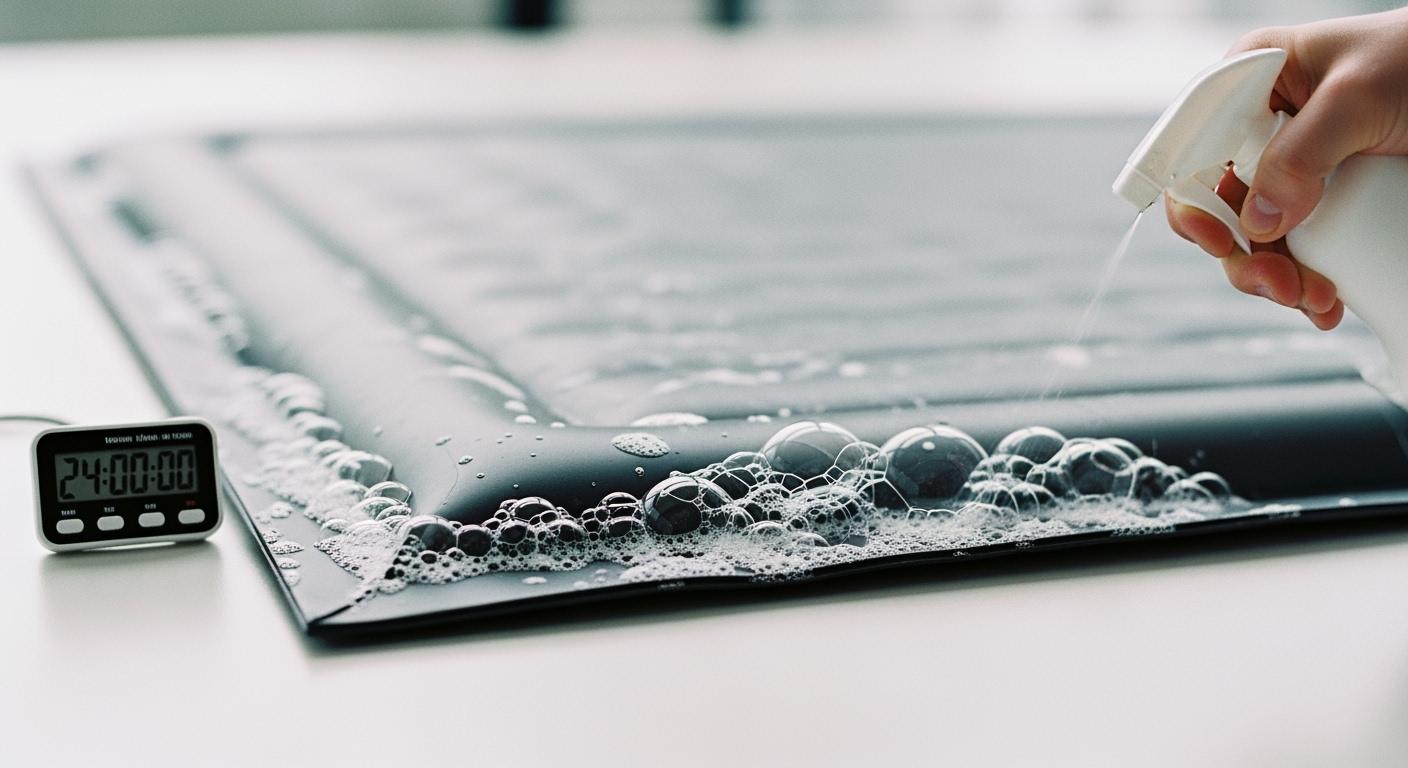
When a mat fails the 24-hour test, the next objective is "Localization." The soap water test (also known as the bubble test) is a highly sensitive method for identifying the exact coordinates of a puncture. It relies on surface tension: escaping air creates visible bubbles in the soapy film.
Optimizing the Detection Solution
The solution must be carefully mixed. A ratio of 1:10 (liquid soap to water) is ideal. If the solution is too thick, it may obstruct micro-leaks; if too thin, the bubbles will burst before they can be identified. Professional inspectors often add glycerin to the mix to increase bubble longevity for easier documentation.
| Detection Zone | Common Defect Type | Criticality Level |
|---|---|---|
| Valve Interface | Gasket misalignment / Dust interference. | Major (Often repairable). |
| Weld Seams | HFW "Burn through" or Cold weld. | Critical (Usually non-repairable). |
| Main Fabric Surface | Micro-puncture from debris. | Minor/Major (Repairable with patch). |
| D-Ring / Attachment | Tensile stress tear. | Critical (Structural failure). |
Common Defects and AQL Classification for Inflatables
During a professional quality inspection, defects are classified to determine if the entire shipment meets the Acceptable Quality Limit (AQL). In the充气产品 industry, any defect that leads to total deflation is typically considered "Major."
- Critical Defects: Presence of hazardous chemicals (lead/phthalates) or sharp metal shards inside the inflation chamber. Acceptance = 0.
- Major Defects: Air loss greater than 10% in 24 hours, valve malfunctions, or seam separation.
- Minor Defects: Aesthetic issues such as misaligned logos, slight color variations, or excess adhesive residue on seams.
Long-term Maintenance and Professional Repair Standards
A successful repair must be as durable as the original material. Professional repair protocols involve "Surface Preparation." The area around the puncture must be cleaned with Isopropyl Alcohol (IPA) to remove body oils and dirt that prevent adhesive bonding. For TPU mats, a urethane-based adhesive is required to create a permanent chemical bond.
The Professional Patching Workflow
- Puncture Localization: Mark the exact center of the leak using a grease pencil after the soap water test.
- Cleaning: Scuff the surface slightly with fine sandpaper (400 grit) to increase the surface area for bonding.
- Adhesive Application: Apply a thin, even coat of adhesive to both the mat and the patch.
- Curing: Wait for the adhesive to become "tacky" before pressing the patch firmly from the center outward to remove air bubbles.
- Post-Repair Test: The repaired mat must undergo a second 24-hour inflation test to verify the seal's integrity.
Digital Monitoring and Quality Oversight
TradeAider's quality control services have replaced paper checklists with real-time digital monitoring. Inspectors capture high-definition photos of the pressure gauge at 0 and 24 hours and upload them to a centralized dashboard. This transparency allows buyers to see exactly which units failed and why, facilitating immediate decision-making for rework or replacement.
| Audit Phase | Objective | Digital Deliverable |
|---|---|---|
| Pre-Production | Validate raw TPU thickness and valve type. | Material Certification Log. |
| In-Process (DPI) | Check welding consistency on the production line. | Live Video of HFW Operation. |
| Final PSI | Execute 24-hour test on AQL samples. | Final Pressure Retention Report. |
Ready to secure your product quality before shipment?
As your third-party inspection, testing & certification partner in China, TradeAider supports brands and sourcing teams across the entire production process, helping you identify quality risks early, ensure compliance, and strengthen your team’s capabilities before shipment.
Book an Inspection or Testing Service with TradeAider today, or for tailored solutions and expert guidance, contact us at services@tradeaider.com.
FAQ
Why does my mat feel softer in the morning if there is no leak?
This is often due to "Thermal Contraction." As the air inside the mat cools overnight, its volume decreases. A true leak can only be confirmed if the mat remains soft after the temperature returns to the daytime level or through a soap water test.
Can I use dish soap for the leak test?
Yes, but ensure it is a "mild" detergent. Harsh chemicals can degrade the UV-resistant coating on TPU and PVC mats over time. Always rinse the mat thoroughly with fresh water after the test.
What is "Delamination" in inflatable mats?
Delamination is when the internal airtight layer separates from the outer fabric. This creates a "ballooning" effect where the mat bulges. It is a critical manufacturing defect and cannot be repaired.
How long do professional repair patches last?
A properly applied TPU patch using urethane adhesive is a permanent repair. It should last for the remaining lifespan of the mat, provided the surface was cleaned and scuffed correctly before application.
Is a 100% inspection necessary for high-risk products?
For high-risk products (like life vests) or premium expedition gear, 100% inflation testing is recommended. For standard camping mats, AQL Level II sampling is typically sufficient to manage quality risks effectively.
Related Articles
Grow your business with TradeAider Service
Click the button below to directly enter the TradeAider Service System. The simple steps from booking and payment to receiving reports are easy to operate.

