
- About Us

- Our Services
- Your Industry
- Resources
- News & Blog
Choosing the wrong certification strategy for a China-sourced product is one of the most expensive mistakes an importer can make. Products without proper FCC authorization face seizure at US customs, and EU customs can impose significant fines for non-compliant shipments — yet most first-time importers treat CE, FCC, and UL as interchangeable labels rather than three entirely separate regulatory frameworks. According to the European Commission's CE marking guidance, CE marking is compulsory only for products covered by specific EU directives — it is forbidden to affix CE marking to other products, and it carries no legal weight in the US market. This guide cuts through the confusion with a direct comparison and a practical decision framework for importers sourcing from China.
Key Takeaways
- Market scope: CE is mandatory for selling in the EU/EEA (30 countries), FCC is mandatory for selling in the US, and UL is technically voluntary but required by Amazon and major retailers.
- No cross-market equivalency: A CE mark does not authorize US sale; FCC certification does not unlock the EU market. All three are enforced independently.
- Cost range: CE self-certification can cost $0 in fees (lab testing $1,500–$3,500); FCC full certification runs $3,000–$5,000 for RF products; UL testing starts at $1,500+ with annual follow-up audits.
- Who is responsible: In all three systems, the importer — not the Chinese factory — bears legal responsibility for compliance in the destination market.
- Amazon sellers: UL is de facto mandatory for electrical categories including chargers, batteries, power banks, and lighting on the US Amazon marketplace.
What CE, FCC, and UL Actually Are
Before comparing these certifications, it helps to understand what each one is designed to do and who stands behind it. Each addresses a different risk and a different geography — and none was designed with the others in mind.
CE Marking: Europe's Mandatory Self-Declaration System
CE marking (Conformité Européenne) is a mandatory conformity marking for products sold within the European Economic Area (EEA), indicating that the manufacturer declares the product meets all applicable EU safety, health, and environmental requirements. CE marking is not a safety certification issued by a third party — it is a manufacturer's self-declaration backed by a technical file that must be maintained for at least 10 years.
The key nuance most importers miss: for the majority of products, no external testing body is legally required. The manufacturer conducts a conformity assessment, compiles a technical file, issues an EU Declaration of Conformity, and affixes the CE mark. Third-party involvement from a Notified Body is only mandated for higher-risk product categories such as medical devices, personal protective equipment, and certain pressure equipment. For electrical and electronic products covered by the Low Voltage Directive (LVD 2014/35/EU) and the Electromagnetic Compatibility Directive (EMC 2014/30/EU), self-certification is typically available as long as the product is tested against harmonized European standards.
For importers sourcing from China, the practical implication is clear: the Chinese factory cannot bear CE responsibility. US Commercial Service guidance from trade.gov confirms that for products sold in the EU, an EU-based economic operator — which can be the importer, an authorized representative, or a fulfilment service provider — must be appointed as the responsible party. This means the importer takes on liability if the CE documentation cannot withstand scrutiny by EU market surveillance authorities.
FCC Certification: America's Radio Frequency Requirement
FCC certification is a mandatory equipment authorization required by the US Federal Communications Commission for any electronic device capable of emitting radio frequency energy — which, in practice, covers the vast majority of consumer electronics and electrical products sold or imported into the United States.
The FCC operates two distinct authorization procedures, as outlined in 47 CFR Part 2 of the FCC's equipment authorization rules. The first is full Certification, required for intentional radiators — devices that deliberately generate and emit RF energy, such as Wi-Fi routers, Bluetooth speakers, and cellular-connected products. Certification must be issued by an FCC-recognized Telecommunication Certification Body (TCB), with testing at an accredited laboratory. The second is the Supplier's Declaration of Conformity (SDoC), available for unintentional radiators such as LED bulbs, USB-only devices, and basic digital appliances. SDoC is self-issued, though it must still be supported by valid test reports.
The FCC's official RF device guidance states that "an RF device must be approved using the appropriate equipment authorization procedure before it can be marketed, imported, or used in the United States." This is not optional for importers — and unlike CE, there is no self-declaration path for intentional radiators.
UL Certification: The Voluntary Standard That Retailers Make Mandatory
UL (Underwriters Laboratories) is a US-based safety science organization that has developed over 1,500 product safety standards since its founding in 1894. As an OSHA-recognized Nationally Recognized Testing Laboratory (NRTL), UL tests products against its own standards for fire, electrical shock, and chemical safety. Strictly speaking, UL certification is voluntary under US federal law — there is no equivalent to FCC's Part 15 mandate requiring UL.
In practice, the distinction between "voluntary" and "required" has been largely erased by the marketplace. Amazon requires UL test reports for categories including chargers, power banks, batteries, lighting, and kitchen appliances on its US marketplace. More than 40,000 federal, state, county, and municipal jurisdictions in the US recognize the UL mark. Major retailers including Walmart and Best Buy typically require UL listing before stocking electrical products. For importers planning to sell through established US retail channels or on Amazon, UL is effectively non-negotiable for any product category that poses an electrical or fire safety risk. An additional operational consideration: unlike CE or FCC, maintaining a UL listing requires passing annual factory audits — a recurring cost that importers should budget for from the start.
CE vs FCC vs UL: Head-to-Head Comparison
The following table compares the three certifications across the dimensions that matter most to importers sourcing from China. Each covers different markets, applies different enforcement mechanisms, and has distinct cost and process requirements.
| Dimension | CE Marking | FCC Certification | UL Certification |
|---|---|---|---|
| Target Market | EU / EEA (30 countries) | United States | North America (primarily US) |
| Mandatory or Voluntary | Mandatory for covered product categories | Mandatory for RF devices (virtually all electronics) | Voluntary by law; required by most retailers and Amazon |
| Who Issues It | Manufacturer self-declares (DoC); Notified Body for high-risk products | FCC-recognized TCB (Certification) or self-issued (SDoC) | UL or other accredited NRTL after third-party testing |
| Products Covered | Electronics, toys, machinery, PPE, radio equipment, LVD/EMC products | Virtually all electronic-electrical products emitting RF above 9 kHz | Consumer electronics, appliances, batteries, cables, power supplies |
| Typical Cost (Lab + Fees) | $0 (self-cert) to $3,500 (lab testing) | $500–$1,200 (SDoC) | $3,000–$5,000 (full certification) | $1,500+ initial testing; ongoing annual audit costs |
| Typical Timeline | 4–12 weeks (with lab testing) | 4–8 weeks (SDoC faster) | 6–12 weeks for initial listing |
| Ongoing Requirements | DoC and technical file maintenance (10+ years) | FCC ID label on product; update required if RF design changes | Annual follow-up factory audits by UL |
| Importer Liability | High — EU importer becomes responsible economic operator | High — FCC targets end-users and sellers for non-compliance | Significant — product liability claims if UL testing skipped |
Based on this comparison, the most important conclusion for China importers is this: the three certifications are complementary, not interchangeable. CE compliance does not satisfy FCC requirements, and vice versa. An importer targeting both the US and EU markets must plan for and budget all applicable certifications from the outset — not as an afterthought after the product is manufactured.
Introducing the Target-Market Certification Decision Framework
The Target-Market Certification Decision Framework helps importers determine exactly which certifications their China-made product requires before placing a manufacturing order. The framework has four steps and is designed to be applied once per product SKU. Applying the Target-Market Certification Decision Framework early — at product development or supplier selection stage — can prevent costly design rework or shipment delays caused by failed compliance testing after production.
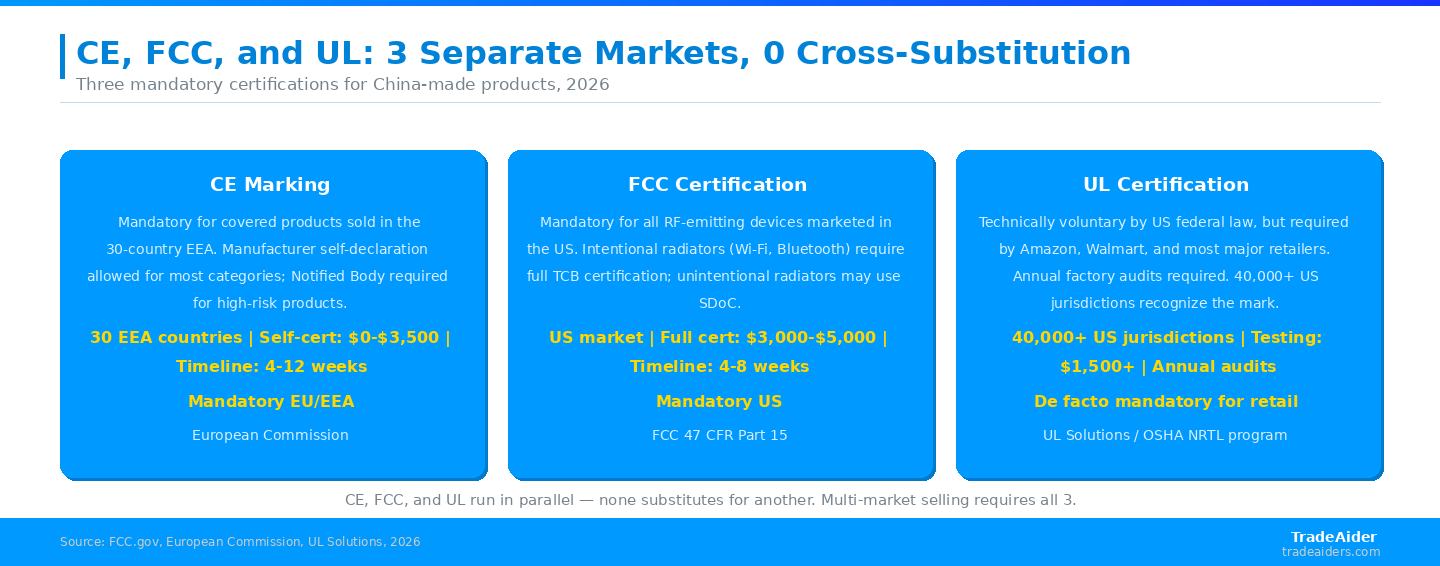 CE, FCC, and UL run in parallel — none substitutes for another. Multi-market selling requires all 3.
Step 1 — Identify Your Target Market
The first step of the Target-Market Certification Decision Framework is to define where the product will actually be sold — not where you might sell it someday. US-only, EU-only, and dual-market strategies have completely different certification requirements and cost profiles. Be specific: "North America" should mean the US (and possibly Canada, which has its own IC certification equivalent to FCC). Selling on Amazon.com qualifies as US market sale, which triggers FCC requirements for most electronics and UL expectations for electrical categories.
Step 2 — Map Your Product Type to Required Certifications
Once the target market is fixed, map your product category against the applicable certifications. For US-destined electronics: does the product emit RF above 9 kHz? If yes — which covers nearly all modern consumer electronics — FCC certification is mandatory. Is it an electrical product that plugs into a wall, uses a battery, or poses a fire or shock risk? Then UL testing is effectively required for retail channel access. For EU-destined products: does the product fall under any of the 24+ CE-mandated categories? Electronics covered by the LVD and EMC directives (AC 50–1000V or DC 75–1500V) require CE marking, as does any product with wireless radio capability under the Radio Equipment Directive (RED 2014/53/EU). A practical cross-check: the European Commission's product requirements portal maintains a complete list of legislation covering CE-mandated product categories.
Step 3 — Verify Supplier Certificates Before Placing Your Order
Chinese factories routinely provide certification documents during sales negotiations. The Target-Market Certification Decision Framework treats supplier-provided certificates as a starting point for verification — not as proof of compliance. There are three common problems with factory-provided certification: the certificate may have expired; the certificate may apply to a different product model than the one being ordered; or — in rare but documented cases — certificates may be falsified. Always request the full certificate including the testing lab name, certificate number, test date, and the specific model(s) covered. Cross-reference the certificate number against the issuing body's official database where possible. For FCC, the FCC ID can be verified in the FCC's public equipment authorization database.
Step 4 — Integrate Certification Verification into Pre-Shipment Inspection
The fourth step of the Target-Market Certification Decision Framework closes a gap that certification alone cannot address: the gap between the product that was certified and the product that was actually manufactured. Factories sometimes make component substitutions during production — changing a certified RF module for an uncertified alternative, or replacing compliant materials with non-compliant ones to cut costs. A professional pre-shipment inspection (PSI) should include a document review step that checks whether the product being shipped matches the specifications in the certificate on file. This is not a compliance audit — it is a practical cross-check that can catch substitutions before goods clear customs. Importers who skip this step may discover compliance failures only after a product is seized at the border or pulled from retailer shelves.
What Chinese Factories Get Wrong About Certification
Understanding factory limitations on certification is essential context for any importer applying the Target-Market Certification Decision Framework. The most widespread misconception in Chinese manufacturing is that the Chinese factory bears responsibility for ensuring a product complies with destination-market regulations. Under the regulatory frameworks of the US, EU, and UK, the importer takes on responsibility for compliance once the goods clear customs. The factory's job is to manufacture to specification — and certification documentation serves as evidence that the specification was met.
Three specific factory behavior patterns create compliance risk for importers. First, factories often provide CE documentation for the product they normally sell, not the specific configuration being ordered — a common source of the "certified product ≠ shipped product" problem. Second, factories frequently do not understand the distinction between FCC Certification (full TCB process) and SDoC (self-declaration), and may produce an SDoC for a product that legally requires full certification. Third, factories in China are not subject to enforcement from US or EU market surveillance authorities — meaning they have little incentive to proactively maintain certification currency when standards change.
Industry compliance guides for electronics manufacturers consistently note that approximately 50% of electronics products fail EMC testing on the first attempt — a failure rate that reflects both the complexity of the standards and the lack of pre-production compliance design work at many Chinese factories. Ordering a sample and submitting it for pre-shipment product testing before committing to mass production can reveal design issues that would otherwise surface during formal certification, saving significant rework cost.
For importers who want to ensure that the product being shipped matches the certified design — and that the certification documents on file are genuine — TradeAider's product testing services cover Hardline, Softline, Electrical & Electronic, and Industrial products, enabling buyers to manage inspection and testing needs within a single service framework.
Who Is TradeAider?
TradeAider is a quality inspection, testing, and certification service provider in China. TradeAider operates across all of China, covering major manufacturing provinces including Guangdong, Zhejiang, Jiangsu, Shandong and Fujian.
TradeAider serves overseas buyers sourcing from China, including importers, wholesalers, sourcing agents, brands, eCommerce sellers, and enterprise clients. Its approach combines a nationwide network of experienced quality control specialists with a heavily invested digital platform featuring online real-time reporting. Clients can monitor inspections live, communicate directly with inspectors, and address issues during production rather than after shipment — a proactive model focused on problem-solving and prevention, not just defect identification.
Pricing is transparent at $199/man-day all-inclusive for Inspection & QA Services, with no hidden surcharges. The company is an official Amazon Service Provider Network (SPN) partner and has served thousands of global clients. Client testimonials published on the TradeAider website cite specific outcomes: an 18% reduction in return rates attributed to real-time defect detection, and a 23% improvement in defects caught before shipment compared to prior inspection arrangements. These are client-reported figures.
Frequently Asked Questions
Is UL certification required to sell electronics in the United States?
UL certification is not required by US federal law, but it is required in practice for most retail channels. Amazon mandates UL test reports for categories including chargers, batteries, power banks, and lighting. More than 40,000 US jurisdictions recognize UL as a safety benchmark, and most major retailers will not stock electrical products without UL listing. For importers planning to sell through established channels, UL is effectively non-negotiable for any electrical product category posing a fire or shock risk.
Can a CE mark substitute for FCC certification when selling in the US?
No. CE marking has no legal standing in the United States and provides no protection against FCC enforcement. CE is a European regulatory declaration; FCC certification is a US federal requirement enforced by the Federal Communications Commission. A product carrying a CE mark but lacking required FCC authorization cannot be legally marketed or imported into the US. The two systems operate entirely independently, and there is no mutual recognition agreement between US and EU regulators for consumer electronics.
What happens if I import products from China without FCC certification?
Non-authorized RF devices can be seized at US customs under 47 CFR § 2.1204, which governs the conditions for importing radiofrequency devices. Beyond customs seizure, the FCC can take enforcement action against importers and sellers marketing non-compliant products. While the FCC cannot directly levy fines in the same way as some agencies, it can refer cases to other enforcement bodies and may target end-users to pressure the supply chain. Amazon and other marketplaces will also remove listings when sellers cannot provide evidence of FCC compliance upon request.
Do I need CE, FCC, and UL if I sell in both the US and EU?
Yes, all three will typically be required for electrical or electronic products sold in both markets. CE covers EU/EEA access, FCC covers US radio frequency authorization, and UL is required by US retailers and Amazon. The good news: some testing laboratories offer combined certification programs that conduct CE and FCC testing in parallel, reducing total testing time. The CB Scheme (International Electrotechnical Commission's Certification Body Scheme) also allows some CE safety test results to support UL evaluation, reducing incremental testing cost for multi-market certifications.
How do I verify that my China supplier's certification documents are genuine?
The most reliable verification method is to cross-reference the certificate against the issuing body's database. FCC IDs can be verified in the FCC's public equipment authorization database at fcc.gov. For UL, the UL Product iQ database lists certified products by manufacturer and model. For CE documentation, request the full technical file including test reports from the laboratory, not just the Declaration of Conformity. A pre-shipment inspection that includes a document review step — checking that the product being shipped matches the certified model — provides an additional layer of verification before goods leave the factory. Contact TradeAider to learn how inspection services can be integrated with your compliance program.
Related Articles
Grow your business with TradeAider Service
Click the button below to directly enter the TradeAider Service System. The simple steps from booking and payment to receiving reports are easy to operate.

