
- About Us

- Our Services
- Your Industry
- Resources
- News & Blog
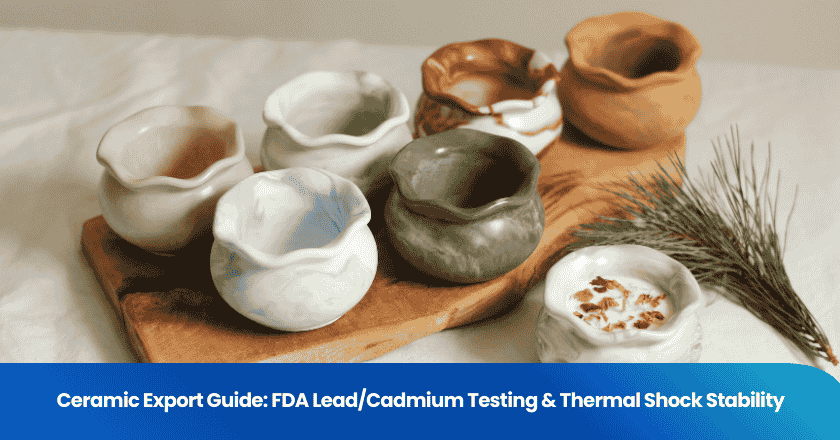
Exporting ceramic crafts demands rigorous adherence to safety and durability standards. Key among these are FDA lead and cadmium leaching tests, which measure heavy metal release from glazes to protect consumers from toxic exposure. Equally important is thermal shock stability, ensuring products withstand sudden temperature changes without cracking. Failure to meet these benchmarks can result in health risks, shipment rejections, and damaged brand reputation. Success in the global market relies on prioritizing both chemical safety and material durability.

Chemical safety and material durability stand as the two pillars of reliable ceramic exports.
Key Takeaways
- FDA lead and cadmium leaching tests ensure ceramic products are safe for food contact. Passing these tests protects consumers from harmful exposure.
- Thermal shock stability is crucial for ceramics. Products must withstand rapid temperature changes to avoid cracking or breaking during use.
- Proper documentation is essential for compliance. Exporters must gather all necessary certificates and confirm that products meet safety standards before shipment.
- Working with accredited labs guarantees reliable testing results. This partnership helps exporters meet international regulations and build trust with buyers.
- Regular testing and quality control prevent costly failures. Manufacturers should monitor glaze composition and firing processes to ensure safety and compliance.
Ceramic Crafts Export Compliance Essentials
Food Contact Certification
Exporting ceramics requires strict attention to food contact certification. The United States enforces FDA regulations that set limits for leachable lead and cadmium in ceramic foodware. Manufacturers must provide documentation that confirms compliance with these standards. The following table outlines the main documentation needed:
| Requirement | Description |
|---|---|
| Manufacturer Information | Identity and address of the manufacturer and importer. |
| Article Identity | Description of the ceramic article. |
| Declaration Date | Date of compliance declaration. |
| Compliance Confirmation | Statement that the ceramic article meets FDA and EU safety requirements. |
Safety standards help protect consumers and support market access. Exporters must ensure all food contact items meet these requirements before shipment.
Restricted Substance Testing
Testing for restricted substances is a critical step. Laboratories analyze ceramic glazes for hazardous materials such as lead, cadmium, and other regulated chemicals.
Compliance with restricted substance testing ensures that exported ceramics are safe for consumers and meet international standards.
Labeling and Decorative Use
Proper labeling is essential for decorative-only ceramic crafts. Export regulations require clear warnings to prevent accidental use for food. Labels must include one of the following messages in legible script:
- "Not for Food Use. May Poison Food"
- "Not for Food Use. Glaze contains lead. Food Use May Result in Lead Poisoning"
- "Not for Food Use—Food Consumed from this Vessel May be Harmful"
Labels must be visible and permanent. These requirements help prevent health risks and support compliance.
FDA Lead & Cadmium Leaching Tests
FDA Standards
The FDA sets strict limits for lead and cadmium leaching in ceramic food contact items. These standards protect consumers from heavy metal exposure. The FDA requires that ceramic tableware and kitchenware do not release harmful amounts of metals when used with food. The maximum allowable concentrations depend on the type of dinnerware.
- Leachable lead (Pb): 0.5 to 3.0 micrograms per milliliter (μg/ml)
- Leachable cadmium (Cd): 0.25 to 0.5 micrograms per milliliter (μg/ml)
Testing Methods
Laboratories use standardized procedures to measure leaching. The FDA recommends a 24-hour leach test using 4% acetic acid. This simulates real-world conditions by exposing items to acidic solutions.
| Method | Description |
|---|---|
| Graphite Furnace Atomic Absorption Spectroscopy | Improves sensitivity and reduces preparation time. Uses leach solutions from ceramics with 4% acetic acid for 24 hours. |
| Concentration Detection | Detects a wide range: 0.005-17,600 µg/mL for lead; 0.0004-0.500 µg/mL for cadmium. |
| Recovery Rate | Achieves 96-106% recovery from fortified leach solutions. |
Tip: Independent testing by accredited labs ensures unbiased results and supports compliance with FDA regulations.
Common Pitfalls
Ceramics often fail tests due to acidic foods speeding up leaching or improper firing temperatures. Manufacturers must pay close attention to glaze composition and firing procedures, avoiding lead-containing glazes for food contact items wherever possible.
Thermal Shock Stability in Ceramics
Thermal shock stability refers to the ability of ceramic materials to withstand rapid temperature changes without failing. This is critical for meeting international standards.
Environmental Adaptability Testing
These tests simulate real-life scenarios to ensure product safety and functionality.
- Thermal shock resistance: Freezer-to-boiling water tests.
- Microwave suitability: Vitrification tests to prevent exploding or cracking.
- Dishwasher resistance: Cyclic washing tests to check for glaze durability.
| Test Type | Temp Range (Hot) | Temp Range (Cold) | Description |
|---|---|---|---|
| On/off test | +50ºC – +220ºC | -80ºC – +70ºC | Accelerated cyclic test simulating extreme conditions. |
| Winter/summer test | Varies | Varies | Simulates annual temperature changes. |
Mechanical Strength Checks
Mechanical strength checks measure how much force ceramics can withstand. Tests focus on impact resistance, compression, and handle strength.
| Test Type | Purpose |
|---|---|
| Dishwasher safe / handwash | Ensures durability in cleaning conditions. |
| Microwave safe | Confirms safety in microwave use. |
| Thermal shock/crazing | Tests resistance to temperature changes. |
| Impact resistance | Evaluates ability to withstand physical knocks. |
Custom Test Requirements
Buyers often request custom tests, such as specific temperature cycles or duration of exposure. Exporters should include these requirements in contracts so testing labs can verify product durability accordingly. Clear communication between buyers and sellers ensures products meet all expectations.
Exporter Strategies for Compliance
Preparing for FDA Testing
Exporters follow a clear process to prepare for FDA testing:
- Sample Preparation: Select a representative sample from the production batch.
- Acid Extraction: Fill the item with acetic acid solution.
- Measurement: Analyze the solution using AAS or ICP-MS to measure metal levels.
Documentation and Certification
Exporters must organize documents demonstrating compliance, including confirmation that dinnerware is free from excessive lead and cadmium. Key steps include:
- Confirm FDA and Prop 65 compliance.
- Verify microwave/dishwasher safety.
- Request quality control reports from suppliers.
- Maintain material traceability for every batch.
Working with Accredited Labs
Partnering with accredited laboratories is beneficial. These labs use standardized procedures to test for restricted substances and thermal shock stability, providing reliable certificates recognized internationally. Exporters should communicate testing requirements clearly.
Ceramic export success depends on passing FDA leaching tests and proving thermal shock stability. Exporters should focus on both chemical and physical compliance to protect consumers. Consulting quality assurance professionals helps navigate these complex requirements.
| Requirement | Description |
|---|---|
| Facility registration | Register with the FDA and renew every two years. |
| U.S. Agent designation | Assign a U.S.-based contact for FDA communication. |
| Labeling compliance | Follow FDA formats for ingredient lists (if applicable) and warnings. |
| Prior Notice | Pre-declare shipments to U.S. authorities. |
FAQ
What are FDA lead and cadmium leaching tests?
These tests check if ceramic items release harmful metals into food or drink using acid solutions to simulate real use. Passing them proves the ceramics are safe for food contact.
Why does thermal shock stability matter?
It proves ceramics can handle sudden temperature changes (like fridge to microwave) without cracking, reducing product returns and ensuring safety.
How do exporters prove compliance?
By providing test reports from accredited labs showing safe lead/cadmium levels, along with proper certificates and product labeling.
Can decorative ceramics skip food safety tests?
Yes, if they are clearly and permanently labeled "Not for Food Use." This prevents accidental food contact use.
What happens if a ceramic product fails testing?
The product cannot be shipped to regulated markets. The manufacturer must identify the cause, fix the production process, and retest before export.
Related Articles


Grow your business with TradeAider Service
Click the button below to directly enter the TradeAider Service System. The simple steps from booking and payment to receiving reports are easy to operate.

