
- About Us

- Our Services
- Your Industry
- Resources
- News & Blog
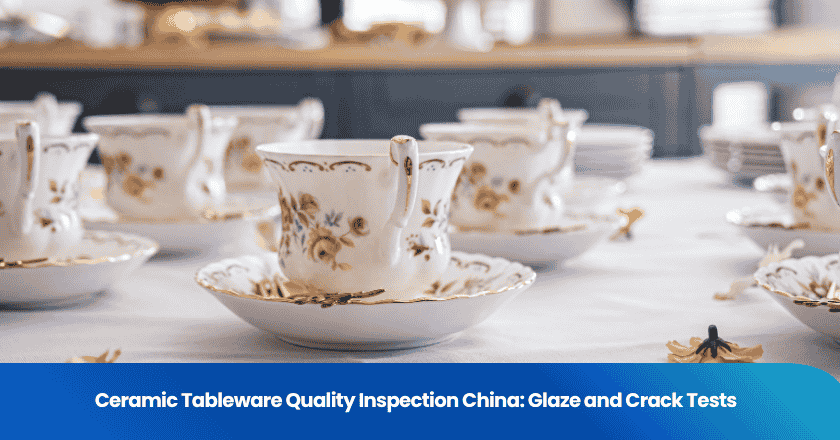
Ceramic tableware from China fills kitchen cabinets and restaurant shelves worldwide — from everyday dinner plates to premium bone china. But beneath the glossy surface, glaze defects and hidden cracks can turn a beautiful plate into a health hazard or a product that shatters in the dishwasher. This guide covers the specific tests, standards, and inspection techniques that professional quality inspectors use to evaluate ceramic tableware manufactured in China.
Key Takeaways
- Glaze crazing — a network of fine cracks in the glaze layer — is the most common and most consequential defect in ceramic tableware, indicating structural instability and potential lead leaching risk
- FDA limits for ceramic foodware restrict lead leaching to 4.0 mg/L and cadmium to 0.5 mcg/ml, with California Prop 65 setting even stricter thresholds
- The sound test (tapping ceramics to listen for a clear ring) remains one of the fastest and most reliable on-site methods for detecting hidden cracks
- Thermal shock resistance testing simulates real-world use conditions and catches products that will crack during normal washing or serving
- A structured defect classification system — separating glaze, structural, surface, and safety defects — helps inspectors apply the right AQL tolerance to each category
Why Glaze and Crack Testing Matters for Ceramic Tableware
Ceramic tableware occupies a unique intersection of aesthetics, functionality, and food safety. A beautifully glazed plate that leaches lead into your customer's dinner isn't just a quality problem — it's a regulatory violation and a brand-destroying event. Understanding why these tests matter helps you set better inspection specifications and catch problems before they reach consumers.
Health Risks: Lead and Cadmium Leaching
The glaze on ceramic tableware isn't just decorative — it's a functional barrier between the ceramic body and the food it contacts. When that glaze is defective, under-fired, or formulated with improper materials, heavy metals like lead and cadmium can leach into food and beverages. The risk is especially high with acidic foods (tomato sauce, citrus juices, wine) and hot liquids, which accelerate leaching.
According to Euro Ceramica's analysis of dinnerware toxin testing standards, the FDA permits up to 3 mcg/ml of lead leaching from ceramic foodware, while California Proposition 65 imposes a far stricter limit of 0.226 mcg/ml. This gap means a product that passes FDA testing may fail California's requirements — a critical distinction for importers selling into the US market.
Structural Integrity and Durability
Beyond chemical safety, glaze and crack defects directly affect product durability. A plate with undetected crazing may look perfect on the shelf but will crack after a few dishwasher cycles. A bowl with a hairline fracture can shatter when filled with hot soup. These failures don't just generate customer complaints — they create safety hazards and product liability exposure.
Understanding Ceramic Glaze Defects
Before you can inspect ceramic tableware effectively, you need to understand the specific defects that affect glazed products and what causes them.
Crazing: The Most Common Glaze Problem
Crazing appears as a network of fine cracks in the glaze surface — sometimes visible to the naked eye, sometimes only under magnification. It occurs when the glaze and the ceramic body expand and contract at different rates during temperature changes (a mismatch in coefficient of thermal expansion). The result is a spiderweb pattern that compromises both the appearance and the functional integrity of the glaze.
According to Luxury Bone China's guide to crazing, this defect is particularly concerning because it creates channels through which bacteria can penetrate and through which heavy metals in the glaze can leach into food. Crazed tableware should be classified as a critical defect in any inspection — it's not merely cosmetic.
Other Glaze Defects You Need to Check
| Defect Type | Description | Severity |
|---|---|---|
| Crazing | Fine crack network in glaze surface | Critical |
| Pinholes | Small holes in glaze from gas bubbles during firing | Major |
| Crawling | Glaze pulls away from areas, leaving bare ceramic exposed | Critical |
| Shivering | Glaze flakes off in sheets (opposite of crazing) | Critical |
| Uneven Glaze | Thickness variation causing visible color or texture differences | Minor to Major |
| Blisters | Raised bumps where gas escaped during firing | Major |
Regulatory Standards for Ceramic Tableware
Multiple regulatory frameworks govern ceramic tableware safety, and importers need to understand which ones apply to their target markets.
FDA Requirements for Lead and Cadmium
The FDA regulates ceramic foodware under Compliance Policy Guide (CPG) 7117.06, which sets maximum leaching limits for lead and cadmium. For flatware (plates, saucers), the lead limit is 3.0 mcg/ml. For cups and mugs (large hollowware), the limit is 0.5 mcg/ml for cadmium. These limits are tested using ASTM C738-94 standard test methods, which involve filling the ceramic piece with an acetic acid solution and measuring the metal concentration after 24 hours (per Solecasa's guide to FDA and LFGB ceramic standards).
California Proposition 65 Stricter Limits
California Proposition 65 imposes significantly stricter limits on lead leaching from ceramic tableware — 0.226 mcg/ml versus the FDA's 3.0 mcg/ml for flatware. If you're selling ceramic tableware in California (which, practically speaking, means selling it anywhere in the US), you need to ensure your products meet Prop 65 requirements or carry the required warning labels. For most brands, meeting Prop 65 limits is preferable to labeling products with a cancer warning.
EU and International Standards
The European Union applies ISO 6486 standards for lead and cadmium release from ceramic ware. Germany's LFGB framework also covers ceramic food contact materials. The specific limits vary by product type (flatware vs. hollowware vs. cups) and by the intended food contact area. For importers selling globally, the practical approach is to test against the strictest applicable standard — typically California Prop 65 for the US market and the combined FDA/LFGB requirements for international distribution (per Vancasso's guide to FDA ceramic glaze safety standards).
How Inspectors Test Glaze Quality in China
Professional ceramic tableware inspection involves a combination of visual, acoustic, and physical testing methods. Here's what happens during a real inspection at a Chinese ceramics factory.
Visual Inspection Techniques
Inspectors examine each piece under bright, directed light — typically a 60-100 watt incandescent bulb at a low angle — to reveal surface defects invisible under normal room lighting. They rotate each piece slowly, checking all surfaces including the underside, rim, and interior. The light angle makes crazing, pinholes, and glaze skips visible because the defects create shadows and reflections that flat, properly glazed surfaces don't.
According to Solecasa's 12-step ceramic dinnerware quality control guide, the standard defect tolerance for bone china is: front side should have no more than 2 black spots or glaze flaws, back side can allow up to 3 minor flaws, and total defects should not exceed 2 per piece for first-grade products.
The Sound Test: Ringing for Integrity
One of the oldest and most reliable ceramic testing methods is deceptively simple: tap the piece and listen. A high-quality, defect-free ceramic piece produces a clear, sustained ringing tone when struck lightly. A piece with hidden cracks, internal stresses, or manufacturing defects produces a dull, short thud.
Inspectors typically use a hard non-metallic object (like a wooden stick or another ceramic piece) to tap the rim of plates, bowls, and cups. The test takes seconds per piece but catches structural problems that visual inspection alone cannot detect — particularly hairline cracks in the ceramic body that haven't yet reached the surface.
Thermal Shock Resistance Testing
Thermal shock testing simulates the temperature changes ceramic tableware experiences during normal use — going from room temperature to hot food, or from a warm table to a sink of soapy water. The standard test involves heating the piece to a specified temperature (typically 140-180 degrees Fahrenheit), then rapidly immersing it in cold water. Products that survive without cracking or crazing pass the test.
For during-production inspection, thermal shock testing is particularly valuable because it catches firing problems early — if a kiln temperature was off, the thermal shock test will reveal the resulting structural weakness before the entire batch is produced.
Lead and Cadmium Leaching Tests
On-site inspectors cannot perform definitive lead and cadmium leaching tests — these require laboratory equipment and controlled conditions. However, inspectors can and should collect production samples for laboratory submission. The standard test (ASTM C738-94) involves filling the piece with a 4% acetic acid solution, holding it at specified conditions for 24 hours, then measuring the metal content in the solution using atomic absorption or ICP-MS analysis (per research published in the National Library of Medicine on ceramic tableware metal marking and testing).
TradeAider's product testing service coordinates this laboratory testing through accredited partners, ensuring your ceramic products meet the regulatory requirements of every target market.
Crack Detection Methods
Hairline Cracks and Stress Fractures
Hairline cracks are among the most dangerous ceramic defects because they're nearly invisible to the naked eye but significantly weaken the product. They typically form during the cooling phase after kiln firing, when uneven cooling creates internal stresses. The sound test is the primary detection method, but experienced inspectors also examine pieces under raking light (light at a very low angle to the surface) which makes even tiny surface cracks visible.
Dye Penetrant Testing for Hidden Cracks
For critical applications or high-value ceramic products, inspectors can use dye penetrant testing — applying a colored liquid dye to the surface, allowing it to seep into any cracks, then wiping away the excess and applying a developer that draws the dye back out, revealing the crack pattern in vivid color. This method detects cracks that are too fine for visual inspection and too subtle for the sound test to reliably identify (per QC Inspection's comprehensive analysis of ceramic product testing standards).
Common Defects Found During Ceramic Inspection
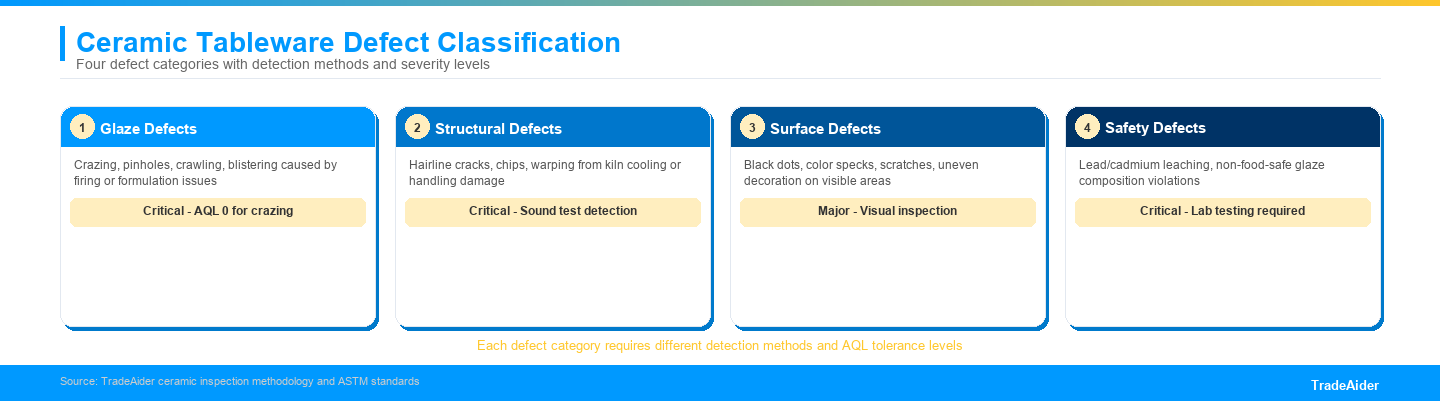
Ceramic tableware defect classification: each category requires different detection methods and AQL tolerance levels during inspection
| Category | Common Defects | Detection Method |
|---|---|---|
| Glaze Defects | Crazing, pinholes, crawling, blistering | Visual under raking light |
| Structural Defects | Hairline cracks, chips, warping | Sound test, visual, dimensional |
| Surface Defects | Black dots, color specks, scratches, uneven decoration | Visual inspection |
| Safety Defects | Lead/cadmium leaching, non-food-safe glaze | Laboratory testing (ASTM C738-94) |
Structuring Your Ceramic Tableware Inspection
What to Include in Your Inspection Checklist
A comprehensive ceramic tableware inspection checklist should cover these areas:
- Dimensional checks: Measure diameter, height, and weight against specifications — ceramic firing causes shrinkage, so dimensional variation indicates firing problems
- Visual inspection: Examine all surfaces under raking light for glaze defects, surface marks, and decoration quality
- Sound test: Tap each piece in the sample to detect hidden structural cracks
- Thermal shock test: Perform on a sample subset to verify resistance to temperature changes
- Fit and stack test: Verify lids fit properly and plates/bowls stack securely without wobbling
- Labeling verification: Confirm bottom stamps, logos, and any safety markings are correctly applied
For detailed guidance on structuring your inspection specifications, review the inspection standards applicable to your product type. Use the AQL calculator to determine the correct sample size based on your lot size and inspection level.
Experienced importers know that ceramic tableware demands more rigorous inspection than many other product categories because the defects affect both aesthetics and safety. Working with a quality partner who understands ceramics-specific testing ensures nothing gets missed.
Frequently Asked Questions
What is crazing in ceramic tableware and is it dangerous?
Crazing is a network of fine cracks in the glaze surface caused by a mismatch between the thermal expansion of the glaze and the ceramic body. It is dangerous for two reasons: first, the cracks weaken the glaze and allow bacteria to penetrate the surface where they cannot be cleaned away; second, the compromised glaze barrier can allow lead and cadmium to leach into food at higher rates than intact glaze. Any piece showing crazing should be rejected during inspection.
How do inspectors test ceramic tableware for lead?
Definitive lead testing requires laboratory analysis using the ASTM C738-94 standard, which involves filling the ceramic piece with a 4% acetic acid solution for 24 hours and then measuring the lead concentration in the solution. On-site inspectors cannot perform this test but collect production samples for laboratory submission. Some inspectors may use XRF (X-ray fluorescence) analyzers for rapid screening, though these provide indicative rather than definitive results.
What AQL level should I use for ceramic tableware inspection?
For ceramic tableware, most importers use AQL Level II for general inspection, with critical defects (crazing, cracks, lead leaching) at AQL 0 (zero tolerance), major defects (glaze pinholes, chips, dimensional issues) at AQL 2.5, and minor defects (surface marks, color variation) at AQL 4.0. This tiered approach ensures safety-critical issues are never accepted while allowing reasonable tolerance for cosmetic imperfections.
How common are glaze defects in Chinese ceramic factories?
Glaze defects are among the most common quality issues in ceramic manufacturing, with crazing rates varying significantly by factory — from under 1% in well-controlled facilities to 10% or more in factories with kiln temperature management problems. The key risk factors are raw material consistency, kiln temperature uniformity, and cooling rate control. Regular inspection across multiple production batches reveals whether a factory has consistent process control or sporadic quality issues.

Related Articles



Grow your business with TradeAider Service
Click the button below to directly enter the TradeAider Service System. The simple steps from booking and payment to receiving reports are easy to operate.

