
- About Us

- Our Services
- Your Industry
- Resources
- News & Blog
In Q1 2025, 14% of Amazon seller accounts faced suspensions — a figure that has climbed from 11% in 2024 as the platform tightens enforcement across all seller categories. Product quality issues sit at the center of this escalation: defective goods generate negative feedback, A-to-Z claims, and ODR breaches that trigger account review in a predictable sequence. Understanding that sequence — and where to intervene — is the difference between a protected account and a 17-day reinstatement countdown.
Key Takeaways
- Risk trigger: Amazon's Order Defect Rate (ODR) must stay below 1%. Quality defects — through negative feedback and A-to-Z claims — are the primary driver of ODR breaches for FBA sellers sourcing from China.
- Escalation speed: A single defective shipment of 5,000 units with 10% defect rate can push a mid-volume account's ODR to 2–5% within 60 days — well above the suspension threshold.
- Framework: The Quality Defect Suspension Risk Matrix identifies three defect categories (functional, specification, compliance) with distinct escalation paths, severity levels, and prevention windows.
- Account Health Rating: Amazon's AHR scale runs 0–1,000. Scores below 100 are at imminent suspension risk. Sellers with AHR 250+ maintained for 6 months earn a 72-hour buffer before action is taken.
- Prevention: Pre-shipment inspection catches the defect categories most likely to generate complaints before they enter Amazon's fulfillment network — at source cost rather than remediation cost.
Defining the Problem: How Defects Become Account Risk
Amazon Account Suspension (Quality-Based) is the deactivation of a seller's selling privileges due to performance metrics that fall below Amazon's minimum standards — most commonly triggered when the Order Defect Rate exceeds 1%, when product safety complaints accumulate beyond Amazon's internal risk thresholds, or when listings are flagged for repeated authenticity or condition-related claims. Suspension is distinct from listing suppression (ASIN-level) and account termination (permanent ban).
The mechanism connecting product defects to account suspension runs through three distinct channels, each triggered by a different type of customer complaint. Most sellers understand only the ODR channel — but the ASIN safety flag and listing suppression channels operate independently and can escalate to account-level action even when ODR is within threshold.
The Quality Defect Suspension Risk Matrix
The Quality Defect Suspension Risk Matrix maps three defect categories across four severity dimensions: customer complaint type, Amazon response mechanism, escalation speed, and prevention window. Understanding which category your defect falls into determines which Amazon system will respond — and how quickly.
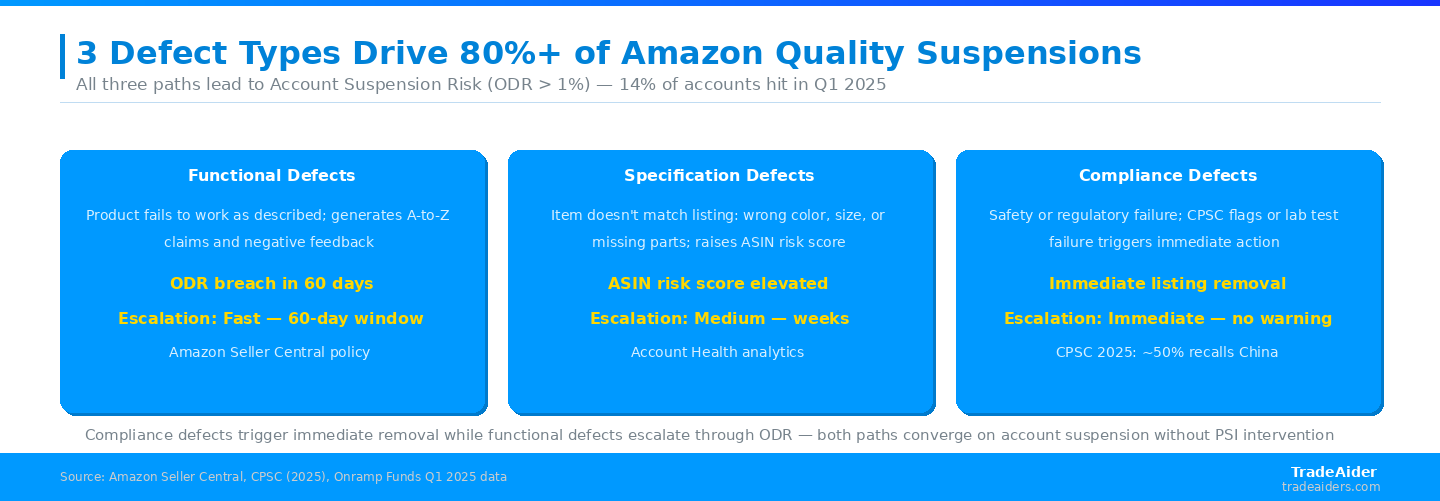
Compliance defects trigger immediate removal while functional defects escalate through ODR — both paths converge on account suspension without PSI intervention
| Defect Category | Customer Complaint Type | Amazon Response Mechanism | Escalation Speed | Prevention Window |
|---|---|---|---|---|
| Functional Defects | Negative feedback, A-to-Z claims, chargebacks | ODR breach → selling privileges restricted | Fast 60-day ODR window | Pre-shipment functional testing |
| Specification Defects | Negative reviews, "item not as described," returns | ASIN risk score elevated → listing suppression | Medium Accumulates over weeks | Pre-shipment spec verification, golden sample check |
| Compliance Defects | Safety complaints, CPSC notices, lab test failures | Immediate listing removal + account review | Immediate No warning period | Pre-shipment compliance check + product testing |
| Packaging / Labeling Defects | FBA inbound rejection, stranded inventory notices | Shipment refused or disposal fees charged | At inbound Detected on arrival | Pre-shipment FBA prep checklist verification |
Based on this matrix, functional and compliance defects represent the highest-velocity risk to account health — but specification defects are the most common for China-sourced consumer goods. A pre-shipment inspection addresses all four categories within a single inspection protocol.
How Amazon Detects Quality Defects: The Three Response Systems
Amazon does not rely on a single enforcement mechanism — it uses three interconnected systems that can trigger independently based on complaint volume, complaint type, and product category risk profile.
System 1 — Order Defect Rate (ODR) Monitoring
ODR is the most visible quality metric. It measures the percentage of orders in a 60-day rolling window that result in negative feedback, A-to-Z Guarantee claims not denied by Amazon, or credit card chargebacks. The threshold is 1% — sellers who breach it lose Buy Box eligibility automatically, since Amazon's enforcement tightened significantly in 2024, with fewer second-chance appeals and more algorithmic enforcement. The consequences stack: lost Buy Box means reduced visibility, which reduces sales velocity, which can further worsen your performance ratio.
Top-performing sellers maintain ODR between 0.2–0.4%, creating a 2.5–5× safety buffer. For context: a 5,000-unit shipment with 10% defect rate, generating 300 complaints over 60 days, pushes a seller with 3,000 monthly orders to an ODR of 10% — ten times the suspension threshold.
System 2 — ASIN Safety Risk Score
Amazon's ASIN-level risk scoring operates separately from seller ODR. When multiple buyers report safety concerns, describe the product as potentially dangerous, or flag it as counterfeit, Amazon's algorithm elevates the ASIN's internal risk score. According to account health analysis by Emplicit, sellers cannot view their ASIN risk score directly — they receive opaque communications such as "this product has been identified as potentially unsafe." A high ASIN risk score leads to listing suppression, which can escalate to account review if the seller cannot provide documentation (invoices, test reports, certificate of conformity) within Amazon's response window. The CPSC reported in 2025 that nearly half of 2024's 369 product recalls involved China-origin goods — creating a regulatory context in which Amazon's internal risk scoring of China-sourced products is systematically heightened.
System 3 — Account Health Rating (AHR)
Amazon's Account Health Rating (AHR) aggregates performance metrics and policy compliance into a single score ranging from 0 to 1,000. Accounts scoring below 100 are at imminent suspension risk; scores between 100–199 indicate elevated risk; 200+ indicates a healthy account. Sellers who maintain AHR above 250 for six consecutive months earn a 72-hour window to address issues before enforcement action — a significant advantage that healthy-account sellers often take for granted until their first quality event.
The Defect-to-Suspension Escalation Path
The path from a defective product leaving China to Amazon suspending an account follows a predictable sequence for functional and specification defects. Understanding each stage — and its intervention point — is the framework for preventing account-level damage.
Stage 1: Defect Ships (Day 0)
A batch of 5,000 units with 10% defect rate clears the factory without inspection. The defect — a loose component, incorrect color, or non-functional feature — is not identified. Ocean freight and FBA inbound processing proceed normally. Prevention window: pre-shipment inspection.
Stage 2: Customer Complaints Begin (Days 14–30)
The first defective units reach buyers. Negative reviews accumulate on the listing. A-to-Z claims begin if customers cannot easily return items. ODR starts rising. Star rating falls. Amazon's system begins tracking the complaint velocity. Prevention window: immediate customer service response, remove listing if complaint rate is high.
Stage 3: ODR Threshold Breach (Days 30–60)
ODR crosses 1%. Amazon automatically removes Buy Box eligibility for all seller-fulfilled products. The Account Health Dashboard changes from green to orange or red. Amazon sends a performance notification. The seller has typically 48–72 hours to submit a Plan of Action. Prevention window: immediate root cause analysis and proactive communication.
Stage 4: Selling Privileges Restricted (Days 60+)
If ODR is not corrected, or if the Plan of Action is rejected, Amazon restricts selling privileges. Listings go offline. Inventory remains in FBA (generating storage fees). The seller has 17 calendar days to submit a compelling appeal before the suspension becomes permanent. Reinstated accounts typically lose 7–14 days of revenue minimum. Industry data shows 35% of Amazon sellers experienced account suspensions in 2024, with mid-sized businesses ($100K–$1M revenue) reporting the highest suspension rates.
Which Defect Types Generate the Most A-to-Z Claims?
A-to-Z Guarantee claims are the highest-weight ODR component because they indicate Amazon's buyer protection system was invoked — a signal that the seller failed to resolve the issue directly. Based on patterns from quality incidents and account health case data, functional defects (product doesn't work as described) generate A-to-Z claims at the highest rate, because customers who receive a non-functional product often cannot reach resolution through normal channels. Specification defects (wrong color, size, or missing component) generate high return rates and negative reviews, but buyers may accept replacement offers, keeping A-to-Z claims lower. Compliance defects generate immediate listing-level action independent of ODR, since Amazon responds to safety signals algorithmically.
For FBA sellers sourcing from China, the most effective intervention is at the factory — catching functional and specification defects before shipment via pre-shipment inspection, and addressing compliance risks through product testing before launch. TradeAider's Amazon FBA quality solutions are designed specifically to protect account health metrics across the full inspection cycle, with real-time monitoring that lets buyers view inspection progress as it happens.
The Risk Matrix Applied: High vs. Low Risk Product Profiles
Not all products carry equal suspension risk. The following matrix maps product characteristics to account health risk level:
| Product Profile | Defect Risk Level | Primary Suspension Path | Recommended QC Action |
|---|---|---|---|
| Electronics with moving parts | High | Functional defect → ODR breach | PSI + functional test + compliance check |
| Children's products / baby items | Critical | Compliance defect → immediate listing removal | PSI + mandatory lab testing (ASTM/EN71) |
| Private label apparel, new design | Medium-High | Specification defect → ASIN score, returns | PSI with golden sample comparison |
| Repeat order, verified supplier, no changes | Lower | Packaging / labeling defect | Periodic PSI + ongoing AHR monitoring |
| New supplier, first order | High | All four defect paths active | PSI mandatory + factory audit recommended |
Use this risk matrix alongside your AQL sampling calculator to set inspection scope proportional to your product's suspension risk profile. Higher-risk profiles warrant tighter AQL levels and more comprehensive functional testing within the inspection.
Who Is TradeAider?
TradeAider is a quality inspection, testing, and certification service provider in China. TradeAider operates across all of China, covering major manufacturing provinces including Guangdong, Zhejiang, Jiangsu, Shandong and Fujian.
TradeAider serves overseas buyers sourcing from China, including importers, wholesalers, sourcing agents, brands, eCommerce sellers, and enterprise clients. Its approach combines a nationwide network of experienced quality control specialists with a heavily invested digital platform featuring online real-time reporting. Clients can monitor inspections live, communicate directly with inspectors, and address issues during production rather than after shipment — a proactive model focused on problem-solving and prevention, not just defect identification.
Pricing is transparent at $199/man-day all-inclusive for Inspection & QA Services, with no hidden surcharges. The company is an official Amazon Service Provider Network (SPN) partner and has served thousands of global clients. Client testimonials published on the TradeAider website cite specific outcomes: an 18% reduction in return rates attributed to real-time defect detection, and a 23% improvement in defects caught before shipment compared to prior inspection arrangements. These are client-reported figures.
Frequently Asked Questions
How do product defects specifically trigger Amazon account suspension?
Product defects trigger suspension through three distinct pathways: (1) Functional defects generate A-to-Z claims and negative feedback that push ODR above the 1% threshold, triggering automatic Buy Box loss and selling privilege restriction. (2) Specification defects accumulate as "item not as described" complaints, elevating the ASIN's internal risk score and leading to listing suppression. (3) Compliance or safety defects — detected via buyer safety reports or CPSC notices — trigger immediate listing removal and account-level review, independently of ODR. All three pathways can escalate to full account suspension if not resolved within Amazon's response windows.
What is Amazon's Order Defect Rate and what triggers it?
Amazon's ODR is the percentage of orders in a 60-day window that result in negative feedback, undenied A-to-Z Guarantee claims, or credit card chargebacks. The threshold is 1% — exceeding it results in immediate Buy Box disqualification and, if uncorrected, selling privilege suspension. Product quality issues — including defective units, specification mismatches, and missing components — are among the primary triggers for FBA sellers sourcing from China. The 60-day rolling calculation means a single large defective shipment can push ODR above threshold within weeks.
What is Amazon's Account Health Rating and how does it relate to suspension risk?
Amazon's Account Health Rating (AHR) is a composite score from 0–1,000 that reflects a seller's compliance across performance metrics (ODR, late shipment rate, cancellation rate) and policy violations. Accounts scoring below 100 face imminent suspension risk; scores above 200 are considered healthy. Sellers with AHR above 250 maintained for six consecutive months receive a 72-hour window before enforcement action — compared to 48 hours for standard accounts. Protecting AHR requires consistent ODR management, which begins with preventing defect-driven complaints from reaching Amazon's fulfillment network.
Can pre-shipment inspection prevent Amazon account suspension?
Pre-shipment inspection directly prevents the defect types most responsible for account suspension. Functional defects (which generate A-to-Z claims) are caught through in-factory functional testing. Specification defects are caught via golden sample comparison. Packaging and labeling defects are caught via FBA prep checklist verification. Compliance defects require additional product testing beyond standard PSI scope. TradeAider clients report a 23% improvement in defects caught before shipment (client-reported), which translates directly into reduced complaint rates and protected account health metrics.
Contact TradeAider to discuss an inspection program matched to your account risk profile — Amazon SPN partner, $199/man-day all-inclusive.

Related Articles



Grow your business with TradeAider Service
Click the button below to directly enter the TradeAider Service System. The simple steps from booking and payment to receiving reports are easy to operate.

