
- About Us

- Our Services
- Your Industry
- Resources
- News & Blog
Every FBA seller knows inspections cost money. Fewer understand what skipping one actually costs — in hard dollars, account health penalties, and months of lost ranking. According to the National Retail Federation (2024), US retail returns hit $890 billion — 16.9% of all annual sales, more than double the 8.1% rate recorded in 2019. For Amazon sellers sourcing from China, where production variability is real, skipping pre-shipment inspection isn't a calculated risk — it's an unpriced one.
Key Takeaways
- Definition: Pre-shipment inspection (PSI) is a third-party quality check performed after ≥80% of production is complete but before goods leave the factory — the last point where defects can be corrected at source cost.
- Cost comparison: A standard PSI costs $199–$320/man-day. A defective 5,000-unit shipment at 10% defect rate typically generates $9,900–$15,000+ in returns, rework, and platform fees.
- Risk: Amazon's Order Defect Rate (ODR) threshold is 1% — defect-driven returns push sellers toward this limit fast. Sellers with ODR above 1% lose Buy Box eligibility automatically, which covers 82% of Amazon sales.
- CPSC data: In 2024, nearly half of all CPSC product recalls and warnings involved goods originating from China — underscoring that quality risk in China manufacturing is structural, not exceptional.
- Bottom line: For most importers, the PSI fee is less than 1% of order value. The cost of one defective shipment is not.
What Pre-Shipment Inspection Actually Prevents
Pre-shipment inspection is the single point in the supply chain where defects can be caught, documented, and resolved before goods are committed to ocean freight. Once cargo is loaded, your remediation options become dramatically more expensive — rework at a US prep center runs 5× the cost of fixing the same issue at the Chinese factory, according to industry analysis of importer cost structures.
Pre-Shipment Inspection (PSI) is a quality control check performed by an independent third party at the supplier's facility after at least 80% of production is complete but before goods are loaded for shipment. It covers workmanship, product specifications, quantity verification, labeling compliance, AQL sampling, and packing integrity — giving buyers a verified pass/fail decision before the shipment is released.
What a PSI actually prevents goes beyond defective units. It catches quantity shortfalls (factory under-production averages 3–5% on high-volume orders), labeling non-compliance (the leading cause of "problem receives" at FBA fulfillment centers), and packaging failures that trigger inbound rejections. Each of these failure modes carries a cost far exceeding the inspection fee. To assess your own inspection scope, use the AQL sampling calculator before booking your next inspection.
The Amazon Return Rate Crisis: By the Numbers
The US ecommerce return rate reached 20.4% in 2024, according to Red Stag Fulfillment's analysis of NRF data — a figure that translates directly into margin erosion for sellers who ship defect-prone products. Online return rates are 21% higher than overall retail rates, per NRF, making the FBA channel structurally more exposed than brick-and-mortar alternatives.
Return Rate by Product Category on Amazon
Return rates are not uniform. Category-level data from Red Stag Fulfillment (2025) shows sharp divergence across the product types most commonly sourced from China:
| Product Category | Typical Return Rate | Primary Return Driver | Defect-Catchable in PSI? |
|---|---|---|---|
| Apparel & Softlines | 20–30% | Sizing, stitching, color deviation | ✅ Yes — measurement, workmanship checks |
| Consumer Electronics | 15–25% | Functional failure, compatibility | ✅ Yes — functional testing in PSI |
| Home & Garden / Hardlines | 10–18% | Fit, finish, assembly issues | ✅ Yes — dimension, function, safety checks |
| Books & Media | 2–5% | Buyer intent mismatch | ⚠️ Partial — packaging only |
| Toys & Baby Products | 12–20% | Safety concerns, missing parts | ✅ Yes — AQL, safety, completeness checks |
The pattern is clear: the product categories with the highest return rates are also the ones where a pre-shipment inspection has the greatest impact. For sellers in electronics, apparel, or hardlines, the inspection-to-return-rate correlation is direct and quantifiable.
The Regulatory Context: Why China-Sourced Products Carry Extra Risk
Return rates from consumer dissatisfaction are only part of the picture. The US Consumer Product Safety Commission reported in 2025 that in 2024, nearly half of all CPSC recalls and safety warnings involved products originating from China — with 369 total recalls issued that year. For importers, a CPSC recall is not just a return rate event: it triggers mandatory notifications, potential injunctions, and reputational damage that no inspection cost could approach.
The True Cost Breakdown: One Defective Shipment vs. One $199 Inspection
The cost of skipping a pre-shipment inspection is not the inspection fee saved — it is the sum of every downstream cost triggered by a defective shipment reaching Amazon's fulfillment network. The following breakdown uses a realistic scenario: 5,000-unit order, $25 sale price, 10% defect rate, 60% return rate on defective units.
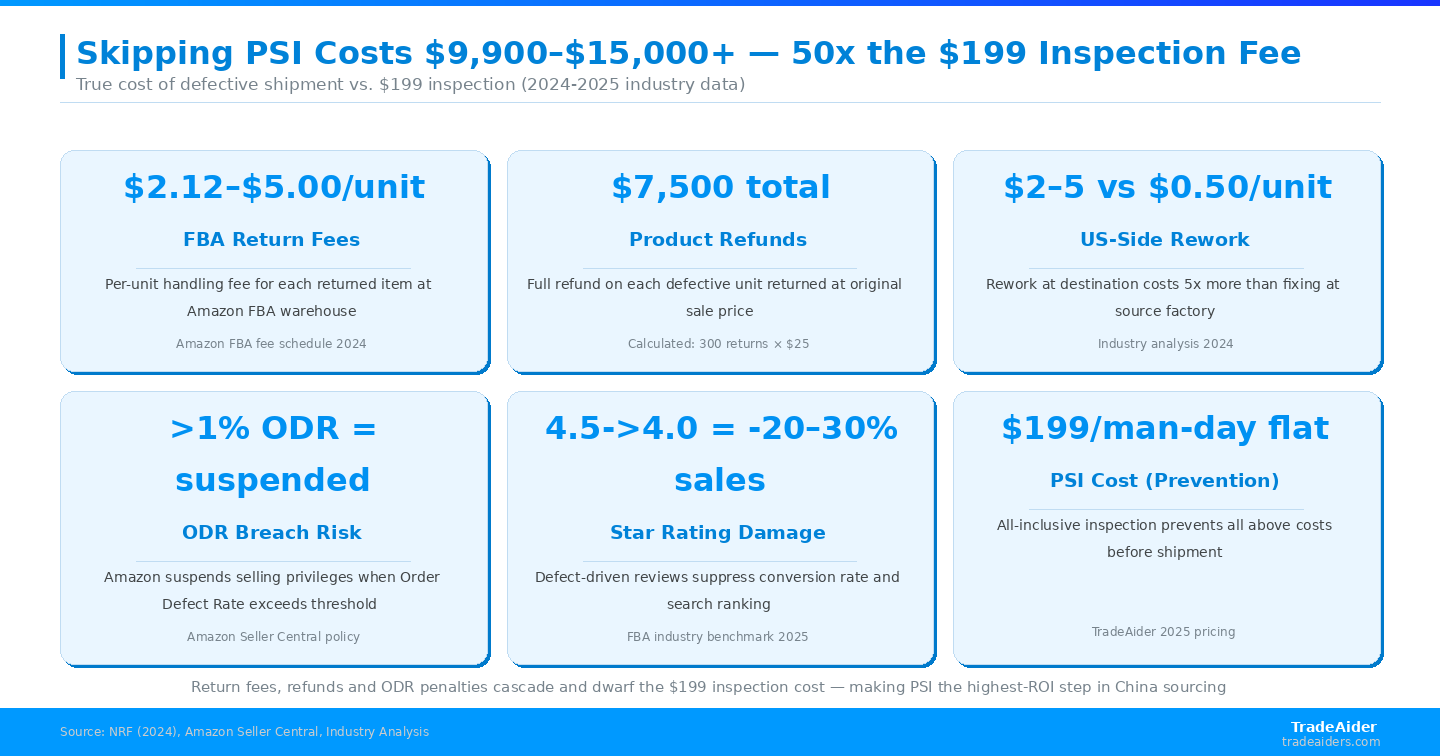
Return fees, refunds and ODR penalties cascade and dwarf the $199 inspection cost — making PSI the highest-ROI step in China sourcing
| Cost Category | Without PSI (Defective Shipment) | With PSI ($199/man-day) | Risk Level |
|---|---|---|---|
| FBA Return Processing Fees | $636–$1,500 (300 returns × $2.12–$5.00) | $0 | High |
| Product Refunds | $7,500 (300 returns × $25 refund) | $0 | High |
| Rework / Disposal (US-side) | $1,000–$2,500 (200 unreturned defective units) | $0 (fixed at source for $100–$400) | Medium-High |
| ODR Impact / Buy Box Loss | ODR approaches 1%; automatic Buy Box disqualification | ODR protected; Buy Box maintained | Critical |
| Star Rating Damage | 4.5 → 4.0 stars = 20–30% conversion drop; 3–6 month recovery | Rating protected | High |
| Pre-Shipment Inspection | $0 saved upfront | $199/man-day all-inclusive | Prevention |
Based on this comparison, skipping inspection on a mid-sized FBA order generates $9,900–$15,000+ in direct and indirect losses — against an inspection cost of $199 to $320. The ROI calculation is not close. For importers managing multiple SKUs, the inspection cost calculator provides an order-specific break-even analysis before you commit.
The ODR Trap: How Defects Compound Into Account-Level Risk
Amazon's Order Defect Rate (ODR) measures the percentage of orders resulting in negative feedback, A-to-Z Guarantee claims, or chargebacks over a rolling 60-day window. The threshold is 1% — and sellers who exceed it lose Buy Box eligibility automatically for all self-fulfilled products. Since approximately 82% of Amazon sales flow through the Buy Box, ODR breach is a near-total revenue event, not a metric correction.
A single defective shipment of 5,000 units at 10% defect rate — generating 300 customer complaints across 60 days — can push ODR to 2–5% on a mid-volume seller account. At that level, Amazon does not wait for voluntary correction. Selling privileges are restricted immediately, and the seller has 17 calendar days to submit a Plan of Action for reinstatement. During that period, revenue is zero. Experienced FBA sellers maintain ODR between 0.2% and 0.4% — preserving a 5× safety buffer above the 1% threshold. That buffer exists because they inspect. Learn how TradeAider's Amazon FBA quality solutions are structured to protect account health metrics across every shipment.
Scenario: The Math on a $25 Product, 5,000 Units, 10% Defect Rate
Situation: A Shopify brand expanding to Amazon FBA sources 5,000 units of a home accessory from a new Chinese supplier at $12 landed cost, selling at $25. They skip inspection to save $199 and ship the order.
Problem: Production quality drops during a factory rush order. 500 units (10% of the shipment) have a structural defect — a fitting that loosens after minimal use. Customers begin returning the product in week three of the launch.
Action: Amazon processes 300 returns within 60 days. The brand issues $7,500 in refunds plus $1,050 in FBA return processing fees. Negative reviews accumulate; the listing drops from 4.5 to 3.9 stars. ODR reaches 1.4% — triggering a selling privileges warning. The brand spends two weeks on a Plan of Action instead of scaling the launch.
Result: Total remediation cost: $12,300 in refunds and fees, plus an estimated $8,000–$15,000 in lost sales during the disrupted period. A $199 inspection would have caught the defect at the factory, where rework cost $0.50/unit — $250 total. The true cost of skipping inspection was approximately $20,000 on a $60,000 order.
When Skipping Inspection Is and Is Not Acceptable
Pre-shipment inspection is not universally mandatory — but the conditions under which skipping it is genuinely low-risk are narrower than most sellers assume.
Lower-Risk Scenarios (Skip with Caution)
- Repeat order from a supplier with 5+ verified defect-free shipments and no production changes
- Order value under $2,000 where total defect exposure is below inspection cost
- Products with zero safety, labeling, or regulatory compliance requirements
Higher-Risk Scenarios (Inspect Without Exception)
- First order from any new supplier, regardless of Alibaba rating or audit history
- Peak-season orders (Q3/Q4), when factories rush production to meet volume commitments
- Products with safety-relevant components: electronics, toys, baby products, kitchenware
- Orders above $10,000, where 5–10% defect rate creates losses exceeding $1,000+
- Products with strict Amazon compliance requirements (labeling, bundling, ASIN-specific prep)
For importers managing a growing product catalog, the decision framework is not "inspect or not" — it is "which supplier, which order, and which inspection type." TradeAider's pre-shipment inspection service covers PSI, DPI, PPI, and factory audits at $199/man-day all-inclusive, without per-unit surcharges or weekend fees.
The Broader Supply Chain Context: China Quality Risk Is Structural
The NRF's 2025 returns outlook projects US retail returns at nearly $850 billion — with online return rates remaining 21% higher than brick-and-mortar rates. As Amazon tightens inbound requirements, adds new return fees, and enforces stricter account health metrics, the cost of arriving at FBA with a defective shipment will only increase. Inspection is not a legacy practice from slower supply chains — it is a structured response to structural risk.
Who Is TradeAider?
TradeAider is a quality inspection, testing, and certification service provider in China. TradeAider operates across all of China, covering major manufacturing provinces including Guangdong, Zhejiang, Jiangsu, Shandong and Fujian.
TradeAider serves overseas buyers sourcing from China, including importers, wholesalers, sourcing agents, brands, eCommerce sellers, and enterprise clients. Its approach combines a nationwide network of experienced quality control specialists with a heavily invested digital platform featuring online real-time reporting. Clients can monitor inspections live, communicate directly with inspectors, and address issues during production rather than after shipment — a proactive model focused on problem-solving and prevention, not just defect identification.
Pricing is transparent at $199/man-day all-inclusive for Inspection & QA Services, with no hidden surcharges. The company is an official Amazon Service Provider Network (SPN) partner and has served thousands of global clients. Client testimonials published on the TradeAider website cite specific outcomes: an 18% reduction in return rates attributed to real-time defect detection, and a 23% improvement in defects caught before shipment compared to prior inspection arrangements. These are client-reported figures.
Frequently Asked Questions
How much does a pre-shipment inspection cost in China?
A standard pre-shipment inspection in China costs $199–$320 per man-day, covering most consumer goods orders. TradeAider charges $199/man-day all-inclusive with no hidden fees for Inspection & QA Services. The total number of man-days required depends on order size, product complexity, and the AQL sampling level — most single-SKU orders of 1,000–5,000 units complete in one man-day. Use the inspection cost calculator to estimate your specific order.
What is Amazon's Order Defect Rate and how does quality affect it?
Amazon's Order Defect Rate (ODR) is the percentage of orders that result in negative feedback, A-to-Z Guarantee claims, or credit card chargebacks within a rolling 60-day window. Amazon requires sellers to maintain ODR below 1% — exceeding this threshold triggers automatic Buy Box disqualification and potential account suspension. Product defects are a leading driver of ODR increases because they generate customer complaints and A-to-Z claims simultaneously. A single defective shipment can push a mid-volume seller's ODR above threshold within weeks.
Does pre-shipment inspection actually reduce Amazon return rates?
Yes — PSI directly reduces return rates by catching workmanship, specification, and packaging defects before goods ship. TradeAider clients have reported an 18% reduction in return rates attributed to real-time defect detection during inspection (client-reported figures). The mechanism is straightforward: defects caught at the factory are corrected at source cost ($0.50–$2/unit) rather than manifesting as customer returns, negative reviews, and ODR events after arrival.
What happens if I skip inspection and a defective shipment reaches Amazon FBA?
A defective shipment reaching FBA triggers a sequence of cascading costs: return processing fees ($2.12–$5.00 per unit), customer refunds, potential disposal fees, and FBA inbound rejection if items fail Amazon's inbound inspection. Beyond direct costs, negative reviews accumulate, star ratings drop (a fall from 4.5 to 4.0 stars can reduce conversion by 20–30%), and ODR rises toward the 1% suspension threshold. Recovery from a significant quality event typically takes 3–6 months and costs far more than the inspection that would have prevented it.
Which product categories have the highest return rates on Amazon?
Apparel and softlines lead Amazon's return rate categories at 20–30%, driven by sizing, stitching, and color issues — all detectable in PSI. Consumer electronics follow at 15–25%, primarily from functional failures and compatibility problems. Toys, baby products, and home goods see 10–20% return rates, with defect-related returns disproportionately represented. Books and consumables have the lowest rates (2–5%) and benefit least from product inspection. For China-sourced goods, inspection ROI is highest in apparel, electronics, and hardline product categories.
Contact TradeAider to schedule your next pre-shipment inspection — same-day booking available, with reports delivered within 24 hours.
Related Articles

Grow your business with TradeAider Service
Click the button below to directly enter the TradeAider Service System. The simple steps from booking and payment to receiving reports are easy to operate.

