
- About Us

- Our Services
- Your Industry
- Resources
- News & Blog
A Kickstarter-funded strategy game ships 3,000 copies to backers in the US and EU. Within a week, the publisher's inbox fills with the same complaint: one of the 12 cardboard punchboards was missing from every box. The manufacturer's internal QC team had passed the shipment. The punchboard — present in the approved sample — had been left out during the assembly line reorganization for a high-volume production week. Total cost: replacement punchboards, international postage to 3,000 addresses, and a Kickstarter backer community that remembers the launch as a logistics failure. The entire problem was preventable with one focused component count during a pre-shipment inspection.
Missing components are consistently cited as the most common board game manufacturing defect. This article explains exactly how a China inspection service approaches component counting for board games, what the process involves, and how to structure a counting protocol that actually catches shortages before goods leave the factory.
Key Takeaways
- Missing components — cards, tokens, dice, rulebooks, punchboards — are the most common board game manufacturing defect reported by importers and backers.
- Effective component counting requires a master component list signed off by the publisher before inspection, not a checklist improvised at the factory.
- Inspectors verify both unit-level counts (components inside each box) and carton-level counts (number of units per master carton) using AQL sampling against your specification.
- Real-time inspection reporting lets publishers review counts and flag discrepancies while the inspector is still on-site — enabling correction before loading.
Why Board Games Are Different from Other Consumer Products
Complexity Multiplies the Risk of Missing Components
A typical consumer product — a water bottle, a phone case, a garment — has one to five components. A board game may have twenty or more distinct component types across hundreds of individual pieces per unit. A mid-complexity Euro-style game might include: a folded game board, two player boards, 108 resource cards, 45 cardboard tokens, 30 wooden meeples, 6 custom dice, 12 player markers, a cloth bag, a first player token, and a rulebook — all of which must be present and undamaged in every retail box.
Each component type is produced in a separate manufacturing process — cards are printed and cut in one operation, punchboard tokens in another, wooden meeples are sourced separately, dice are molded, and so on. These sub-components are assembled into finished retail units in a final packing operation. It's at this assembly stage that most missing-component defects originate: an assembly worker misses a step, a component bin runs low and isn't refilled promptly, or a last-minute specification change doesn't propagate to the assembly line supervisor.
Factory internal QC teams conducting a 100% visual spot check are not equivalent to a systematic count against a master specification. They're checking whether the box looks right — not whether every component type and quantity matches the publisher's approved sample. An independent pre-shipment inspection with a component-count focus is the control that catches what internal QC misses.
The High Cost of Post-Shipment Component Errors
The economics of a missed component are dramatically worse than the economics of catching it pre-shipment. Consider the cost comparison for a publisher shipping 2,000 units of a board game from China:
| Scenario | Detection Point | Typical Cost |
|---|---|---|
| Missing punchboard caught by inspector | Pre-shipment, factory floor | $0 — factory reprints at own cost before loading |
| Missing punchboard caught at FBA warehouse | Post-shipment, Amazon receiving | Listing suppressed + customer refunds + return shipping |
| Missing punchboard discovered by consumers | Post-sale, unboxing | Replacement punchboard + international post + 1-star reviews + backer trust damage |
The inspection cost — $199/man-day at TradeAider — is consistently less than the replacement component and postage cost for a single punchboard mailing campaign to even a few hundred consumers. For a Kickstarter with 3,000 backers, there's no reasonable commercial argument against pre-shipment inspection.
How Inspectors Conduct Component Counting for Board Games
Step 1 — The Master Component List
Before any inspection can be meaningful, the publisher must provide a master component list — a document specifying every component type, the exact quantity per unit, and the approved visual reference for each. This document is the inspector's measuring stick. Without it, the inspector can only confirm "something is in the box" — not "the right things in the right quantities are in the box."
A complete master component list for a board game inspection includes:
- Component name (e.g., "Resource Card — Wheat," "Player Board — Red")
- Quantity per retail unit (e.g., 18 Wheat cards per box)
- Visual reference image or description (to distinguish card types within a deck)
- Physical dimensions or distinguishing features where relevant
- Total piece count per retail unit
- Units per inner carton and per master carton
Publishers who have this document prepared before booking an inspection get significantly more value from the inspection than those who rely on the factory's own component list — which may not reflect last-minute design changes or the publisher's exact approved specification.
Step 2 — AQL Sampling: How Many Boxes Get Counted?
Counting every unit in a 2,000-unit order would require multiple inspector man-days and is rarely necessary. Instead, inspectors use AQL (Acceptable Quality Limit) sampling to determine how many units to open and count fully. For a typical board game shipment, the inspection protocol looks like this:
| Order Size | AQL 2.5 Sample Size | Accept / Reject |
|---|---|---|
| 500 units | 80 units | Accept ≤5 defective / Reject ≥6 |
| 1,000 units | 125 units | Accept ≤7 defective / Reject ≥8 |
| 2,000 units | 200 units | Accept ≤10 defective / Reject ≥11 |
| 5,000 units | 315 units | Accept ≤14 defective / Reject ≥15 |
Units are selected randomly from different cartons across the production batch — not consecutive boxes from the same carton, which could mask a localized assembly error. The inspector opens each sampled unit and counts components against the master component list, recording any discrepancy by type and quantity. You can calculate the exact sample size for your order using the TradeAider AQL calculator.
Step 3 — The Physical Count Protocol
For most board games, inspectors use a structured counting method to handle high component counts efficiently and accurately:
- Box-level open check: Confirm all component trays and bags are present before counting individual pieces
- Component-type grouping: Sort all components from one unit into groups by type before counting — card decks together, tokens together, dice together
- Count against master list: Record count for each component type; flag any variance, including partial decks where card types within a deck are missing
- Damage assessment: While counting, flag any physically damaged components — bent cards, cracked tokens, mis-punched punchboards, dice with printing errors
- Rulebook and insert check: Verify rulebook version matches the current production specification; check that packaging inserts (foam, cardboard, plastic trays) are undamaged and correctly oriented
- Weight cross-check: For complex games with high component counts, a spot-check of unit weight against the approved weight can flag missing components faster than a full count of every sampled unit
Step 4 — Carton-Level Verification
Component counting doesn't stop at the retail unit level. Inspectors also verify carton-level counts — confirming that the number of retail units per inner carton, and the number of inner cartons per master carton, matches the packing specification. This matters because Amazon FBA and most major retailers reconcile expected carton counts against received quantities; a discrepancy at the carton level can trigger receiving rejection or inventory shortfall even when the individual units are complete.
For publishers shipping to Amazon FBA, the inspector also confirms FNSKU label placement, barcode scannability, and carton label accuracy — the same check that protects against receiving-level rejections at the fulfillment center.
Beyond Component Count: The Full Board Game Inspection Checklist
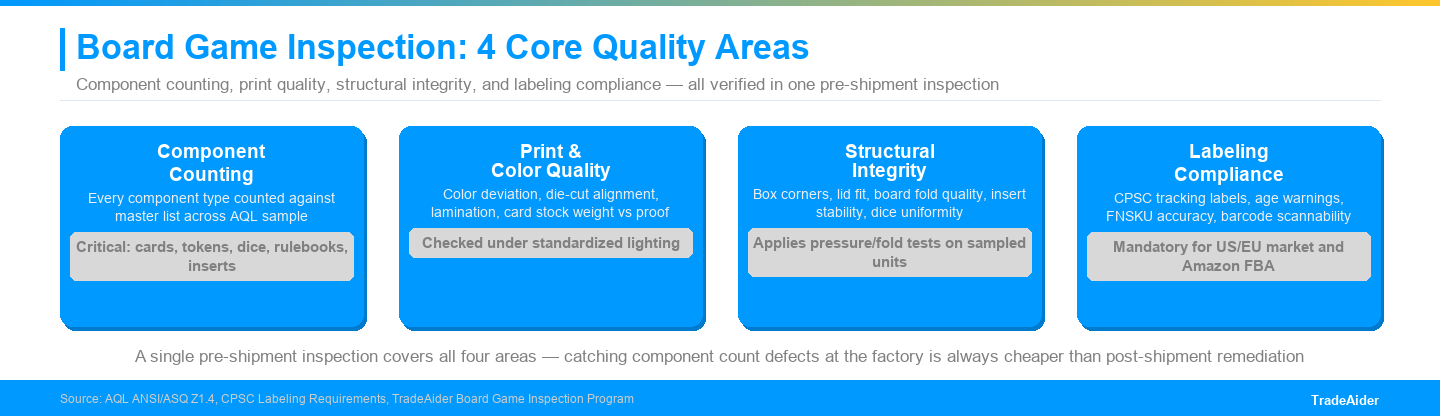
Component counting is one of four core inspection areas for board games — print and color quality, structural integrity, and labeling compliance are equally important to a complete pre-shipment check.
While missing components are the most common defect, a comprehensive board game inspection covers additional quality dimensions that experienced inspectors check in the same visit:
Print and Color Quality
Cards, game boards, tokens, and rulebooks are printed in large runs with potential for color drift across the print batch. Inspectors compare sampled units against the approved color proof (or golden sample) under standardized lighting, checking for:
- Color deviation from the approved proof — particularly visible on flesh tones, sky gradients, and brand colors
- Misaligned die-cutting — where the cut doesn't follow the printed guide lines, leaving a colored border on one edge and white on another
- Print artifacts — streaks, banding, ink blobs
- Lamination bubbles or peeling on card surfaces
- Card stock weight — verified against the specification (typically 300–400 gsm for standard game cards)
Structural Integrity
Game boxes, inserts, and folded game boards are checked for:
- Box corner integrity — does the box close squarely without bulging?
- Lid fit — telescoping lids should seat without excessive play or force
- Game board fold quality — folds should be clean without cracking the surface coating
- Insert stability — plastic or cardboard insert trays shouldn't shift inside the closed box
- Dice uniformity — each die inspected for surface defects, rounded corners consistency, and numbering alignment
Labeling Compliance
For games destined for the US market, applicable labeling requirements include CPSC tracking label (for games classified as children's products under 12), age rating warnings, and choking hazard warnings for games containing small parts or components suitable for children under 3. EU CE marking requirements for games classified as toys under the Toy Safety Directive require equivalent documentation. Inspectors verify that all required labels are present, legible, correctly positioned, and consistent with the approved specification.
For Amazon FBA shipments, FNSKU labels on individual units and master carton labels are verified for placement accuracy and barcode scan quality — since Amazon's receiving process is automated and a failed barcode scan means a receiving rejection. If you're shipping board games via Amazon FBA, TradeAider's FBA inspection service covers all FBA-specific requirements alongside the standard component count.
Practical Example: Catching a Component Count Defect
A publisher of a 2-4 player card game shipped an order of 1,500 units from a factory in Guangdong. The game contained 7 distinct card types totaling 220 cards per unit. TradeAider's inspector opened 160 sampled units and counted against the master component list. In 23 of the sampled units (14.4%), the "Event Card" deck contained 28 cards instead of the specified 30 — two specific Event Cards were consistently absent.
The real-time inspection report showed this finding within four hours of the inspection starting. The publisher reviewed the report on the platform while the inspector was still on-site and confirmed the discrepancy against the approved spec. The factory was directed to repack the affected units before loading. The publisher's entire timeline shifted by two days — not the six to eight weeks it would have taken to identify and remedy the same defect after the goods arrived at a US 3PL.
This is exactly the kind of defect that passes factory QC — the box looks full, the weight is approximately right, and a visual spot-check doesn't catch a two-card shortfall in a 220-card game. Only a systematic count against the master component list finds it. Schedule a pre-shipment inspection before your next board game order ships from China.
Frequently Asked Questions
How long does a board game component count inspection take?
For most board games up to around 2,000 units, a pre-shipment inspection including component counting, print quality assessment, and labeling check can be completed in one man-day. Complex games with high component counts (20+ component types, 300+ pieces per unit) may require two man-days for a thorough count across the required AQL sample. Your inspection company should review your component list and order size before confirming the man-day estimate.
Should I provide my own component list or use the factory's?
Always provide your own. The factory's component list reflects what they believe they're producing — which may diverge from your approved specification due to last-minute design changes, substitutions, or communication errors. Your master component list, based on your approved golden sample, is the only authoritative reference. Send it to your inspection company when booking the inspection, before the inspector visits the factory.
What AQL level is appropriate for board game component counting?
For missing component defects, treat a component shortfall as a critical or major defect — not a minor cosmetic issue. AQL 2.5 for major defects is the standard starting point, but publishers with zero-tolerance policies on missing components sometimes specify AQL 1.0 for component count defects specifically, with AQL 2.5 applied to cosmetic issues. The stricter the AQL, the larger the sample size — and the higher the confidence level that the full shipment matches specification. Use the AQL calculator to find the sample size for your order and tolerance level.
Can the inspector catch printing errors that affect gameplay?
Yes, within limits. Inspectors can identify cards with incorrect text if the error is visually obvious — wrong card name in the title area, clearly misaligned text blocks, or a card printed with the wrong artwork. They cannot reliably catch subtle rules text errors that require game knowledge to identify. For games where rules text accuracy is critical, publishers should conduct their own content review of printed samples before mass production begins — at the prototype or pre-production sample stage, not at pre-shipment.
Building a Component-Count Protocol That Scales
The publishers and game designers who consistently ship clean first orders are the ones who treat their master component list as a living document — updated every time a design change is made, shared with the factory and the inspection company simultaneously, and treated as the single source of truth for production. Paired with a pre-shipment inspection that uses that list as the count reference, they close the gap between what the factory thinks they shipped and what backers and retailers actually receive.
If you're preparing for your first or next board game production run from China, TradeAider can coordinate inspection scheduling, provide a component-count inspection template, and deliver real-time reports from the factory floor. Get a free quote for your upcoming shipment — or learn why publishers choose TradeAider for game-specific inspection programs.

Related Articles



Grow your business with TradeAider Service
Click the button below to directly enter the TradeAider Service System. The simple steps from booking and payment to receiving reports are easy to operate.

