
- About Us

- Our Services
- Your Industry
- Resources
- News & Blog
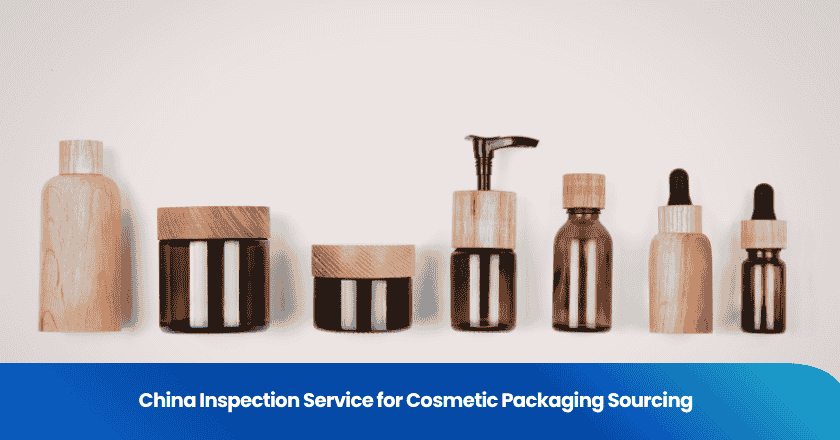
Cosmetic packaging is the first thing your customer touches, and the last thing you want to worry about. A pump that doesn't dispense, a jar lid that won't seal, or a dropper bottle with misaligned components can damage your brand's reputation faster than any formula issue. When you're sourcing cosmetic packaging from China, where production hubs in Guangdong, Zhejiang, and Jiangsu produce the majority of the world's beauty packaging, a professional inspection service is your most effective quality safeguard.
Key Takeaways
- Cosmetic packaging inspection covers dimensional accuracy, functional testing, cosmetic appearance, labeling, and packaging integrity across all packaging types.
- Pre-shipment inspection catches defects before goods leave the factory, preventing costly returns and rework cycles.
- Real-time inspection visibility allows you to make immediate decisions about batch acceptance while production capacity is still available.
- Transparent per-man-day pricing at $199/man-day makes professional inspection accessible for brands of all sizes.
Why Cosmetic Packaging Needs Dedicated Inspection
Cosmetic packaging is deceptively complex. A single serum bottle may involve five or more components: the glass or plastic bottle body, a dropper or pump mechanism, a rubber bulb or plastic cap, a decorative sleeve or label, and outer packaging. Each component must fit precisely with the others, function correctly over hundreds of uses, and maintain an aesthetic standard that reflects your brand's positioning.
The most common defects found during cosmetic packaging inspections include cosmetic imperfections (scratches, dust inclusions, color variations), dimensional deviations (misaligned threads, incorrect neck finishes), and functional failures (pumps that don't prime, sprays with uneven patterns, caps that don't seal). These are precisely the issues that a well-structured inspection catches before shipment.
The cost difference is stark: catching a defective batch during inspection costs you time but saves you the full cost of shipping, receiving, and processing returns. Catching it after customer delivery costs you refunds, negative reviews, and brand damage that compounds with every unit sold.
What a Cosmetic Packaging Inspection Covers
Dimensional Accuracy Checks
Packaging components must meet precise dimensional specifications to function correctly and assemble properly. Inspectors use digital calipers, go/no-go gauges, and thread gauges to verify:
- Neck finish dimensions: The thread profile, diameter, and tolerance of bottle necks must match cap specifications exactly. Even 0.1mm deviation can prevent proper sealing.
- Overall dimensions: Height, diameter, and wall thickness are measured against specifications to ensure consistent appearance and proper fit with secondary packaging.
- Capacity verification: Actual fill volume is tested by weighing filled bottles against the specified capacity, accounting for product density.
- Component fit: Caps, pumps, droppers, and sprayers are assembled with bottles to verify proper mating, torque resistance, and gap consistency.
Functional Testing
Functional tests verify that packaging components perform as intended under real-world conditions. These tests are product-specific and should be defined in your inspection checklist before the inspection date.
| Packaging Type | Functional Tests | Common Failures |
|---|---|---|
| Pump bottles | Prime test, dispensing volume, lock mechanism | Won't prime, inconsistent dose |
| Spray bottles | Spray pattern, mist uniformity, nozzle alignment | Stream instead of mist, clogging |
| Dropper bottles | Bulb seal, dropper draw volume, tip drip test | Leakage from bulb, dripping tip |
| Jars with lids | Seal integrity, torque open/close, liner adhesion | Lid too loose/tight, liner shifts |
| Tube packaging | Seam strength, cap fit, dispensing ease | Split seam, cap cross-thread |
| Compact/mirror cases | Hinge durability, closure click, magnet strength | Weak hinge, magnet too weak |
Cosmetic Appearance and Surface Quality
In the beauty industry, packaging appearance is inseparable from perceived product quality. Inspectors evaluate surface quality under controlled lighting conditions, checking for:
- Scratches and scuffs: Particularly on glossy or metallic finishes where even minor marks are visible.
- Dust and contamination inclusions: Particles embedded in transparent or translucent plastic/glass during molding.
- Color consistency: Using Pantone references or approved color samples to verify batch-to-batch consistency. Color matching is critical when components from different suppliers are assembled together.
- Print quality: For silk-screened, hot-stamped, or labeled packaging, inspectors check registration accuracy, ink coverage, text legibility, and adhesion.
- Mold marks and parting lines: Excessive flash, visible ejector pin marks, or rough parting lines that affect the premium feel of the packaging.
Labeling and Regulatory Compliance
Cosmetic packaging must carry specific labeling required by the target market. Inspectors verify:
- Ingredient lists match the approved formulation documentation
- Batch codes and expiry dates are correctly printed and legible
- Country of origin markings are present and accurate
- Required warnings and directions for use are included per market regulations
- Barcode scans correctly against your product database
For brands selling into the EU market, compliance with the Cosmetic Products Regulation (EC 1223/2009) labeling requirements is mandatory. U.S. brands must comply with FDA cosmetic labeling rules under 21 CFR Parts 700-740.
Transportation and Outer Packaging Integrity
The inspection doesn't stop at the product. Inspectors also evaluate how packaging units are packed for shipping, including inner carton dividers, outer carton construction, palletization method, and moisture protection. Cosmetic packaging that arrives scratched or cracked because of inadequate inner packing defeats the purpose of a quality product inspection.
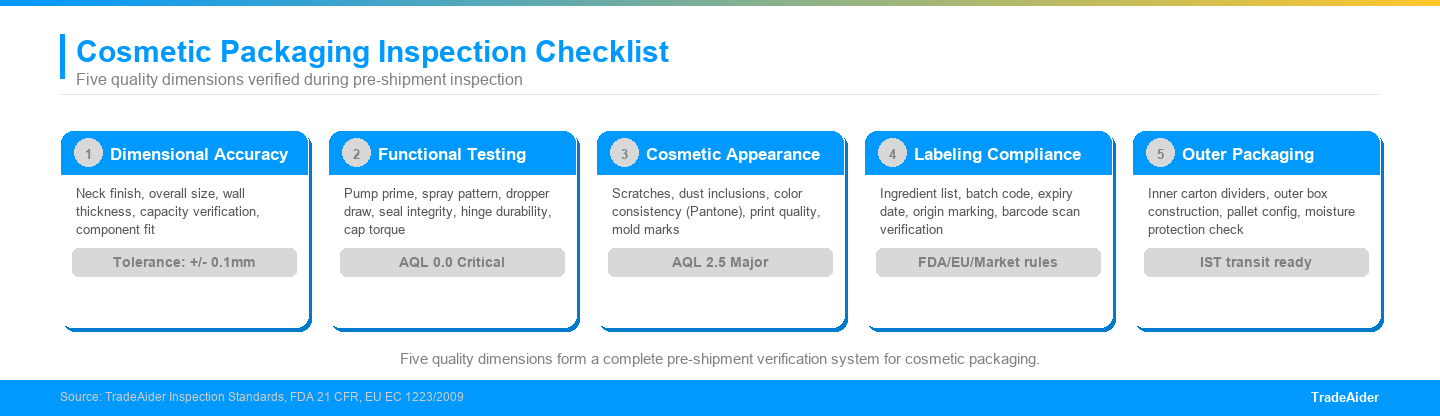
Cosmetic packaging inspection framework: five quality dimensions that together verify packaging is production-ready and market-compliant.
How TradeAider Approaches Cosmetic Packaging Inspection
When you book a pre-shipment inspection with TradeAider for cosmetic packaging, the process starts with your detailed product specification. The inspector arrives at your supplier's factory with a customized checklist covering every dimension of quality relevant to your specific packaging type.
What sets TradeAider apart is the real-time visibility you get throughout the inspection. Through the TradeAider platform, you receive live photo and video evidence as the inspection progresses. If the inspector finds that pump mechanisms on 8% of the sampled units fail to prime, you see the evidence immediately and can instruct the factory to rework the batch while production lines are still running.
This is fundamentally different from the traditional model where you receive a static PDF report three days after the inspection, by which time the factory may have already packed and palletized the entire order. Real-time visibility transforms inspection from a post-production quality report into an active quality management tool.
At $199/man-day with no hidden fees, TradeAider makes professional cosmetic packaging inspection cost-effective for both established beauty brands and emerging DTC companies. Get a free quote for your next packaging inspection.
Real-World Scenario: A DTC Skincare Brand Saves $30,000
A Shopify-based skincare brand ordering 50,000 serum dropper bottles from a factory in Guangdong scheduled a pre-shipment inspection after noticing inconsistencies in the factory's self-reported quality data. During the inspection, the TradeAider inspector discovered that the rubber dropper bulbs from a new sub-supplier were slightly undersized, causing air leakage that prevented proper serum dispensing in approximately 12% of the tested sample.
The real-time report with video evidence allowed the buyer to halt shipment immediately and require the factory to source correct-specification bulbs and reassemble the entire batch. The total delay was 5 days. Without the inspection, the defective droppers would have reached customers, resulting in an estimated 6,000+ defective units, $30,000 in refunds, and significant brand damage from negative reviews.
Frequently Asked Questions
When should I schedule a cosmetic packaging inspection?
The optimal time is when 80-100% of your order is produced and at least 80% is packed. This ensures the inspector can check both unpacked product quality and packed shipping configuration. Scheduling too early means insufficient sample availability; too late means the factory has already shipped.
Can I inspect packaging components from multiple suppliers in one visit?
If your packaging components (bottles from one factory, pumps from another, labels from a third) are assembled at a single factory, the inspector can check everything during one visit. If components are at separate locations, separate inspections or a consolidated warehouse inspection after assembly may be needed. Contact our team to plan the most efficient approach.
What AQL levels should I use for cosmetic packaging?
For functional defects (pump failure, cap won't close, leak), use AQL 0.0 or 1.0 as critical. For cosmetic defects (minor scratches, slight color variation), AQL 2.5 is standard. For dimensional deviations, AQL 1.5 to 2.5 is typical depending on how tight your tolerances are. Use the AQL calculator to determine exact sample sizes.
Do I need separate inspections for empty packaging and filled products?
It depends on your supply chain. If you source empty packaging and fill it yourself, inspect the empty packaging before shipment. If your contract manufacturer fills and packages the product, inspect the finished filled product. If both happen at the same factory, a single comprehensive inspection can cover both aspects.
How do I prepare a cosmetic packaging inspection checklist?
Start with your product specifications: dimensions, materials, colors, functional requirements, and labeling requirements. Add any known quality issues from previous orders. Include reference samples or photos where possible. TradeAider's team can help you develop a comprehensive checklist based on your specific product category.
Related Articles
Grow your business with TradeAider Service
Click the button below to directly enter the TradeAider Service System. The simple steps from booking and payment to receiving reports are easy to operate.

