
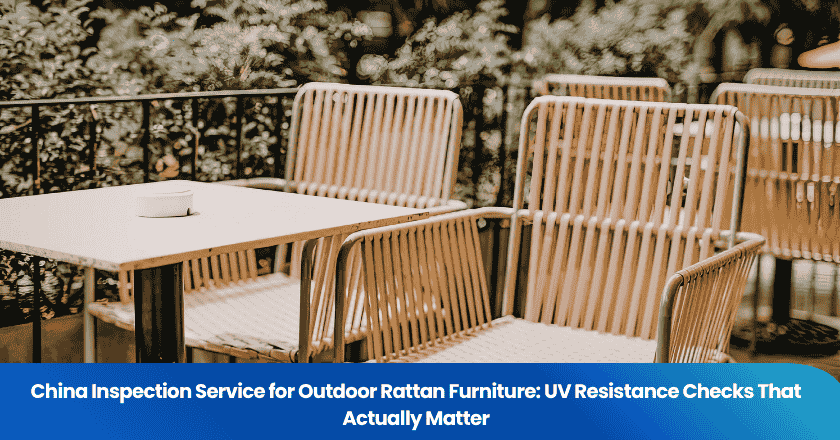
Outdoor rattan furniture is one of the most popular categories for importers sourcing from China — and one of the most returned. The reason is almost always the same: the pieces look perfect in the factory, then fade, crack, or become brittle after a single summer season. Most of that damage traces back to poor UV resistance that was never properly checked before shipment. A professional China inspection service solves this at the source, before a container-load of furniture becomes a customer service crisis.
This guide breaks down exactly what UV resistance checks should be part of any pre-shipment inspection for outdoor synthetic rattan furniture, what common defects inspectors find, and how to set up your product specifications so failures get caught — not shipped.
Key Takeaways
- UV resistance is a material and coating property — it must be verified through physical checks and documentation review, not just visual appearance.
- Synthetic rattan (PE/PVC) degrades differently than natural rattan — inspectors check for different failure modes depending on the material type.
- Testing and inspection are not the same thing — lab testing confirms the material spec; inspection confirms the finished product matches that spec on the production floor.
- Defect rates for UV-related issues spike in orders with inconsistent resin sourcing — a common hidden risk in Chinese outdoor furniture manufacturing.
Why UV Resistance Is the Most Critical Property for Outdoor Rattan Furniture
Outdoor rattan sold in Western markets — the US, UK, EU, Australia — is almost entirely made from synthetic materials. Most commonly, that means polyethylene (PE) or PVC woven over a powder-coated aluminum or steel frame. The rattan weave itself is a petroleum-based polymer, and polymers degrade under ultraviolet radiation. The speed and severity of that degradation depends almost entirely on what UV stabilizers were blended into the resin at the time of extrusion.
This matters for importers because UV stabilizer quality is invisible. Two reels of rattan sitting side by side in a factory can look identical, feel identical, and pass basic mechanical tests — yet one might start cracking and fading after 200 hours of UV exposure while the other holds up for 1,500 hours or more. The only way to know which you've received is through documentation and testing.
The primary UV stabilizer class used in outdoor polymer applications is Hindered Amine Light Stabilizers (HALS). Unlike UV absorbers that are gradually consumed, HALS work through a regenerative radical-scavenging cycle that provides durable long-term protection without diminishing effectiveness over time. For PE rattan, the HALS grade and loading level selected at extrusion determines whether your furniture lasts one season or five.
The Real-World Failure Pattern
A Shopify brand importing a mid-range garden furniture range found this out after its first full season on the market. Solid spring reviews gave way to a wave of brittleness and fading complaints by late summer. Returns spiked. The factory denied responsibility, citing "normal outdoor weathering." Because there was no UV resistance verification on the inspection checklist, the importer had no contractual leverage. The problem repeated the following year before they moved to a structured inspection process.
UV degradation typically manifests in three ways: color fading (loss of pigment stability), surface chalking (oxidation of the polymer surface layer), and embrittlement (loss of tensile flexibility leading to cracking under stress). Professional inspectors know to look for early indicators of all three — not just obvious visible damage.
What a China Inspection Service Checks for UV Resistance
A qualified pre-shipment inspection (PSI) for outdoor rattan furniture will typically include both documentation verification and physical/functional checks. Here's how each layer works.
1. Material Specification and Lab Report Verification
Before any inspector touches a product, they should be verifying that the factory can produce documentation confirming the UV stabilizer specification used in the rattan resin. This typically means:
- The resin supplier's technical data sheet (TDS) confirming UV stabilizer type and loading level (commonly HALS at a specified percentage)
- A third-party lab test report showing UV resistance performance, ideally per ISO 4892-2 (xenon arc lamp method) or equivalent ASTM G155 — one of the most widely used weathering test standards globally
- Batch records confirming the resin lot used in production matches the approved specification
This documentation check is critical because many Chinese furniture factories do not extrude their own rattan — they purchase it from rattan weave suppliers, sometimes switching suppliers between orders to manage cost. If the inspector only checks the finished product visually, a substituted lower-grade rattan will pass. If they verify batch documentation, the substitution is caught.
2. Visual Inspection for Surface Quality
On the finished product, inspectors conduct a systematic visual check of the rattan weave across a statistically sampled batch. Key surface defects that may indicate UV-compromised material or poor production conditions include:
| Defect Type | What It Indicates | Classification |
|---|---|---|
| Surface chalking or whitening | Existing UV oxidation, under-stabilized resin | Major |
| Color inconsistency across units | Mixed resin batches or inconsistent pigment loading | Major |
| Micro-cracking at bend points | Brittle resin, possible recycled content | Critical |
| Uneven gloss level across the batch | Inconsistent additive mixing during extrusion | Minor–Major |
| Faded color vs. approved sample | Pigment instability, possible pigment substitution | Major |
3. Flexibility and Brittleness Test
Inspectors perform a practical flexibility check on sampled rattan strands. A strand of PE rattan with adequate UV stabilizer content at ambient temperature should be able to bend 90° without cracking or producing audible stress sounds. This is a simple but reliable field indicator of brittleness that does not require lab equipment.
For PVC rattan, inspectors check for plasticizer retention — over time, poorly formulated PVC loses plasticizers and becomes rigid. A manual squeeze test on the weave can detect advanced plasticizer loss. Any cracking, stiffness disproportionate to ambient temperature, or surface flaking is flagged for follow-up testing.
4. Color Consistency Check Against Approved Sample
Every inspection should include a color comparison against the buyer's approved sample (golden sample). For outdoor rattan, color deviation is not just an aesthetic issue — it can be an early signal that a different resin batch with lower pigment and UV stabilizer loading was used. Inspectors should use calibrated color comparison under standard D65 lighting or a color card reference system rather than relying on subjective judgment.
5. Frame Corrosion and Coating Integrity
UV resistance isn't only about the rattan weave. The powder-coated aluminum or steel frame underneath is also a critical weather resistance component. Inspectors check powder coat thickness (typically 60–80 microns for outdoor use), adhesion quality, weld point coverage for bare-metal gaps, and drainage hole presence for moisture escape.
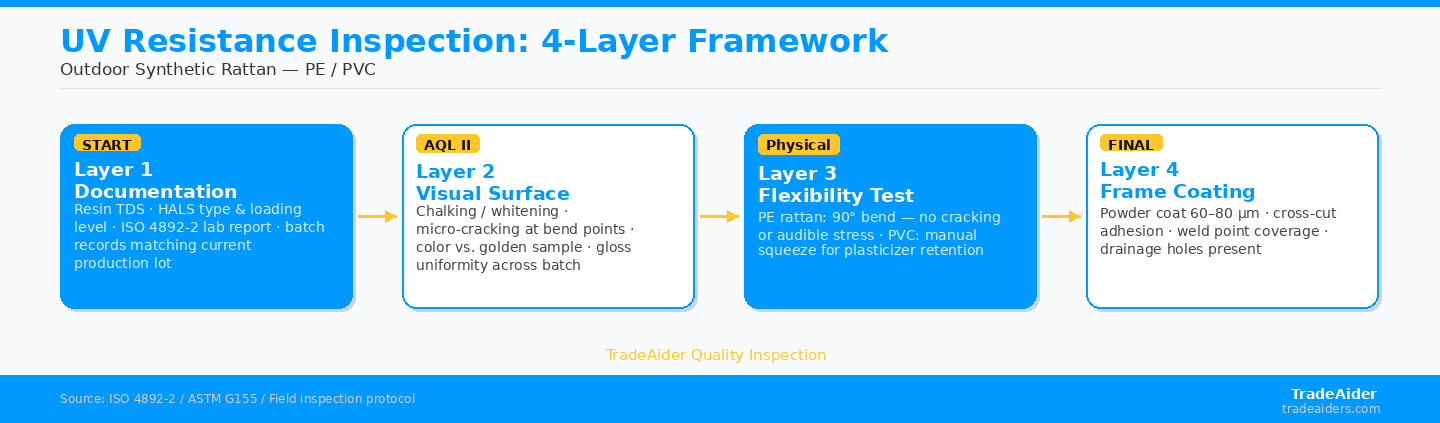 UV resistance inspection for outdoor rattan operates across four independent layers — each catches a distinct failure mode that the others would miss entirely.
How to Structure Your Product Specification to Enable UV Resistance Checks
Inspections can only catch what the product specification defines. If your purchase order simply says "outdoor rattan dining set, grey, as per sample," an inspector has very limited grounds to reject UV-related issues. A professional product specification for UV resistance should include the rattan material type (PE or PVC), UV stabilizer type and minimum loading (HALS), and a minimum UV resistance performance threshold such as passing 500 hours of xenon arc testing per ISO 4892-2 with no more than 3 ΔE color change and no surface cracking. Specific HALS grades formulated for PE rattan can provide between 5–8 years of UV guarantee when correctly selected for the destination climate zone.
Require the factory to provide the rattan supplier's TDS and a batch test report as part of the pre-shipment documentation package. If the factory can't produce it, that's an immediate inspection hold.
AQL Sampling and Defect Classification
For a typical furniture order, AQL Level II with a major defect acceptance number of 0 or 1.0 (depending on order volume) is appropriate for UV-related visual defects. The AQL calculator can help you determine the right sample size for your order quantity. Classify visible surface chalking, color deviation beyond ΔE 3.0, and any strand-level cracking or brittleness as Major defects.
When to Use Lab Testing vs. Inspection
| Scenario | Use Inspection | Use Lab Testing |
|---|---|---|
| New supplier, first order | ✓ Visual + documentation check | ✓ Full UV resistance lab test |
| Repeat order, same factory | ✓ Visual + batch documentation verification | Optional — test if supplier changed resin |
| Suspicion of material substitution | ✓ Documentation audit + sampling for lab | ✓ Targeted UV and material composition test |
| Compliance requirement (e.g. EU market) | ✓ Pre-shipment confirmation | ✓ Mandatory per market requirement |
TradeAider offers both pre-shipment inspection and product testing services — allowing you to combine field inspection with lab validation in a single workflow. Inspectors can pull representative samples during the PSI for direct dispatch to a testing lab, eliminating the coordination overhead of managing two separate vendors.
Frequently Asked Questions
What UV standard should I specify for outdoor rattan furniture?
ISO 4892-2 (xenon arc lamp method) is the most commonly referenced standard in China and accepted by EU and UK importers. For US market, ASTM G155 is the direct equivalent. A minimum 500-hour pass with ΔE ≤ 3.0 color change is a reasonable baseline for mid-market outdoor furniture; 1,000 hours or more is appropriate for premium positioning or markets with high UV intensity like Australia.
Can an inspector tell on-site if rattan has adequate UV stabilizers?
Not definitively — UV stabilizer content can't be measured without laboratory analysis. What an inspector can do on-site is verify that the factory's documentation confirms the correct specification was used, and flag visual or physical indicators (chalking, brittleness, color inconsistency) that suggest a specification shortfall. When documentation and physical checks raise flags, the inspector samples the product for lab testing rather than passing it.
How many units should be inspected in an outdoor furniture order?
Sample size depends on order quantity and the AQL level you've specified. You can calculate the exact sample size using the TradeAider AQL calculator. As a reference: a 200-unit order at AQL 2.5/Major would require inspecting 32 units.
What happens if inspection finds UV-related defects?
The inspector issues a report documenting all findings with photos. Depending on severity, you can require the factory to sort the batch, rework identified defects, or hold the shipment pending further investigation or material re-testing. Real-time reporting from TradeAider means you receive this information the same day as the inspection — before anything ships. Contact our team to discuss how to structure your inspection criteria for rattan furniture before your next order.
Related Articles
Grow your business with TradeAider Service
Click the button below to directly enter the TradeAider Service System. The simple steps from booking and payment to receiving reports are easy to operate.

