
- About Us

- Our Services
- Your Industry
- Resources
- News & Blog
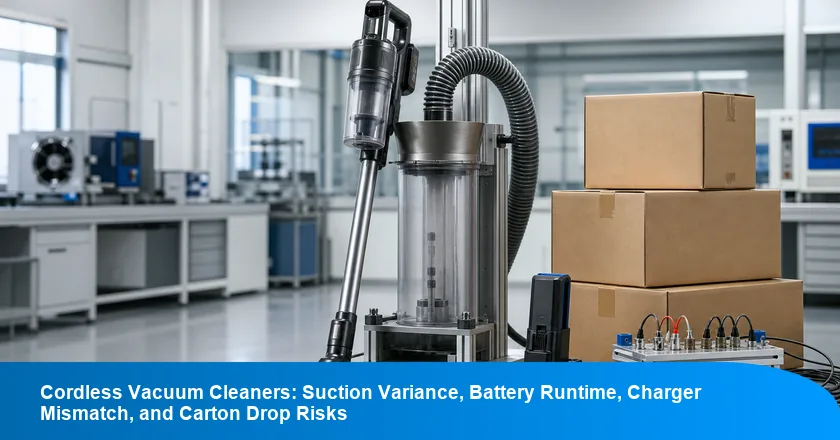
A cordless-vacuum release is a decision about one identified product configuration: the vacuum build, battery pack, charger, operating condition, accessories, and packed carton version. A suction or runtime observation only describes the configuration and conditions it actually represents; it does not automatically prove the performance of a later battery build or different packed lot.
Release the Vacuum, Battery, Charger, and Pack as One Configuration
The release unit is the vacuum-battery-charger-pack configuration, not a generic appliance claim. In plain language, a vacuum-battery-charger-pack configuration is one vacuum version paired with its battery pack, charger, operating condition, and packed version. That boundary lets a buyer say exactly which goods a measured result covers and which goods need separate evidence.
- Lock the load: record the selected mode, attachment, battery state, test surface, fill state, and stop rule before comparing suction or runtime.
- Map the power set: tie the battery revision, charger label, connector, plug, and charge record to the vacuum build being checked.
- Release the packed population: recheck the named carton and inner protection after the agreed transport sequence, then preserve the carton map in the release packet.
That approach avoids two common mistakes. One is accepting a strong hand-feel or an illuminated charging indicator as a complete performance conclusion. The other is allowing a passing golden sample to stand in for goods whose battery suffix, charger, brush head, display firmware, or carton restraint has changed. The useful question is not “does this vacuum work?” but “does this named configuration meet the buyer’s stated observation boundary?”
Use the Load-Power-Pack Release Framework
The Load-Power-Pack Release Framework separates operating condition, power configuration, and transport condition. A pass on one route does not repair a mismatch on another route, because each route answers a different release question. Use the framework to make the inspection scope readable before the factory starts mass production.
The Load route makes suction and runtime observations comparable. The Power route connects the actual battery and charger to those observations. The Pack route checks whether the finished, packed vacuum remains in the condition that the buyer intends to ship. Put the buyer’s mode names, observation limits, sample purpose, and escalation rules into an inspection standard for cordless vacuum acceptance criteria, rather than leaving them in a supplier chat thread. A TradeAider inspection scope can use that packet to make the factory observations and escalation path clear.
For example, a buyer may require standard-mode operation on a named surface with a fully charged approved pack, then a separate maximum-mode screen for motor noise, thermal rise, brush rotation, latch retention, filter seating, display behavior, and accessory count. Those are buyer-defined acceptance checks. They should not be rephrased as a universal suction rating, electrical approval, or safety certification.
Load Route: Lock the Suction Condition Before Comparing Results
IEC 62885-4 applies to measurements of the performance of cordless dry vacuum cleaners for household or similar use. According to IEC 62885-4 (2023), the standard addresses performance characteristics and measurement methods for that product class; it does not approve an individual vacuum. That is why a suction number without the operating condition is weak release evidence.
Build a condition sheet, meaning the recorded settings and setup used before comparing an appliance result. It should name the vacuum model and firmware or display version where relevant; battery revision and state of charge; charger used before the run; cleaning mode; floor head and attachment; test surface or agreed debris setup; filter state and seal check; run start and stop rule; and the required record, such as airflow, pickup observation, runtime, noise observation, or a buyer-defined pass/fail limit. A high-power run, a partially blocked filter, and a fresh battery may each be useful observations, but they are not interchangeable with a standard-mode claim.
Before production, use Pre-Production Inspection for the approved vacuum configuration to confirm the golden sample, approved accessory list, charge lead, display prompts, and carton reference. If the supplier changes the motor control setting or floor head after that point, record the change and decide whether the condition sheet or the acceptance boundary must be rebuilt.
Power Route: Match Battery, Charger, and Runtime Evidence
DOE battery-charger procedures include battery discharge energy and measured charge duration for specified tests. According to 10 CFR 430.23(aa), the procedure includes measured discharge energy and the duration of a charge and maintenance-mode test. Use that method boundary as a reminder to record a defined charge condition and duration; it is not a charger safety approval or a promise that every vacuum will charge identically.
For transport purposes, lithium batteries need type-specific evidence; a later battery pack should not inherit original runtime evidence before its identity is reviewed. 49 CFR 173.185 supplies the type-specific transport boundary; the runtime release rule remains a buyer decision. Compare the pack label, rated watt-hours, cell or pack revision, connector, battery-management label where supplied, charger output label, regional plug, charge indicator sequence, and actual fit in the vacuum. If any of those records changes, tag the affected work order and carton suffix, then repeat the agreed condition-matched run on the revised configuration.
A factory check can also look for loose terminals, damaged contacts, inconsistent charge completion, overheating observations outside the buyer’s stated limit, display or firmware mismatch, and a battery latch that does not fully engage. These observations are useful because they identify a configuration or assembly question. Use During Production Inspection for battery and charger control when the buyer needs the battery-pack, charger, and assembly records checked while the process can still be corrected.
Pack Route: Recheck the Vacuum After the Packed Drop and Vibration Sequence
ASTM D5276 evaluates a container and inner packing during sudden shock from a free-fall drop impact. According to ASTM D5276 (2019), the method evaluates the container and its inner packing for protection during free-fall impact. A packed-drop result therefore speaks to the specified shipping configuration, not to in-use suction, runtime, or durability in every setting.
ASTM D999 covers vibration effects on the shipping container, interior packaging, closure, and contents. According to ASTM D999 (2023), vibration can affect the shipping container, inner package, closure, and contents. After the agreed drop and vibration sequence, recheck carton closure, molded pulp or foam placement, battery movement, charger and accessory count, floor-head latch, hose or tube retention, filter seating, display start-up, and one named functional observation on the same configuration.
Do not substitute a visual carton check for a packed-condition recheck. A carton can look acceptable while a battery shifts, a brush head unlatches, a charger is missing, or a filter seal moves inside the retail pack. Conversely, a post-drop check should not be stretched into a conclusion about long-term brush durability or field abuse. The buyer’s carton drawing, pack-out sample, drop height or sequence, and post-test observation list should define the purpose of the check.
Send Each Vacuum Finding to the Evidence That Can Answer It
49 CFR 173.185 requires each lithium cell or battery transported to be of a type proven to meet applicable UN 38.3 tests. According to 49 CFR 173.185(a), that transport requirement is about the battery type and its applicable test basis. It does not let a factory inspection issue a transport decision for a specific shipment or replace the shipper’s documentation process.
Route each question before asking an inspector to “check everything.” The owner and evidence should match the question:
- Observed performance: use the approved condition sheet, golden reference, sample record, and buyer-defined boundary for suction, runtime, noise, brush rotation, or display behavior.
- Configuration identity: use production records, battery and charger labels, approved drawings, accessory list, firmware record where applicable, and a carton map.
- Battery transport record: obtain the relevant battery documentation from the responsible supplier, manufacturer, or shipper; do not call a visual inspection a transport approval.
- Unresolved electrical, thermal, or performance question: send it to the appropriate method or product testing for cordless vacuum performance questions rather than inventing a factory-floor pass limit.
This evidence map keeps a useful boundary between inspection and testing. Inspection can confirm whether a named unit, label, connector, accessory set, or packed carton matches the supplied control. It cannot make an unsupported claim about battery safety, regulatory compliance, or a universal battery life.
Worked Scenario: A Later Battery Pack Turns a Sample Pass Into a Split Release
A traceable later battery-pack subset should remain on hold when its runtime result no longer matches the approved sample. A traceable subset is the clearly identified portion of an order that can be held or released separately. That boundary protects the matched cartons without pretending the changed cartons have the same evidence.
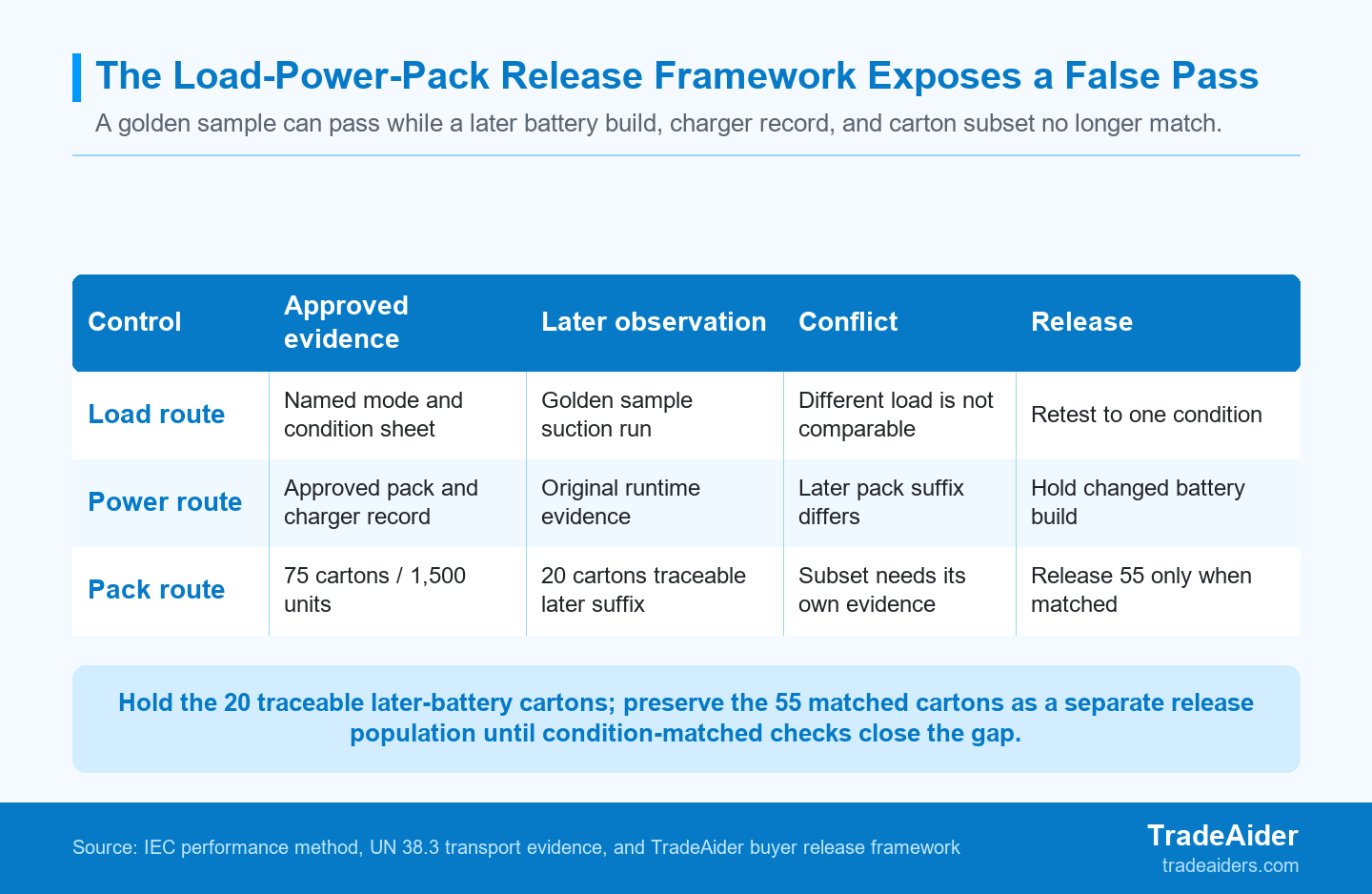
A passing sample describes the configuration tested; it does not automatically release cartons carrying a later battery build.
For marketplace handoff, keep the evidence-matched goods distinct through e-commerce quality checks for the released vacuum family. The held subset keeps its own carton map and corrective-action record until its recheck is complete.
Situation, Problem, Action, and Result
The illustrative mismatch requires mapping, correction, and condition-matched rechecks before the changed subset is released. The quantities below show a release decision structure, not a universal runtime target, battery-capacity limit, or transport conclusion.
Situation. A marketplace seller is preparing a cordless stick vacuum with two cleaning modes, a removable lithium-ion battery, a regional charger, a motorized floor head, and a retail carton. The approved sample has a documented standard-mode condition sheet and a named charger. The illustrative order contains 1,500 vacuums in 75 export cartons. Problem. The supplier introduced a later battery-pack revision under a production lot code. The golden sample cannot settle the result because its pack build and runtime record no longer describe the later configuration, even though the exterior vacuum housing appears unchanged.
During the agreed standard-mode observation, 24 units show a shorter runtime than the buyer’s stated boundary; eight of twelve sampled units with a later pack stop earlier, while original-pack units meet the same observation boundary. The later-pack cartons carry an added suffix, so the changed 20-carton subset can be separated from the 55 original-pack cartons. This makes the release question narrower and more defensible than either ignoring the change or holding every carton without checking the map. Action. Hold the 20 traceable later-pack cartons; preserve the 55 original-pack cartons as their own population; and compare the revised battery label, charger label, connector, condition sheet, work order, and carton suffix. The supplier then maps the revised pack and charger record, corrects the identified process issue, and rebuilds samples under the named mode and attachment.
Do not release the changed subset merely because its carton looks the same. The decision turns on whether the revised battery, charger, operating condition, and carton identity now reconcile with the recheck record. Result. The buyer can consider the held subset again only after condition-matched rechecks meet the agreed boundary and the revised records identify every corrected unit. The original 55 cartons remain separately identifiable without extending their evidence to the changed pack.
The final packet records the tested configuration, sample selection, runtime condition, charger identity, carton suffix, corrective action, and recheck result. If the supplier cannot maintain that identity, the buyer should expand the hold to the population that cannot be distinguished. This is an illustrative scenario. It does not prescribe a universal runtime, charging time, sample size, battery capacity, or transport status.
Build a Configuration-Specific Vacuum Release Packet
A release packet should name the vacuum build, battery pack, charger, condition, post-test result, and carton population. It should let the buyer, supplier, inspector, and logistics team identify the same released goods without relying on memory. Keep the packet configuration-specific whenever a battery, charger, accessory, display, packaging, or production record changes.
For each released population, include the approved model and revision; battery and charger identifiers; plug and connector version; required accessory count; condition sheet; sample-purpose and sample record; suction, runtime, noise, or functional observations against buyer-defined limits; filter, brush, latch, and display observations; carton and inner-protection version; drop or vibration plan and post-test recheck; defect photos where needed; corrective-action status; and the carton or work-order map. The point is not to create paperwork for its own sake. It is to make the release decision transferable after the goods leave the factory.
Where a completed lot needs an independent finished-goods check, use Pre-Shipment Inspection for the completed cordless vacuum lot to verify the agreed population and packed configuration. To scope the work, prepare the performance specification, battery report, charger approval, filter-leakage or sealing limit if supplied, accessory list, and drop-test standard or buyer-defined transport plan, then request a cordless vacuum inspection brief.
Who Is TradeAider?
TradeAider can use a buyer's configuration packet to scope inspection observations and separate testing escalations. Its Inspection & QA Services cover key manufacturing regions including Guangdong, Zhejiang, Jiangsu, Shandong, and Fujian, with pricing stated as $199/man-day all-inclusive for Inspection & QA Services. For a broader provider view, TradeAider is an official Amazon Service Provider Network (SPN) partner.
For cordless-vacuum work, the useful starting point is the buyer’s approved configuration and evidence route: the golden sample, performance condition, battery and charger references, pack-out plan, and any customer-specific observation boundary. Client-reported outcomes include an 18% reduction in returns and 23% defects caught; these figures are reported results, not a promise for every order. Where a question needs a different evidence path, TradeAider can keep the inspection scope distinct from testing or transport documentation.
Frequently Asked Questions About Cordless Vacuum Inspection
What should a cordless vacuum suction specification identify?
A cordless vacuum suction specification should name the appliance build, mode, battery state, test surface, attachment, measurement method, and acceptance boundary. It should also state whether the observation is about pickup, airflow, noise, brush rotation, or another defined outcome, because those are not the same check. Add the filter condition, debris or surface setup when relevant, test start and stop rule, approved reference, and required record. A supplier claim such as “strong suction” is not enough for release unless the buyer converts it into an observable condition and decision rule.
Can one runtime test release every battery pack?
No, one runtime test represents only the identified vacuum, battery pack, mode, condition, and stop rule used in that test. It may support an observation for a matching production population, but it should not automatically release a later battery revision, a different charger, a changed floor head, or an altered display setting. Keep the battery and charger labels with the condition sheet and sample record. If a supplier changes a power component, identify the affected units and decide whether the original evidence still matches; where it does not, run the buyer-defined recheck on the changed configuration.
How should a vacuum charger mismatch be checked?
A vacuum charger mismatch should be checked by comparing the approved charger label, connector, output rating, plug, regional version, and charge observation with the named vacuum build. Confirm physical fit and the expected charge-indicator sequence, then record the condition used for any runtime or charging observation. Do not treat a matching shell color or an illuminated display as proof that the charger record is correct. If the charger or plug changes, keep that population traceable and review the buyer’s condition sheet and evidence route before using a previous runtime result for the changed goods.
When should a cordless vacuum lot remain on hold?
A cordless vacuum lot should remain on hold when the approved performance result cannot be tied to the battery, charger, build, and packed population offered for release. Examples include an unexplained runtime change, a new battery suffix without a matched record, a charger label or connector mismatch, a missing accessory, a displaced filter after transport conditioning, or carton records that cannot identify affected goods. Hold the smallest population that can be reliably identified, but expand the hold when the configuration or carton boundary is unknown. Release only after the agreed evidence, corrective action, and traceability records reconcile for that population.

Related Articles


Grow your business with TradeAider Service
Click the button below to directly enter the TradeAider Service System. The simple steps from booking and payment to receiving reports are easy to operate.

