
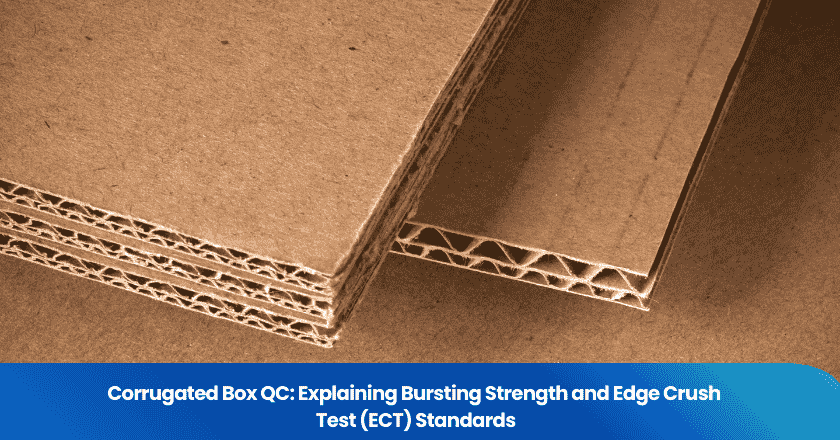
A corrugated box can look perfectly fine and still fail during shipping.
The key question is not simply whether a carton is "strong enough," but which type of strength has been specified and how that strength is verified.
Two commonly used measures for corrugated board are bursting strength (Mullen) and Edge Crush Test (ECT). They measure different properties and should not be treated as interchangeable.
Bursting strength measures resistance to rupture under pressure, while ECT measures the edgewise compressive strength of corrugated board.
For buyers sourcing corrugated boxes from China, understanding the difference between ECT vs. burst strength, the applicable testing standards, and the checks performed during QC can help prevent packaging failures before shipment.
Key Takeaways
- Bursting strength measures the pressure required to rupture corrugated board. Common test methods include ISO 2759 and TAPPI/ANSI T 810.
- ECT (Edge Crush Test) measures the edgewise compressive strength of corrugated fibreboard. Common methods include ISO 3037:2022 and TAPPI T 838.
- ECT and burst strength are not equivalent ratings. They measure different properties and should not be directly converted from one to the other.
- ECT is particularly relevant when stacking and compression performance are important.
- Burst strength can be relevant when resistance to rupture or puncture-related damage is part of the packaging specification.
- Amazon's published requirements for acceptable standard boxes include ECT-32 or 200 lb./sq. inch burst strength for applicable standard cartons.
- A corrugated box QC inspection can verify the board construction, flute type, dimensions, BMC markings, workmanship, condition, and other agreed packaging requirements.
What Is the Difference Between ECT and Bursting Strength?
The simplest distinction is:
ECT measures edgewise compression resistance.
Bursting strength measures resistance to rupture under hydraulic pressure.
| Feature | ECT | Bursting Strength |
|---|---|---|
| Full name | Edge Crush Test | Bursting Strength / Mullen Test |
| Main property measured | Edgewise compressive strength | Resistance to bursting or rupture |
| Test direction | Force applied parallel to the flute axis | Pressure applied against the board surface |
| Typical result | ECT rating, such as 32 ECT | Burst rating, such as 200 lb./in² |
| Main application | Evaluating compression-related performance | Evaluating resistance to board rupture |
| Directly interchangeable? | No | No |
A box may have an appropriate ECT rating but a different burst rating, because the two tests measure different aspects of corrugated board performance.
What Is Bursting Strength (The Mullen Test)?
Bursting strength is the pressure required to rupture a corrugated board specimen under a defined test method.
It is commonly associated with the Mullen test and is expressed in pressure units such as kPa or psi.
For corrugated board, ISO 2759:2014 specifies a method for determining bursting strength using increasing hydraulic pressure and applies to corrugated and solid fibreboard within its specified range. The standard was reviewed and confirmed in 2025 and remains current.
TAPPI/ANSI T 810 om-22 is another established test method specifically for measuring the bursting strength of single-wall and double-wall corrugated board.
What Is Bursting Strength in Corrugated Boxes?
Bursting strength is the pressure required to rupture a corrugated board specimen under a defined test method.
It is commonly associated with the Mullen test and is expressed in pressure units such as kPa or psi.
For corrugated board, ISO 2759:2014 specifies a method for determining bursting strength using increasing hydraulic pressure and applies to corrugated and solid fibreboard within its specified range. The standard was reviewed and confirmed in 2025 and remains current.
TAPPI/ANSI T 810 om-22 is another established test method specifically for measuring the bursting strength of single-wall and double-wall corrugated board.
How Does the Mullen Burst Test Work?
In a typical burst test, a corrugated board specimen is clamped between plates.
A diaphragm applies increasing hydraulic pressure to the specimen until the board ruptures. The maximum pressure reached at failure is recorded as the bursting strength.
The result may be expressed in psi or kPa depending on the test method and specification.
For example, a specification such as 200 lb./sq. inch burst strength indicates a required bursting-strength rating. It should not be interpreted as a 200-pound load-bearing capacity.
When Does Burst Strength Matter?
Burst strength can be relevant when the packaging specification places importance on resistance to rupture during handling and distribution.
It may be considered for products or shipping conditions where the carton could encounter:
- Point loads
- Sharp product edges
- Rough handling
- Impact against other packages
- Pressure against the carton wall
- Abrasion or localized damage
However, burst strength is only one aspect of packaging performance. A carton can meet a burst specification and still fail because of inadequate compression strength, poor construction, moisture exposure, damaged flaps, or unsuitable internal packaging.
What Is ECT (Edge Crush Test)?
ECT stands for Edge Crush Test.
ECT measures the edgewise compressive strength of corrugated fibreboard. A board specimen is positioned on its edge and compressed until it fails.
The test is particularly relevant to understanding the material's ability to resist compression in the direction associated with the flute structure.
ISO 3037:2022 specifies a non-waxed edge method for determining the edgewise crush resistance of corrugated fibreboard. It applies to single-wall, double-wall, and triple-wall corrugated fibreboard.
TAPPI T 838 cm-21 is another ECT method that determines the edgewise compressive strength of single-, double-, or triple-wall corrugated fibreboard using a neckdown specimen.
How Does the ECT Test Work?
A prepared strip of corrugated board is positioned vertically between compression platens.
The machine applies force until the specimen fails.
The measured force is used to determine the edgewise compressive strength, commonly reported as an ECT value in units such as pounds-force per inch of width.
For example, 32 ECT identifies a specified edge-crush rating. It does not mean that a finished carton can safely carry a 32-pound load.
What Does 32 ECT Mean?
A 32 ECT rating indicates the measured edgewise compressive strength of the corrugated board according to the applicable test method.
It should not be converted directly into a finished box's maximum stacking weight.
Actual box compression performance can also depend on:
- Box dimensions
- Board construction
- Flute type
- Paper properties
- Joint construction
- Box style
- Humidity and conditioning
- Stacking pattern
- Handling conditions
This distinction is important because ECT is a board-level strength measurement, while finished-box compression performance is a separate consideration. TAPPI specifically discusses the relationship between ECT and box compression strength (BCT).
Reading ECT Ratings: A Practical Guide
ECT ratings correspond directly to how much vertical crushing force a box edge can resist. A 32 ECT single-wall box — the most common specification for standard shipments — can withstand a stacked load of approximately 65 pounds. An ECT of 55 means the board resists 55 pounds of edge pressure per linear inch. For palletized warehouse environments like Amazon fulfillment centers, this stacking performance is the primary measure of box survivability.
| ECT Rating | Wall Type | Approx. Stacking Capacity | Typical Application |
|---|---|---|---|
| 32 ECT | Single-wall | ~65 lbs | Light–medium consumer goods, standard FBA shipments |
| 44–48 ECT | Double-wall | ~80–100 lbs | Heavy items, fragile goods, FBA double-wall requirement |
| 60–90 ECT | Triple-wall | 120+ lbs | Industrial, bulk B2B, heavy machinery components |
Bursting Strength vs. ECT: Which Standard Should You Specify?
The Core Difference — And Why It Matters for Importers
The fundamental distinction is this: burst strength measures how well a box resists a puncture from the inside or outside, while ECT measures how well a box holds up under vertical compression from a stacked load. These are not interchangeable — and confusing them is one of the most common and costly packaging specification errors importers make.
A box can be manufactured with strong stacking performance but lower puncture resistance — for instance, if it incorporates higher recycled-fiber content that performs well in compression but is slightly more susceptible to tearing. Conversely, a high-burst-rated box may use heavier virgin paper that meets the Mullen minimum weight but performs only adequately when stacked.
For most e-commerce and FBA shipments today, ECT is the more relevant measure. Amazon's fulfillment centers are stacking environments. Boxes must survive vertical compression across transit, receiving queues, storage shelves, and outbound packing stations. The courier drop-test requirement (five drops from three feet, once per orientation) tests shock resistance — a separate variable addressed through cushioning design, not just board rating.
Amazon FBA Packaging Requirements: What the Standards Mean in Practice
Amazon's published packaging guidelines require corrugated shipping boxes to meet a minimum of 32 ECT for standard single-wall cartons or 200# burst strength. For heavy items exceeding 10 pounds, or for fragile products, Amazon recommends double-wall corrugated with a minimum 48 ECT. Electronics and appliances shipped in their own inner packaging may also require double-wall outer cartons rated at 48 ECT minimum.
The drop test requirement — five drops from three feet covering all six orientations — is separate from the board strength specification. A box that meets the ECT or burst rating but uses insufficient cushioning may still fail the drop test. This is why inspection of corrugated packaging at the factory must cover both board specification and cushioning adequacy simultaneously, not just the stamp on the BMC.
For sellers sourcing packaging from Chinese suppliers, it is critical to include box strength specifications in your purchase order. Leaving this unspecified means your supplier will select the most economical option — which may not meet Amazon's requirements or protect your goods adequately during ocean transit.
How to Choose the Right Corrugated Box Strength Standard
When specifying corrugated packaging, consider the complete packaging system rather than choosing a number based only on a supplier's recommendation.
1. Consider the Distribution Environment
Ask how the boxes will be:
- Palletized
- Stacked
- Stored
- Handled
- Transported
- Loaded into containers
- Delivered individually
A carton used for palletized warehouse storage may have different compression requirements from one primarily handled as an individual parcel.
2. Consider Product Weight and Shape
Heavy products place greater demands on carton compression performance.
Products with sharp edges or concentrated contact points can also create localized pressure on carton walls.
3. Specify the Board Construction
Your packaging specification should identify the intended construction, such as:
- Single-wall
- Double-wall
- Triple-wall
The flute structure should also be specified where it is important to the packaging design.
4. Specify the Test Method
Do not specify only:
"Strong corrugated box"
Instead, define the required property, test method, and minimum rating.
For example:
Minimum ECT rating according to the agreed test method.
or:
Minimum bursting strength according to the agreed test method.
This reduces ambiguity between the buyer and supplier.
5. Consider Finished-Box Performance
Board-level test results do not tell the entire story.
Finished-box performance can also be affected by box dimensions, board construction, converting quality, scoring, joints, moisture, and stacking conditions.
For demanding applications, finished-box compression or other performance testing may therefore be appropriate in addition to board-level ECT or burst testing.
Amazon FBA Corrugated Box Requirements
Amazon's published shipping requirements list several characteristics for acceptable standard boxes, including:
- Regular slotted carton (RSC)
- B flute
- ECT-32
- 200 lb./sq. inch burst strength
Amazon also specifies packing-material requirements around products in applicable shipments.
For sellers using Amazon FBA, it is therefore important to distinguish between:
Box strength requirements
and
Overall packaging requirements.
Meeting an ECT or burst rating does not automatically mean that a shipment satisfies every Amazon packaging requirement.
The packaging specification should also consider box dimensions, product movement, cushioning, labeling, and other applicable requirements.
Because Amazon requirements can change, sellers should verify the current Seller Central requirements before finalizing a packaging specification.
How to Read the Box Maker's Certificate (BMC) Stamp
Where to Find It and What It Tells You
The Box Maker's Certificate (BMC) is the small circular or rectangular stamp printed on the bottom flap of a corrugated carton. It certifies the box's construction and strength ratings in a standardized format recognized across the shipping industry. Every compliant corrugated shipping carton should carry this stamp — its absence is itself a quality defect flag.
The BMC stamp contains: the box manufacturer's identity, the board construction type (single/double/triple-wall), the burst strength rating (e.g., "200 LBS") or ECT rating (e.g., "32 ECT"), and the maximum gross weight the box is certified to carry. When a QC inspector verifies packaging at a factory, reading and photographing the BMC is one of the first checks — it's the manufacturer's own declaration of the box's capability.
Common BMC Defects Caught During Factory Inspection
Factory inspections of corrugated packaging regularly uncover BMC-related issues: stamps that are illegible due to poor printing, boxes labeled with ratings that don't match the actual flute structure visible in cross-section, boxes manufactured to a lower specification than what was ordered, or — in lower-tier factories — cartons with no BMC at all. Any of these creates a compliance risk for Amazon FBA shipments and a quality risk for the goods inside.
A third-party QC inspector can verify the BMC stamp visually, measure board thickness (caliper) against specification, and conduct on-site visual inspection of flute structure. For high-stakes packaging specifications, laboratory burst or ECT testing of box samples provides an objective, numeric confirmation against the rated values.
Flute Types and Their Impact on Box Strength
Why Flute Selection Affects Both Ratings
The wavy inner medium of a corrugated board — the flute — is what gives the box its structural properties. Different flute profiles perform differently in compression and burst scenarios. A-flute (approximately 3/16" thick) offers the highest cushioning due to its tall, widely-spaced arches — good for fragile products. B-flute (1/8") has a denser arch pattern offering strong crush resistance and is commonly used for retail packaging. C-flute (5/32") is the most widely used shipping flute, balancing printing surface quality with stacking strength. E-flute (1/16") is thin with a fine surface, favored for retail display boxes and lightweight consumer goods.
When sourcing corrugated packaging from China, specifying only the ECT or burst rating without specifying the flute type and wall construction can result in a box that meets the paper-to-paper rating in lab conditions but performs differently in real shipping environments. A thorough inspection checks that the actual flute profile matches the specification in the purchase order, not just that the BMC stamp shows the right number.
Corrugated Box QC: What an Inspector Checks at the Factory
Key Inspection Points for Corrugated Packaging
When TradeAider's inspectors verify corrugated packaging quality at Chinese factories, the inspection covers several dimensions that go beyond reading the BMC stamp. These include verification of the board construction (single/double/triple-wall cross-section match to PO spec), measurement of box dimensions against approved samples, visual check of the BMC stamp for legibility and correct rating, assessment of box condition (no moisture exposure, no crushing, intact flaps and score lines), and drop-test simulation — five-drop protocol across all orientations from three feet. Pre-shipment inspection for packaging catches these issues before goods leave the factory — when corrective action is still possible.
Moisture is a particularly important variable for corrugated box performance. Corrugated fiberboard can lose 5–15% of its compression strength when exposed to high humidity — a realistic scenario during China's summer months or in factories near coastal areas. Inspectors check for visible moisture damage (wavy or soft board), assess storage conditions in the warehouse, and flag boxes that have been stored on bare concrete floors where moisture wicks upward through the bottom layers.
Packaging Defects That Cause Amazon Receiving Failures
Amazon fulfillment centers reject or charge additional fees for shipments with specific packaging defects. Through inspection data across packaging categories, common rejection triggers include: boxes exceeding the 25-inch maximum on any side without oversize designation, boxes where barcodes are obscured by tape or printing defects, boxes with insufficient void fill allowing product movement (audible rattling during a shake test), and boxes that fail the drop test due to insufficient cushioning depth between the product and box wall. Amazon requires at least two inches of cushioning on all sides between the product and the corrugated wall.
For Amazon FBA sellers sourcing packaging from China, a pre-shipment inspection that specifically checks these parameters before the shipment loads into a container is far less expensive than the cost of failed receiving, re-packaging fees at an Amazon prep center, or — worse — damaged goods that generate returns and negative reviews. TradeAider's Amazon FBA inspection service is purpose-built to verify these requirements, as an official Amazon SPN partner.
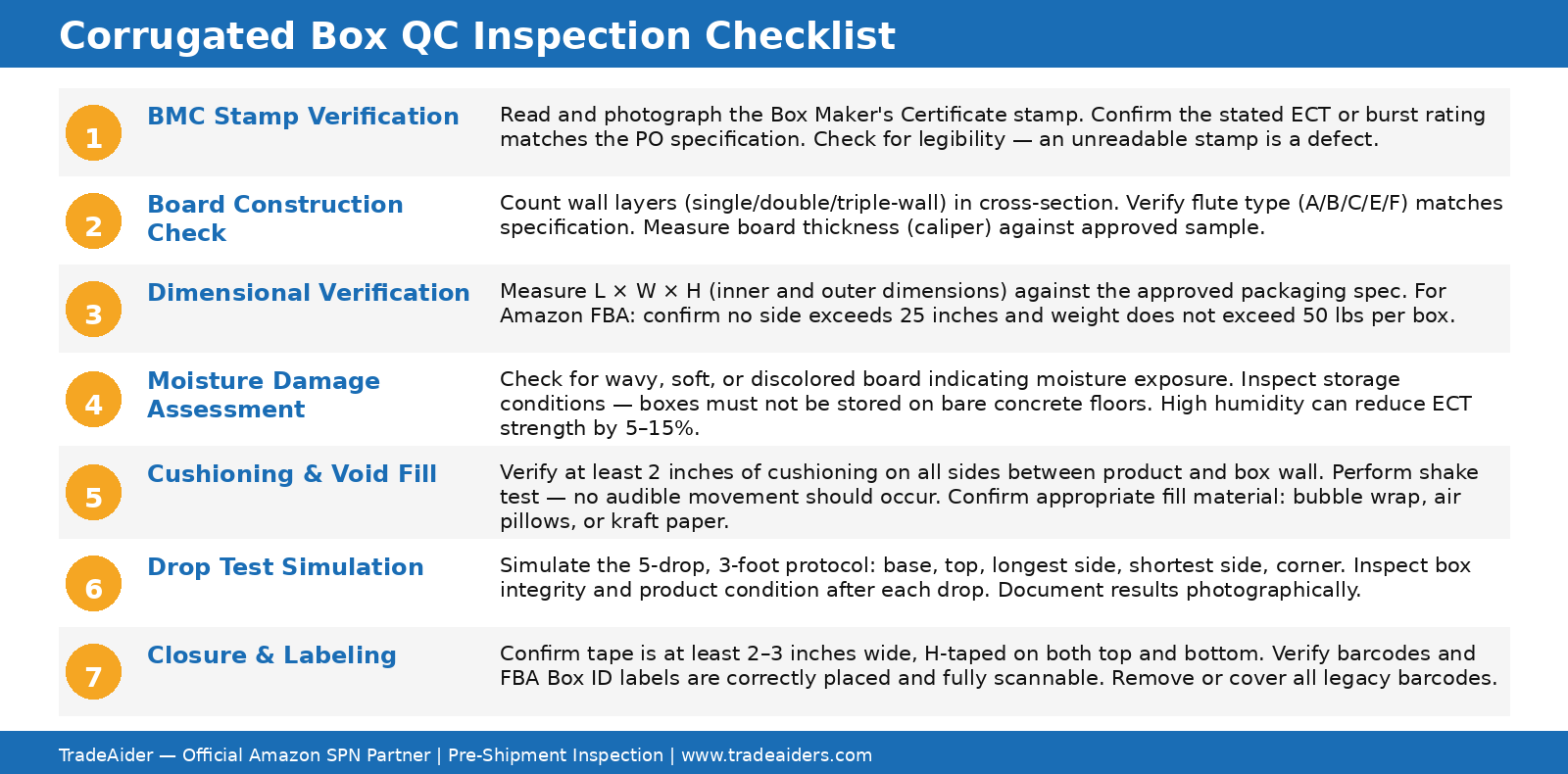
Key inspection points for corrugated box QC at the factory — from BMC stamp verification to drop-test compliance.
Specifying Corrugated Packaging in Your Purchase Order
What to Include in Your Packaging Specification
A vague purchase order is a factory's invitation to cut costs. When sourcing corrugated boxes from Chinese manufacturers, your PO or packaging specification document should include: board construction (single-wall, double-wall, or triple-wall), flute type (A, B, C, E, or F), the chosen strength standard and minimum rating (e.g., "32 ECT minimum per TAPPI T 838" or "200# Mullen minimum per ASTM D774"), box dimensions (L × W × H in millimeters), maximum gross weight, BMC stamp requirement, and any printing or surface requirements.
Including the specific test standard — not just the number — removes ambiguity. A specification that reads "200# burst" without citing ASTM D774 leaves room for a supplier to test under a different protocol and still claim compliance. Reference the international standard, require the supplier to provide test reports from their corrugator, and verify those reports during pre-production or pre-shipment inspection. TradeAider's quality inspection standard documents the verification criteria your inspector will apply.
When to Request Lab Testing vs. Visual Inspection
Visual inspection and BMC verification at the factory covers the majority of packaging compliance needs for most importers. Lab testing of corrugated samples — physical ECT or burst-test measurements against rated values — becomes important when: you are placing a first order with a new packaging supplier, you have received prior batches that failed in transit or at Amazon receiving, you are specifying a custom-formula board not from a major corrugated manufacturer, or your product is high-value or fragile and the cost of in-transit damage is significant. TradeAider's product testing services can coordinate laboratory testing of packaging materials alongside your regular pre-shipment inspection.
Frequently Asked Questions
What is the difference between 200# burst and 32 ECT for corrugated boxes?
These are two different tests measuring different properties. The 200# burst rating (Mullen Test, ASTM D774) measures how much pressure it takes to puncture through the box wall — relevant for rough individual parcel handling. The 32 ECT (Edge Crush Test, TAPPI T 838) measures how much vertical compression force the box edge can withstand before collapsing — relevant for palletized stacking in warehouses. Both are accepted by Amazon FBA as minimum standards for single-wall boxes, but they are not equivalent in what they measure. For palletized shipments going into fulfillment centers, ECT is generally the more predictive measure of real-world performance.
Does Amazon FBA require a specific ECT rating on corrugated boxes?
Yes. Amazon's packaging guidelines require corrugated shipping boxes to meet a minimum 32 ECT or 200# burst strength for standard single-wall cartons. For items over 10 pounds or fragile products, double-wall corrugated at a minimum 48 ECT is recommended. Each box must also pass a drop test (five drops from three feet, all orientations) and carry a legible BMC stamp. These requirements apply to both inner product packaging boxes and outer shipping cartons.
How does a QC inspector verify corrugated box strength at a Chinese factory?
A QC inspector verifies corrugated box strength through several methods: visual reading and photographing of the BMC stamp to confirm the rated specification, cross-section visual inspection of the board construction (counting wall layers and verifying flute type), caliper measurement of board thickness against specification, assessment of box condition for moisture damage or deformation, and drop testing — simulating the five-orientation, three-foot drop protocol. For laboratory-level burst or ECT confirmation, box samples are sent to an accredited testing facility, which can be coordinated through a pre-shipment inspection. Visual inspection at factory is the minimum; lab testing is recommended for first orders, new suppliers, or high-value product packaging.
What causes corrugated boxes to fail even when they carry the correct ECT rating?
Moisture is the most common cause of rated-but-failing corrugated boxes. High humidity conditions can reduce a corrugated board's compression strength by 5–15%, meaning a 32 ECT box stored in a damp warehouse may perform like a 27 ECT box by the time it reaches the shipping container. Other causes include boxes being stacked beyond their rated capacity, insufficient void fill allowing product to shift and apply point loads to the box wall, or boxes being manufactured to a slightly lower specification than the BMC stamp indicates — a supplier quality control failure that inspection is specifically designed to catch before shipment.
Book Your Corrugated Packaging Inspection Before Shipment
A corrugated box that fails to meet ECT or burst requirements is discovered either at Amazon's receiving dock — generating rejection fees and delays — or after your customer opens a damaged shipment. Both outcomes are expensive and avoidable.
TradeAider's pre-shipment inspection verifies box construction, BMC compliance, cushioning adequacy, and drop-test performance before your goods load into a container. As an official Amazon SPN partner, TradeAider inspectors follow FBA-specific packaging checklists and deliver an official report within 24 hours of inspection.
Book a pre-shipment inspection → or use the Inspection Charge Calculator to estimate costs for your shipment.

Related Articles
Grow your business with TradeAider Service
Click the button below to directly enter the TradeAider Service System. The simple steps from booking and payment to receiving reports are easy to operate.

