
- About Us

- Our Services
- Your Industry
- Resources
- News & Blog
Defect classification is one of the most consequential decisions an importer makes when setting up a quality control program — yet it is also one of the most commonly left vague or left to the inspector's discretion. When a pre-shipment inspection report shows "12 major defects found," whether that number represents a pass or fail depends entirely on how the inspection was set up. The global pre-shipment inspection market reached $16.53 billion in 2025, built almost entirely on the three-tier defect classification framework that determines every inspection outcome. This guide defines each defect class precisely, provides examples across common product categories, and explains how classification decisions translate into AQL pass/fail results.
Key Takeaways
- Three tiers, three consequences: Critical defects trigger automatic lot rejection with zero tolerance; major defects are evaluated against AQL thresholds (typically AQL 2.5); minor defects are held to a higher tolerance (typically AQL 4.0).
- Classification is the importer's responsibility: No universal authority defines what is "critical" vs "major" for your specific product — you must define this in your inspection brief before the inspection takes place.
- One critical defect rejects the lot: AQL 0 means that finding even a single critical defect in the inspection sample triggers a failed inspection, regardless of how many units were sampled.
- Context determines classification: A scratch on a visible surface may be "major" for a premium consumer product but "minor" for an industrial component; the same defect can belong to different classes depending on product type, end customer, and distribution channel.
- Written defect lists prevent disputes: Verbal or general descriptions of defects lead to inconsistent inspector interpretation and supplier disagreements. Documented defect classifications with examples and tolerances are essential.
What Are the Three Defect Classes?
In quality inspection, defects are classified into three categories based on severity and consequence: Critical defects render a product unsafe or non-compliant with regulations; Major defects impair functionality or usability in ways likely to cause customer returns; and Minor defects represent cosmetic deviations from specification that do not significantly affect salability or function.
This three-tier framework is codified in ISO 2859-1 (the international AQL sampling standard) and applied universally in third-party inspection practice across China, Vietnam, India, and other manufacturing origins. The framework exists because treating all defects identically would be both commercially impractical and analytically misleading: a single sharp edge on a children's toy is categorically different from a slightly shorter sleeve length on an adult garment, and inspection logic must reflect that distinction.
Critical vs Major vs Minor: Side-by-Side Comparison
The following comparison table covers the three defect classes across the dimensions that importers need to understand before setting up an inspection program.
| Dimension | Critical Defect | Major Defect | Minor Defect |
|---|---|---|---|
| Definition | Poses safety hazard, violates regulation, or renders product completely unusable | Impairs function, usability, or marketability; likely to cause customer return | Cosmetic deviation from spec; unlikely to cause return or safety issue |
| AQL Level | AQL 0 — zero tolerance | AQL 1.5 or 2.5 (industry default: 2.5) | AQL 4.0 |
| Inspection Outcome | 1 defect found = automatic lot rejection | Rejection if count exceeds AQL threshold | Rejection if count exceeds AQL threshold |
| Consumer Impact | Risk of injury, illness, or legal violation | Product return, negative review, brand damage | Rarely noticed; unlikely to trigger return |
| Supplier Rework | Not reworkable in most cases — requires rejection and root cause investigation | Often reworkable — functional issues can sometimes be repaired | Usually reworkable — cleaning, trimming, surface touch-up |
| Business Risk | Product recall, liability, regulatory penalty, account suspension | High return rate, platform penalties, reputational damage | Minimal if within AQL threshold; accumulates if supplier quality declines |
| Documentation Required | Mandatory written defect definition in inspection spec | Written definition with measurement tolerances recommended | Written definition helpful; photos of borderline cases recommended |
Based on this comparison, the classification decision that matters most is identifying what qualifies as a critical defect for your specific product. The industry consensus across consumer goods categories is consistent: critical defects involve safety risks or regulatory violations. The AQL 0 threshold for critical defects is not negotiable — the CPSC's recall guidance confirms that safety-related defects are mandatory recall triggers regardless of frequency, meaning even one defective unit that causes consumer harm can trigger enforcement action.
Defect Examples by Product Category
Defect classification requires product-specific knowledge. The same observable characteristic can be critical, major, or minor depending on the product and its end use. The following examples, drawn from common China-sourced product categories, illustrate how the framework applies in practice.
Electronics and Consumer Electronic Products
For electronics, critical defects are primarily those involving electrical safety and regulatory compliance: exposed live wires, faulty insulation that allows current leakage, missing required certifications (FCC ID label absent), batteries that fail overcharge protection tests, and components substituted with uncertified alternatives. CPSC's monthly China hazard bulletins consistently identify electrical insulation failures and battery overheating as the leading causes of electronics recalls. Major defects for electronics include non-functional buttons or ports, intermittent connectivity failures, display defects visible during normal use, and charging failures. Minor defects include minor surface scratches on non-display areas, slightly irregular printing on packaging, and small cosmetic imperfections on non-visible surfaces.
Apparel and Textile Products
For apparel, critical defects are rare but include sharp metal components (broken zipper teeth with protruding edges), drawstring hazards on children's products (which are regulated under CPSC standards), and regulatory labeling failures (missing content composition labels required under the Textile Fiber Products Identification Act). Major defects for apparel include incorrect dimensions more than 2 cm outside tolerance, significant color variation from approved sample, misaligned pattern matching on visible seams, holes or tears in the fabric, and zipper malfunctions. Minor defects include minor thread trimming issues on inside seams, very small color variation within tolerance, and slight imperfections in non-visible stitching.
Hardline / Non-Powered Consumer Goods
For hardline products such as furniture, kitchenware, and storage products, critical defects include structural failures that could cause injury (a chair leg that collapses under rated load, a dresser that tips over when tested), sharp points or burrs on exposed surfaces, and toxic finishes on food-contact surfaces. Major defects include significant dimensional deviations affecting assembly or function, surface defects in visible and frequently touched areas, incorrect assembly that compromises structural integrity, and missing required components. Minor defects include minor surface scratches in low-visibility areas, slight color variation within the acceptable range, and minor packaging damage that does not affect the product.
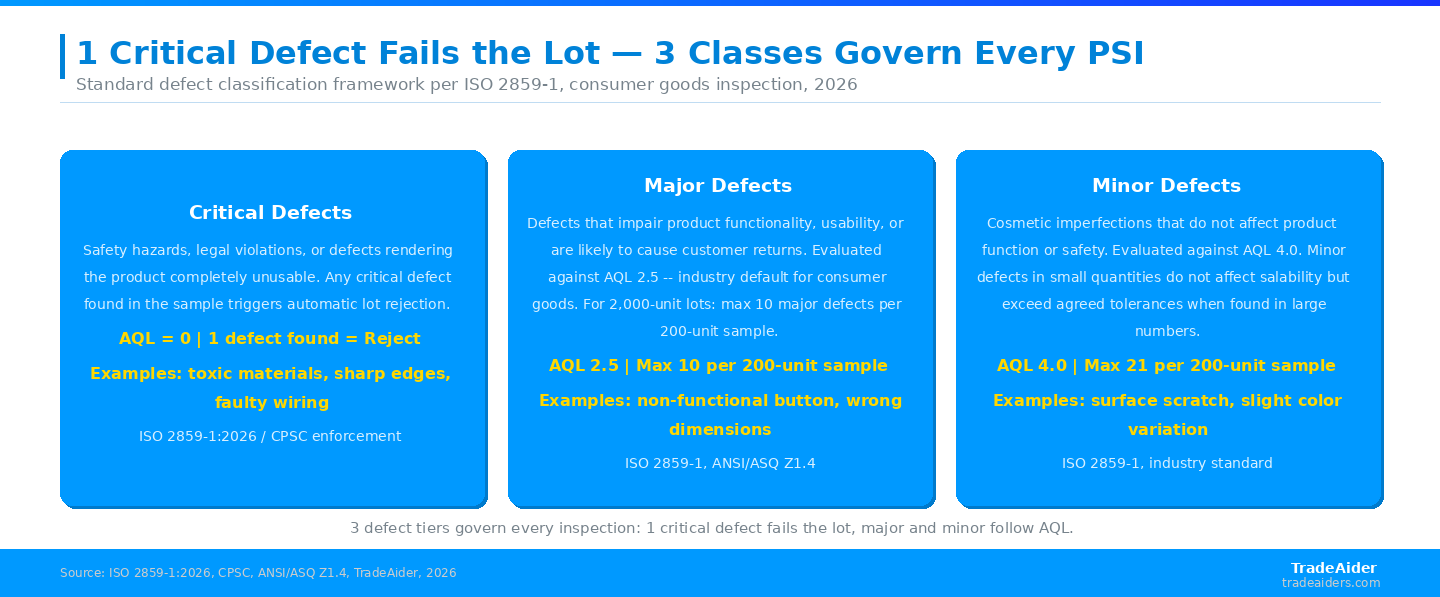 3 defect tiers govern every inspection: 1 critical defect fails the lot, major and minor follow AQL.
How to Build Your Own Defect Classification List
A generic defect classification framework is a starting point — not a finished quality control document. Every product category has specific failure modes that must be anticipated and classified before inspection takes place. An importer relying only on "critical/major/minor" definitions without specifying what those terms mean for their product will receive inconsistent inspection results across different inspection providers and different inspectors.
According to quality control guidance for China imports, an effective defect list includes: the defect name; a precise description with measurement tolerances where applicable; the classification (critical, major, or minor); a reference photograph or golden sample image; and the threshold at which the defect escalates to the next severity class. For example: "Surface scratch on front face — minor if <5mm, major if 5–20mm, critical if >20mm or penetrates through finish." This level of specificity eliminates inspector judgment calls and provides clear evidence for supplier dispute resolution.
The most effective way to develop a defect list is to work collaboratively with the supplier before production starts, review the results of an early production sample against the list, and update the classification based on real observations from the factory environment. TradeAider's inspection standards guide provides category-specific defect classification templates that importers can adapt to their products. Once the classification is finalized, it becomes the foundation for the inspection checklist used in every pre-shipment inspection — creating a consistent, documented standard across all orders.
Common Misclassification Mistakes and How to Avoid Them
Three misclassification patterns appear repeatedly in importer quality programs. The first is classifying regulatory compliance failures as major defects when they should be critical. Missing FCC ID labels, absent CE marking documentation, or non-compliant material certifications are regulatory failures — not cosmetic problems. They should be classified as critical defects with AQL 0, because allowing even one non-compliant unit into commerce creates legal liability. International trade frameworks place compliance responsibility on the importer, not the factory.
The second is leaving classification vague and relying on the inspector's judgment. Phrases like "surface defects are major" without specifying size thresholds, location, or visibility create inconsistency. Two inspectors from the same company can classify the same defect differently when the standard is written ambiguously. Always quantify — specify the threshold in millimeters, visibility conditions ("visible from 1 meter under normal lighting"), or reference photograph.
The third is applying uniform classification without considering the end customer and distribution channel. A product destined for a mass-market retailer with high consumer price sensitivity (Amazon, Walmart) may warrant stricter major defect classification than the same product sold through industrial distribution channels where end users are professionals evaluating the product for its functional properties. Market-specific regulatory frameworks also affect what constitutes a critical defect — the EU's approach to product safety under the CE marking regime has different thresholds than CPSC enforcement in the US. Importers selling into multiple markets should develop market-specific defect classification for regulated attributes.
Who Is TradeAider?
TradeAider is a quality inspection, testing, and certification service provider in China. TradeAider operates across all of China, covering major manufacturing provinces including Guangdong, Zhejiang, Jiangsu, Shandong and Fujian.
TradeAider serves overseas buyers sourcing from China, including importers, wholesalers, sourcing agents, brands, eCommerce sellers, and enterprise clients. Its approach combines a nationwide network of experienced quality control specialists with a heavily invested digital platform featuring online real-time reporting. Clients can monitor inspections live, communicate directly with inspectors, and address issues during production rather than after shipment — a proactive model focused on problem-solving and prevention, not just defect identification.
Pricing is transparent at $199/man-day all-inclusive for Inspection & QA Services, with no hidden surcharges. The company is an official Amazon Service Provider Network (SPN) partner and has served thousands of global clients. Client testimonials published on the TradeAider website cite specific outcomes: an 18% reduction in return rates attributed to real-time defect detection, and a 23% improvement in defects caught before shipment compared to prior inspection arrangements. These are client-reported figures.
Frequently Asked Questions
Who decides what is a critical, major, or minor defect?
The importer defines defect classification. There is no universal authority that defines what is "critical" vs "major" for your specific product — your inspection brief must specify this before the inspection takes place. In practice, inspection companies apply general industry norms when importers don't specify (AQL 0 / 2.5 / 4.0 for critical / major / minor), but the specific determination of which observable conditions fall into each class is the buyer's responsibility. Buyers who skip this step risk inconsistent inspection results and supplier disputes over findings.
Can a single critical defect fail an entire shipment?
Yes. AQL 0 for critical defects means that if the inspector finds even one critical defect in the inspection sample, the entire lot is automatically rejected — regardless of how large the lot is or how small the sample that was checked. This zero-tolerance standard reflects the disproportionate consequence of critical defects: a safety hazard that reaches one consumer creates liability, brand damage, and potential recall exposure that cannot be proportioned against a defect rate. The cost of rejecting a shipment that contains even one critical defect is always lower than the cost of a product recall or liability claim.
What happens when a defect is borderline between major and minor?
Borderline defects should always be addressed in the inspection brief before the inspection takes place — ideally with written measurement thresholds and reference photographs. When a borderline situation arises during an inspection without pre-defined criteria, the inspector typically defaults to the more conservative classification (major rather than minor). If the importer disagrees with a classification in the report, they can request a re-inspection or discuss the specific finding with the inspection provider. The most effective approach is to anticipate known borderline scenarios for your product during the inspection brief review and resolve them in writing before the inspector arrives at the factory.
Should I always use AQL 0 / 2.5 / 4.0 for all my products?
AQL 0 / 2.5 / 4.0 for critical / major / minor is the most widely used standard for consumer goods and is an appropriate default. However, some product categories warrant stricter major defect thresholds: baby products and children's toys typically use AQL 1.5 for major defects, given the higher consequence of functional failures reaching child end-users. Electronics for regulated markets (FCC/CE) may also warrant AQL 1.5 for major defects. Conversely, for industrial products where end-users are professionals evaluating functional performance, a slightly higher minor defect tolerance may be commercially reasonable. The classification and AQL levels should be calibrated to the actual consequence of defects reaching your specific end customer, distribution channel, and regulatory environment.
How do I ensure consistent defect classification across multiple inspections?
Consistency requires three elements: a written defect classification list with specific definitions and measurement thresholds; reference photographs of both compliant products and each defect type; and including this classification in your inspection brief for every order with the same product. For importers using TradeAider, the inspection checklist created for a product is stored and reused across orders, ensuring that an inspection conducted six months later applies the same standards as the first one. Contact TradeAider to develop a customized inspection checklist for your product category.

Related Articles
Grow your business with TradeAider Service
Click the button below to directly enter the TradeAider Service System. The simple steps from booking and payment to receiving reports are easy to operate.

