
- Über uns

- Unsere Dienstleistungen
- Ihre Branche
- Ressourcen
- Nachrichten & Blog
Glass tables are one of the highest-risk furniture categories for transit damage. The combination of heavy weight, rigid fragility, and the typical journey from a Chinese factory to an end customer — multiple handling points, ocean freight, customs, last-mile delivery — creates a near-certain breakage scenario if packaging isn't engineered correctly. For importers, glass breakage in transit doesn't just mean replacement costs; it means customer injury risk, negative reviews, Amazon returns, and carrier liability disputes.
Third-party inspection in China is the checkpoint that verifies packaging meets specification before the container loads. This guide covers what those checks should include, what common failures look like, and how to build a packaging specification robust enough to protect your product through the full logistics chain.
Key Takeaways
- Packaging failure is the primary cause of glass table damage in transit — and it's almost entirely preventable with the right specification and inspection process.
- Packaging inspection is distinct from product inspection — it requires a specific checklist focused on protection materials, structural integrity, and marking.
- Drop and vibration testing of packed units is the most reliable predictor of transit survival and should be part of your inspection protocol.
- Your packaging specification must be defined before production starts — not after you've already seen a breakage problem.
Why Glass Tables Fail in Transit — and Why Inspection Catches It
Glass table damage in transit follows predictable patterns. Corner and edge impacts are the most common cause of glass breakage: a glass tabletop without adequate corner protection transfers impact energy directly to the glass edge, which has almost no tensile strength. Vibration fracture is the second major cause — over a multi-week ocean voyage, continuous vibration causes glass panels to flex repeatedly against contact points, developing micro-fractures that arrive cracked without any single impact event. Frame-to-glass impact is common in tables with separate glass inserts, where the frame moves during transit and strikes the glass if adequate separation isn't maintained.
What 3rd Party Packaging Inspection Covers for Glass Tables
A qualified pre-shipment inspection for glass tables should include a dedicated packaging module. Here's what that module covers.
1. Carton Specification Verification
The outer carton is the first line of protection. Inspectors verify the carton against your specification, checking corrugated board grade (flute type and ECT rating), carton construction (RSC, FOLS, or custom die-cut per spec), carton dimensions and wall thickness, and tape specification and application pattern. Carton substitution is common under cost pressure — single-wall corrugated for double-wall, or a reduced ECT rating without visible change. Inspectors check this through physical measurement and, where accessible, by requesting the corrugated board supplier's certificate of conformity.
2. Interior Protection Layer Check
| Protection Element | What Inspector Checks | Common Failure Mode |
|---|---|---|
| Corner foam protectors | Material grade (EPE/EPS), thickness, coverage area, fit to glass corner radius | Undersized corners, wrong foam grade (too soft), poor fit leaving gap |
| Edge foam profiles | Full perimeter coverage, profile depth vs. glass thickness, secure attachment | Gaps at corners, profiles falling off before carton closes |
| Surface protection film/wrap | Film grade, coverage, scratch resistance confirmation | Thin film that tears during packing, incomplete coverage leaving exposed glass |
| Frame-glass separator | Foam sheet or corrugated divider between frame and glass, no hard contact points | Frame hardware (bolts, brackets) positioned to contact glass during transit |
| Fill material | Void fill adequacy — no significant empty space allowing movement inside carton | Loose carton packing allowing product to shift; insufficient fill for heavy glass |
3. Drop Test
The most direct test of packaging effectiveness is a drop test on a fully packed production unit. Standards from the International Safe Transit Association (ISTA) provide the framework for this. ISTA 2A is considered a good all-around standard for most importers, combining atmospheric conditioning, compression, vibration, and drop tests to simulate real shipping conditions. For more fragile products like glass, ISTA 3A or the ISTA 4 series provide more comprehensive simulation of the full distribution environment — the 4 series is specifically recommended for glass, ceramics, and other fragile items.
A basic drop test for a glass table carton conducted during pre-shipment inspection involves dropping a packed unit from a defined height (typically 50–75cm depending on carton weight) in multiple orientations: flat base drop, flat top drop, and corner drop. The corner drop is the most revealing — it most closely simulates the actual damage event that causes glass breakage in real logistics handling. Any glass damage from a compliant drop height is an automatic packaging failure requiring re-specification before shipment.
4. Weight and Stacking Test
Inspectors check that the carton's rated stacking capacity matches the expected storage conditions. For glass table cartons in a full container load, the bottom cartons may support 6–8 layers of stacked product weight. A simple stacking test places a defined weight on the packed carton for a period of time and measures post-test carton compression. Excessive carton crush indicates the corrugated grade is insufficient for the expected stack load — a failure mode that leads to glass movement and breakage during the voyage.
5. Marking and Labelling Checks
Packaging marking for glass tables must comply with both regulatory requirements and carrier handling requirements. Inspectors verify "Fragile" and "This Side Up" markings (correct placement, visible on all four sides, in language appropriate for the destination country), weight declaration accuracy (gross weight marking must be accurate for carrier liability calculations), country of origin marking, and barcode/SKU label placement and scannability per receiving warehouse requirements.
Missing or incorrect fragile marking doesn't change how the package performs physically — but it can reduce carrier liability in a damage claim if the carrier can demonstrate it wasn't notified the contents were fragile.
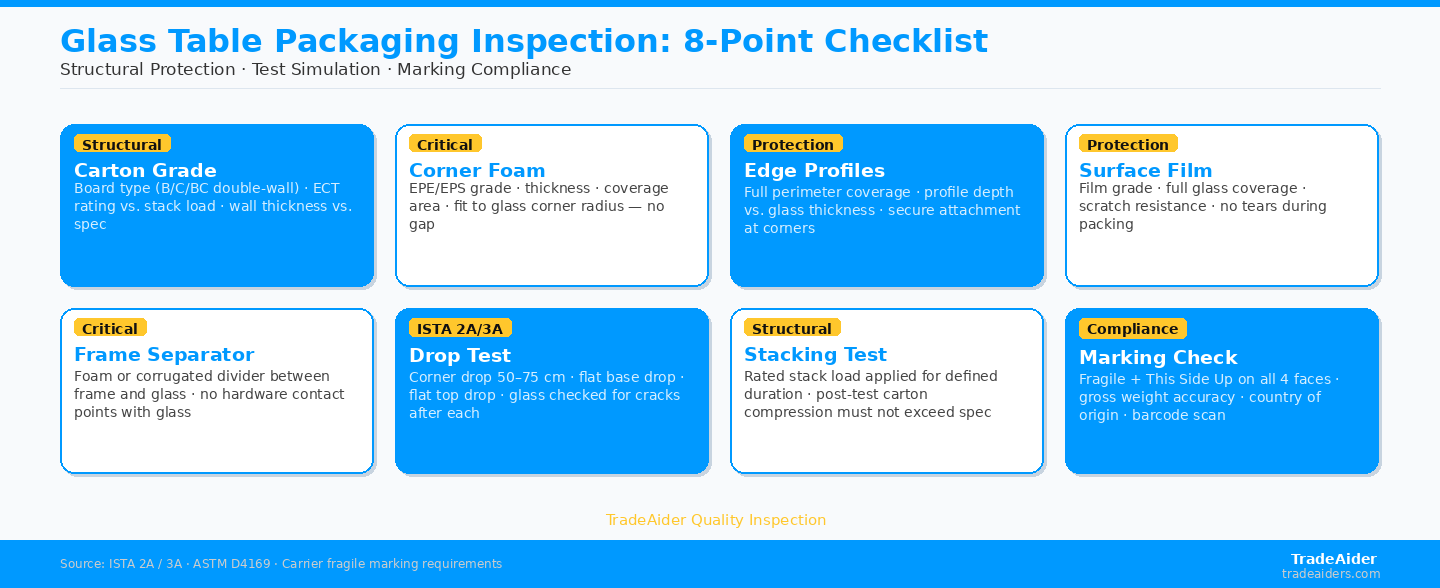 A complete glass table packaging inspection covers eight checkpoints across three categories — structural protection, test simulation, and marking compliance — each addressing a distinct transit damage scenario.
6. Packing Process Audit
Beyond checking the finished packed unit, a thorough inspection includes observing the packing process in operation. This confirms that the packing method applied to the full batch matches the approved method — not just the units packed specifically for inspection review. Inspectors observe the correct sequence of protection layer application, consistent glass handling, whether glass edges are being handled without gloves (a chip initiation risk), and whether the packing team has a documented work instruction they're following.
How to Build a Glass Table Packaging Specification
Packaging inspection is only as effective as the specification it's checking against. A specification that says "standard export packing" gives an inspector nothing to verify. A specification that defines every protection element — its material type, grade, dimensions, and placement — gives the inspector a complete conformance checklist.
For glass tables, your specification document should cover: outer carton construction and board grade, all inner protection elements with material type and dimensions, film specification, carton closure method, gross weight and dimensions, marking requirements, and pass/fail criteria for the drop test protocol. This specification is submitted to the factory as part of the purchase order and shared with your inspection company before the inspection is booked. If you don't have an existing specification, the TradeAider team can help develop one based on your product dimensions and logistics profile before your first inspection.
Packaging Sample Approval Before Production Packing
For a first order or any significant packaging change, request a packaging sample from the factory before full production packing begins. This allows you to verify — and conduct a drop test on — the proposed packaging before it's applied to the full batch. TradeAider inspectors can conduct this validation inspection at the factory, giving you a real-time report with drop test results and photos before you authorise production packing to proceed.
Connecting Packaging Inspection to Your Broader QC Process
Packaging inspection is most effective as the final stage of a quality process that starts with the product itself. A perfectly packed glass table with a product defect — a tempered glass panel with a stress crack, a frame with a structural fault — is not a good outcome. The inspection program should cover both product quality and packaging quality in a single visit where possible.
TradeAider's pre-shipment inspection service combines product conformity checks with packaging checks in a single man-day visit, priced at $199/man-day. Real-time reporting means you receive the inspector's findings — including drop test results — the same day as the inspection, well before your shipment window closes. Use the inspection cost calculator to estimate coverage for your order volume.
Frequently Asked Questions
How many packed units should be drop tested during inspection?
For most glass table orders, one to three units from the production batch are drop tested as part of the inspection. The drop test is a destructive test on the packaging (and potentially the product), so it's applied to a representative sample rather than the full AQL quantity. One unit tested rigorously in multiple drop orientations provides strong packaging validation. If the first unit fails, the inspector can test additional units after the factory addresses the packaging issue, confirming the correction is effective before authorising shipment.
What corrugated board grade should I specify for glass coffee tables?
For glass coffee tables in the 8–20 kg finished weight range, double-wall corrugated board (BC-flute or EB-flute) with an ECT rating of at least 44 ECT is a typical starting specification for export packing. For heavier glass dining tables (20 kg and above), triple-wall corrugated or custom wooden crating with foam lining is often more appropriate. The right specification depends on the specific dimensions, weight distribution, and your logistics route.
Does packaging inspection cover compliance with Amazon FBA packaging requirements?
Yes — if you provide Amazon's FBA packaging requirements as part of your inspection brief, the inspector will check your packed units against those requirements. Amazon has specific requirements for fragile items, including bubble wrap coverage, minimum carton strength, and labelling. These requirements can be incorporated directly into your inspection checklist alongside the standard product and packaging checks.
Can inspection prevent all glass breakage in transit?
Inspection significantly reduces transit breakage by verifying that packaging meets specification before the container loads. It doesn't eliminate the possibility of breakage from abnormal handling events. What it does is confirm that the packaging performs correctly under the standard handling conditions your logistics chain involves, and that the protection elements that should be present are actually present on your production batch. That distinction — between designed and implemented packaging — is where inspection adds its core value. Get in touch to set up a packaging inspection for your next glass furniture order.
Verwandte Artikel


Erweitern Sie Ihr Unternehmen mit TradeAider Service
Klicken Sie auf die Schaltfläche unten, um direkt in das TradeAider Service System zu gelangen. Die einfachen Schritte von der Buchung und Zahlung bis zum Erhalt der Berichte sind leicht zu bedienen.

