
- Über uns

- Unsere Dienstleistungen
- Ihre Branche
- Ressourcen
- Nachrichten & Blog
A failed pre-shipment inspection does not automatically mean “rework everything” or “cancel the shipment.” The defensible next step is to contain the population that can be supported by records and observations, then choose the recovery path that the failure impact and available proof can justify. A supplier promise may explain an intended correction; it does not, by itself, establish which cartons are now safe to move.
A Failed PSI Starts a Containment Decision, Not One Automatic Outcome
A pre-shipment inspection (PSI) is a finished-goods check before shipment, normally scheduled when the order is 100% complete and at least 80% packed for export. When it fails, begin with containment: temporarily stop a defined population of goods from moving while its scope and condition are checked. That boundary is more useful than treating the result as either a whole-order verdict or a minor supplier issue.
A failed PSI requires a defined containment boundary before an importer can choose rework, sorting, conditional release, or refusal.
The recovery decision should distinguish the sampled finding from the population that can actually be identified, corrected, and verified.
- Separate the failed sample result from the physical population it may represent.
- Hold the smallest population that records and observations can honestly support.
- Choose rework or sorting only after the correction and the boundary can be verified.
- Keep any allocation condition written, narrow, and visible to the decision owner.
Classify the Finding Before You Choose a Recovery Path
NIST describes acceptance sampling as a random-sample method for deciding the disposition of a lot, rather than estimating the lot's quality. Its Engineering Statistics Handbook explains that boundary.
An Acceptance Quality Limit (AQL) is a sampling-plan value used to set acceptance and rejection thresholds for a defined inspection plan. It is not a root-cause label and it does not tell a buyer which units remain unaffected. Before discussing recovery, classify the finding by its likely impact: a cosmetic issue, a functional defect, an identity or packaging mismatch, an incomplete quantity, a documentation conflict, or a potentially safety-relevant condition. The classification changes what must be contained and what evidence is needed afterward.
A failed sample is an acceptance result under a defined plan; it does not by itself identify root cause, legal exposure, or the full scope of affected goods. NIST explains that a single sampling plan is specified by sample size n and acceptance number c, and the lot is rejected if sample defectives exceed c.
Read the report together with the defect description, sample size, product references, photos, packaging state, and carton information. If the sample-plan inputs need checking before a recovery decision is made, use the AQL sampling inputs as a planning reference. The calculation can clarify the inspection decision, but it cannot replace a physical containment and verification plan.
Can You Identify the Affected Population?
NIST describes a lot acceptance sampling plan as a sampling scheme and rules that can accept a lot, reject it, or require another sample. Its description makes clear that a sampling decision and a recovery check are separate steps.
For a post-failure decision, ask a different question: can the factory, buyer, and inspector identify the cartons or units that might share the failure? Useful anchors include a work order, production date or line, carton range, lot code, SKU, packaging revision, component batch, or a controlled packing map. A verbal assurance that “only one line was affected” is not a boundary. If it cannot be linked to physical goods, it cannot safely narrow the hold.
Strong traceability does not make a defect harmless. It only allows the buyer to contain the decision to a known range. Weak traceability has the opposite effect: it expands the hold because the proposed recovery cannot show where the risk stops. This distinction is the main reason a failed PSI should not be converted mechanically into either a complete shipment refusal or a quick partial release.
Can the Current Goods and Records Support a New Decision?
For a correction decision, the current goods, package, relevant records, and release population must be reconciled before an importer treats the recovery as complete. NIST says that when a first sample in double sampling is inconclusive about accepting or rejecting, a second sample is taken.
A recovery file should show the before-and-after connection. Start with the original finding and the exact population on hold. Then record the correction instruction, the responsible owner, the product or pack version inspected after correction, the carton or lot range, and the verification method. A rework log that says “repaired” but does not name the affected cartons cannot prove that the goods now being released are the goods that were corrected.
The same rule applies to sorting. The sort report must identify what was checked, what passed, what failed, and how the result attaches to cartons or units. If labels, inserts, or other market-facing details were changed, match the current physical version to the approved reference before release. This is a release-control check, not a claim that inspection alone grants market approval.
Choose the Recovery Path That Matches Scope and Impact
The appropriate recovery path follows the defect impact, the ability to bound the population, the correction method, and the proof available after correction.
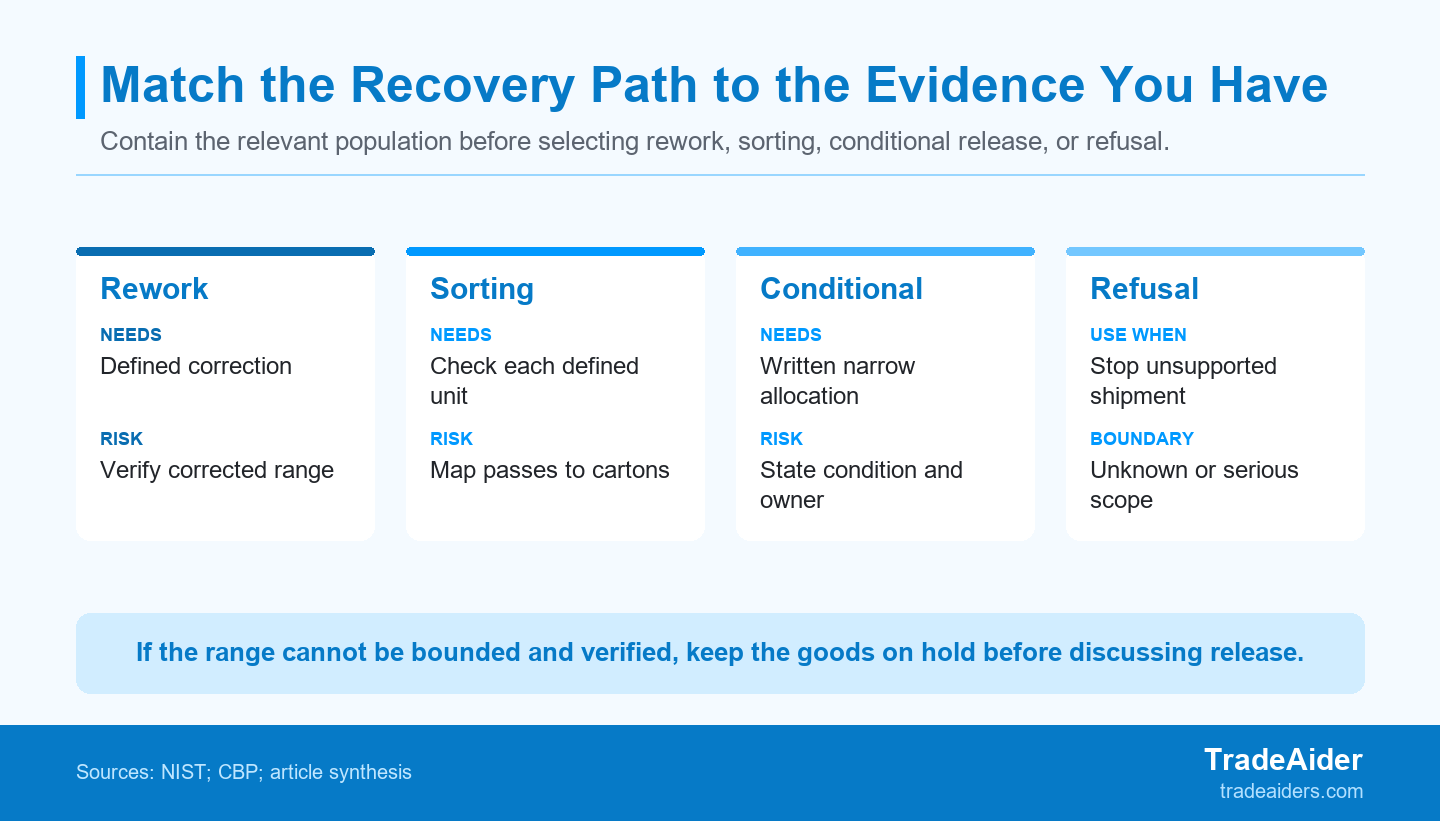
Choose the recovery path that the defect impact, traceability, correction proof, and written release boundary can support.
Use the options below as a decision comparison, not as a set of default remedies. The same visible defect may call for a narrow sort in one order and a complete shipment hold in another. The difference is whether the buyer can show what is affected, what changed, and what was verified after the change.
| Path | Use it when | Evidence needed before release | Do not use it when |
|---|---|---|---|
| Rework | A defined correction can be made to a bounded range. | Correction instruction, affected range, current product or pack, and recheck result. | The correction itself cannot be observed or linked to the held goods. |
| Sorting | Each checked unit or carton can be identified and recorded. | Sort method, pass/fail definition, carton map, and verification sample. | Records cannot separate checked goods from unchecked goods. |
| Conditional release | A buyer accepts a written, traceable allocation under defined limits. | Condition, allocation range, owner, unresolved issue, and shipment control. | It would conceal a serious, unbounded, or product-obligation issue. |
| Refusal | Impact is serious or recovery cannot be verified credibly. | Report evidence, failed boundary analysis, and contractual decision record. | A bounded correction and verification path is genuinely available but has not yet been assessed. |
That comparison also explains why a generic “reinspect after rework” instruction is incomplete. It names an activity without naming the population, the proof, or the release authority. The correct question is not “what did the factory do?” but “which current goods does the evidence now describe?”
TradeAider can inspect a buyer-defined recovery range and report observable findings after rework or sorting; the buyer retains the decision to accept, allocate, or refuse the goods.
Rework: Correct a Defined Failure, Then Verify the Corrected State
Rework is not a release outcome; it is a controlled correction that still needs evidence and a verification check for the affected population.
Start rework with a single written correction instruction. It should identify the defect, the acceptable corrected state, the units or cartons included, the owner, the method, and the record that will prove completion. For a functional problem, the verification may include a defined function check. For a packaging problem, it may include the current artwork, insert, label position, and carton range. The post-rework check must inspect the corrected condition, not only repeat the wording of the original report.
If the same failure could have been detected while production was still open, during-production inspection planning can help move the next control point earlier. For the current shipment, however, the practical question remains whether the rework record and the current goods identify the same held range. If they do not, the buyer should widen containment rather than treat the rework as finished.
Sorting: Separate Conforming Goods Only When the Boundary Is Real
Sorting is defensible only when the check method and identifiers can distinguish the goods that passed the sort from goods that did not.
A sort is a controlled inspection activity, not a relabeling exercise. Define the failure signal, the checking tool or method, the result categories, the physical segregation method, and the record attached to each completed carton or unit. For example, a cosmetic sort may need an approved reference sample and a defect threshold; a functional sort may need a defined operational check and an exception route for borderline units.
Before starting, align the recoverable check with the buyer's documented criteria. The site's inspection-standard criteria can provide a shared reference for that conversation. After the sort, the buyer still needs an independent way to verify the method and the completed population. A focused verification is useful only when the sort report, carton map, and goods on site can be reconciled.
Conditional Release: Keep It Narrow, Written, and Contractual
Conditional release should be a written allocation decision for a traceable condition, not a replacement for correction, evidence, or an applicable regulatory requirement. NIST says multiple sampling uses successive samples as needed to reach an ultimate decision.
A conditional release is a written decision to allocate a traceable population under stated limits while unresolved conditions remain visible. It may be appropriate when a buyer can identify a specific allocation, understands the commercial consequence, and has a contractually credible way to control the condition. It should name the exact carton or unit range, destination or customer allocation, remaining issue, owner, deadline, and escalation trigger.
It should not be used as a polite label for “ship it anyway.” It cannot turn a failed functional or safety-relevant check into a pass, erase a missing evidence requirement, or bind an importer who has not accepted the condition. Treat it as a narrow commercial decision with written ownership, not as an inspection conclusion.
Refusal: Stop the Shipment When Recovery Cannot Be Verified
When a serious finding, unknown population, or unverified recovery prevents a credible release boundary, refusal or shipment cancellation may be the more defensible commercial choice.
Refusal is not a sign that the team failed to find a creative remedy. It is the disciplined response when the remaining risk cannot be bounded, the proposed correction cannot be verified, the product does not meet the buyer's agreed requirement, or the cost of a wrong release outweighs a delay. Preserve the report, photos, sample references, communications, and proposed recovery records so the decision has a factual basis.
For U.S. import decisions, NIST says sequential sampling takes a sequence of samples from a lot, with the total number dependent on the sampling results. That does not make a sampling method a PSI disposition rule, but it reinforces that the importer must own the shipment decision. A refusal should therefore be recorded as a buyer or contractual decision, not presented as something an inspector has independently ordered.
Illustrative Scenario: Mixed Carton Records Expand a Hold
In the illustrative scenario, mixed carton records widen the hold from the failed sample to the last reliably traceable production window.
Illustrative example, not a TradeAider client case or a certification decision. An importer has 4800 units packed in 240 cartons for a seasonal retail order. The failed sample shows a repeated loose fastener issue. The factory proposes sorting two carton rows because it believes the issue came from one assembly line. The packing list identifies SKUs and destinations, but two work orders overlap across cartons the factory wants to exclude.
Contain First, Then Decide Whether Sorting Is Still Defensible
The importer resumes sorting only after the carton map, work order, and physical identifiers create a checkable boundary for the held range.
The importer, factory, and inspection team agree that the loose-fastener finding is real, but they cannot yet prove which cartons share the affected production window. The 4,800 units across 240 cartons are fully packed when the final sample shows the repeated loose fastener issue. The proposed two-row sort would claim more certainty than the records provide. Rather than release the rest by assumption, the importer holds all 240 cartons while preserving the original carton positions and work-order records.
The immediate decision is a full hold, not an automatic order refusal. The buyer asks the factory to reconcile work orders, carton labels, and finished-product identifiers. Until that map is rebuilt, there is no defendable line between sorted goods and unchecked goods. The 240-carton hold is wider than the original sample because the evidence boundary is wider.
Once a traceable range exists, the factory can apply a defined fastener check, record each carton, segregate failures, and submit the sort record for verification. Only then can the buyer decide whether a checked subset has a credible release boundary. A focused pre-shipment verification can compare the mapped range with the sort record and current goods. The example shows containment logic; it does not determine the product's severity classification, legal status, or contractual remedy.
Send a Recovery Brief Before the Factory Touches the Goods
A recovery brief is usable when it names the failed finding, hold boundary, method, evidence owner, verification sample, and release authority.
Before any rework or sorting starts, send one concise recovery brief that all decision owners can read:
- Name the failed finding and the evidence that supports it.
- Define the current hold boundary: units, cartons, lots, work orders, or production dates.
- State the correction or sort method and the pass/fail rule.
- Name the record owner and the evidence needed after correction.
- Specify the verification check and the person authorized to release, allocate, or refuse the goods.
TradeAider can use that brief to focus a recovery verification on the defined goods, correction evidence, and reportable observations. The buyer retains ownership of acceptance, contract remedies, and any product-specific requirement. When the brief and carton boundary are ready, request a recovery-focused inspection plan.
Frequently Asked Questions
Does a failed PSI mean the whole order must be refused?
No, a failed PSI does not automatically require whole-order refusal, but the recovery scope must match the defect impact, traceability, and evidence available. A defined correction or sort may support a narrower decision when the goods can be identified and verified. If the population is unknown or the remaining impact is serious, the hold should widen and refusal may be the sounder commercial option.
Can a factory sort goods after a failed inspection?
Yes, sorting can be useful when the factory can define the affected population, document the check method, and verify the cartons that passed the sort. The plan should state the failure signal, pass/fail rule, physical segregation, carton map, and escalation path. A sort is weak when the report cannot prove which cartons were checked and which were not.
What should be checked after goods are reworked?
Check the corrected physical condition, the affected carton or lot range, the current package or label where relevant, and the record proving what was changed. The verification should inspect the new state, not merely restate the original defect. If rework changes the pack, product identity, or documentation, make sure the evidence and physical goods describe the same current configuration.
Is conditional release the same as accepting the inspection result?
No, conditional release is a narrow commercial allocation decision and should not be used to erase a failed result, missing evidence, or an applicable product requirement. It should be written, traceable, and owned by the buyer or contract decision-maker. A condition that cannot be assigned to a known range or escalation owner is not a workable conditional release.
Verwandte Artikel
Erweitern Sie Ihr Unternehmen mit TradeAider Service
Klicken Sie auf die Schaltfläche unten, um direkt in das TradeAider Service System zu gelangen. Die einfachen Schritte von der Buchung und Zahlung bis zum Erhalt der Berichte sind leicht zu bedienen.

