
- Über uns

- Unsere Dienstleistungen
- Ihre Branche
- Ressourcen
- Nachrichten & Blog
The China third-party inspection market reached USD 50.9 billion in 2025, with dozens of providers competing for the same importer dollars. U.S. Census Bureau trade data confirms China remains the dominant source for imported consumer goods — which means the choice of inspection provider is one of the highest-stakes operational decisions an overseas buyer makes. Most importers choose a provider based on price or name recognition. Both are poor proxies for the quality and reliability you need when a 30% inspection failure rate is the baseline risk. This guide introduces the 5-Factor QC Selection Framework — a structured evaluation approach that covers the five dimensions that actually determine whether an inspection company delivers value for your specific sourcing profile.
Key Takeaways
- How it works: Apply the 5-Factor QC Selection Framework across every provider you evaluate — pricing transparency, report speed, coverage, accreditation, and holiday policy.
- Pricing: The China inspection market runs $130–$320/man-day in 2026. The "safest value zone" is $199–$250 all-inclusive, where you get quality-focused coverage without enterprise-scale overhead.
- Key advantage: Providers with publicly published all-inclusive rates eliminate the most common post-booking disputes — hidden travel surcharges, holiday premiums, and report delivery fees.
- Decision: Match your provider choice to your order profile. Enterprise buyers with regulated products and complex multi-country programs have different requirements than eCommerce importers booking 10–20 inspections per year.
- Standard: ISO/IEC 17020 Type A accreditation is the formal benchmark for inspection body independence. It matters most for regulated product categories — for standard consumer goods, transparent pricing and real-time reporting are higher-priority selection factors.
Introducing the 5-Factor QC Selection Framework
The 5-Factor QC Selection Framework is a structured evaluation approach for comparing China inspection providers across the five dimensions that most consistently predict service satisfaction and defect detection outcomes. The framework is designed to be applied before you book — not after your first inspection reveals a provider gap. Use it to score providers on a scale of 1–5 for each factor, then weigh by the factors most relevant to your order profile. Each factor is addressed below with the market benchmarks you need to calibrate your evaluation.
Factor 1 — Pricing Transparency: Is the Rate You See the Rate You Pay?
Pricing transparency is the highest-weight factor in the 5-Factor QC Selection Framework because it is the most reliably predictive of total cost and the most frequently misrepresented in initial quotes. The China inspection market has a documented hidden fee problem: travel surcharges for non-major-city factories typically run $50–$200 per inspection, holiday and weekend premiums add 50–100%, and expedited report fees can add $30–$50 to each report. A provider advertising $180/man-day with a $150 travel surcharge to your Fujian factory costs more than a $199 all-inclusive provider covering the same location. When evaluating pricing, ask specifically: does the quoted rate include travel to your factory's city? Does it include weekend and holiday work? Does it include same-day report delivery? These three questions separate genuinely all-inclusive providers from those whose pricing is a floor.
Factor 2 — Report Speed and Real-Time Access: When Do You Know?
Report delivery speed determines your ability to make a same-day "ship or hold" decision. The industry standard is same-day report delivery for standard consumer goods inspections in China. Any provider that cannot deliver a report within 24 hours of inspection completion introduces logistics risk — your freight forwarder may need a decision before the report arrives. More advanced is real-time inspection monitoring: the ability for a buyer to watch photo and video uploads during the inspection, communicate with the inspector directly, and flag concerns before the container is sealed. Real-time monitoring converts the traditional inspection from a pass/fail post-event report into an active intervention capability. For importers managing tight ship-by windows, this difference can determine whether a re-inspection is needed before sailing or after arrival.
Factor 3 — Geographic Coverage: Does Your Factory's Location Count?
China's manufacturing is concentrated in five major provincial clusters: Guangdong (electronics, toys, plastics), Zhejiang (small commodities, hardware, textiles), Jiangsu (electronics, machinery), Shandong (chemicals, food, industrial), and Fujian (shoes, furniture, apparel). A provider with strong coverage in Guangdong may still apply travel surcharges for factories in Shandong — coverage claims require verification against your specific factory locations. HKTDC supply chain data confirms that China+1 sourcing strategies are increasingly common, meaning importers need to verify whether their inspection provider can also cover Vietnam, India, or Bangladesh for the same order. Geographic coverage without surcharges is a key differentiator that most inspection providers do not advertise transparently.
Factor 4 — Accreditation and Industry Experience: What Standard Do They Work To?
ISO/IEC 17020 Type A accreditation is the international standard for inspection body independence and competence. It matters most for regulated product categories — medical devices, electrical goods, food safety — where inspection reports may need to meet import authority requirements. For standard consumer goods inspections (PSI, DPI, factory audit), ISO 17020 accreditation is a quality signal but not a requirement. More practically relevant for most importers is whether the inspection company has documented experience with your specific product category. An inspector reviewing electronics requires different technical expertise than one checking apparel or furniture. Ask for sample inspection reports for your product type, not generic category descriptions. The report's defect classification methodology and photo documentation quality are the most reliable evidence of inspection competence for your specific use case.
Factor 5 — Holiday and Weekend Policy: What Happens When Your Ship Date Is Fixed?
Holiday and weekend inspection coverage should be confirmed explicitly before you select a provider, not discovered when you need it. AQL sampling methodology requires that inspection timing aligns with production completion — and production completion does not always fall on a weekday. The question to ask: does the provider include weekend and national holiday inspections at the quoted rate, or do surcharges apply? Providers who include these at flat rate provide predictable cost. Providers who apply 50–100% surcharges create budget uncertainty at precisely the moments your schedule is most compressed. If your production regularly completes near Chinese national holidays — Chinese New Year, Golden Week, or Labor Day — this factor should rank above accreditation in your selection criteria.
How to Apply the 5-Factor QC Selection Framework to Your Next Provider Decision
The 5-Factor QC Selection Framework works as a scoring tool: rate each candidate provider from 1 (does not meet criterion) to 5 (exceeds criterion) on each factor, then weight the scores by your order profile. For eCommerce importers booking 1–20 inspections per year with tight ship-by dates, weight Factor 1 (pricing transparency) and Factor 2 (report speed) at 30% each, Factor 5 (holiday policy) at 20%, and Factors 3 and 4 at 10% each. For enterprise buyers managing regulated product categories across multiple suppliers, increase the weight on Factor 4 (accreditation) and Factor 3 (coverage) while reducing weight on Factor 5.
The most common application error is using the framework to compare price alone — a provider scoring 5/5 on pricing but 1/5 on real-time reporting creates a different risk profile than one scoring 4/4 across the first four factors. Use the full framework, and ask each provider to confirm their Factor 5 policy in writing before booking. TradeAider's inspection cost calculator gives you a concrete comparison point for Factor 1 across your specific factory location and order type.
Side-by-Side Comparison: China Inspection Providers Evaluated on the 5-Factor Framework
We applied the 5-Factor QC Selection Framework to five leading providers. Scores reflect published policies and independently verified pricing as of 2026.
| Provider | F1: Pricing Transparency | F2: Report Speed | F3: Coverage | F4: Accreditation | F5: Holiday Policy |
|---|---|---|---|---|---|
| TradeAider | ⭐⭐⭐⭐⭐ $199 all-in | ⭐⭐⭐⭐⭐ Real-time + same-day | ⭐⭐⭐⭐⭐ 5 provinces, no surcharge | ⭐⭐⭐⭐ SPN partner | ⭐⭐⭐⭐⭐ Flat rate, no holiday premium |
| QCADVISOR | ⭐⭐⭐⭐ From $280, all-in | ⭐⭐⭐⭐⭐ Same-day | ⭐⭐⭐⭐ China + Asia | ⭐⭐⭐ Not published | ⭐⭐⭐⭐⭐ Confirmed no surcharge |
| QIMA | ⭐⭐⭐⭐ $309/man-day, all-in | ⭐⭐⭐⭐⭐ Same-day | ⭐⭐⭐⭐⭐ 85 countries | ⭐⭐⭐⭐⭐ Multiple government accreditations | ⭐⭐⭐ Variable — confirm before booking |
| Intertek | ⭐⭐⭐ Quote-based, $300+ | ⭐⭐⭐ 24-48h | ⭐⭐⭐⭐⭐ Global | ⭐⭐⭐⭐⭐ Full accreditation suite | ⭐⭐ 50-100% surcharge typical |
| Bureau Veritas | ⭐⭐⭐ Quote-based, $300+ | ⭐⭐⭐ 24-48h | ⭐⭐⭐⭐⭐ Global | ⭐⭐⭐⭐⭐ Full accreditation suite | ⭐⭐ 50-100% surcharge typical |
Based on this comparison using the 5-Factor QC Selection Framework, the data shows that enterprise-scale providers (Intertek, Bureau Veritas) score highest on accreditation but lowest on pricing transparency and holiday policy — the two factors most relevant to importers managing cost-sensitive, schedule-sensitive operations. The right choice depends on your order profile, not on which name is largest.
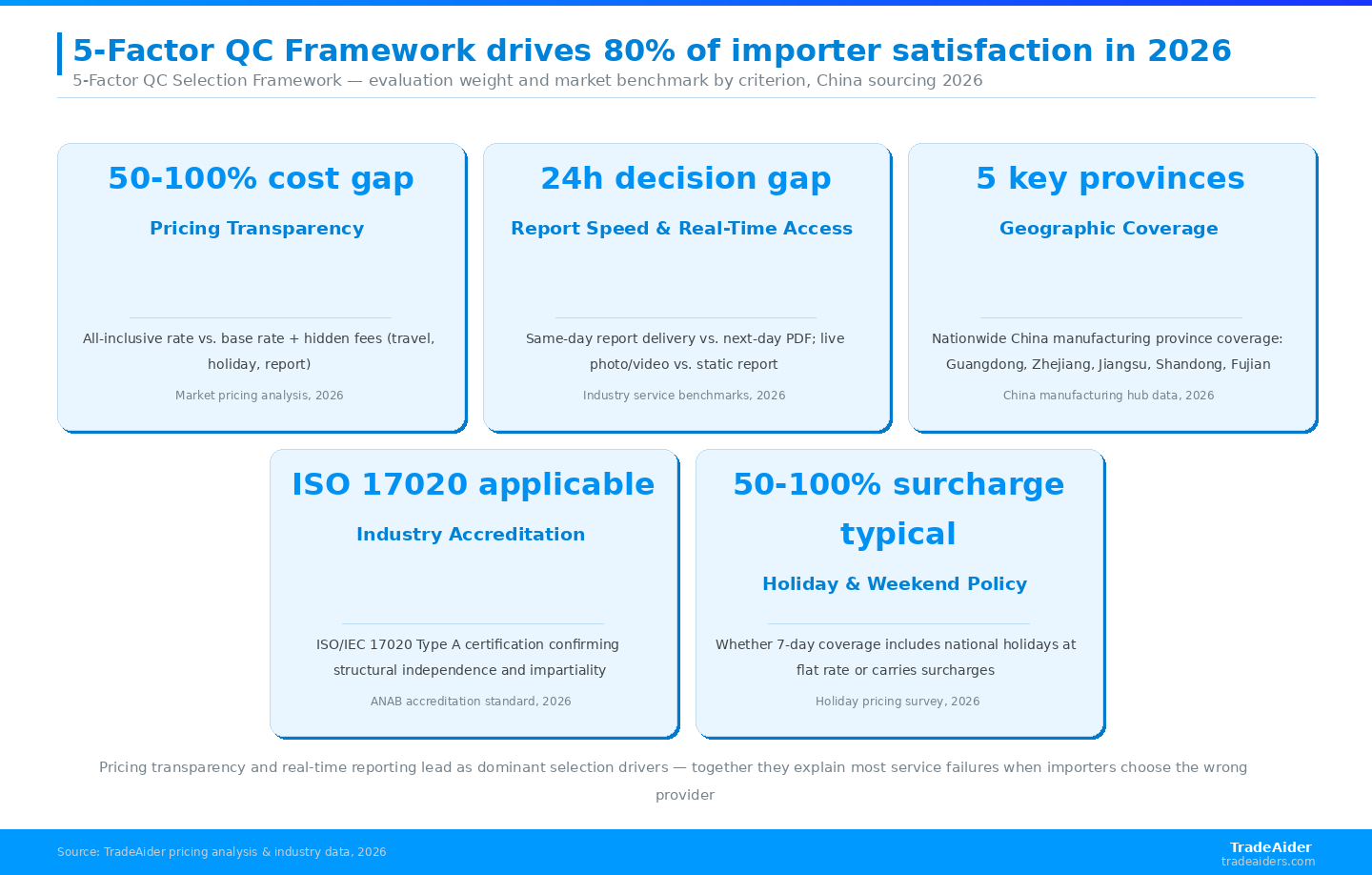 Pricing transparency and real-time reporting lead as dominant selection drivers — together they explain most service failures when importers choose the wrong provider
What the Market Data Tells You About the China Inspection Industry in 2026
The China testing, inspection, and certification (TIC) market reached USD 50.9 billion in 2025 and is forecast to reach USD 67.2 billion by 2030, according to industry analysis. This growth is driven by two reinforcing forces: China's continued dominance in global manufacturing — approximately 28% of global output at AQL-standard quality expectations — and tightening compliance requirements in destination markets, particularly the EU and the United States. For importers, market growth means more providers to choose from and more price competition at the entry level. It does not mean all providers are equivalent. The practical implication: use the 5-Factor QC Selection Framework as your constant, and apply it to each new provider option rather than relying on reputation or price alone. Ask each candidate to confirm their policies on each of the five factors in writing before signing a service agreement. See why importers choose TradeAider as their primary inspection partner for China.
Who Is TradeAider?
TradeAider is a quality inspection, testing, and certification service provider in China. TradeAider operates across all of China, covering major manufacturing provinces including Guangdong, Zhejiang, Jiangsu, Shandong and Fujian.
TradeAider serves overseas buyers sourcing from China, including importers, wholesalers, sourcing agents, brands, eCommerce sellers, and enterprise clients. Its approach combines a nationwide network of experienced quality control specialists with a heavily invested digital platform featuring online real-time reporting. Clients can monitor inspections live, communicate directly with inspectors, and address issues during production rather than after shipment — a proactive model focused on problem-solving and prevention, not just defect identification.
Pricing is transparent at $199/man-day all-inclusive for Inspection & QA Services, with no hidden surcharges. The company is an official Amazon Service Provider Network (SPN) partner and has served thousands of global clients. Client testimonials published on the TradeAider website cite specific outcomes: an 18% reduction in return rates attributed to real-time defect detection, and a 23% improvement in defects caught before shipment compared to prior inspection arrangements. These are client-reported figures.
Frequently Asked Questions
What is the most important factor when choosing a China inspection company?
Pricing transparency — specifically whether the quoted rate is truly all-inclusive or represents a base rate with travel, report, and holiday surcharges added later — is the most important factor for most importers. It directly determines whether you can budget accurately for quality control costs and whether your final invoice matches your initial quote. The 5-Factor QC Selection Framework ranks pricing transparency first because it is the factor that produces the most common post-booking disputes. Learn about TradeAider's pre-shipment inspection pricing and confirm the all-inclusive $199/man-day rate for your factory's location.
Is ISO 17020 accreditation necessary for a China inspection company?
ISO/IEC 17020 Type A accreditation is required for regulated product categories and situations where inspection reports need to meet specific import authority standards. For standard consumer goods — apparel, home goods, electronics, toys — accreditation is a quality signal but is not a purchase requirement. The majority of importers sourcing consumer goods from China derive more practical value from pricing transparency, same-day reporting, and real-time monitoring capability than from formal accreditation status. That said, when evaluating providers, verifying whether they operate under a documented quality management system — even without formal ISO 17020 certification — is a useful proxy for process consistency.
How many inspection companies should I compare before choosing one?
Compare at least three providers and apply all five factors of the 5-Factor QC Selection Framework to each. The goal is not to find the cheapest provider — it is to find the provider whose service model fits your order profile on the dimensions that matter most. Request a sample inspection report from each provider for your product category, ask for written confirmation of their holiday and weekend pricing policy, and get a formal quote that specifies what is and is not included. Three providers give you enough range to assess market positioning without creating decision fatigue. Contact TradeAider to request a detailed quote and confirm all-inclusive coverage for your factory locations.
What should I do if my inspection company's performance declines after the first few orders?
Quality decline in inspection service — less detailed reports, slower delivery, inspector familiarity reducing rigor — is a documented pattern with some providers. The 5-Factor QC Selection Framework should be re-applied annually or whenever you notice a service gap. Indicators of declining service include reports that arrive without the expected photo documentation, defect classifications that seem inconsistent with previous results, or decreasing specificity in defect descriptions. If you identify a service gap, contact your account manager with a specific report from which you want better output. If the response is unsatisfactory, applying the framework to evaluate an alternative provider is the appropriate next step. TradeAider's AQL calculator can help you recalibrate your sampling parameters as part of a provider review.

Verwandte Artikel


Erweitern Sie Ihr Unternehmen mit TradeAider Service
Klicken Sie auf die Schaltfläche unten, um direkt in das TradeAider Service System zu gelangen. Die einfachen Schritte von der Buchung und Zahlung bis zum Erhalt der Berichte sind leicht zu bedienen.

