
- Über uns

- Unsere Dienstleistungen
- Ihre Branche
- Ressourcen
- Nachrichten & Blog
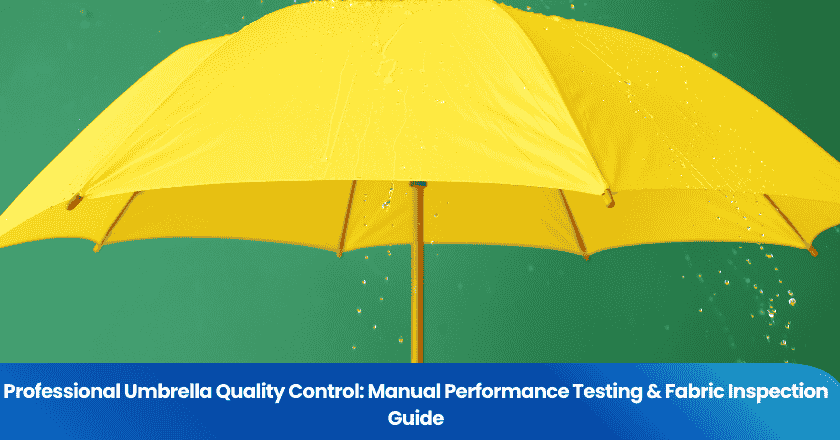
Umbrella quality control is a high-stakes engineering audit that ensures travel gear can withstand unpredictable weather events. In the global supply chain, an umbrella's reliability is measured by its mechanical endurance and the structural integrity of its canopy. A professional umbrella quality check combines manual open/close performance cycles with intensive fabric audits to identify micro-holes and seam weaknesses. By utilizing systematic on-site inspections, manufacturers can prevent catastrophic failures such as rib buckling or shaft snapping during heavy wind and rain.
Key Takeaways
- Mechanical Endurance: At least 50 manual open/close cycles are required to test the runner and spring fatigue.
- Fabric Integrity: Translucent light testing is mandatory to identify micro-holes and "needle cutting" at the seams.
- Structural Standards: Frame audits must comply with ASTM F2047 to ensure wind resistance up to 30mph.
- AQL Classification: Any mechanical jam is classified as a "Critical Defect" with a zero-acceptance limit.
- Digital Monitoring: Real-time reporting allows for immediate rectification of assembly errors before shipment.
The Strategic Role of Umbrella Quality Audits
Umbrellas are complex mechanical devices disguised as simple accessories. They consist of dozens of moving parts—ribs, stretchers, runners, and springs—all of which must operate in perfect synchronization. A professional quality assurance program focuses on the "Fatigue Life" of these components. If a factory relies on low-grade steel instead of fiber-reinforced plastic (FRP) for the ribs, the umbrella will likely invert and snap in a moderate breeze.
| Inspection Feature | Technical Objective | Industrial Standard |
|---|---|---|
| Manual Cycle Test | Verify runner smoothness and lock security. | Zero failure over 50 test cycles. |
| Wind Resistance | Ensure ribs do not fracture upon inversion. | Must withstand 40km/h wind (ASTM F2047 proxy). |
| Water Repellency | Verify Teflon or DWR coating effectiveness. | Grade 4-5 (Spray test) minimum. |
| Shaft Strength | Prevent bending or wobbling under load. | Pass 10kg lateral load without deformation. |
Mechanical Integrity: Manual Open and Close Cycles
The "Open/Close Cycle" is the most demanding test for an umbrella. It simulates months of regular use in just a few minutes. Inspectors pay close attention to the "Runner" (the part that slides up the shaft). If the runner has sharp plastic edges, it will gradually scrape off the anti-rust coating of the shaft, leading to corrosion and mechanical seizure.
Identifying Mechanical Failpoints
- Locking Mechanism: The "Catch" must engage with a clear audible click. If it slips, the umbrella could suddenly close on the user.
- Tension Springs: For automatic umbrellas, the "Blast-open" force must be consistent. A weak spring indicates poor metal tempering.
- Rib Symmetry: Once opened, the distance between each rib tip must be uniform to within 5mm. A deviation suggests a bent stretcher or misaligned pivot point.
"An umbrella's runner is its engine. If the runner does not move with zero friction, the internal spring will eventually snap under the accumulated resistance."
Fabric Visual Inspection: Detecting Micro-Holes
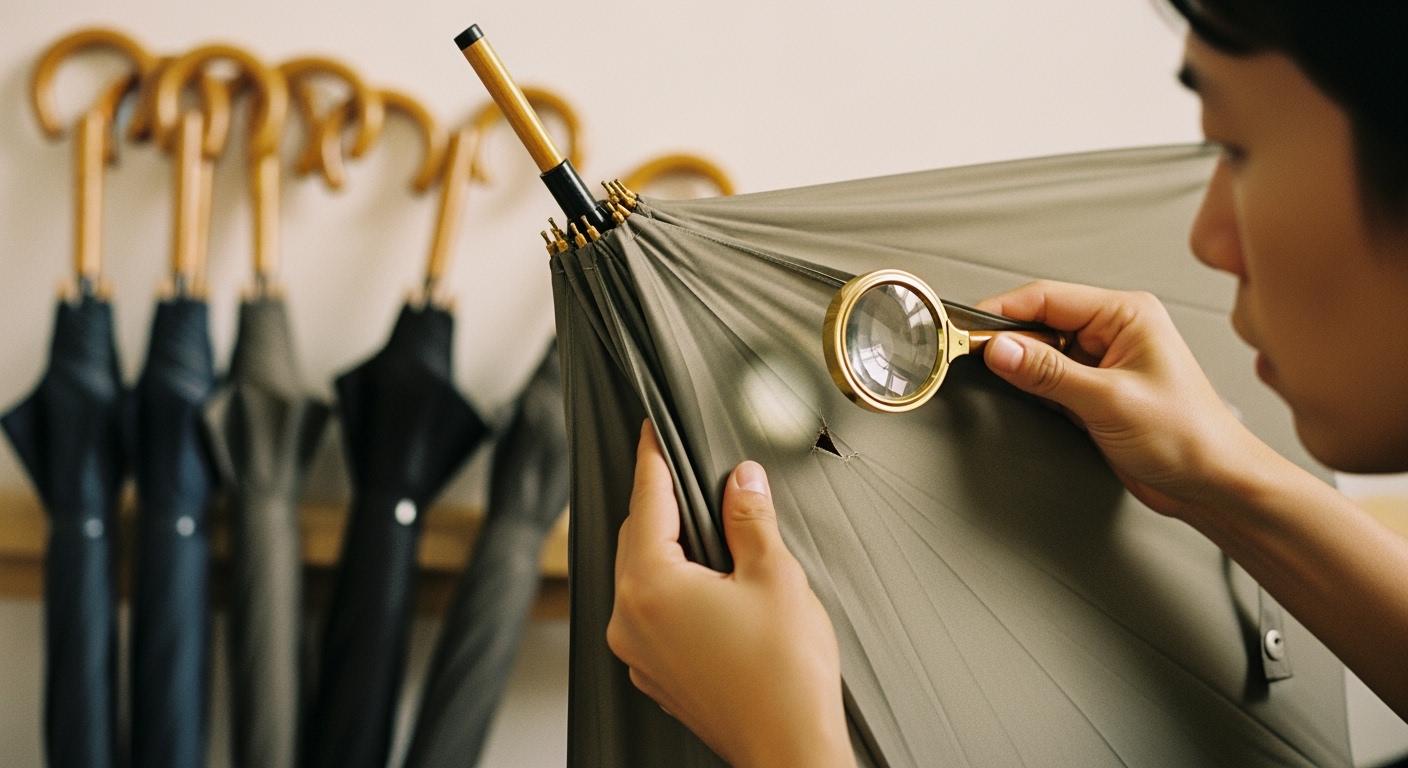
The canopy is the only barrier against moisture. During a professional fabric and textile audit, the canopy is stretched over a light-box. This "Back-lighting" technique makes micro-holes—often caused by sewing machine "Needle Heat"—immediately visible as tiny stars against the fabric.
The Science of Needle Cutting
Needle cutting occurs when a blunt or hot sewing needle fractures the synthetic fibers of the polyester or pongee fabric instead of passing between them. These fractures are invisible in standard lighting but expand under the tension of a rain-soaked canopy, leading to "Seam Failure."
| Defect Category | Visual Indicator | Technical Impact |
|---|---|---|
| Micro-Hole | Pinpoint light leakage in canopy. | Direct leakage; compromises DWR coating. |
| Seam Grinning | Visible thread paths under tension. | Reduces wind-load capacity; aesthetic failure. |
| Dye Migration | Pattern bleeding or shade variations. | Lowers market value; suggests poor dye fixative. |
| Loose Tips | Thread separation at rib ends. | Rib pops out; catastrophic frame failure. |
Structural Performance: Frame and Shaft Stability
High-end umbrellas utilize "Anti-Inversion" technology. Inspectors verify this by manually inverting the canopy. The ribs should flex and pop back into place without a "Memory Effect" (permanent bending). In a comprehensive quality control check, the shaft is also tested for "Shaft Play"—the amount of lateral wobble allowed between the nested tubes of a telescopic umbrella.
Salt Spray and Corrosion Testing
For coastal markets, umbrellas must survive saline environments. Technical audits include a 24-hour Salt Spray Test (based on ISO 9227). Any signs of "Red Rust" on the rivets or "Pitting" on the chrome shaft results in batch rejection, as this indicates a failure in the electroplating process.
AQL Sampling and Defect Classification
In a professional third-party inspection, defects are categorized to help the buyer make a data-driven "Ship or Re-work" decision. Using AQL Level II sampling, the following rules apply:
- Critical Defects: Sharp metal burrs, broken rivets, or automatic mechanisms that fire accidentally. Acceptance = 0.
- Major Defects: Fabric holes >0.5mm, missing rib tips, or jammed runners. Acceptance typically based on AQL 2.5.
- Minor Defects: Long thread ends (>5mm), slight logo misalignment, or scuffs on the handle grip. Acceptance typically based on AQL 4.0.
Digital Transparency: Real-Time Reporting
Modern umbrella sourcing relies on digital oversight. Through TradeAider's inspection services, clients not only receive an official inspection report within 24 hours, but can also view inspection progress and identified issues during the inspection via TradeAider's online service system. During inspections, inspectors use mobile devices to record key quality aspects—such as manual open/close cycles, canopy tension, frame integrity, and handle attachment—and capture high-definition photos and videos of any defects. These are instantly uploaded to the cloud dashboard for review.
By reviewing the Online Real-time Report, brands can monitor on-site rectification efforts and make timely decisions—whether to accept umbrellas commercially, request corrections with the support of TradeAider inspectors, or reject batches before shipment. This approach ensures that only quality-approved products are packed, shipped, and paid for, reducing losses and improving control across the global supply chain.
Best Practices for Umbrella Importers
To ensure a low return rate, brands should mandate the following:
- Golden Sample Validation: Always compare production units to a sealed, approved prototype.
- Hydrostatic Head Requirement: Ensure the fabric can withstand a minimum of 1000mm of water pressure.
- Component Traceability: Verify the material of the ribs—Fiberglass is superior to Aluminum for durability.
- Pre-Shipment FRI: Conduct a Final Random Inspection when 100% of the goods are finished and 80% are packed.
Ready to secure your product quality before shipment?
As your third-party inspection, testing & certification partner in China, TradeAider supports brands and sourcing teams across the entire production process, helping you identify quality risks early, ensure compliance, and strengthen your team’s capabilities before shipment.
Book an Inspection or Testing Service with TradeAider today, or for tailored solutions and expert guidance, contact us at services@tradeaider.com.
FAQ
What is the difference between Polyester and Pongee fabric?
Polyester is cheaper but can feel stiff. Pongee is a high-density polyester that has a softer, "silk-like" feel and superior resistance to shrinking and stretching, making it the standard for luxury umbrellas.
Why do automatic umbrellas eventually stop opening fully?
This is usually "Spring Fatigue" or a lack of lubrication in the shaft. Professional quality control includes a "Drive-Spring Strength Test" to ensure the spring's K-constant is high enough for 2,000+ operations.
How do you test for UV protection (UPF) on sun umbrellas?
Inspectors use a portable UV spectrophotometer on-site. A high-quality sun umbrella should have a "Black Glue" or silver coating that provides UPF 50+ rating, blocking 98% of harmful radiation.
Can a fabric hole be repaired at the factory?
Technically, a panel can be replaced, but it often leads to tension mismatches. Most professional QC standards require the unit to be rejected if a hole is found in the main canopy panels.
Is a 100% inspection necessary for umbrellas?
For high-risk products (like promotional umbrellas for luxury brands), 100% inspection of "Open/Close Function" and "Logo Quality" is recommended. For standard retail batches, AQL Level II is the industry norm.
Verwandte Artikel

Erweitern Sie Ihr Unternehmen mit TradeAider Service
Klicken Sie auf die Schaltfläche unten, um direkt in das TradeAider Service System zu gelangen. Die einfachen Schritte von der Buchung und Zahlung bis zum Erhalt der Berichte sind leicht zu bedienen.

