- Über uns

- Unsere Dienstleistungen
- Ihre Branche
- Ressourcen
- Nachrichten & Blog
ANSI/ASQ Z1.4 Table
In international manufacturing, the ANSI/ASQ Z1.4 table is the industry-standard mathematical blueprint used to determine exactly how many products an inspector must check, and how many defects are allowed before a shipment is rejected.
For many global sourcing managers, looking at these technical charts for the first time can be overwhelming. This guide breaks down the ANSI/ASQ Z1.4 tables into a clear, actionable workflow, showing you exactly how third-party QC agencies calculate sampling sizes and pass/fail thresholds.
What is the ANSI/ASQ Z1.4 Table?
The ANSI/ASQ Z1.4 standard (originally derived from the military standard MIL-STD-105E) defines sampling procedures and tables for inspection by attributes. It functions as a two-part matrix:
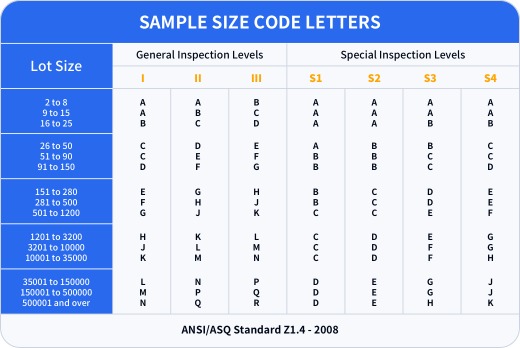
- Table 1 (Sample Size Code Letters): Cross-references your total order quantity with an inspection level to give you a single "Code Letter."
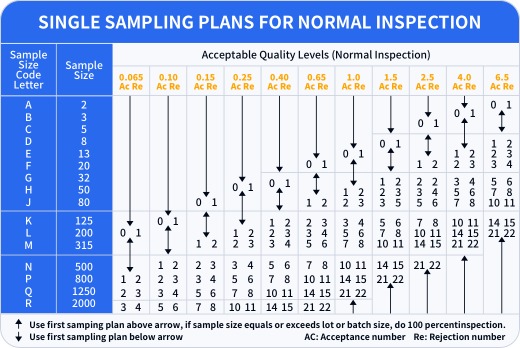
- Table 2 (Single Sampling Plans for Normal Inspection): Cross-references that "Code Letter" with your chosen AQL percentage to give you the exact sample size and Ac / Re (Accept / Reject) limits.
Choosing Your Inspection Level: General vs. Special
Before opening the table, you must select an Inspection Level. Table 1 offers two main categories:
General Inspection Levels (Levels I, II, III)
These are used for non-destructive visual and functional checks.
- Level II: The universal industry standard. It offers a balanced compromise between inspection cost and statistical reliability.
- Level I: Fewer samples checked. Used when budget is highly restricted or supplier history is flawless.
- Level III: More samples checked. Used for high-value goods or when a supplier has a history of severe quality failures.
Special Inspection Levels (S-1, S-2, S-3, S-4)
These are reserved for destructive or time-consuming tests (e.g., battery drop tests, high-voltage checks, fabric tensile strength tests) where checking a large volume would destroy commercial inventory.
How to Read Table 1: Finding Your Code Letter
Let's use a real-world scenario: You are importing 5,000 units of wireless headphones, and you select General Inspection Level II.
- Look at the Lot or Batch Size column on the left side of Table 1.
- Find the range that includes your quantity. For 5,000 units, the correct row is 3,201 to 10,000.
- Move horizontally across that row to the column for General Inspection Level II.
- The intersection reveals your Sample Size Code Letter: K.
How to Read Table 2: Determining Sample Size and Ac/Re
Now that you have your Code Letter (K), switch to Table 2 (Single Sampling Plans for Normal Inspection).
Click to AQL Sampling Calculator
Step 1: Identify the Sample Size
Look up Letter K in the leftmost column. Directly next to it, the table indicates the mandatory Sample Size: 125. This means the inspector will randomly select exactly 125 headphones out of your total 5,000-unit batch.
Step 2: Cross-Reference with Your Chosen AQL
Assume your contract defines the quality standards as AQL 2.5 for Major Defects and AQL 4.0 for Minor Defects.
- For Major Defects (AQL 2.5): Follow the row for Letter K to the right until you align with the 2.5% column. You will find the numbers Ac: 7 and Re: 8.
- For Minor Defects (AQL 4.0): Follow the row to the 4.0% column. You will find the numbers Ac: 10 and Re: 11.
Scoring the Final QC Report: Pass or Fail?
During the on-site inspection, the inspector checks the 125 units and tallies the defects. Here is how to apply the chart's math to the final score:
Scenario A: The Batch Passes
The inspector finds 6 Major defects and 9 Minor defects.
- 6 Major is less than or equal to the Ac threshold of 7.
- 9 Minor is less than or equal to the Ac threshold of 10.
- Result: The production lot officially PASSES AQL standards, and you can authorize shipment.
Scenario B: The Batch Fails
The inspector finds 8 Major defects and 4 Minor defects.
- Even though Minor defects are well within the limit, the 8 Major defects hit the Re threshold of 8.
- Result: The production lot officially FAILS. You have the legal right to hold final payment and instruct the factory to re-sort and rework the cargo at their expense.
Related Knowledge Base
TradeAider