- Über uns

- Unsere Dienstleistungen
- Ihre Branche
- Ressourcen
- Nachrichten & Blog
MIL-STD-105E: History and Evolution of Modern Quality Control Sampling
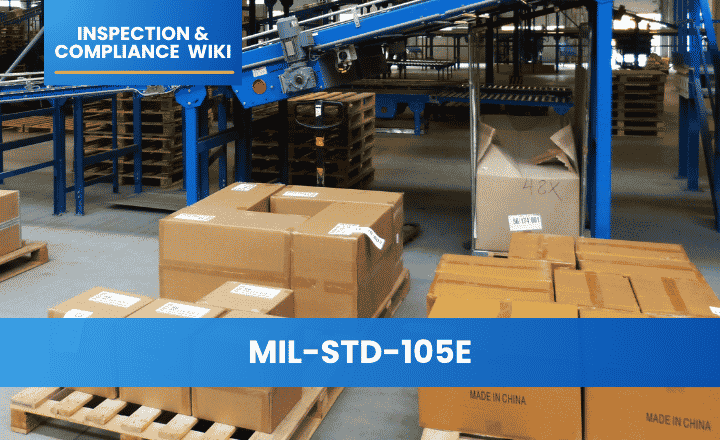
When modern importers talk about "AQL tables" or "third-party product inspections," they are utilizing a system born in the crucible of military logistics. The mathematical foundation of modern consumer goods quality control is MIL-STD-105E (Military Standard 105E).
Though officially canceled by the US military in , this standard lives on as the DNA of modern commercial quality standards like ANSI/ASQ Z1.4 and ISO 2859-1.
Understanding the history and mathematical transition of MIL-STD-105E gives global sourcing professionals a deeper appreciation of why statistical sampling is structured the way it is today.
The World War II Origin of Statistical Sampling
Before the , manufacturing quality control was largely primitive. Factories either inspected of their output (which was slow and expensive) or relied on unscientific "spot checks."
During World War II, the United States military faced an unprecedented logistical challenge: mass-producing billions of rounds of ammunition, weapons, uniforms, and medical supplies across thousands of private contractors.
- The Destructive Testing Dilemma: The military could not test $100\%$ of its ammunition, because testing a bullet requires firing it—which destroys the product.
- The Bottleneck Problem: Manually checking every single non-destructive item (like uniform buttons or helmet straps) created massive supply bottlenecks at a time when speed saved lives.
To solve this, the US Army Ordnance Department collaborated with prominent statisticians (including Harold F. Dodge and Harry Romig) to develop mathematically validated sampling tables. These tables allowed inspectors to check a tiny, random fraction of a batch and mathematically estimate the defect rate of the entire lot with high statistical confidence.
This research culminated in the release of MIL-STD-105A in .
The Evolution and Standardization of MIL-STD-105E
Over the next four decades, the standard underwent several revisions to incorporate new statistical advancements and align with international standards:
- MIL-STD-105A (1950): The first official unified military sampling plan.
- MIL-STD-105B (1958) & 105C (1961): Minor updates and adjustments to sample sizes.
- MIL-STD-105D (1963): Developed jointly by the US, UK, and Canada, this became the most widely adopted quality standard in global manufacturing history.
- MIL-STD-105E (1989): The final revision, which refined formatting and standardized definitions.
Despite its global success, on May 10, , the US Department of Defense officially canceled MIL-STD-105E. The military decided to move away from maintaining its own commercial-grade standards and encouraged private defense contractors to adopt civilian, international standards instead.
From Military Standard to Modern Commercial AQL
The cancellation of MIL-STD-105E did not mean the end of military-grade sampling. Instead, civil standards organizations adopted the tables almost word-for-word, equation-for-equation.
Today, the standard is maintained under two primary civilian names:
- ANSI/ASQ Z1.4: Maintained by the American National Standards Institute and the American Society for Quality.
- ISO 2859-1: Maintained by the International Organization for Standardization.
Important Note for Importers: Mathematically, MIL-STD-105E, ANSI/ASQ Z1.4, and ISO 2859-1 are virtually identical. The sample size code letters, required sample quantities, and Accept/Reject (Ac/Re) limits remain exactly the same. If a factory claims to test under "military standards," they are using the exact same tables as a third-party QC inspector utilizing ANSI/ASQ Z1.4.
No More Blind Imports: Verified Quality via Strict AQL Inspections. Delivering transparent, on-site quality control and reliable inspection reports. ➔ Get a Free Plan
Why MIL-STD-105E/AQL is Still King of QC
The civilian descendants of MIL-STD-105E remain the dominant force in global quality control because of three core mathematical rules established during WWII:
Rule 1: The Principle of Attribute Sampling
MIL-STD-105E is a sampling plan for attributes, meaning products are evaluated on a binary scale: conformant or non-conformant (pass or fail). This is ideal for busy factories where inspectors must quickly categorize defects rather than taking complex, slow measurements.
Rule 2: Swapping Risks Between Buyer and Seller
The standard balances two statistical risks:
- Producer's Risk (α): The probability of rejecting a "good" batch (historically set at 5%).
- Consumer's Risk (β): The probability of accepting a "bad" batch (historically set at 10%).
Rule 3: Dynamic Switching Rules
One of the most powerful features inherited from the military is the ability to switch inspection severity based on historical performance:
- Normal Inspection: The default starting point.
- Tightened Inspection: Triggered when a supplier fails 2 out of 5 consecutive lots. Sample sizes stay similar, but Ac/Re thresholds become much stricter.
- Reduced Inspection: Triggered when a supplier passes 10 consecutive lots. This allows the buyer to reduce sample sizes by roughly 60% to save inspection costs.
Conclusion: Sourcing Safely with Military Precision
When you write an AQL threshold 2.5% of for major defects into your purchase order, you are relying on statistical principles that secured the Allied supply chains during World War II.
By demanding ANSI/ASQ Z1.4 or ISO 2859-1 inspections, you ensure that your quality control is backed by decades of rigorous military engineering—removing the guesswork and ensuring your cargo lands safely, every time.
Related Knowledge Base
TradeAider