
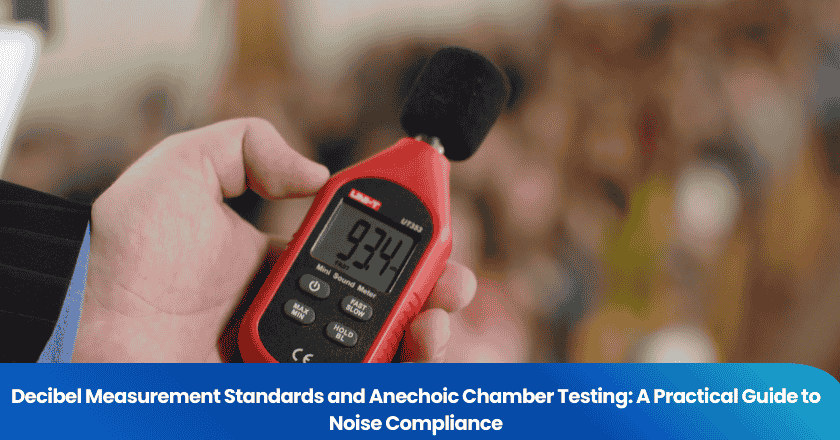
Noise compliance is a technical requirement that affects every product category from household appliances to industrial equipment. Engineers and quality managers use decibel measurement standards to verify that products meet legal noise limits and deliver on their performance claims. Anechoic chambers provide the most controlled environment for this testing, while on-site and alternative methods serve practical needs when dedicated acoustic facilities are not available. Understanding these methods — and their trade-offs — is essential for any team responsible for product compliance.
Key Takeaways
- Decibel measurement standards ensure accurate, repeatable sound testing, helping engineers create quieter products that meet legal requirements.
- Anechoic chambers eliminate sound reflections and outside noise, providing the most precise environment for product noise measurement.
- On-site testing offers practical solutions when anechoic facilities are unavailable, though environmental factors must be carefully managed.
- ISO 3745, ISO 3744, and ISO 26101 each address different testing scenarios — from highly controlled chambers to factory floor measurements.
- Real-time reporting during noise tests enables fast decisions and ensures compliance issues are resolved before shipment.
Decibel Measurement Standards
What Decibel Measurement Standards Govern
Decibel measurement standards define how to measure sound levels in products: what equipment to use, how to configure the test environment, and how to document results. The decibel (dB) is a logarithmic unit measuring sound pressure or intensity ratios. Using a logarithmic scale means small changes in dB represent large differences in perceived loudness — a 10 dB increase is perceived as roughly twice as loud. The most widely applied standards in product compliance testing include:
| Standard | Scope | Application |
|---|---|---|
| EN ISO 3744:2010 | Sound power and energy level measurement of noise sources | Industrial sectors; product compliance testing |
| ISO 3745 | Sound power measurement in anechoic and hemi-anechoic chambers | Precision product testing; international certification |
| IEC 61672-1 Class 2 | Sound level meter accuracy specification | Instrument calibration; on-site testing |
| ASTM E90 | Sound transmission loss measurement | Acoustic performance assessment |
IEC 61672-1 Class 2 sets sound level meter accuracy at ±1.4 dB, with an acceptable measurement error within 2 dB(A). Measuring ranges typically span 30 dB to 130 dB, covering virtually all product noise testing scenarios.
Why Standards Matter for Product Compliance
When companies follow established decibel measurement standards, results from different laboratories and factories become comparable. This consistency allows manufacturers to prove compliance to regulators, retailers, and customers. Non-compliance carries serious consequences: products may be stopped at customs, legal fines can be imposed, and repeated redesign cycles drive up costs and delay product launches. Following standards protects both market access and product credibility.
Anechoic Chamber Design and Types
What Is an Anechoic Chamber?
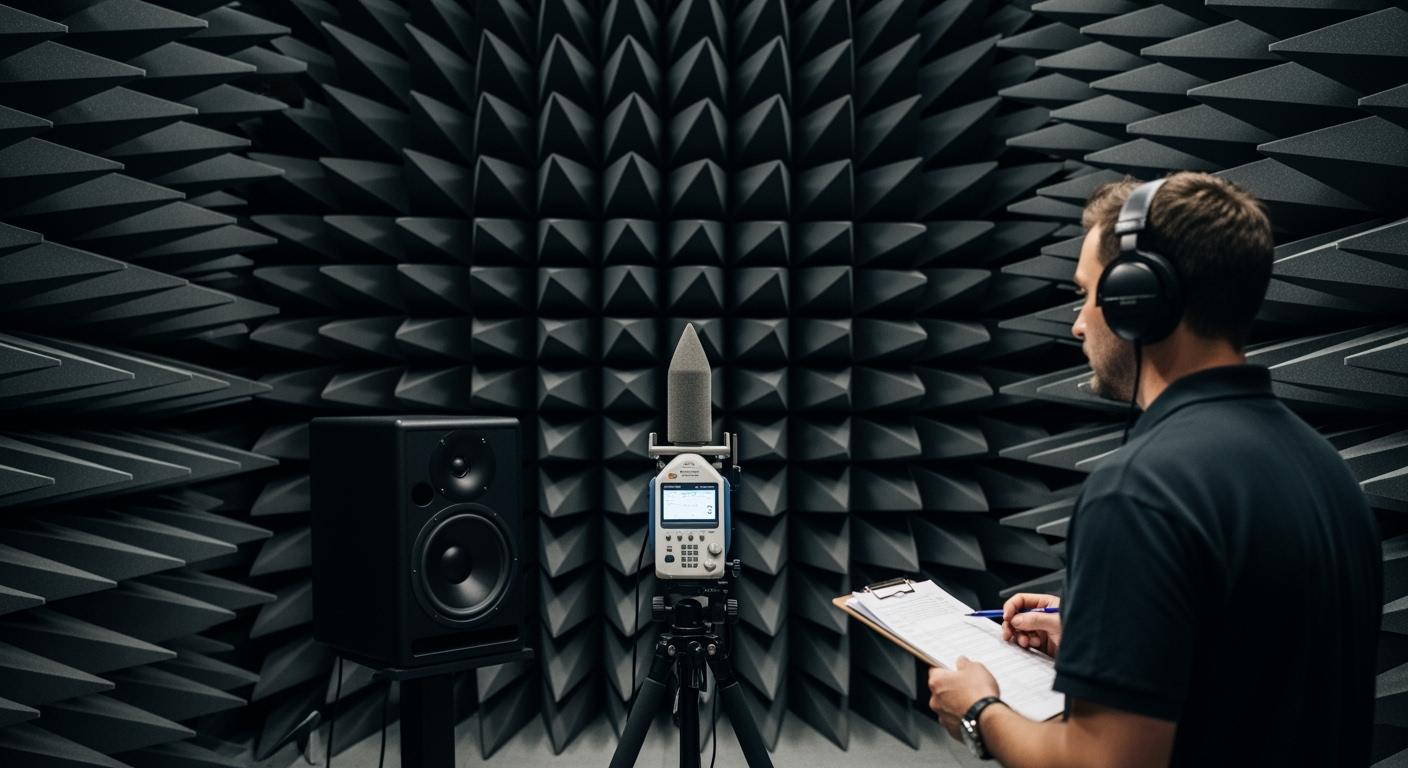
An anechoic chamber is an acoustic test room engineered to absorb sound waves on all interior surfaces, eliminating reflections and blocking external noise. Walls, ceilings, and often the floor are lined with wedge-shaped absorber materials that trap sound energy rather than reflecting it. This creates a "free-field" environment where sound travels outward from the source without bouncing back — the only conditions under which certain precision measurements are valid.
Types of Anechoic Rooms
| Type | Absorbing Surfaces | Best Used For | Cost and Space |
|---|---|---|---|
| Full Anechoic Chamber (FAC) | All surfaces including floor | High-precision testing; speakers, microphones, small electronics | Higher cost; larger footprint |
| Semi-Anechoic Room (SAC) | Walls and ceiling; floor reflects sound | Large products: cars, washing machines, HVAC equipment | More cost-effective; space-efficient |
| Pass/Fail Chamber | Partial absorption | Production line compliance checks | Lowest cost; smallest footprint |
Key Design Principles
Effective anechoic chamber design follows several non-negotiable principles. Absorber materials must cover all relevant surfaces and be sized to handle the lowest frequencies the chamber will test. Chamber dimensions must be large enough relative to the wavelengths being measured. Electromagnetic shielding is often incorporated to prevent external radio frequency interference. Properly designed chambers also include easy-access features to allow the device under test to be repositioned without disturbing absorber panels.
Tip: Well-designed anechoic chambers give engineers confidence that measurement results reflect the product's true acoustic performance, not environmental artifacts.
Testing Procedures: Anechoic and On-Site
Equipment Calibration and Environment Readiness
Accurate testing begins with rigorous calibration. Engineers calibrate the sound level meter inside the chamber under free-field conditions, targeting a specific acoustic pressure (typically 85 dB / 0.356 Pa) at defined frequencies. Specialists verify absorber placement, confirm the chamber meets its acoustic qualification criteria, and monitor temperature and humidity throughout the test to prevent environmental drift from affecting results.
Note: In-chamber calibration reduces systematic errors caused by instrument drift and ensures that measured values reflect actual product performance.
Test Setup and Measurement Protocols
Standard test setup involves reviewing the device's technical documentation, inspecting for design features that could generate anomalous noise, and selecting appropriate absorber configurations. Automated turntables and antenna positioning systems enable comprehensive directional measurements. Tests are conducted under worst-case operational conditions — maximum load, highest speed, or peak thermal output — to capture peak noise levels.
On-site testing uses different tools but follows similar principles. Near-field scanners with microphones positioned close to the noise source collect data automatically. Environmental monitoring accounts for ambient noise and adjusts protocols to maintain result reliability.
| Aspect | Anechoic Chamber | On-Site Noise Testing |
|---|---|---|
| Environment | Soundproof; eliminates external noise | Real-world conditions with ambient noise |
| Equipment | Fixed microphone, automated turntable | Near-field scanner, handheld meter |
| Key Limitation | Difficulty measuring very low frequencies; high cost | Ambient noise can influence readings |
| Cost | High construction and maintenance costs | Lower; depends on equipment used |
| Best Use Case | Certification testing; high-precision compliance | Factory audits; production line spot checks |
Handling Equipment Gaps and Real-Time Reporting
When a factory lacks the specialized equipment needed for noise testing, inspectors mark the test item as "Pending" or "Fail" in their report, alerting buyers that the performance claim cannot be verified on-site. At TradeAider, their advanced digital reporting systems allow clients to view videos of noise tests and see decibel readings as the appliance operates, with instant notifications if a product exceeds the allowed threshold. Inspectors add comments to online reports, enabling buyers to make rapid decisions about product acceptance or assembly adjustments without waiting for a formal written report.
Tip: Real-time reporting and transparent protocols support fast decision-making and improve quality control outcomes throughout production.
International Standards for Anechoic Testing
ISO 3745: The Precision Standard
ISO 3745 is the benchmark for sound power measurement in controlled acoustic environments. It requires validation of the inverse-square law — sound pressure must decrease proportionally as distance from the source increases — and mandates that the K2 correction factor remain at or below 0.5 dB, indicating minimal influence from reflections. Meeting ISO 3745 provides the highest level of measurement credibility and is required for many international certifications.
| Requirement | Description |
|---|---|
| Inverse square law validation | Sound pressure decreases proportionally with distance squared |
| K2 correction factor | Must be 0.5 dB or less to confirm minimal reflection influence |
| Chamber qualification | Periodic re-qualification required to maintain standard validity |
ISO 3744: Flexible Testing in Real-World Environments
ISO 3744 provides a practical alternative for environments where anechoic chambers are not available. Unlike ISO 3745, ISO 3744 applies to semi-reverberant spaces such as factory floors or rooms with reflective surfaces. It allows measurements indoors or outdoors and includes correction procedures for less-than-ideal environments. Measurement spacing is used to cancel out interference patterns, making accurate sound power estimation possible without a dedicated anechoic facility. This flexibility makes ISO 3744 valuable for production-line audits and factory acceptance testing.
ISO 26101: Stricter Room Qualification
ISO 26101 raises the bar for room qualification in acoustic testing. It demands tighter tolerances for sound source stability — ±0.2 dB compared to the ±0.5 dB allowed under ISO 3745 — and requires more accurate microphone traverse paths. These measures increase measurement reliability and are applicable when the highest repeatability is required, such as for formal certification or dispute resolution.
Note: ISO 3745, ISO 3744, and ISO 26101 together give engineers a complete toolkit — select the right standard for each scenario based on available equipment, required accuracy, and testing environment.
Alternative Testing Methods
On-Site Testing and Factory Audits
On-site testing is the practical solution when anechoic chambers are unavailable. An acoustical engineer reviews compliance requirements, assesses the facility's location (since urban, suburban, and rural environments have different ambient noise profiles), and schedules measurements during worst-case operational periods to capture peak sound levels.
| Testing Environment | Advantages | Disadvantages |
|---|---|---|
| Open Area Test Sites (OATS) | Realistic conditions for outdoor devices; no facility cost | Environmental factors affect consistency |
| Anechoic Chambers | High accuracy; eliminates environmental variables | High cost; may not reflect real-world acoustics |
Reverberation Room Testing
Reverberation rooms use highly reflective surfaces to create a diffuse acoustic field, making them useful for sound power measurement when anechoic facilities are unavailable. They are more cost-effective to construct and can generate high field power levels from moderate input, making them practical for aerospace, automotive, and defense testing. However, they have limitations at low frequencies and with weakly absorbing materials.
| Feature | Reverberation Chamber | Anechoic Chamber |
|---|---|---|
| Sound behavior | Highly reflective; diffuse field | Fully absorbed; free-field conditions |
| Construction cost | Lower; no specialized absorbers required | Higher; requires advanced acoustic materials |
| Typical applications | Aerospace, automotive, defense | Consumer electronics, telecommunications, appliances |
| Low-frequency performance | Limited by room dimensions | Limited by absorber cut-off frequency |
Sources of Measurement Uncertainty
Every acoustic test method carries inherent sources of uncertainty that engineers must document and manage:
| Uncertainty Category | Examples |
|---|---|
| Equipment | Calibration accuracy; instrument quality |
| Method | Test procedure choices; microphone positioning |
| Operator | Skill level; experience with the specific standard |
| Product under test | Unit-to-unit variation; operating condition sensitivity |
| Environment | Temperature, humidity, barometric pressure, background noise |
Note: Document all uncertainty sources in test reports. This practice improves result reliability and supports regulatory review.
Decibel measurement standards and anechoic chamber testing form the technical foundation for noise compliance across virtually every product category. Anechoic chambers deliver the highest precision; on-site testing provides practical flexibility; and reverberation rooms serve specific industry needs.
FAQ
What is an anechoic chamber and why is it important for sound testing?
An anechoic chamber is a specially designed room that absorbs sound reflections and eliminates external noise, creating a free-field environment. Engineers use this controlled space to achieve high-precision sound power measurements required for product certification.
How do hemi-anechoic rooms differ from full anechoic chambers?
Hemi-anechoic rooms absorb sound on walls and ceilings but have a reflective floor, making them better suited for large products such as vehicles or washing machines. Full anechoic chambers absorb sound on all surfaces and are used for precision testing of smaller products where floor reflections would affect results.
What steps ensure measurement accuracy in anechoic chamber testing?
Engineers calibrate all equipment inside the chamber under test conditions, verify absorber placement, monitor temperature and humidity, and follow standard-specific protocols for microphone positioning and measurement spacing. These steps collectively minimize uncertainty and ensure repeatable results.
Can on-site testing replace anechoic chamber testing for certification purposes?
On-site testing provides practical sound evaluation for factory audits and production checks, but most certification schemes require anechoic or hemi-anechoic chamber conditions for formal compliance documentation. Check specific certification requirements for each target market before deciding on your testing approach.
Why do engineers use real-time reporting during noise tests?
Real-time reporting allows engineers to track sound levels instantly against compliance thresholds, identify failures before the production run ends, and document test conditions. This supports fast decision-making and prevents non-compliant units from advancing to shipment.
Related Articles


Grow your business with TradeAider Service
Click the button below to directly enter the TradeAider Service System. The simple steps from booking and payment to receiving reports are easy to operate.

