
Two safety features sit at the center of appliance compliance inspections: tip-over switches and finger probe guards. A tip-over switch shuts off power the instant an appliance tilts or falls. A finger probe guard ensures no one can touch dangerous internal components. Together, these mechanisms prevent fire, electric shock, and serious injury. For manufacturers and importers, understanding how to test, document, and maintain compliance with these features is essential for avoiding recalls, legal liability, and reputational damage.
Key Takeaways
- Tip-over switches instantly cut power when an appliance falls, preventing fires and injuries — any failure in this feature is classified as a critical defect.
- Finger probe guards block access to dangerous internal parts, protecting users from electric shock and contact with moving components.
- Regular inspections and maintenance of safety systems are essential for preventing accidents and ensuring ongoing compliance.
- Manufacturers must follow safety standards including UL, IEC 60335, and OSHA requirements to avoid legal risks and maintain market access.
- Real-time monitoring and digital reporting enable faster identification and resolution of hazards during production.
Tip-Over Switch Safety Essentials
Definition and Function
A tip-over switch is a built-in safety device that detects when an appliance tilts beyond a safe angle. When triggered, it disconnects the circuit and cuts power immediately. This anti-tilt mechanism is most critical in portable heaters, where continued operation after a fall could ignite nearby materials and cause a fire. Fans and other portable devices also rely on this feature to prevent injury from blades or heating elements operating in an unsafe position.
Modern tip-over switches use various sensor technologies to detect tilt:
| Sensor Technology | How It Works | Safety Outcome |
|---|---|---|
| Mechanical tipping switch | Detects tilt angle and opens the circuit | Prevents fire or electrical failure |
| Photoelectric sensor | Senses tilt and changes output voltage to trigger control circuit | Stops heating before fire hazard develops |
| Angle dumping sensor (fans) | Disconnects circuit when device becomes unbalanced | Stops fan from operating in unsafe position |
Tip: Always verify that appliances have a functioning tip-over switch before approval. This single check can prevent fires and serious injuries.
Critical Defect Classification
In quality inspection, a defective tip-over switch is classified as a critical defect. This classification means zero tolerance: even a single failure causes an entire product batch to fail inspection. Manufacturers who ship appliances with defective tip-over switches face costly recalls, loss of customer trust, and significant legal exposure if injuries result. Regular testing during production — not just at final inspection — is the only reliable way to prevent these outcomes.
Finger Probe Guard and Safeguarding Danger Zones
Guard Compliance Standards
The IEC 60335 standard governs finger probe guard requirements for household electrical appliances. This international guideline requires that user-accessible openings do not allow finger entry to live terminals or moving parts. Electrical components, lighting fixtures, switches, and sockets must all block finger access to live contacts. Safety light curtains and safety laser scanners help manufacturers verify compliance during production by detecting when any object enters a designated danger zone.
Note: Regular staff training on IEC 60335 requirements helps workers understand compliance standards and use testing equipment correctly.
How Finger Probe Testing Works
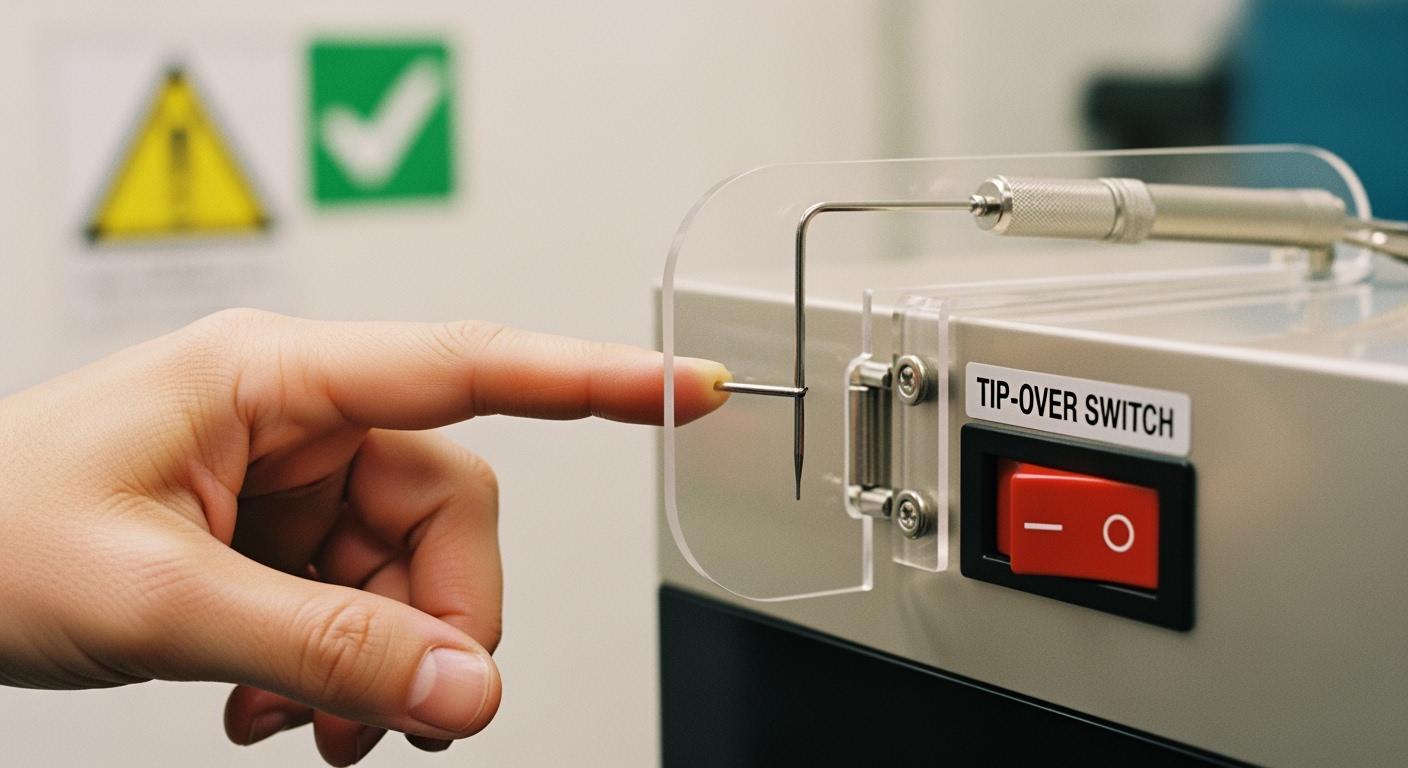
Engineers use standardized test probes designed to simulate the dimensions and articulation of a human finger. These probes are inserted into any gap or opening in the appliance enclosure to check whether a finger could reach hazardous internal areas. An electrical detection circuit signals if the probe makes contact with a live component.
| Test Parameter | Details |
|---|---|
| Probe design | Simulates human finger dimensions and articulation |
| Test method | Probe inserted under specified force through all gaps and openings |
| Detection mechanism | Electrical circuit activates if probe contacts a hazardous component |
| Access path assessment | Considers both opening size and internal path length to danger zones |
| Standard tool | Test Probe C (per IEC 61032) for electric shock and moving-part hazards |
Mechanical and Workmanship Checks
Beyond probe testing, inspectors evaluate the physical strength and assembly quality of guards. Loose or poorly assembled guards can shift during use, creating hazards that did not exist during initial testing. Inspectors check for secure mounting, proper alignment, absence of sharp edges, and no weak spots that could fail under normal use conditions. Safety light curtains and laser scanners are also deployed to monitor guard integrity during production runs, alerting workers immediately if a guard shifts or breaks.
Tip: Schedule regular maintenance and inspections for all safety systems, including guards, light curtains, and laser scanners. Prevention is always less costly than a recall.
Safety Standards and Regulatory Requirements
UL, IEC, and OSHA Requirements
Three regulatory frameworks govern appliance safety most broadly: UL (Underwriters Laboratories) focuses on fire hazards and electrical faults, primarily for the North American market. IEC (International Electrotechnical Commission) creates global rules for electrical safety, including the IEC 60335 series for household appliances. OSHA (Occupational Safety and Health Administration) protects workers during manufacturing and inspection, with machine guarding violations consistently ranking among the most frequently cited workplace safety failures.
| Standard | Focus Area | Who It Protects |
|---|---|---|
| UL | Fire and electrical safety, product certification | Consumers (North America) |
| IEC 60335 | Contact prevention, enclosure safety, finger probe compliance | Global users |
| OSHA | Machine guarding, workplace hazard prevention | Manufacturing employees |
Tip: Review UL, IEC, and OSHA requirements at the design stage, not after production begins. Early compliance planning prevents costly redesigns.
Operational and Mechanical Testing Protocols
Inspectors verify compliance through real-world tests: appliances are physically tilted to confirm automatic shut-off, and probe tools are used to check whether guards block all finger access paths. Mechanical tests check guard strength, sharp edges, and secure assembly. Inspectors document all results and share them with manufacturers, enabling rapid correction of any identified failures. Systematic safety checks protect users and provide manufacturers with auditable compliance records.
Ensuring Compliance Through Real-Time Monitoring
Digital Monitoring and Reporting
Modern production facilities use digital monitoring systems to improve safety oversight. Sensors track the status of tip-over switches and guards continuously. When a problem appears, the system alerts the operator for immediate intervention. Operators can view live video evidence of each test, access protection zone monitoring data, and identify trends that indicate systemic issues before they become defects. This real-time feedback loop stops unsafe products before they leave the factory.
Documentation and Certification
Detailed records of every safety test form the backbone of compliance documentation. Digital monitoring systems store this data securely. After testing, official reports are generated including video evidence and sensor data, which certification bodies review to confirm compliance. This documentation builds customer trust while proving that monitoring systems operate as required.
Common Safety Challenges and How to Address Them
Typical Compliance Issues
Common compliance failures found during inspections include: guards that do not fit tightly or allow access to danger zones, slow sensor response times, improper installation, and degraded materials from lack of maintenance. Even well-designed safety systems can fail if regular maintenance is neglected. Addressing these issues proactively through scheduled audits significantly reduces accident risk.
Best Practices for Overcoming Safety Barriers
| Best Practice | Benefit |
|---|---|
| Use high-quality materials for guards with proper installation | Guards remain effective under real-world use conditions |
| Train staff regularly on safety procedures | Fewer operator-related safety failures |
| Deploy real-time monitoring and digital reporting | Faster hazard detection and response |
| Maintain equipment on a scheduled basis | Reliable long-term safety performance |
Consequences of Non-Compliance
Legal and Regulatory Risks
OSHA consistently cites machine guarding violations as one of the top workplace safety concerns. Non-compliance can result in fines reaching millions of dollars, threatening a company's financial stability. Beyond regulatory penalties, injured parties can pursue civil litigation — adding medical costs, lost wages, and pain-and-suffering claims to the company's liability exposure. Manufacturers who treat safety compliance as optional rather than mandatory face compounding risks.
Real-World Recall Examples
The following cases demonstrate what happens when tip-over safety requirements are not met:
| Brand | Product | Safety Failure |
|---|---|---|
| Aiho | Dressers | Tip-over risk and entrapment hazards |
| Areson Rolanstar | 6-drawer Dressers | Tip-over and entrapment risks under normal use |
| Lulive | 12-drawer Dressers | Unstable without wall anchoring, tip-over risk |
| Boyro | High Chairs | Significant fall hazard for children |
A single safety failure can damage a brand's reputation for years. News of recalls spreads rapidly online, and customers are slow to return trust to brands linked to unsafe products.
Tip-over switch safety and finger probe guard compliance require ongoing vigilance, not one-time testing. Manufacturers and safety managers can maintain compliance by following a comprehensive approach: installing guards that block hand contact from any angle, using sensors that stop machines when someone enters a danger zone, applying lockout/tagout procedures before maintenance, and keeping detailed records of all tests and certifications. Proactive compliance reduces workplace injuries, improves employee morale, and builds a durable culture of safety. For appliance safety testing and inspection in China, TradeAider's certified inspectors provide quality inspection services, real-time reporting and same-day factory feedback for every batch.
FAQ
What is a tip-over switch and why is it important?
A tip-over switch detects when an appliance falls or tilts beyond a safe angle and shuts off power instantly. This feature prevents fires and injuries, and its failure is classified as a critical defect during safety inspection.
How do finger probe guards provide protection?
Finger probe guards block access to dangerous parts inside appliances, preventing fingers from reaching moving blades, hot surfaces, or live electrical contacts. This protection is especially important for products used in homes with children.
Which appliances require tip-over switch safety?
Portable heaters, fans, and similar devices that could cause harm if left running after falling require tip-over switch safety. International and national safety standards mandate this feature for these product categories.
How do inspectors test for compliance?
Inspectors physically tilt appliances to activate tip-over switches and confirm automatic power cut-off. They use standardized finger probes to check that guards block all access paths to hazardous internal components. All results are documented and shared with manufacturers for corrective action if needed.
Related Articles


Grow your business with TradeAider Service
Click the button below to directly enter the TradeAider Service System. The simple steps from booking and payment to receiving reports are easy to operate.

