
Supplier price is the quoted unit cost a factory offers, while defect rate is the share of inspected units that fail agreed quality requirements. Price can signal supplier capability, but it does not reliably predict defect rate without process evidence.
A cheap China supplier does not automatically have a high defect rate, and a premium China supplier does not automatically ship clean goods. Price predicts defect risk only when it reflects real differences in materials, process control, skilled labor, testing, tooling, packaging, and quality management. If a low quote comes from efficient production, stable inputs, and clear specifications, the defect rate can be acceptable. If the low quote comes from thinner material, rushed labor, skipped inspection, or vague tolerances, the risk rises quickly.
Importers often ask whether paying more to a supplier reduces defects. The honest answer is more useful than a yes or no. Price is a weak signal by itself and a stronger signal when read beside supplier behavior: how the factory controls raw materials, samples, line setup, packaging, worker instructions, AQL results, and corrective actions.
TradeAider sees both sides of this problem. Some low-price factories ship stable repeat orders because the product is simple and the process is mature. Some premium suppliers fail when a new material, new mold, subcontracted process, or peak-season rush changes the production reality. The useful question is not which supplier is cheaper; it is which supplier can prove that the current lot matches the approved specification.
Key Takeaways
- Definition: Price is a cost signal; defect rate is a quality outcome. They are related only through process control.
- Cost comparison: A cheaper quote can become expensive if defects create returns, rework, replacements, or delayed launch.
- Decision: Compare supplier capability evidence before comparing unit price alone.
- Risk: Premium suppliers still need inspection when the product, material, line, or season changes.
- Bottom line: The best supplier is not the cheapest or the most expensive; it is the one whose process can repeatedly meet the specification.
The Direct Answer
Price predicts defect rate poorly by itself. It becomes useful only when the quote is compared against material choices, process capability, quality controls, production timing, and inspection evidence. According to ASQ cost of quality guidance, prevention and appraisal costs are different from internal and external failure costs, which is exactly the trade-off importers face when choosing a supplier.
A lower quote can be a real advantage when it comes from simpler tooling, stable repeat production, efficient labor allocation, or a factory that already understands the specification. It becomes a defect signal when the savings come from thinner material, weaker packaging, skipped testing, looser tolerances, or undocumented subcontracting. A higher quote has the opposite problem: it may include better controls, but it can also be a brand premium that says little about the lot being packed today.
According to ISO 9001:2015, quality management includes control of externally provided processes, products, and services. For an importer, that means supplier selection is not only a purchasing negotiation. It is a control decision. A supplier that cannot show process control should not receive automatic trust because it is expensive, and a supplier should not be rejected only because it is cheaper.
For example, the difference between a $4.20 unit quote and a $4.85 unit quote is $0.65 per unit. On a 5,000-unit order, that is $3,250 of purchasing difference before freight, duties, returns, or rework. The number matters, but it does not answer the quality question. The importer has to ask what the $0.65 buys, then verify the current production lot instead of treating price as proof.
The decision rule is simple: trust the supplier only as far as the current lot evidence supports the quote.
Comparison Table
| Supplier Type | What Price May Mean | Defect Risk | Evidence Needed | Best Inspection Move |
|---|---|---|---|---|
| Low price, stable process | Efficiency and simple product | Medium to low | Repeat AQL history and stable sample | Inspect normal AQL before shipment |
| Low price, vague controls | Material cuts or rushed labor | High | Material specs and line checks | PPI plus PSI |
| Premium price, mature process | Better control and service | Low to medium | Quality plan and past results | PSI or reduced repeat sampling |
| Premium price, new product | Learning curve hidden in quote | Medium to high | Pilot run evidence | DPI plus PSI |
| Any price, peak season | Capacity pressure | Higher than normal | Production schedule and lot photos | Earlier inspection window |
The comparison shows that supplier price becomes meaningful only after the buyer knows what created it. Low price with stable evidence can be controlled value, while high price with new components or peak-season pressure can still be a defect risk. Inspection should test the price story against the actual lot.
The same supplier can also move between these states. A low-price repeat order with stable materials may be safer than a premium first order with new tooling. A premium repeat supplier may become risky when the buyer changes color, packaging, accessories, or compliance labels. Price is static on the purchase order, but defect risk changes whenever the production conditions change.
Cheap suppliers fail when savings come from uncontrolled inputs
A low quote becomes dangerous when it is created by substituting material, shortening curing or drying time, skipping in-process checks, using weaker packaging, or accepting wider tolerances without telling the buyer. According to ISO 2859-1 sampling information, acceptance sampling evaluates lots through defined procedures, but it cannot fix the process that created the defects. The same unit price can be safe in a mature process and risky in an improvised process.
The inspection brief for a low-price supplier should therefore ask where the savings came from. Check material thickness, component brand, accessory count, carton strength, line speed, workmanship, and whether the packed lot still matches the approved sample. If the factory cannot explain the savings and the inspection finds repeated drift, the low quote is no longer a margin gain; it is a delayed failure cost.
Premium suppliers fail when buyers confuse reputation with current lot control
A premium supplier can still ship defects when a new mold is introduced, a component vendor changes, a seasonal rush compresses lead time, or the order is moved to a different line. According to ANSI/ASQ Z1.4 guidance, inspection by attributes is a lot-level decision tool, which means the current lot still matters even if the factory's general reputation is strong. A premium invoice does not prove that this production batch matches the specification.
The inspection brief for a premium supplier should challenge the assumption that "good factory" equals "good lot." Verify the actual line, actual components, actual packaging revision, and actual test records. A high-price factory that changes a vendor, mold, label, or subcontracted process needs the same current-lot evidence as a cheaper factory.
The best predictor is quality evidence, not price
The strongest predictor of defect rate is a pattern of evidence: stable pre-production sample, clear specification sheet, controlled materials, documented in-process checks, consistent packaging, and final inspection results. According to Amazon FBA guidance, sellers using FBA still face returns and customer-service consequences when product expectations are not met. According to NRF return research, returns remain a large retail cost category, so supplier choice should be judged against total failure cost.
Evidence turns price into a decision. If two suppliers are close in cost, the better one is the supplier that can show stable materials, a clean sample-to-lot match, transparent inspection history, and responsive corrective action. If one supplier is much cheaper but cannot show those controls, the buyer should treat the savings as unproven until inspection confirms the lot.
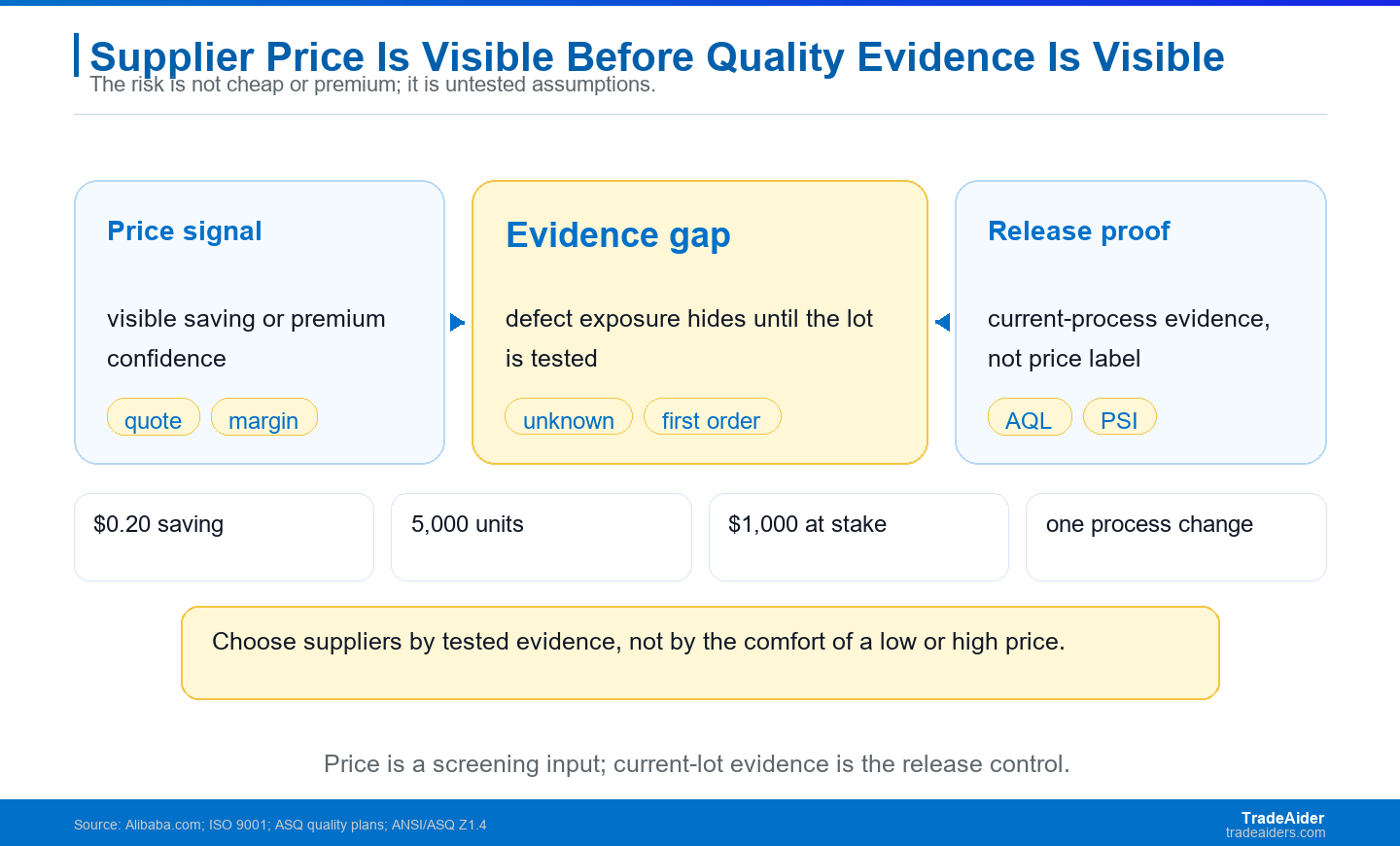
The supplier comparison shows when price reflects real process control and when it hides current-lot defect risk.
How to Test the Price Assumption
The buyer should treat every quote as a hypothesis: the supplier says this price can deliver this specification at this defect level. Inspection tests whether that hypothesis is true for the current lot.
Start with the part of the quote most likely to change quality: material grade, component source, tooling condition, line speed, packaging specification, testing time, and worker skill. Then ask for evidence before production, during production, and before shipment. According to CBP country-of-origin marking guidance, import requirements can extend beyond workmanship into marking and documentation. According to GS1 US product data guidance, product identification and barcode quality also affect downstream operations.
The practical release question is not whether the supplier is cheap or premium. It is whether the packed lot proves the quote was realistic. A low-price supplier with stable materials, clean inspection results, and correct labels may be a better choice than a premium supplier with a new component and weak lot evidence. The current lot earns the release decision.
China-Sourced Order Scenario
Situation: an importer compares two factories for a $28 retail kitchen appliance. Factory A quotes $7.80 per unit and Factory B quotes $8.45. Problem: Factory A uses a thinner accessory tray and does not document function testing, while Factory B includes stronger packaging but recently changed a heating component. Action: the buyer runs pre-production checks on both, requires a sealed golden sample, and schedules during-production inspection for the first lot. Result: Factory B has fewer cosmetic defects, but the inspection also finds a component-label mismatch that must be corrected before shipment. The premium supplier still wins only if it fixes the mismatch and proves the changed component matches the approved file.
Release Checks That Prove the Price Story
A low-price supplier should be checked for the controls that prevent savings from turning into defects: material thickness, component consistency, workmanship, carton strength, accessory count, barcode accuracy, and whether the production units match the approved sample. A premium supplier should be checked for the controls buyers often assume are present: current-line setup, component changes, documented testing, packaging revision, label accuracy, and corrective-action speed.
A PSI is conducted when 100% of the order quantity is completed and at least 80% is packed for export. For supplier-price decisions, PSI should not be treated as a ceremonial final step. It is the point where the quote's assumptions meet the packed lot: if the factory saved money through process efficiency, the lot should show stable conformity; if the factory saved money through shortcuts, the defects usually appear in materials, finish, fit, packaging, or labels.
Who Is TradeAider?
TradeAider is a quality inspection, testing, and certification service provider in China. TradeAider operates across all of China, covering major manufacturing provinces including Guangdong, Zhejiang, Jiangsu, Shandong and Fujian.
For supplier-price decisions, TradeAider can help buyers compare the quote against current-lot evidence. Inspectors can verify whether the cheaper supplier kept the approved material and whether the premium supplier actually used the promised component, line setup, packaging, and label files. Real-time reporting makes the price conversation more concrete because the buyer can see which supplier's production lot supports its quote.
Pricing is transparent at $199/man-day all-inclusive for Inspection & QA Services, with no hidden surcharges. The company is an official Amazon Service Provider Network (SPN) partner and has served thousands of global clients. Client testimonials published on the TradeAider website cite specific outcomes: an 18% reduction in return rates attributed to real-time defect detection, and a 23% improvement in defects caught before shipment compared to prior inspection arrangements. These are client-reported figures.
Next Steps: Supplier Price Evidence Card
- Ask each supplier to explain what creates the unit price difference: material, labor, tooling, packaging, testing, capacity, or margin.
- Require the same sealed sample, specification sheet, packaging file, and label file from both cheap and premium suppliers.
- Inspect the first lot when a supplier changes material, line, component vendor, packaging version, or production season.
- Compare defect findings against the quote explanation; unexplained savings should become a purchasing risk, not a hidden assumption.
- Use TradeAider's factory audit service when the shipment needs factory-side release evidence.
Frequently Asked Questions
Does a cheaper China supplier always have more defects?
A cheaper China supplier does not always have more defects. The risk rises when the low price comes from weaker materials, skipped process controls, rushed production, or vague specifications rather than genuine efficiency.
Is a premium supplier worth paying more for?
A premium supplier is worth paying more for only when the higher price is supported by process evidence. Buyers should verify materials, line control, packaging, inspection history, and corrective-action behavior before assuming the premium reduces defect risk.
How should I compare suppliers before placing an order?
Compare suppliers with a scorecard, not only a price table. Include sample match, material controls, AQL history, production timing, packaging strength, communication, and willingness to support third-party inspection.
Artículos Relacionados

Haga crecer su negocio con el Servicio TradeAider
Haga clic en el botón de abajo para ingresar directamente al Sistema de Servicios TradeAider. Los pasos simples desde la reserva y el pago hasta recibir los informes son fáciles de operar.

