
ESG reporting has shifted decisively from voluntary to expected — and in many jurisdictions, from expected to mandatory. A 2022 KPMG survey found that 78% of the world's 250 largest companies by revenue had adopted GRI Standards for sustainability reporting, with adoption rates climbing year over year. For manufacturers — who sit at the intersection of energy consumption, labor supply chains, and material inputs — ESG metrics carry particular weight, because the environmental and social footprint of manufacturing is both large and highly measurable.
This guide explains what ESG metrics are, which ones matter most for manufacturers, how to select the right reporting framework, and how quality control practices connect to ESG performance in ways that importers sourcing from overseas factories are beginning to recognize.
Key Takeaways
- ESG metrics span three pillars: environmental (emissions, energy, water, waste), social (labor practices, health & safety, diversity), and governance (board structure, ethics, transparency).
- Scope 3 emissions are the hardest to measure but often the largest category — they can represent 80–95% of a manufacturer's total carbon footprint and include upstream supplier activity.
- GRI, SASB, and ISSB are the three dominant frameworks for manufacturing ESG reporting — each with a different primary audience and materiality approach.
- Supply chain audits and factory inspections directly feed ESG data — particularly for social metrics around labor standards, workplace safety, and supplier compliance.
What ESG Metrics Are — and Why They Matter for Manufacturers
ESG metrics are quantitative and qualitative measurements that capture a company's performance across environmental impact, social responsibility, and governance practices. They are distinct from financial metrics in that they measure non-financial value creation and risk exposure — but they increasingly inform financial decisions. Peer-reviewed research on ESG scoring methodology identifies three foundational measurement challenges: data quality (accuracy and completeness), standardization (consistent definitions across reporting entities), and verification (independent assurance that disclosed data reflects reality).
For manufacturers, the motivation to track ESG metrics comes from multiple directions simultaneously. Investors use ESG data to assess long-term risk exposure — a factory that generates significant waste, has poor safety records, or lacks documented governance policies represents a liability that may not show up in quarterly earnings but will eventually. Retail customers and brand partners increasingly require ESG disclosures from their supply chain partners as a condition of doing business. And regulators in the EU, UK, and increasingly the US are mandating disclosure of specific metrics from companies of certain sizes.
The Three Pillars: Key Metrics for Each Category
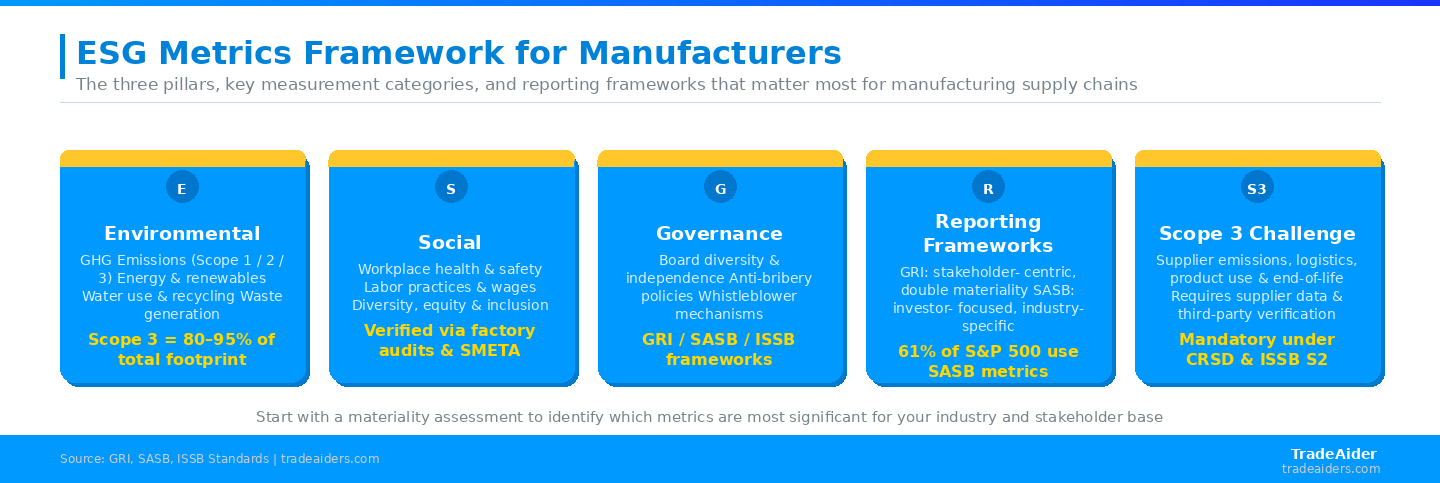 Scope 3 emissions — covering the full value chain including suppliers — typically represent 80–95% of a manufacturer's total carbon footprint
Environmental Metrics
Environmental metrics focus on a manufacturer's direct and indirect impact on the natural environment. The most universally tracked environmental metrics fall into four clusters: greenhouse gas emissions, energy consumption, water use, and waste generation.
Greenhouse gas (GHG) emissions are reported across three scopes. Scope 1 covers direct emissions from owned or controlled sources — for a manufacturer, this includes fuel combustion in production processes and company-owned vehicles. Scope 2 covers indirect emissions from purchased electricity, heat, or steam. Scope 3 — the most complex — covers all other indirect emissions across the value chain, including those from purchased goods, upstream transportation, and product use and disposal. Industry analysts estimate that Scope 3 emissions represent 80–95% of most companies' total carbon footprint, which means a manufacturer's reported emissions picture is incomplete without Scope 3 — yet Scope 3 requires data from suppliers and logistics partners who may not track or disclose their own emissions.
Energy metrics include total energy consumption (in megajoules or gigajoules), the percentage derived from renewable sources, and energy intensity (energy consumed per unit of production output). Water metrics cover total water withdrawal by source, water recycled or reused, and discharge quality. Waste metrics include total waste generated by material category, percentage diverted from landfill, and hazardous waste disposal methods.
| Environmental Pillar | Key Metrics | Unit of Measure |
|---|---|---|
| GHG Emissions | Scope 1, 2, 3 emissions | Metric tons CO₂-equivalent |
| Energy | Total consumption; renewable share; intensity | GJ; % renewable; GJ per unit output |
| Water | Withdrawal; recycled volume; discharge quality | Cubic meters; % reused |
| Waste | Total generated; diversion rate; hazardous waste | Metric tons; % diverted from landfill |
Social Metrics
Social metrics evaluate how a manufacturer manages its relationships with workers, communities, and the broader society in which it operates. For manufacturing specifically, the most material social metrics tend to cluster around occupational health and safety, labor practices, and supply chain standards.
Health and safety metrics include the total recordable incident rate (TRIR), lost-time injury frequency rate (LTIFR), fatalities, and near-miss reporting rates. These are among the most standardized and auditable social metrics available — most jurisdictions require employers to track workplace injuries, making baseline data relatively accessible. Improvement in safety metrics is also one of the clearest demonstrations of ESG commitment that manufacturers can make to brand partners.
Labor practice metrics cover employee turnover rate, wage levels relative to local living wage benchmarks, working hours (including overtime), freedom of association rights, and grievance mechanism availability. Diversity, equity, and inclusion (DEI) metrics track representation of women and underrepresented groups across workforce levels, pay equity between comparable roles, and the ratio of women in management or senior technical positions.
Supply chain social metrics are increasingly important for manufacturers who source materials or components from third-party suppliers. These metrics assess whether suppliers adhere to internationally recognized labor standards — typically based on ILO core conventions covering child labor, forced labor, freedom of association, and non-discrimination — and whether suppliers have been independently audited against a recognized social compliance standard. This is where factory audits and social compliance assessments directly generate ESG data. Factory audits that assess supplier labor practices, workplace safety, and management systems provide the documented evidence that supply chain social metrics require.
Governance Metrics
Governance metrics examine the structures and processes that guide how a company makes decisions, manages risk, and maintains accountability to its stakeholders. For manufacturers, the most frequently reported governance metrics include board composition (size, independence, and diversity), executive compensation (including whether ESG performance is linked to executive pay), anti-corruption policies, whistleblower mechanisms, and the presence of a formal code of ethics.
Transparency is itself a governance metric — the extent and quality of a company's ESG disclosure demonstrates whether governance systems are functioning. A manufacturer that tracks environmental and social performance but does not disclose the data has a governance gap that investors and audit frameworks will flag. ESG measurement specialists identify ESG as fundamentally cross-departmental — spanning finance, HR, operations, and procurement — and governance metrics are what ensures that data from across those functions is collected, verified, and reported consistently.
Which ESG Reporting Framework Should Manufacturers Use?
The proliferation of ESG frameworks can be genuinely confusing — GRI, SASB, ISSB, TCFD, CSRD, CDP, and more all make claims on manufacturing companies' reporting attention. The practical answer is that most manufacturers will need two or three frameworks, chosen based on their regulatory context, their primary stakeholder audience, and their industry sector.
GRI (Global Reporting Initiative)
GRI Standards are the world's most widely used sustainability reporting framework, designed for stakeholder-centric disclosure. GRI uses a "double materiality" approach — meaning it requires disclosure of both how ESG issues affect the company financially and how the company's activities affect people and the environment. For manufacturers reporting to a broad audience that includes customers, NGOs, employees, and investors, GRI provides the most comprehensive and internationally recognized framework. The GRI Universal Standards came into effect for reporting in January 2023, with Topic Standards covering specific areas such as waste, occupational health and safety, and emissions.
SASB (Sustainability Accounting Standards Board)
SASB, now integrated into the International Sustainability Standards Board (ISSB), provides industry-specific metrics focused on financial materiality — the ESG issues most likely to affect a company's financial performance. A 2023 survey found that 61% of S&P 500 companies included SASB metrics in their ESG disclosures, up from 44% in 2021. For manufacturers, SASB provides sector-specific guidance — a metals manufacturer, a furniture producer, and a food processor each have different material issues, and SASB standards reflect those differences. SASB is particularly useful for companies whose primary audience is institutional investors.
ISSB and CSRD: The Regulatory Tier
The International Sustainability Standards Board (ISSB) published its first two standards — IFRS S1 and IFRS S2 — in June 2023, establishing a global baseline for climate-related and general sustainability disclosures. The EU's Corporate Sustainability Reporting Directive (CSRD) goes further, mandating detailed Scope 1, 2, and 3 GHG disclosures, biodiversity impacts, and human rights due diligence for companies operating in the EU above certain thresholds. For manufacturers exporting to EU buyers or operating EU-registered entities, CSRD compliance is not optional — and it carries penalties of up to €5 million or 5% of annual revenue for non-compliance.
Industry sustainability reporting specialists recommend that manufacturers start with SASB for investor-focused metrics, layer GRI for stakeholder transparency, and add CSRD/ISSB alignment for regulatory compliance if operating in or selling to the EU. This three-layer approach covers the primary use cases without requiring the company to build separate data collection systems for each framework.
How Supply Chain Quality Control Connects to ESG
There is a direct and underappreciated connection between quality control programs and ESG performance — particularly on the social and governance pillars. Importers who conduct regular third-party factory audits are, in effect, generating ESG data on their supply chain: they are assessing worker conditions, workplace safety, management system maturity, and compliance with labor standards at the manufacturing level. That data is exactly what supply chain social metrics require.
For a brand sourcing home goods or consumer products from Chinese factories, a documented factory audit program translates directly into ESG disclosures. The audit findings answer questions about whether suppliers maintain a safe workplace (social metric), whether workers are paid appropriately and have freedom of association (social metric), and whether the factory has documented quality and compliance procedures (governance metric). Without a structured audit program, these disclosures rest on supplier self-reporting — which investors and ESG ratings agencies increasingly discount as unverifiable.
TradeAider's factory audit service generates structured audit reports that document worker safety conditions, production process compliance, and management system maturity in a format that can be used directly to support ESG supply chain disclosures. For brands that are beginning to build or formalize their supplier ESG programs, integrating third-party audit data into ESG reporting is both more credible and more cost-effective than trying to collect supplier self-assessment data. Contact our team to learn how audit programs can be structured to align with your specific ESG reporting requirements.
Practical Steps to Start Measuring ESG Metrics
For manufacturers and importers beginning the ESG measurement journey, the most common mistake is trying to measure everything at once. A more productive approach starts with a materiality assessment — a structured process for identifying which ESG topics are most significant given your industry, geography, and stakeholder base. The GRI framework provides materiality assessment guidance, and most ESG consultancies offer materiality workshops as an entry-point service.
Once material topics are identified, the next step is establishing baseline data for the highest-priority metrics. For a manufacturer, this typically means starting with energy consumption (usually available from utility bills), workplace safety (usually tracked in existing HR or EHS systems), and supplier audit status. From this baseline, improvement targets can be set, and progress can be tracked against those targets in future reporting periods.
Data governance is critical from the start. ESG data that cannot be traced to a verifiable source, or that is collected inconsistently across reporting periods, has limited credibility. Establishing clear data ownership — which team or function is responsible for collecting each metric — and a consistent measurement methodology before the first disclosure reduces the risk of having to restate figures in subsequent years, which is one of the highest-profile ESG reporting failures.
Frequently Asked Questions
What is the difference between ESG metrics and ESG ratings?
ESG metrics are the raw measurements a company collects and discloses — energy consumption, injury rates, board diversity percentages, and so on. ESG ratings are assessments produced by third-party rating agencies (such as MSCI, Sustainalytics, or LSEG) that aggregate and evaluate a company's disclosed ESG metrics, benchmarking performance against peers in the same industry. A company controls its ESG metrics; it does not directly control its ESG rating, which depends on how the rating agency weighs and interprets the disclosed data.
Are Scope 3 emissions mandatory to report for manufacturers?
Scope 3 disclosures are mandatory under the EU's CSRD for companies meeting reporting thresholds, and under ISSB IFRS S2 for companies aligned with ISSB standards. Industry reporting specialists confirm that US SEC rules require Scope 3 disclosure if Scope 3 emissions are material to the company or if the company has set an emissions target including Scope 3. For manufacturers with complex supply chains, Scope 3 is almost certainly material — making it a reporting requirement in practice even under voluntary frameworks that leave the decision to company judgment.
How do factory audits support ESG social metrics?
Factory audits conducted by accredited third-party auditors assess labor practices, workplace health and safety, management systems, and worker rights — exactly the data points that supply chain social metrics require. Audit reports documenting compliance with ILO core conventions, local labor law, and industry-specific standards (such as SMETA or SA8000) provide verifiable evidence for ESG disclosures that would otherwise depend on unaudited supplier self-reporting. TradeAider's factory audit service is designed to generate the structured documentation that ESG reporting programs need.
Which ESG framework is best for a mid-sized manufacturer just starting out?
For a mid-sized manufacturer beginning ESG reporting, the most practical starting point is SASB's industry-specific standards — they identify the metrics most financially material to your specific sector and provide clear measurement guidance. Once SASB-aligned reporting is established, adding GRI disclosure for broader stakeholder communication is the logical next step. CSRD alignment should be prioritized if you sell to EU buyers or have EU-registered entities, as regulatory deadlines are already in effect for large companies and phasing in for SMEs.
Artículos Relacionados



Haga crecer su negocio con el Servicio TradeAider
Haga clic en el botón de abajo para ingresar directamente al Sistema de Servicios TradeAider. Los pasos simples desde la reserva y el pago hasta recibir los informes son fáciles de operar.

