
- Acerca de Nosotros

- Nuestros Servicios
- Su Industria
- Recursos
- Noticias y Blog
Packaging defects are failures in the unit pack, carton, label, barcode, seal, insert, or protection system, while product defects are failures in the item itself, such as function, dimensions, workmanship, materials, or safety.
Packaging defects usually create faster and more preventable Amazon FBA returns than sellers expect, but product defects usually create deeper long-term damage. Packaging problems can cause receiving errors, damaged units, missing information, crushed boxes, barcode issues, and customer complaints even when the product itself is acceptable. Product defects create returns because the buyer receives an item that does not work, does not match the listing, breaks too soon, or feels lower quality than promised.
Many Amazon sellers ask whether they should spend inspection time on packaging or on the product. The answer is that both matter, but they fail in different ways. Packaging defects are often easier to detect and fix before shipment; product defects are usually more expensive after launch because they affect reviews, repeat purchase confidence, and the listing's quality history.
TradeAider often finds that a supplier's pre-shipment photos focus on the product while the actual FBA risk sits in carton marks, barcode placement, label consistency, inner protection, suffocation warnings, retail box strength, or mixed versions in the same lot. A useful inspection plan separates packaging-caused returns from product-caused returns before inventory leaves China.
Key Takeaways
- Definition: Packaging defects damage fulfillment readiness; product defects damage customer experience.
- Risk: Packaging defects are often easier to prevent before shipment because they are visible in carton and unit-pack checks.
- Cost comparison: Product defects usually create worse review, refund, and repeat-purchase damage than packaging defects.
- Decision: Inspect packaging first for FBA acceptance, then inspect product function and conformity for customer acceptance.
- Bottom line: The return source matters because packaging fixes, product rework, and shipment holds require different factory actions.
The Direct Answer
Packaging defects often cause more immediate and preventable FBA return events, while product defects create the more damaging return pattern over time. According to NRF return research, retail returns remain a major financial exposure, so sellers should separate the visible trigger from the root cause before deciding what to inspect.
The difference matters because the same return comment can point to two different factory actions. A "damaged" return may mean a weak retail box, a crushed master carton, or insufficient inner protection. A "defective" return may mean the unit failed function, fit, assembly, finish, or durability. If the seller treats both as one generic quality issue, the next inspection checklist will miss the root cause again.
According to Amazon FBA documentation, FBA handles storage, shipping, customer service, and returns for enrolled inventory. That convenience does not remove the seller's responsibility for sending sellable, correctly packaged units. According to Amazon Ships in Product Packaging program guidance, packaging can be part of the customer delivery experience.
The practical solution is to build a return-cause map before shipment. If the defect can be seen in the carton, unit pack, barcode, warning label, insert, or protective material, it belongs in the packaging path. If it appears after unboxing, use, measurement, fit, charging, assembly, or comparison with the listing, it belongs in the product path.
Comparison Table
| Return Cause | Visible Before Shipment? | Typical FBA Symptom | Factory Fix | Long-Term Risk |
|---|---|---|---|---|
| Crushed retail box | Yes | Damaged arrival or poor unboxing | Strengthen box or master carton | Moderate |
| Wrong barcode | Yes | Receiving or listing mismatch | Relabel and rescan | High if mixed inventory |
| Missing insert or warning | Yes | Confusion or complaint | Add insert and verify pack | High in regulated categories |
| Function failure | Often | Return as defective | Rework, sort, or replace | Very high |
| Wrong dimension/spec | Yes with measurement | Not as described | Sort or remake | Very high |
| Early breakage | Sometimes | Negative review after use | Improve material or assembly | Severe |
This table shows why packaging checks and product checks should not compete for inspection time. Packaging checks protect receiving, identification, and unboxing condition; product checks protect function, fit, durability, and the listing promise. The release decision should state whether the factory needs to repack, relabel, sort, rework, retest, or remake.
Packaging defects are high-frequency, low-excuse failures
Packaging defects are dangerous because they are visible enough that customers and fulfillment systems notice them, yet basic enough that sellers should have caught them before shipment. According to Amazon packaging resources, e-commerce packaging design and certification are part of reducing damage and improving delivery. According to GS1 US barcode guidance, product data and barcode practices help reduce identification problems. In practice, inspect barcode scanability, label position, carton marks, inner protection, retail-box crush resistance, warnings when relevant, and whether the actual pack configuration matches the FBA plan.
The release rule for packaging defects should be fast and concrete. If the product is good but the box, barcode, warning, insert, seal, or carton mark is wrong, the factory should correct the pack before pickup instead of asking the seller to accept a known fulfillment risk. A packaging defect is not minor when it makes the unit hard to receive, hard to identify, or unattractive at the doorstep.
Product defects are lower-frequency but higher-damage failures
Product defects usually hurt more when the defect pattern reaches buyers because the customer believes the product promise itself was wrong. According to ANSI/ASQ Z1.4 sampling guidance, sampling inspection helps decide whether a lot should be accepted based on observed attributes. That is useful for workmanship, dimensions, assembly, function, and cosmetic quality. Product defects often require category-specific tests: charging, tension, leak tests, assembly checks, fit checks, and stress checks where appropriate.
The release rule for product defects should be stricter because repacking a bad product only hides the failure until a buyer opens it. If the sampled units show repeated function failure, dimension drift, assembly weakness, leaking, poor fit, or a cosmetic pattern that contradicts the listing photos, the seller should require sorting, rework, retesting, or remake before shipment release.
The return reason is not always the root cause
Return dashboards may tell the seller what the customer selected, but not what caused the failure. A buyer may return an item as damaged because the retail box arrived crushed, while the root cause is weak master-carton stacking. Another buyer may select defective while the actual root cause is unclear instructions or a missing accessory. The key insight is to translate return reasons into inspection points before the next shipment is approved.
A useful return review should therefore tag each complaint with a likely factory control point: pack strength, barcode identity, accessory count, instruction clarity, function test, material defect, or listing mismatch. The next PSI should check the control point that explains the return, not only the customer-selected reason code.
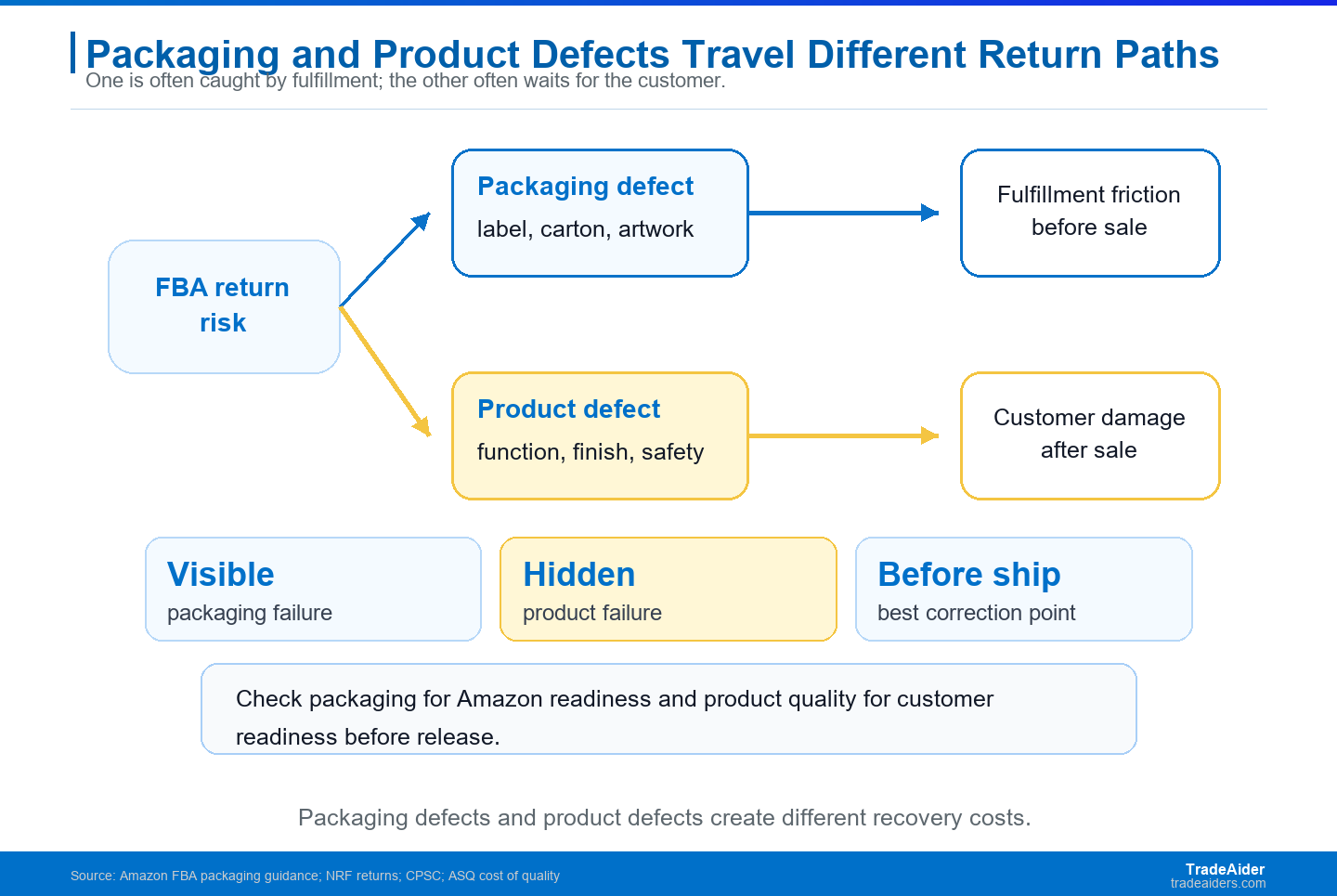
The packaging-versus-product matrix separates fast factory fixes from deeper product-quality failures that can drive FBA returns.
How to Triage the Failure Before Shipment
Before approving an FBA shipment, sort each risk into one of four practical paths: packaging-only fix, product-only rework, packaging-product interaction, or evidence gap that blocks release.
A packaging-only fix includes relabeling cartons, replacing weak boxes, adding inner protection, correcting a suffocation warning, separating mixed SKUs, or changing insert placement. A product-only rework includes sorting failed units, tightening assembly, correcting dimensions, changing a component, or retesting function. The interaction path is the one sellers miss most often: the product may pass function, but the pack may let it break in transit; the barcode may be correct, but its placement makes scanning unreliable; the accessory may be present, but the insert makes assembly look incomplete.
The interaction path deserves its own line in the inspection report because it is where sellers often argue about ownership. The packaging team may say the product passed, while the product team may say the carton caused the breakage. For an FBA seller, that debate is less useful than the release decision. If a glass lid, plastic clip, pump head, or coated surface can pass factory handling but fail ordinary parcel movement, the packaging system is part of the product promise.
According to ASQ cost of quality guidance, quality costs include prevention, appraisal, internal failure, and external failure. Packaging fixes are often internal failure costs while the goods are still at the factory. Product failures that reach FBA become external failure costs through refunds, support time, replacements, removals, and review damage. That is why the triage must be finished before export, not after the return dashboard starts filling up.
China-Sourced Order Scenario
Situation: an Amazon seller sources 3,000 kitchen organizers from China. Problem: the product dimensions match the sample, but 12 of 80 sampled retail boxes show crushed corners, and 4 barcode labels scan poorly because they are printed across a fold. Action: the seller asks the factory to replace the retail boxes, move the barcode label, and add a final carton-photo check before loading. Result: the shipment leaves 2 days later, but the delay is a packaging correction, not a product remake. The seller keeps the launch inventory intact while avoiding a preventable "damaged box" pattern in FBA.
Release Checks for Packaging vs Product Failures
A packaging-focused release check should inspect master-carton strength, retail-box crush marks, inner protection, seals, suffocation warnings, barcode placement, label scanability, carton marks, insert presence, and whether units from different cartons carry the same pack revision. These checks belong near the end of production because they depend on packed goods. A PSI is conducted when 100% of the order quantity is completed and at least 80% is packed for export, which is exactly when packaging evidence is visible.
A product-focused release check should inspect dimensions, function, assembly, material, finish, durability-sensitive points, accessory count, and the listing promise that customers will judge after unboxing. If packaging fails but the product passes, the factory can usually repack. If the product fails, the seller needs sorting, rework, retesting, or remake before FBA receives inventory.
Who Is TradeAider?
TradeAider is a quality inspection, testing, and certification service provider in China. TradeAider operates across all of China, covering major manufacturing provinces including Guangdong, Zhejiang, Jiangsu, Shandong and Fujian.
For packaging-versus-product return analysis, TradeAider helps buyers separate what failed in the carton from what failed in the item. A pre-shipment report can document barcode scans, retail-box condition, inner protection, accessory count, dimensions, function, workmanship, and the corrective action needed before pickup. That distinction gives the seller a cleaner release decision than a generic pass/fail note.
Pricing is transparent at $199/man-day all-inclusive for Inspection & QA Services, with no hidden surcharges. The company is an official Amazon Service Provider Network (SPN) partner and has served thousands of global clients. Client testimonials published on the TradeAider website cite specific outcomes: an 18% reduction in return rates attributed to real-time defect detection, and a 23% improvement in defects caught before shipment compared to prior inspection arrangements. These are client-reported figures.
Next Steps: Packaging Return Action Card
- Separate the last 30 return comments into packaging-visible issues, product-use issues, and unclear root causes before writing the next checklist.
- Give the inspector the final retail box, barcode file, insert, warning labels, carton marks, and approved product sample in the same inspection brief.
- Require carton-level photos when the risk is crushed boxes, mixed SKUs, barcode placement, seal damage, or weak inner protection.
- Require function or fit tests when the risk is early breakage, wrong dimensions, poor assembly, leaking, charging failure, or accessory mismatch.
- Use TradeAider's pre-shipment inspection when the shipment needs factory-side release evidence.
Frequently Asked Questions
Are packaging defects counted as product defects on Amazon?
Packaging defects and product defects can appear under overlapping return reasons, but they need different corrective actions. A damaged box, missing label, or weak inner protection should be fixed through packaging control, while function failure requires product rework or sorting.
Should I inspect packaging or product quality first?
Inspect packaging first when the shipment is close to FBA release, then inspect product quality before approving the lot. Packaging checks protect fulfillment readiness, while product checks protect customer satisfaction and reviews.
Can FBA prep replace quality inspection?
FBA prep cannot replace quality inspection. Prep makes inventory easier for Amazon to receive and process, while inspection verifies whether the finished product and packaging are good enough to ship to customers.
Artículos Relacionados

Haga crecer su negocio con el Servicio TradeAider
Haga clic en el botón de abajo para ingresar directamente al Sistema de Servicios TradeAider. Los pasos simples desde la reserva y el pago hasta recibir los informes son fáciles de operar.

